

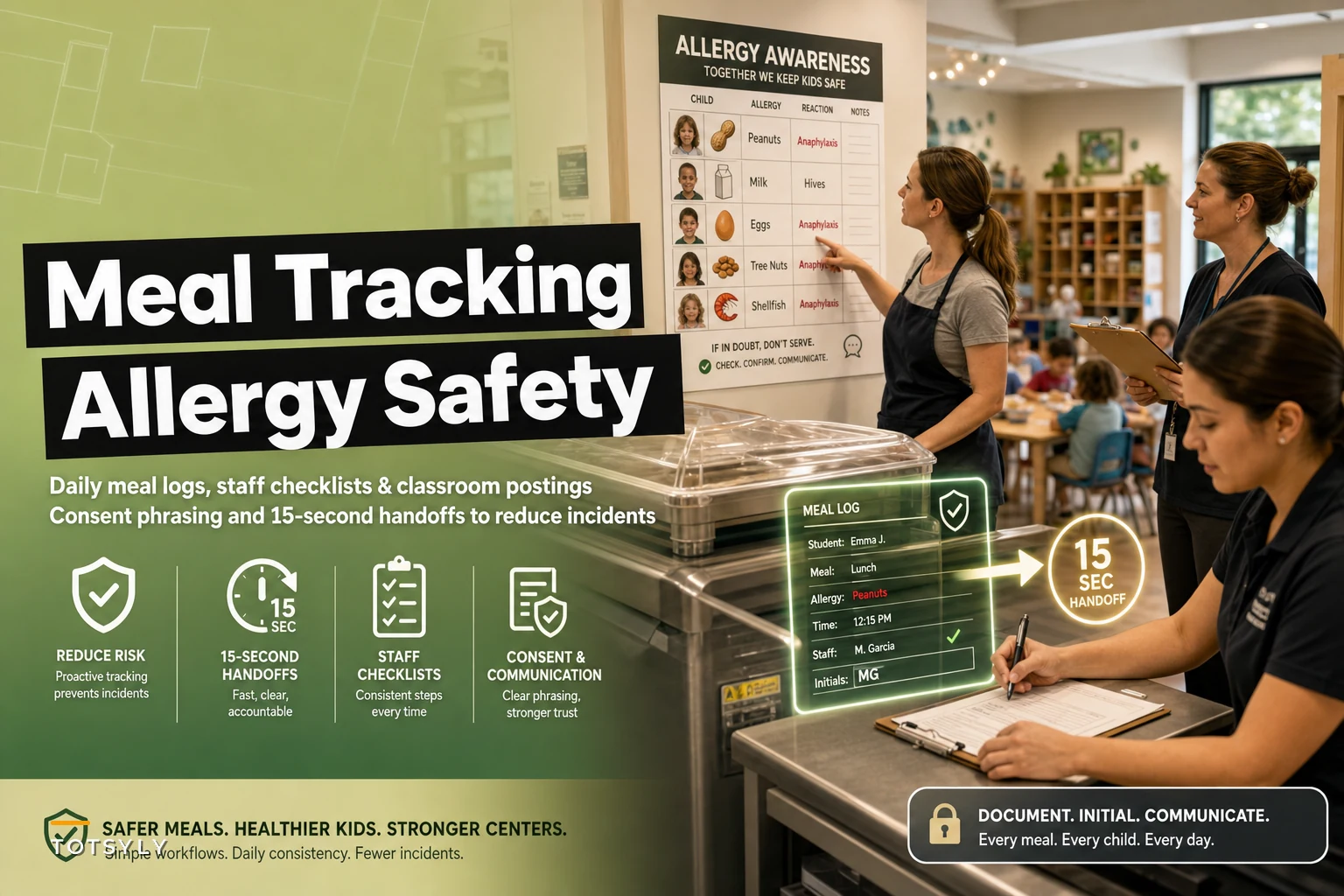

Most centers don't have an allergy policy problem. They have an allergy execution problem. The binder in the front office says all the right things — allergen list, EpiPen location, parent-signed forms. But the actual moment of risk happens in a loud classroom at 11:45 a.m. when a substitute teacher is plating food, one kid is crying, another is throwing a cup, and nobody double-checks that the plate with the shredded cheese didn't slide toward the child with the dairy allergy.
That gap — between the documented protocol and the physical act of handing a child food — is where nearly every avoidable incident lives. So this post stays narrow. Not general food safety, not nutrition planning. Specifically: meal tracking allergy management in childcare, and the consent and monitoring steps that actually prevent the plate from reaching the wrong child.
Where the breakdown actually happens
If you trace real near-misses backward, they rarely start at intake. The consent form was usually filled out fine. The failure is almost always one of these four moments:
-
The handoff. The lead teacher who knows the allergies is on break, and the person covering doesn't have the allergy info in front of them — it's in a filing cabinet or a system they can't access mid-shift.
-
The substitution. Kitchen ran out of the usual snack and swapped in something "similar." Nobody re-checked the swap against the allergy list.
-
The shared table. Food touches food. A peanut-free kid is fine with their own plate but sits next to a child eating a peanut-butter sandwich, and a hand goes where it shouldn't.
-
The verbal-only note. A parent mentioned a new sensitivity at drop-off. The teacher heard it, meant to write it down, and didn't.
The paperwork gets treated as the safeguard. It isn't. The safeguard is a repeatable action that happens every single time food moves toward a child, performed by whoever is physically in the room — including the person who started their shift 20 minutes ago.
The consent intake phrasing that prevents ambiguity later
A surprising number of allergy incidents trace back to vague intake language. A parent writes "sensitive to dairy" and the staff doesn't know if that means anaphylaxis or gets a little gassy. Those require completely different responses, and if your form doesn't force clarity, staff will guess — usually under-reacting.
Simplify your childcare center’s daily operations.
Totsyly helps you manage enrollments, staff, and communications efficiently so you can focus on care.
- Streamlined enrollment & waitlist management
- Automated billing & payment tracking
- Staff scheduling & attendance monitoring
No credit card required
-
Reaction type, in plain terms. Offer checkboxes
hives/rash, swelling, vomiting, breathing difficulty, anaphylaxis. Don't rely on a blank line.
-
Severity and required response. "Avoid entirely" vs. "small amounts acceptable" vs. "life-threatening — administer epinephrine and call 911."
-
Cross-contact tolerance. Can this child sit at a table where the allergen is present, or do they need physical separation? This is the single most-skipped field, and it drives your seating and cleaning steps.
-
Medication authorization and location. Signed authorization to administer, plus exactly where the med lives and its expiration date.
-
A dated re-confirmation line. Allergies change. A field that says "reviewed/updated on ___" forces a periodic check instead of a form that quietly goes stale for two years.
One phrasing detail that matters more than people expect: separate diet preferences from medical allergies on the form entirely. When "no red dye because we prefer it" sits in the same list as "tree nut anaphylaxis," staff start treating all entries with the same medium-urgency shrug. Visual separation keeps the life-threatening items loud.
The daily meal log that actually gets used
Meal logs fail when they're too much work. If logging a snack takes a teacher more than a few seconds, it won't happen consistently during a real shift — it'll get backfilled at the end of the day from memory, which defeats the entire point.
| Field | Why it's there | Common mistake |
|---|---|---|
| Child + allergy flag | Surfaces the risk before food is served | Allergy noted elsewhere, not on the log itself |
| Meal/snack served | Confirms what actually went out vs. planned menu | Logging the menu, not the substitution |
| Substitution flag | Catches last-minute kitchen swaps | Swaps go unrecorded |
| Cross-contact check | Confirms separation was maintained | Assumed, never verified |
| Staff initials + time | Accountability at the moment of service | Initialed in a batch after the fact |
The allergy flag has to appear on the meal log itself, right next to the child's name — not in a separate document staff are supposed to remember to cross-reference. The whole reason incidents happen is that people don't cross-reference under pressure. Put the warning where the action is.
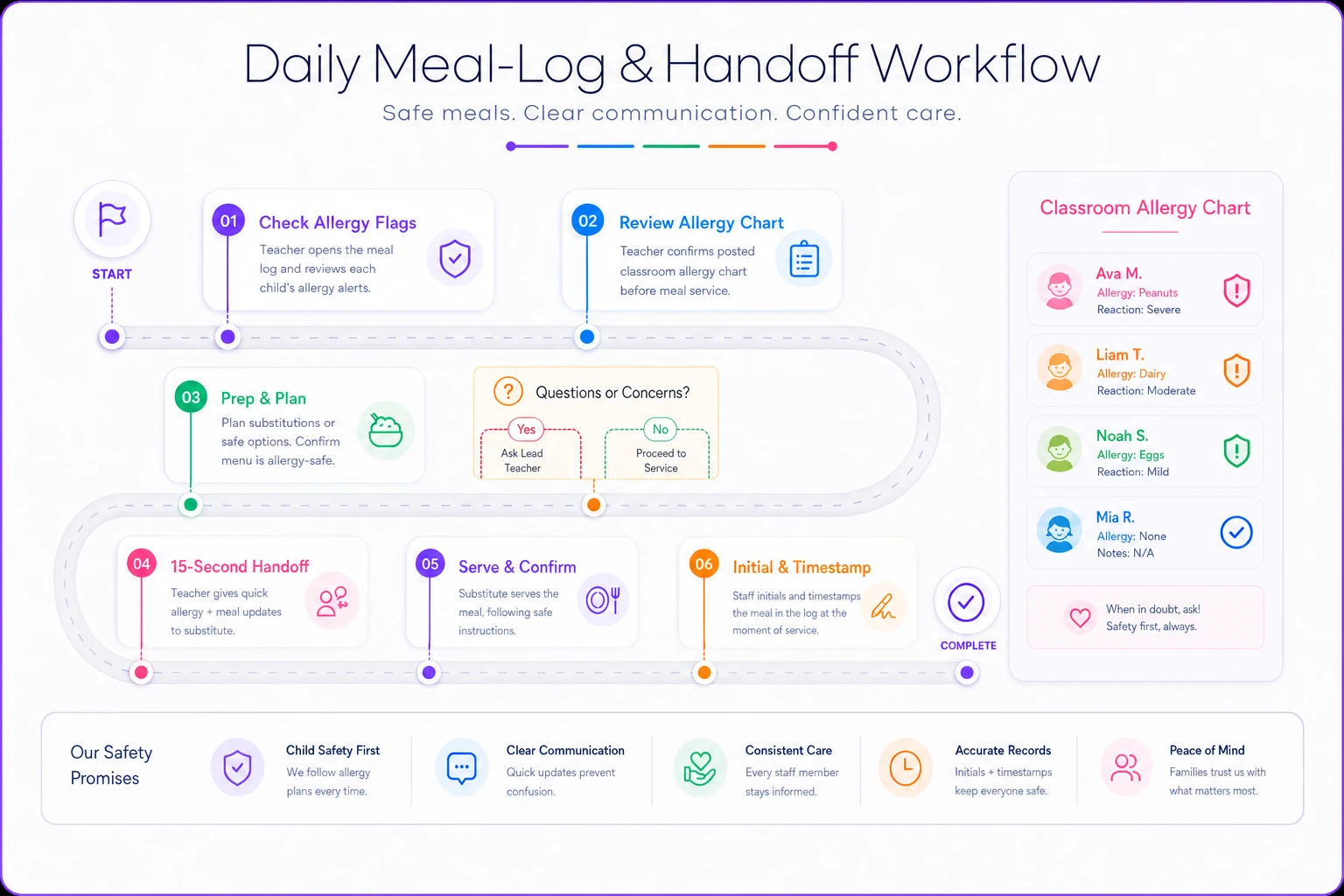
Place the allergy flag next to the child's name on the meal log so staff don't need to cross-reference under pressure.
This image shows the quick workflow from intake to meal service, highlighting where allergy flags should appear and how a substitute receives handoff information.
A quick note on classroom posting standards
-
Post allergen info where staff plate food, not just by the door.
-
Use the child's first name and a photo — never medical detail visible to other families or visitors.
-
Keep it laminated and current. An outdated chart is worse than none, because staff trust it.
-
Every classroom transition or new sub means the chart gets pointed out explicitly during handoff, not assumed.
Every classroom transition or new sub means the chart gets pointed out explicitly during handoff, not assumed.
The monitoring steps that close the loop
Prevention isn't only pre-meal. The minutes after serving matter too, especially for a child with a severe allergy who's been exposed to a new food. A tight monitoring routine looks like this:
-
Pre-serve check — staff confirms the plate against the allergy flag before it touches the table.
-
Seating check — cross-contact-sensitive children are seated per their consent form's separation requirement.
-
During-meal watch — no shared utensils, no reaching across, wiped surfaces between kids.
-
Post-meal window — for severe allergies, brief observation and a note if anything looks off.
-
New-food flag — first time a child eats a given food at the center gets logged, so if a reaction shows up, you know the trigger.
That last step gets skipped constantly, and it's the one that turns a mystery reaction into a documented, defensible timeline.
A real scenario
A two-site preschool, around 90 kids total, had two allergy near-misses in a single spring — both involving substitute staff who didn't have allergy info in front of them at snack time. No injuries, but one family nearly withdrew, and the director realized their "solid" binder-based system had a blind spot exactly where staffing was weakest.
The fix was unglamorous. They moved the allergy flag directly onto a one-page daily meal log per classroom, rewrote the intake form to force reaction-severity and cross-contact answers, and added a 15-second handoff step where the outgoing lead physically points to each allergy child on the posted chart before leaving the room.
Over the next few months, backfilled-from-memory logs basically disappeared because the sheet was fast enough to use live. Substitute-related confusion dropped sharply because the info now lived in the room, not in a cabinet. No incidents. The quieter operational win came during a licensing visit — they could hand over dated, initialed meal logs and updated consent forms without scrambling, which is exactly the kind of documentation that protects you during an audit.
When a lightweight system is enough — and when it isn't
When paper works fine: A single-site center with stable, well-trained staff and a handful of allergy kids can run this on well-designed forms. Don't over-engineer it.
When paper stops working: The moment you're running multiple classrooms, frequent substitutes, or last-minute kitchen substitutions, paper logs create the exact gap that causes incidents — because the allergy info and the meal info live in different places and depend on someone remembering to connect them.
Who should not just "add another form": If your staff are already drowning in duplicate paperwork, a standalone meal log won't get filled out. The problem isn't the form, it's that the allergy data, the roster, and the meal record aren't connected.
That connection is where AI-assisted operational platforms earn their place. Not as a gimmick — the useful version is straightforward: a child's allergy profile from intake automatically surfaces on the classroom's meal log and posted chart, so a substitute opening the room sees the flags without hunting for them. When a kitchen substitution gets entered, the system can flag it against any child whose allergen matches, before service. Every log entry is timestamped and retained automatically, so your monitoring trail exists without anyone rebuilding it from memory. The point isn't to replace the teacher's judgment — it's to make sure the right warning is in front of them at the exact moment food moves.
The bottom line
Allergy safety in a childcare setting doesn't come from a better policy document. It comes from making the right information impossible to miss at the two moments that matter — when you write down what the child can't have, and when someone hands that child a plate. Fix the intake phrasing so severity is never ambiguous, put the allergy flag physically on the meal log where food gets served, and build a handoff step so the newest person in the room knows exactly which kids to watch. That's what actually keeps a near-miss from becoming an incident report.
Ready to elevate your childcare management?
Join hundreds of childcare providers using Totsyly to save time, improve communication, and grow their centers.