Expert advice on childcare center operations, enrollment best practices, staff management, parent engagement, compliance updates, and revenue growth strategies for childcare providers.
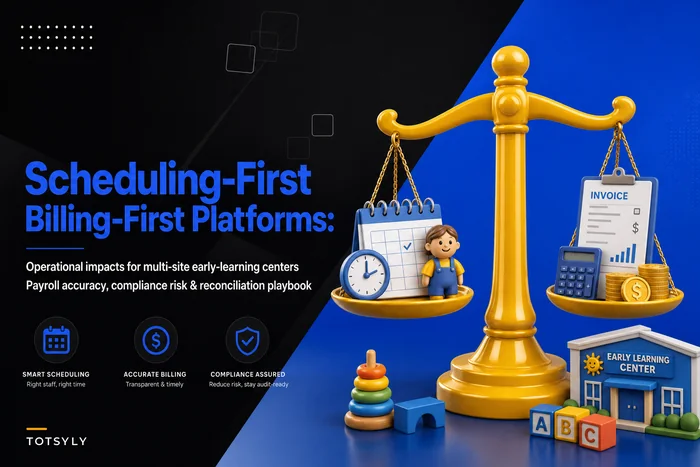
Compare two platform design priorities — one that centres staff scheduling & attendance tracking (scheduling‑first) and one that centres billing, invoicing & revenue features (billing‑first) — and map their downstream impacts on payroll accuracy, regulatory compliance, and month‑end finance reconciliation. The article will: 1) lay out concrete operational consequences (error types, where they surface, and typical cost/effort to remediate); 2) provide a decision rubric for choosing scheduling‑first, billing‑first, or best‑of‑breed with middleware; 3) recommend minimum data sync fields and cadence (attendance rows, employee IDs, shift codes, authorized subsidy hours, fee schedules); 4) list required controls and automated checks to protect payroll accuracy and compliance (attendance→pay auto‑validation, subsidy hour mismatch alerts, retroactive adjustment flags); 5) propose a practical exception workflow with roles, approval thresholds, and escalation; and 6) include KPI targets and SLA suggestions (AR days, billing‑vs‑contract variance, allowable subsidy reconciliation variance) and common integration failure modes with mitigation tactics. The brief avoids full templates (no complete reconciliation worksheets or GL journal examples) but gives a hands‑on mitigation playbook ops and finance teams can implement immediately.
Juan CabreraFounder of SoftWorks Global & Business Systems Researcher
A practical, non-legal implementation roadmap: jurisdiction mapping, minimal technical controls, vendor contract clauses, data localization pragmatics and an ops-focused rollout checklist for multi-state portfolios. Includes templates for vendor clauses and an operational checklist for residency controls.
Juan CabreraFounder of SoftWorks Global & Business Systems Researcher
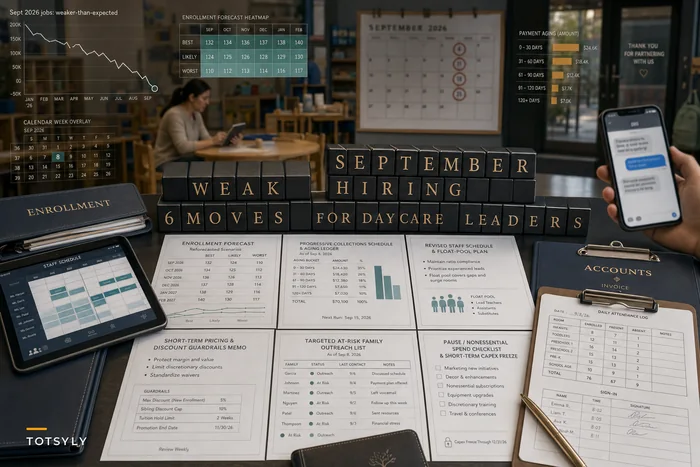
This post translates the Sept. 2026 weak jobs print into six concrete operations moves centers can implement immediately: reforecast enrollment scenarios, tighten progressive collections, adjust scheduling and float‑pool plans, revise short‑term pricing/discount guardrails, run targeted family outreach for at‑risk families, and pause nonessential spend. Each move maps to enrollment, scheduling, attendance, billing, or compliance workflows.
Juan CabreraFounder of SoftWorks Global & Business Systems Researcher
Operational, multi-site-ready QA pack with short, center-actionable observation rubrics, a quarterly coaching cadence with feedback templates, PD ROI model, fidelity metrics, sample improvement sprints and accreditation evidence packs for rollout across centers.
Juan CabreraFounder of SoftWorks Global & Business Systems Researcher
Governance-grade, board-ready 3–5 year scenario models (conservative/base/aggressive), reserve and capital rules, subsidy-mix sensitivity modeling, explicit invest/open/close decision rules, and a one-page board packet plus sample appendices directors can adopt.
Juan CabreraFounder of SoftWorks Global & Business Systems Researcher
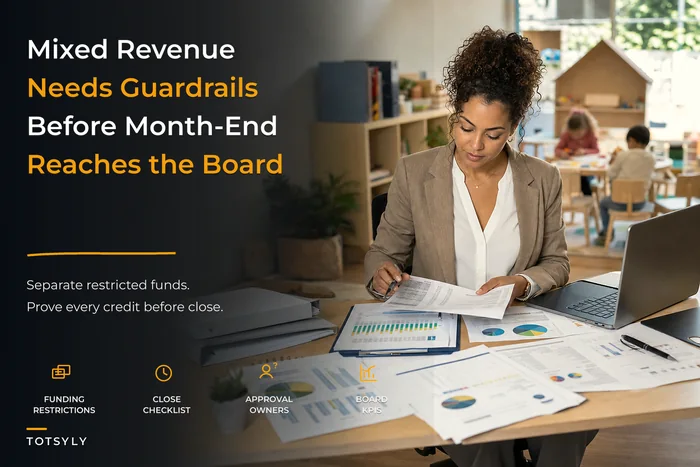
Executive-grade governance pack for mixed-funded centers: chart of restricted funds, revenue crediting approval matrix, monthly close checklist with audit attachments, KPIs and a board-ready packet. Includes policy language, evidence templates, reconciliation tables and a month-end pack directors can drop into governance cycles.
Juan CabreraFounder of SoftWorks Global & Business Systems Researcher