


Most multi-site childcare operators don't set out to accumulate 23 separate vendors. It happens the way weeds happen. One director loves a particular billing tool. A new acquisition came with its own attendance app. Someone signed up for a free messaging platform during COVID and it quietly became load-bearing. Three years later, finance is reconciling across four systems that don't talk to each other, and nobody can tell you the total annual spend without a two-week audit.
Vendor rationalization is the unglamorous work of cleaning that up. But the reason most consolidation projects stall — or make things worse — is that leaders treat it as a cost-cutting exercise instead of an operational design decision. The question isn't just "how do we spend less on software." It's "which parts of our operation benefit from one unified system, and which parts are genuinely better served by a specialist tool we keep on purpose."
This is where a real childcare vendor consolidation strategy separates from a spreadsheet of contracts somebody wants to cancel. Consolidation done well reduces reconciliation errors, kills duplicate data entry, and shortens the time it takes to close the books. Consolidation done badly centralizes everything onto one mediocre platform, breaks three workflows nobody documented, and costs more in lost staff hours than it ever saved in license fees.
Why portfolios drift into vendor sprawl
Single-site centers rarely have this problem badly. They have a billing tool, maybe a parent app, a payroll provider, and that's mostly it. The sprawl starts at the moment of scale — and it compounds in predictable ways.
Acquisitions carry their own stacks. When you buy a center, you inherit whatever they were running. Nobody wants to force a disruptive migration during the first 90 days of ownership, so you let it ride "temporarily." Temporary becomes permanent. Now you're running two billing systems because the acquired site's families are mid-enrollment and migrating them feels risky.
Departments buy independently. Enrollment buys a CRM. Finance buys an accounting add-on. The education team buys an observation and assessment tool. Each purchase is locally rational. None of them were evaluated against the portfolio's overall data architecture. The result is a stack where the same child exists as five different records with five different IDs.
Nobody owns the full vendor list. This is the quiet one. In most portfolios under roughly 15 sites, there's no single person who can produce an accurate, current inventory of every vendor, what it costs, who signed the contract, and when it renews. Spend leaks through auto-renewals on tools half the staff forgot they had.
What breaks at scale isn't any single tool. It's the seams between tools. Every integration point is a place where data gets dropped, duplicated, or silently transformed into something wrong. A portfolio with 20 vendors doesn't have 20 risk points — it has dozens of connection points, and most of them were never designed, they just accreted.
The real cost of a fragmented stack (it's not the license fees)
When operators tally vendor cost, they add up the subscriptions. That's the small number. The expensive part is the operational tax that fragmentation levies on your staff every single day.
Simplify your childcare center’s daily operations.
Totsyly helps you manage enrollments, staff, and communications efficiently so you can focus on care.
- Streamlined enrollment & waitlist management
- Automated billing & payment tracking
- Staff scheduling & attendance monitoring
No credit card required
-
A director re-enters enrollment data into billing because the CRM and billing system don't sync. Say that's 15 minutes per new family, across a few hundred enrollments a year. That's real payroll hours spent on copy-paste.
-
Finance reconciles attendance across two platforms to run subsidy billing, and the two disagree about 4% of the time. Every discrepancy is a manual investigation.
-
A parent updates their phone number in the app, but not in the billing portal, so a late-payment notice goes to a dead number and a collectable balance ages another 30 days.
None of these show up as a line item. They show up as burnout, as reconciliation delays, as the finance close taking six days instead of two. In a mid-size portfolio, the fully-loaded cost of fragmentation — duplicate labor, error correction, delayed collections — routinely dwarfs the actual software spend by a wide margin.
This is why the governance layer matters so much. Operators who've built real vendor contract governance for childcare operations and controls usually catch the sprawl before it metastasizes, because someone is actually watching renewals, overlaps, and spend. If you don't have that visibility yet, the rationalization project has to start by building the inventory.
Consolidate or keep best-of-breed? A decision tree
The central tension in any rationalization effort is consolidation versus best-of-breed. A single integrated platform reduces seams and simplifies data. A best-of-breed specialist usually does its one job better. The mistake is treating this as a philosophy — "we're a one-platform shop" or "we buy the best tool for each job." Neither absolute survives contact with reality.
Run each vendor category through this logic instead:
-
Is this function core to daily operations and shared across sites? (Enrollment, billing, attendance, scheduling.) If yes, lean hard toward consolidation. These are the systems where seams cost the most.
-
Does a specialist tool deliver a capability the integrated platform genuinely can't match? Not "has a nicer interface" — a real functional gap. Assessment and curriculum tools often qualify here. If yes, keep best-of-breed, but demand clean integration.
-
How painful and risky is the data migration? If the tool holds compliance-critical historical records and migration risk is high, the near-term answer might be "keep it running, freeze new data, migrate on a planned timeline" rather than rip-and-replace.
-
What's the total cost of the seam? Estimate the labor hours spent moving data between this tool and the rest of the stack. If the seam is cheap (clean API, syncs reliably), best-of-breed is fine. If the seam is expensive (manual exports, reconciliation), consolidation pays for itself fast.
-
Who depends on it, and would they fight the change? A tool the education team loves and uses daily carries real adoption risk if you force a switch. Sometimes the right call is keeping a good-enough specialist to avoid a change-management battle you'll lose anyway.
The pattern that emerges from running real portfolios through this: consolidate the operational and financial core, stay best-of-breed selectively at the edges. Billing, enrollment, attendance, and parent communication almost always belong together — the data flows between them constantly. Assessment, learning content, and occasionally specialized compliance tools can stay independent if they integrate cleanly.
Building a vendor scorecard that actually drives decisions
"We should consolidate" is an opinion. A scorecard turns it into a defensible decision you can present to ownership without it devolving into whoever argues loudest.
Score each vendor across the dimensions that actually matter operationally — not just price:
| Dimension | What you're measuring | Weight |
|---|---|---|
| Operational criticality | Does the business stop if this fails? | High |
| Data integration quality | Clean API sync vs. manual exports | High |
| Overlap with other tools | Does another vendor already do this? | High |
| Annual cost (fully loaded) | License + the labor tax of using it | Medium |
| Compliance dependency | Does licensing/audit rely on its records? | Medium |
| Staff adoption | Do people actually use it, and will they fight a switch? | Medium |
| Vendor stability & SLA | Support responsiveness, uptime, contract terms | Medium |
The scorecard's real value shows up in the overlaps. When you score honestly, you find two tools both handling messaging, or three touching attendance in different ways. Those overlaps are your first consolidation targets — lowest-risk wins, because you're removing redundancy rather than replacing a critical function.
A tool that scores low on criticality, high on overlap, and low on adoption is an easy kill. A tool that scores high on criticality and high on integration quality is a keeper regardless of price. The hard cases — high criticality, poor integration — are exactly where you need to decide consolidate-versus-migrate deliberately, not reactively.
When you score, record the labor-hour assumptions you use so stakeholders can see how seam-costs drive the recommendation.
If you've already done the work of a technology governance framework for childcare portfolios and vendor SLAs, a lot of this scorecard data already exists. If not, building the scorecard becomes the first version of that governance framework.
Negotiation leverage: your portfolio volume is the point
Here's the lever most operators leave on the table. When sites buy independently, each one negotiates as a small customer. Consolidation isn't only about reducing vendor count — it's about concentrating your volume so the vendors you keep take you seriously.
A single center asking for a discount gets a polite no. A 14-site portfolio consolidating all of its billing onto one platform is a very different conversation. That's a multi-year, high-volume commitment, and it unlocks leverage you simply don't have when fragmented:
-
Per-child or per-site pricing tiers that kick in at volume thresholds you can now actually hit.
-
Migration assistance credits — make the vendor absorb some of the switching cost, because they want the whole portfolio.
-
Rate locks across a multi-year term so you're not re-negotiating every renewal.
-
SLA commitments with teeth — response times, uptime guarantees, named support contacts — which a small single-site contract never commands.
-
Bundled modules where consolidating three functions onto one vendor gets you the third module at a steep discount or free.
The sequencing matters. Run your scorecard and decide your target end-state first, then negotiate. Walking into a renewal knowing "we're moving all 14 sites onto this if the terms are right" is a position of strength. Walking in hoping for a small discount on your current single contract is not. The portfolio is your leverage — fragmentation is what quietly throws it away.
A real scenario: eight sites, too many tools
A regional operator running eight centers was carrying separate billing on two platforms (legacy plus one from an acquisition), two different parent-messaging apps, a standalone enrollment CRM, and payroll that didn't sync with any of it. Monthly finance close was taking close to eight business days, mostly because attendance and billing had to be reconciled by hand across the two billing systems.
The rationalization ran over about four months. They consolidated both billing systems and the enrollment CRM onto one operational platform, kept their assessment tool as a deliberate best-of-breed exception (it integrated cleanly and teachers depended on it), and killed one of the two messaging apps outright since it fully overlapped with the other.
The results weren't dramatic headline numbers — they were the boring operational kind that actually matter. Finance close dropped to roughly three days. The duplicate-data-entry at enrollment, previously around 15 minutes per family, essentially disappeared because enrollment now flowed straight into billing. Subsidy reconciliation discrepancies fell noticeably because there was one source of attendance truth instead of two that disagreed. Total software spend came down modestly — but the real win was reclaiming staff hours that had been bleeding into reconciliation and re-entry.
Notably, they did not try to consolidate everything. The assessment tool stayed independent on purpose. That restraint was part of why adoption went smoothly.
KPIs that prove the consolidation actually worked
If you can't measure the ROI, ownership will reasonably ask whether the disruption was worth it. Rationalization pays off in operational metrics, not just the subscription line. Track these before and after:
-
Finance close time — days from month-end to closed books. The single clearest indicator that seams were removed.
-
Reconciliation discrepancy rate — percentage of records that disagree between systems. Should trend toward zero as sources consolidate.
-
Duplicate data entry hours — staff time spent re-keying the same information. Often the biggest hidden recovery.
-
Days-to-collect / aging balances — consolidation that unifies parent contact data and billing usually tightens collections.
-
Total vendor count and fully-loaded spend — the headline number, but keep it in context with the operational metrics above.
-
Integration failure incidents — how often a sync breaks or data gets dropped between tools. Fewer seams, fewer incidents.
-
Audit prep time — if compliance records now live in fewer, better-integrated systems, pulling an audit package gets dramatically faster.
License savings are usually the smallest part of the return. The real ROI lives in reclaimed labor, faster close, cleaner collections, and fewer errors — which ties directly into the broader discipline of financial controls for mixed-revenue childcare centers, where a fragmented stack is often the root cause of reconciliation pain.
When consolidation is a bad idea
Don't consolidate mid-acquisition. If you're integrating a new site, forcing a system migration in the first few months on top of everything else is how you break operations and alienate the staff you just inherited. Stabilize first, rationalize later.
Don't consolidate onto a weaker platform just to reduce vendor count. If your billing specialist genuinely outperforms the all-in-one's billing module, and billing is mission-critical, "one fewer vendor" is a bad trade. Vendor count is a proxy for complexity, not a goal in itself.
Don't rip out a tool with high staff adoption and no clean replacement. The change-management cost can exceed the integration savings. A beloved, well-used specialist that integrates fine is not your problem.
Who should probably wait entirely: single-site centers and small two-to-three-site operators. The leverage and the seam-cost that justify this work really kick in around five-plus sites. Below that, you can usually fix the specific pain points without a full rationalization program.
Starting the work without blowing anything up
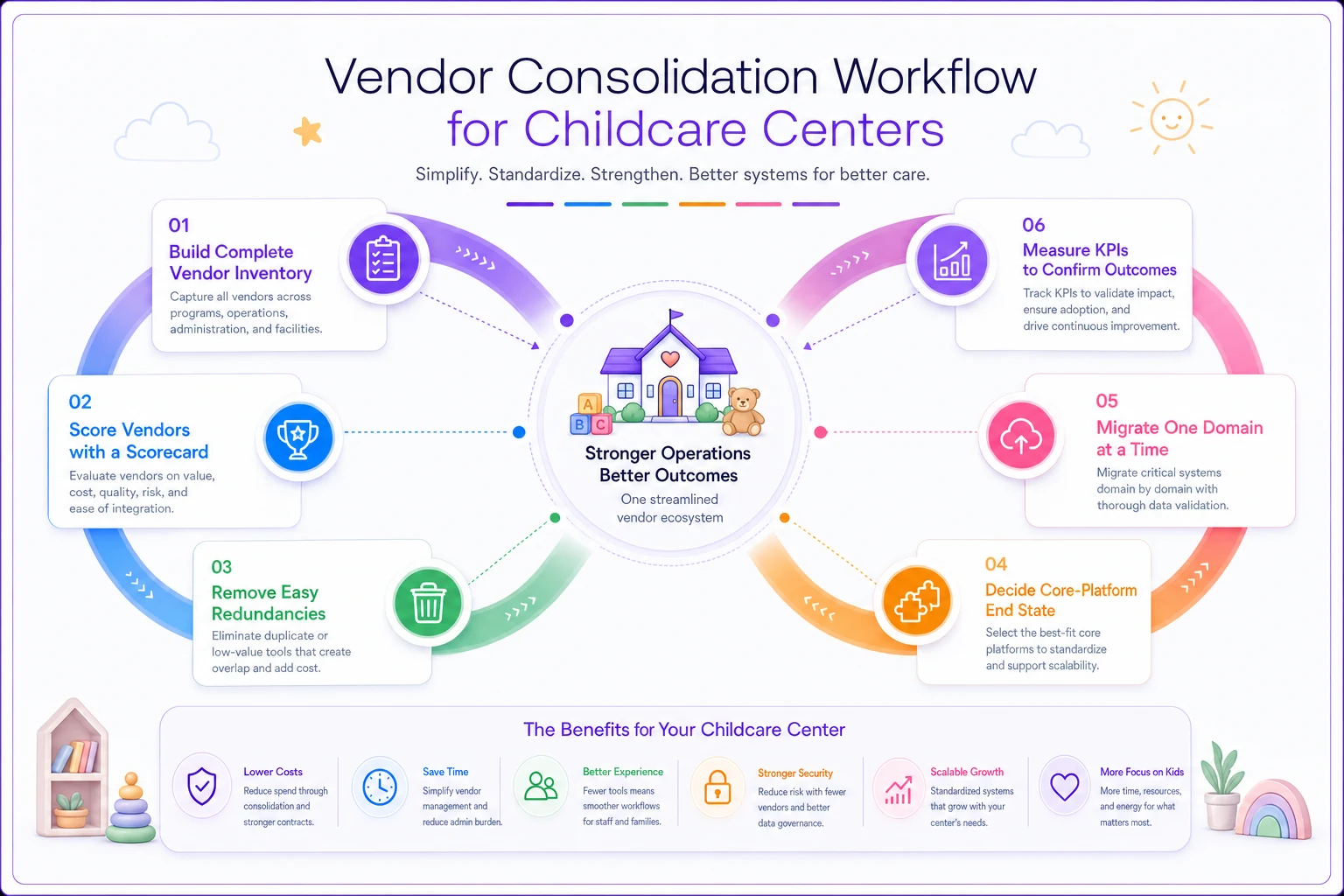
The sequence that keeps rationalization from becoming a self-inflicted outage looks like this:
-
Build the complete vendor inventory first. Every tool, every cost, every renewal date, every contract owner. You can't rationalize what you can't see.
-
Score everything on the dimensions above. Let the overlaps and low-criticality/low-adoption tools surface naturally.
-
Kill the easy redundancies first. Overlapping tools nobody fights for. These wins build credibility and free up budget before you touch anything critical.
-
Decide your core-platform end state, then negotiate from portfolio strength.
-
Migrate critical systems on a planned timeline, one domain at a time, with data validation at every step. Never move billing and enrollment in the same week.
-
Measure against your baseline KPIs so you can prove — to ownership and to yourself — that the disruption paid off.
Here's a simple depiction of the sequence to make sure migrations are staged and validated.
The operators who get this right don't treat vendor consolidation as a one-time purge. They treat it as an ongoing discipline: a living inventory, a renewal calendar somebody actually owns, and a scorecard that gets revisited as the portfolio grows. Sprawl is the default state. Keeping a clean, deliberately-chosen stack is the exception you have to maintain on purpose — and the payoff is an operation where data flows cleanly from enrollment to attendance to billing to the books, instead of being manually dragged across the seams every single day.
The operators who get this right don't treat vendor consolidation as a one-time purge. They treat it as an ongoing discipline: a living inventory, a renewal calendar somebody actually owns, and a scorecard that gets revisited as the portfolio grows. Sprawl is the default state. Keeping a clean, deliberately-chosen stack is the exception you have to maintain on purpose — and the payoff is an operation where data flows cleanly from enrollment to attendance to billing to the books, instead of being manually dragged across the seams every single day.
Ready to elevate your childcare management?
Join hundreds of childcare providers using Totsyly to save time, improve communication, and grow their centers.