



Most centers don't fail an audit because someone stole money. They fail because nobody could prove where a specific dollar came from, what it was allowed to pay for, and who approved crediting it to a particular program. When you run on a single revenue stream, that's easy to track. The moment you're mixing private-pay tuition with state subsidy, CACFP food reimbursements, a quality-improvement grant, and maybe a scholarship fund from a local foundation, the "in your head" method falls apart.
The tricky part is that mixed-revenue centers rarely notice the collapse until something forces it into the open — a subsidy reconciliation that doesn't match, a grant monitor asking for supporting documents you can't locate, or a board member asking why restricted funds show a negative balance. By then you're doing archaeology instead of accounting.
This is a systems piece, not a list of bookkeeping tips. The goal is to show how the pieces connect — restricted fund tracking, revenue crediting rules, monthly close, and the board packet — so you can build governance that actually survives scale and scrutiny.
Why mixed funding breaks normal bookkeeping
A single-source center can run clean books with basic categories: tuition in, payroll and rent out. The chart of accounts is short. Nobody argues about whether a payment was "allowed" to cover a particular cost, because there are no restrictions.
Mixed funding introduces two things that break that simplicity simultaneously: restrictions and crediting decisions.
Restrictions mean certain money can only pay for certain things. A classroom-materials grant can't cover the director's salary. Food-program reimbursement is tied to eligible meals actually served and documented. A scholarship fund can only offset tuition for qualifying families. When you commingle all of it into one operating pool, you lose the ability to prove compliance — even if you never actually misused a dollar.
Crediting decisions are the quieter problem. When a family pays partial tuition and also receives a subsidy, which portion of their bill does the subsidy satisfy? When a payment arrives without a clear reference, which program gets credited? These micro-decisions happen dozens of times a month, usually by whoever is entering payments, usually with no written rule. Multiply that across a year and you get a ledger nobody can defend.
The breakdown almost never comes from a single big error. It comes from hundreds of small, undocumented judgment calls that no two people would make the same way. That's the real enemy: inconsistency, not fraud.
The four pieces of a governance pack that actually holds up
A governance pack isn't a binder that sits on a shelf. It's four connected systems that feed each other. If one is weak, the others inherit the weakness.
Simplify your childcare center’s daily operations.
Totsyly helps you manage enrollments, staff, and communications efficiently so you can focus on care.
- Streamlined enrollment & waitlist management
- Automated billing & payment tracking
- Staff scheduling & attendance monitoring
No credit card required
-
A chart of restricted funds — so every dollar has a home and a rulebook.
-
A revenue crediting approval matrix — so crediting decisions follow a rule, not a mood.
-
A monthly close checklist with audit attachments — so evidence is captured as you go, not reconstructed later.
-
A board-ready packet — so oversight happens on real numbers, not vibes.
Each piece hands off to the next, and the connections matter as much as the pieces themselves.
Piece 1: The chart of restricted funds
Your regular chart of accounts tells you the type of transaction. A restricted-fund chart tells you the source and the rules attached to it. These are different questions, and most centers only track the first one.
A workable restricted-fund chart has, at minimum, these columns for every fund:
-
Fund name and internal code
-
Source (agency, grantor, program)
-
Restriction type (fully restricted, partially restricted, unrestricted)
-
Allowable uses (in plain language)
-
Prohibited uses (also plain language — this is the column everyone skips and later regrets)
-
Reporting period and deadlines
-
Match or maintenance-of-effort requirements, if any
-
Carryover rules (does unused money roll over or get clawed back?)
Here's a simplified version of what the top of that chart looks like:
| Fund code | Source | Restriction | Allowable uses | Prohibited uses | Reporting deadline |
|---|---|---|---|---|---|
| PRV-01 | Private tuition | Unrestricted | General operations | — | Internal monthly |
| SUB-STATE | State subsidy program | Partial | Care for eligible enrolled children | Non-enrolled or ineligible children | Monthly attestation |
| CACFP-01 | Food program | Restricted | Eligible meals served & documented | Non-food, admin overhead beyond cap | Monthly claim |
| GRT-QIS | Quality improvement grant | Restricted | Classroom materials, training | Salaries, rent, capital | Quarterly |
| SCH-FND | Local scholarship fund | Restricted | Tuition offset, qualifying families | Any non-tuition expense | Annual |
The prohibited-uses column is doing the heavy lifting here. When a grant monitor questions a charge, "the allowable-uses list didn't clearly exclude it" is not a defense. Spelling out what a fund cannot touch is what keeps you out of trouble when someone down the line is trying to make the books balance under deadline pressure.
One pattern worth flagging: centers frequently set up restricted funds correctly at the start and then let new revenue sources arrive without adding them to the chart. A new mini-grant shows up, gets dropped into the operating account "temporarily," and never gets its own code. Six months later nobody remembers it was restricted. The fix is a rule, not a reminder — no new revenue source gets deposited until it has a fund code and a rulebook entry.
Piece 2: The revenue crediting approval matrix
This is the piece almost nobody has in writing, and it's where the most avoidable damage happens.
The crediting matrix answers one question for every incoming dollar: which fund gets credited, under what conditions, and who has to approve it if the answer isn't obvious?
-
Tier 0 — Automatic. Clear, matched payments. A private-pay family's autopay hits their tuition balance. No approval needed.
-
Tier 1 — Rule-based, no approval. A subsidy payment with a clear roster attaches to the enrolled children it covers. The rule handles it.
-
Tier 2 — Requires a second set of eyes. Split payments, partial subsidies covering part of a family's bill, retroactive adjustments. Director or finance lead signs off.
-
Tier 3 — Requires documented approval and a note. Reallocating money between funds, applying scholarship dollars, crediting an unmatched or disputed payment. Written justification attached.
The mistake that quietly wrecks mixed-fund books is treating Tier 2 and Tier 3 decisions like Tier 0 ones — just booking them fast to clear the inbox. A partial subsidy that should have satisfied the state's portion gets applied against the family's private balance instead, and now the family shows a credit they didn't earn while the subsidy fund looks short. Each instance is small. In aggregate, they produce reconciliations that never tie out.
This connects directly to how money flows from enrollment through billing. If you want the upstream view of how enrollment and finance have to line up so payments land in the right place to begin with, the enrollment-to-finance operating model for childcare centers walks through the data maps and SLA controls that prevent revenue from leaking before it ever hits your crediting matrix.
The crediting matrix isn't about slowing things down. It's about making sure the fast decisions are genuinely safe to make fast, and the risky ones get the two minutes of attention they actually need.
Piece 3: The monthly close checklist with audit attachments
The shift that separates centers that dread audits from centers that don't is pretty straightforward: evidence gets captured during the close, not hunted down after a request.
The single biggest time sink in a childcare audit isn't answering questions — it's finding the document that supports an answer you already know. A monthly close that attaches evidence as it goes turns a two-week scramble into a folder you already have.
A restricted-fund-aware monthly close looks like this:
-
Reconcile each fund separately, not just the bank account. The bank can reconcile perfectly while individual fund balances are wrong. Tie each restricted fund's activity to its own supporting records.
-
Match subsidy payments to rosters. Confirm every subsidy dollar maps to eligible, enrolled, attending children. Attach the roster used.
-
Reconcile the food claim to meal counts. Eligible meals served, documented, and claimed should agree. Attach the meal-count summary.
-
Review restricted-fund spending against allowable uses. Any charge against a restricted fund gets a one-line "why this is allowable." Attach receipts.
-
Clear the crediting exception queue. Every Tier 2 and Tier 3 decision from the month gets reviewed and its note confirmed.
-
Sign off. Whoever closed the month signs; whoever reviews it countersigns.
Use a consistent file-naming convention (fundcodeYYYY-MMdocumenttype) so attachments are easy to find during review.
Each numbered step should have an attachment slot. By the time you close, the evidence is stapled to the transaction — digitally or otherwise.
A reconciliation table format that works well for restricted funds:
| Fund | Opening balance | Revenue received | Allowable spend | Adjustments | Closing balance | Evidence attached? |
|---|---|---|---|---|---|---|
| GRT-QIS | $4,100 | $0 | $860 | $0 | $3,240 | Y (3 receipts) |
| CACFP-01 | $0 | $1,940 | $1,940 | $0 | $0 | Y (meal count) |
| SCH-FND | $6,500 | $0 | $1,200 | $0 | $5,300 | Y (2 awards) |
The "evidence attached?" column is the one auditors love and the one centers consistently forget. A closing balance with no supporting evidence is just a number you're asking people to trust.
Getting the cash side of this right also protects your forecasting. Mixed timing — subsidies that arrive late, reimbursements that lag the spending — creates cash gaps that catch centers off guard. The mechanics of managing that are covered in the operational playbook for tuition, refunds, and forecasting, which pairs naturally with a fund-level close.
Piece 4: The board-ready packet
This is what turns internal control into governance. A board can't oversee what it can't see clearly, and most childcare board packets are either a single bank balance (useless) or a 40-page export (also useless).
A board packet that directors can actually use needs to fit on a few pages and answer the questions a board is genuinely accountable for:
-
Fund summary. Each restricted fund
opening, activity, closing, and days of runway or time to deadline.
-
Compliance flags. Any fund spent outside allowable uses, any reporting deadline at risk, any subsidy/roster mismatch.
-
KPIs that connect money to operations. A handful with targets — not a data dump.
-
Exceptions log. Tier 3 crediting decisions and reallocations, so the board sees the judgment calls that were made on their behalf.
-
Sign-off page. Who prepared it, who reviewed it, the date.
On KPIs specifically, a mixed-revenue center should track things a single-source center wouldn't bother with:
-
Revenue mix by source (are you dangerously dependent on one grant?)
-
Subsidy collection lag (days between service and payment)
-
Percentage of restricted spend with attached evidence
-
Grant utilization vs. carryover risk (money you'll lose if you don't spend it in time)
-
Crediting exceptions per month (a rising number means your rules aren't clear enough)
That last one is underrated. If crediting exceptions keep climbing, it usually means your crediting matrix has gaps — new situations keep arising that the rules don't cover. It's an early warning signal, not just a metric to report.
A realistic scenario
A center running roughly 90 kids across private tuition, a state subsidy program, CACFP, and a small quality grant kept everything in one operating account. Books reconciled to the bank every month, so leadership assumed things were fine.
Then a grant monitor asked for documentation on about $3,800 in classroom-materials spending. The center could show the receipts but couldn't cleanly prove the money had come from the grant fund rather than commingled tuition — because it had all been pooled. They spent close to two weeks reconstructing which purchases mapped to the grant, and a portion was ultimately questioned. Not because it was misspent, but because it couldn't be traced.
After that near-miss, they rebuilt around the four pieces above: a restricted-fund chart, a crediting matrix, and a fund-level monthly close with attached evidence. The following cycle, the same kind of request took an afternoon — they exported the fund's reconciliation table with receipts already attached. Crediting exceptions dropped from roughly a dozen fuzzy calls a month to two or three genuinely ambiguous ones that got proper sign-off. Nothing dramatic on the revenue side. The win was simply that the books became defensible.
When this level of rigor makes sense — and when it doesn't
When it makes sense: the moment you have more than one restricted funding source. Two funds is where commingling risk begins. If you take any government or grant money alongside private pay, you're already in the zone where a governance pack pays for itself the first time you're asked to prove something.
When it's overkill: a small, fully private-pay center with no restricted funds and no plans to add any. Building a five-fund reconciliation process for a single revenue stream is effort spent solving a problem you don't have.
Who should not try to shortcut this: any center actively applying for grants or expanding into subsidy programs. The worst time to build fund controls is after the money arrives and the reporting clock is already running. Set up the fund code and rulebook before the first deposit, not after.
How the pieces reinforce each other
Restricted-Fund Chart → Crediting Matrix → Monthly Close → Board Packet → [Gaps surfaced] → Restricted-Fund Chart
Here's the handoff flow in one line:
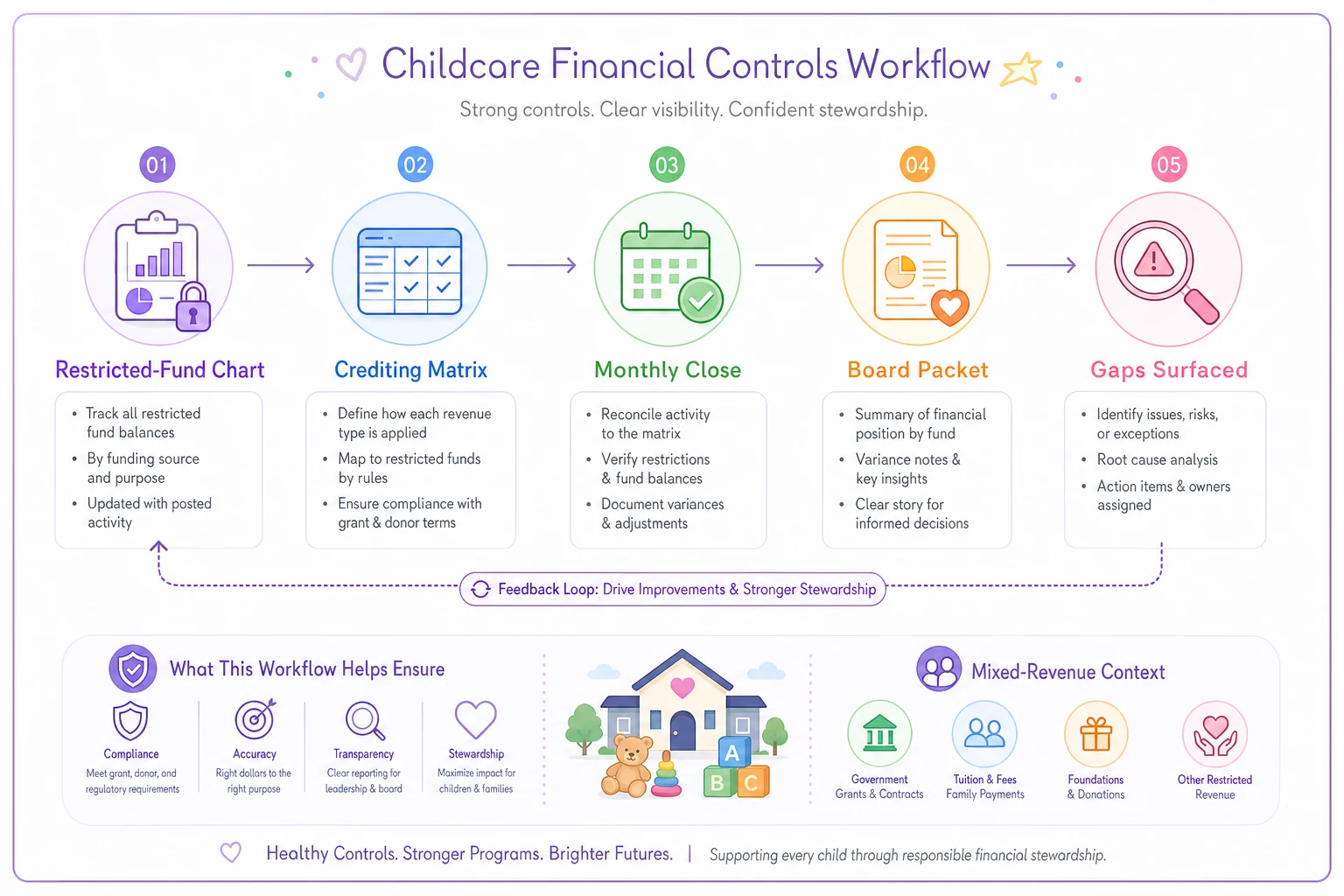
The reason to treat this as one system rather than four separate projects is that each piece protects the next. The restricted-fund chart defines the rules the crediting matrix enforces. The crediting matrix produces clean transactions the monthly close can reconcile. The monthly close produces the evidence the board packet reports on. The board packet's KPIs — especially rising exception counts — point you back to gaps in the chart and matrix.
Break one link and the chain fails quietly. A perfect chart of funds means nothing if crediting decisions ignore it. A disciplined close means nothing if the underlying credits were wrong. And a polished board packet built on unreconciled numbers is worse than none at all, because it manufactures false confidence.
This same logic — controls that hand off to each other rather than standing alone — is what makes a broader operational risk posture work. If you're thinking about how financial controls fit alongside incident, insurance, and liability controls, the childcare risk-management framework covers the wider governance picture these financial pieces plug into.
Where software quietly earns its keep
None of this requires software to be correct. It requires software to be sustainable. A center can run the full governance pack on spreadsheets and disciplined people — plenty do, right up until volume or staff turnover breaks the discipline.
Where AI-powered operational platforms help is in the tedious, error-prone handoffs: flagging a payment that doesn't match a fund rule before it's booked, keeping evidence attached to the transaction instead of buried in a separate folder, surfacing a reporting deadline before it's missed, and generating the board packet from the same data the close already produced. The point isn't to replace judgment — it's to make sure the fast, automatic decisions stay safe and the risky ones get flagged for a human.
That's the difference between controls that work on a quiet month and controls that hold up when you're short-staffed and running behind.
Mixed funding is a growth signal — it means you've diversified beyond a single revenue source and someone trusts you with restricted dollars. But every new funding stream adds rules, deadlines, and crediting decisions that don't announce themselves. The centers that scale cleanly aren't the ones with the most sophisticated accounting. They're the ones that decided, early, that every dollar would have a home, every crediting call would follow a rule, and every closing balance would come with its evidence already attached. Build that once, and audits stop being events you brace for — they become folders you already have.
Ready to elevate your childcare management?
Join hundreds of childcare providers using Totsyly to save time, improve communication, and grow their centers.