



Running a childcare center means juggling dozens of moving pieces every day—ratios, licensing, parent communication, staff scheduling. But nothing derails operations faster than discovering you're $30k short on payroll because half your tuition payments bounced last week.
Most centers operate with surprisingly thin financial controls. Directors often discover cashflow problems only when they can't make payroll or when a vendor threatens to cut off supplies. By then, recovery options are limited and usually painful.
The real problem isn't tracking money—it's that childcare cashflow forecasting requires coordinating enrollment patterns, payment timing, refund obligations, and seasonal variations in ways that standard accounting doesn't capture well. Centers need operational controls built specifically around their unique financial flows.
Why traditional accounting misses childcare operational realities
Standard bookkeeping captures what happened last month. Childcare centers need to predict what happens next Tuesday when three families withdraw unexpectedly and you still need to maintain ratios for the remaining kids.
-
Parents pay in advance but can withdraw mid-month
-
State subsidies arrive 30–60 days late
-
Staff costs are fixed even when enrollment drops
-
Licensing requirements prevent flexible staffing adjustments
-
Summer enrollment drops 20–40% but overhead stays constant
A typical 60-child center might show $85k monthly revenue on paper. But actual cash available for operations swings between $45k and $95k depending on payment timing, subsidy delays, and withdrawal patterns. Without proper controls, directors constantly scramble to cover gaps.
Centers that maintain stable cashflow don't just track numbers better—they build operational systems that create predictability from inherently unpredictable revenue streams.
Tuition models that create (or destroy) cashflow predictability
Your tuition structure determines most of your cashflow variability. Most centers default to monthly billing without really thinking through how payment timing affects day-to-day operations.
Simplify your childcare center’s daily operations.
Totsyly helps you manage enrollments, staff, and communications efficiently so you can focus on care.
- Streamlined enrollment & waitlist management
- Automated billing & payment tracking
- Staff scheduling & attendance monitoring
No credit card required
Weekly vs Monthly billing comparison:
| Aspect | Weekly Billing | Monthly Billing |
|---|---|---|
| Cashflow consistency | Steady weekly income | Large monthly spikes |
| Administrative burden | 4x processing work | Simple monthly process |
| Withdrawal impact | Lose 1 week revenue | Lose full month revenue |
| Late payment detection | Know within 7 days | May take 30+ days |
| Parent preference | Lower commitment feel | Predictable budgeting |
| Subsidy compatibility | Matches most programs | Requires reconciliation |
Centers billing weekly typically maintain 15–20% higher cash reserves naturally because income arrives consistently. But the administrative overhead can consume 8–10 hours weekly for a 100-child center.
Monthly billing works fine when you have strong waitlists and established families. For centers running at 70% occupancy or below, monthly billing amplifies cashflow swings in a way that gets genuinely dangerous.
One option a lot of centers overlook: bi-weekly billing aligned with parent paycheck cycles. This cuts processing burden while keeping cashflow more consistent. Around 65% of parents get paid bi-weekly, so alignment tends to reduce late payments naturally.
Building reserve targets that match your operational reality
Generic advice says maintain 3–6 months of operating expenses in reserve. Childcare centers need more nuanced targets based on their specific risk factors.
Your minimum cash reserve should cover:
-
Two complete payroll cycles (including taxes)
-
One month's rent or mortgage
-
Current month's food program costs
-
Outstanding vendor balances
-
Potential refund obligations
For a 75-child center with $420k annual expenses, that typically means $55k–$65k minimum operating cash. But that's just the floor.
Centers with higher risk profiles need deeper reserves:
-
Heavy subsidy dependence (40%+ of revenue)
add 30% to reserve target
-
Seasonal enrollment swings
add 20% to reserve target
-
New center under 2 years old
add 40% to reserve target
-
Single-site operation
add 25% to reserve target
A center matching multiple risk factors might need $85k–$95k in reserves against that same $420k expense base. Without adequate reserves, one delayed subsidy payment or unexpected enrollment drop triggers immediate crisis.
Payment collection workflows that prevent accumulation
Late tuition becomes uncollectible tuition surprisingly fast. Centers that wait 30 days to address late payments collect only around 40% of outstanding balances. Centers that act within 5 days collect closer to 85%.
The difference isn't aggressive collections—it's systematic early intervention that keeps small problems from becoming big ones.
Day 1–3 after due date:
-
Automated payment retry (for ACH/card payments)
-
Text reminder to parent
-
App notification if using management software
-
No service interruption
Day 4–7:
-
Phone call from assistant director
-
Written notice provided at pickup
-
Payment plan offered if needed
-
Discussion of subsidy status if applicable
Day 8–14:
-
Director meeting required
-
Formal payment arrangement documented
-
Specific consequences timeline provided
-
Service suspension warning issued
Day 15+:
-
Service suspension implemented
-
Spot released to waitlist
-
Collections process initiated
-
Final balance documentation prepared
Centers lose money trying to be understanding without any structure behind it. Clear escalation steps actually help families—they know exactly where they stand and what comes next. Parents struggling financially tend to appreciate transparent timelines over vague warnings.
The workflow also protects staff from making inconsistent decisions under pressure. When a parent asks for "just one more week," staff can point to established policy rather than making judgment calls that create messy precedents later.
Automated systems that flag problems before they cascade
Manual tracking means problems stay hidden until month-end reconciliation. By then, you're reacting to a crisis instead of preventing one.
Centers need automated flags for:
-
Daily deposit variances over 10%
-
Weekly collection rates below 95%
-
ACH/card decline rates above 8%
-
Subsidy payment delays beyond the normal cycle
-
Changes in individual parent payment patterns
-
Enrollment trending below budget assumptions
A 100-child center processing $145k monthly should know within 48 hours if collections are tracking 5% below normal. That early warning creates room for proactive adjustments—calling families, shifting staff schedules, delaying discretionary purchases.
Most childcare management platforms can generate these alerts, but centers rarely configure them properly. The goal is setting thresholds that catch real problems without creating alert fatigue. Flagging every declined payment is noise. But flagging when the same family has three declines in ten days identifies households likely to withdraw—giving you time to intervene or at least prepare for the revenue loss.
Start with thresholds that matter most for your center's size and adjust them monthly to avoid alert fatigue.
AI-assisted operational platforms can handle much of this automatically, surfacing anomalies before they snowball. When your system flags a pattern rather than waiting for you to notice it manually, the whole dynamic shifts from reactive to proactive.
Refund policies that protect operations without alienating families
Refund requests spike during three predictable windows: post-holiday return in January, summer transition in May and June, and back-to-school in August and September. Centers without clear policies end up hemorrhaging cash during these transitions.
Your refund policy needs to balance family fairness with operational reality. Centers with the lowest refund-related cashflow problems tend to use this structure:
Withdrawal notice requirements:
-
30 days written notice for planned withdrawals
-
14 days notice with 50% penalty for emergency withdrawals
-
No refund for same-week withdrawals
-
Deposit forfeit for withdrawals within first 60 days
Refund calculation method:
-
Calculate daily rate from monthly tuition
-
Count actual days attended in final period
-
Subtract from prepaid amount
-
Apply any applicable penalties
-
Process refund within 10 business days
Documentation requirements:
-
Written withdrawal request with specific last day
-
Account reconciliation showing all payments and credits
-
Signature acknowledging refund calculation
-
Copy provided to family and retained for records
Centers regularly lose $3k–$5k monthly to informal refund agreements made during emotional withdrawal conversations. Structured documentation prevents both overpayment and disputes that surface weeks later.
Forecasting templates that translate enrollment into cash reality
Generic cashflow projections assume steady monthly revenue. Childcare revenue follows predictable patterns that standard templates completely miss.
Base scenario (normal operations):
-
Current enrollment × tuition rates
-
Historical collection rate (usually 92–96%)
-
Scheduled subsidy payments
-
Known withdrawals and additions
-
Seasonal adjustment factor
Stress scenario (realistic problems):
-
10% enrollment drop
-
15% increase in late payments
-
30-day subsidy delay
-
2 unexpected staff departures
-
5% food cost increase
Crisis scenario (major disruption):
-
25% enrollment drop
-
30% uncollectable tuition
-
60-day subsidy delay
-
Licensing violation remediation costs
-
Emergency facility repairs
Running these scenarios monthly shows exactly how much cushion you actually have. A center showing $15k monthly profit might discover they're three late subsidy payments away from missing payroll.
The process also reveals which variables matter most. Some centers find that a 5% shift in collection rate hits harder than a 10% enrollment change. That insight redirects focus from filling spots to fixing payment processes—which is usually the more solvable problem anyway.
Building dashboards that surface problems immediately
Financial reports tell you what happened. Operational dashboards show you what's happening right now.
Centers need real-time visibility into:
-
Today's expected vs actual deposits
-
This week's enrollment changes
-
Current accounts past due
-
Upcoming large expenses
-
Available cash after committed expenses
-
Days cash on hand trending
A properly configured dashboard shows problems developing, not problems that already happened. When Thursday's deposit is $3k light, you know immediately instead of catching it during month-end reconciliation.
The dashboard should be checked daily, not just during formal financial reviews. Print it, post it in the office, run through it during morning huddle. Make it part of the daily rhythm. Some centers display anonymized collection metrics where staff can see them—when teachers understand that a 94% collection rate means no supply budget next month, they become partners in encouraging timely payment.
Operational software with built-in reporting makes this significantly easier to sustain. When dashboards update automatically rather than requiring someone to pull reports manually, they actually get used. That consistency is where the real value shows up.
Coordinating subsidy payments with operational needs
Government subsidies create unique cashflow challenges. Payment timing varies by program, rates change mid-year, and documentation gaps can delay payment for months.
Centers with 30%+ subsidy revenue need specialized controls:
Subsidy tracking requirements:
-
Separate tracking for each program
-
Monthly reconciliation of approved vs received amounts
-
Aging report for delayed payments
-
Documentation checklist for each child
-
Reauthorization calendar with 60-day warnings
Buffer management:
-
Never budget assuming 100% subsidy collection
-
Maintain reserves equal to 45 days of subsidy revenue
-
Track average payment delay by program
-
Build relationships with program administrators
-
Document every interaction about outstanding payments
One center found their state subsidy program averaged 47-day payment delays, but they'd been budgeting for 30-day receipt. That 17-day gap meant scrambling for roughly $28k in coverage every single month. Once they identified the pattern, adjusting reserves and payment timing eliminated what had felt like a recurring crisis.
Seasonal variations most centers don't plan for
Childcare demand follows academic calendars, but expenses don't. Centers lose money every summer because they budget assuming steady enrollment.
| Period | Enrollment Trend | Revenue Impact |
|---|---|---|
| September–November | Peak enrollment | Maximum, stable revenue |
| December | Holiday closures | 15–20% revenue drop |
| January–April | Steady enrollment | Predictable revenue |
| May | Transition chaos | Withdrawal spike |
| June–August | Low enrollment | 25–35% drop, same fixed costs |
Centers that stay profitable year-round build these patterns into their annual budget from the start—accumulating reserves during peak months specifically to cover summer shortfalls. Some adjustments that actually help:
-
Offer teacher-only contracts aligned with the school year
-
Negotiate seasonal payment terms with vendors
-
Run summer camp programs at premium rates
-
Reduce facility hours during low-enrollment periods
-
Cross-train staff to cover multiple roles
Centers that struggle tend to treat each month independently. The ones that stay stable understand their annual cashflow cycle and build around it.
Technology and automation for cashflow management
Manual payment processing and reconciliation can consume 15–20 hours weekly in a typical center. That's time not spent on program quality or family engagement.
Modern childcare management platforms automate the repetitive parts: scheduled payment processing, real-time deposit reconciliation, overdue balance tracking with automated reminders, enrollment-based revenue projections, and parent payment portals that reduce front-desk burden significantly.
The real benefit isn't just time saved—it's consistency. When payments process automatically on the 1st, you know exactly when cash arrives. When late notices go out automatically on day 3, families learn the pattern quickly and start planning around it.
Automation requires setup discipline, though. Payment rules, escalation triggers, and reporting thresholds need careful configuration upfront. Centers often implement software and then use maybe 20% of available features because full setup feels overwhelming.
Start with payment automation. Then add collection workflows. Then reporting. Building incrementally prevents the overwhelm that causes many centers to abandon their systems after a few months.
A typical cashflow management workflow
GRAPH: Cashflow Management Workflow
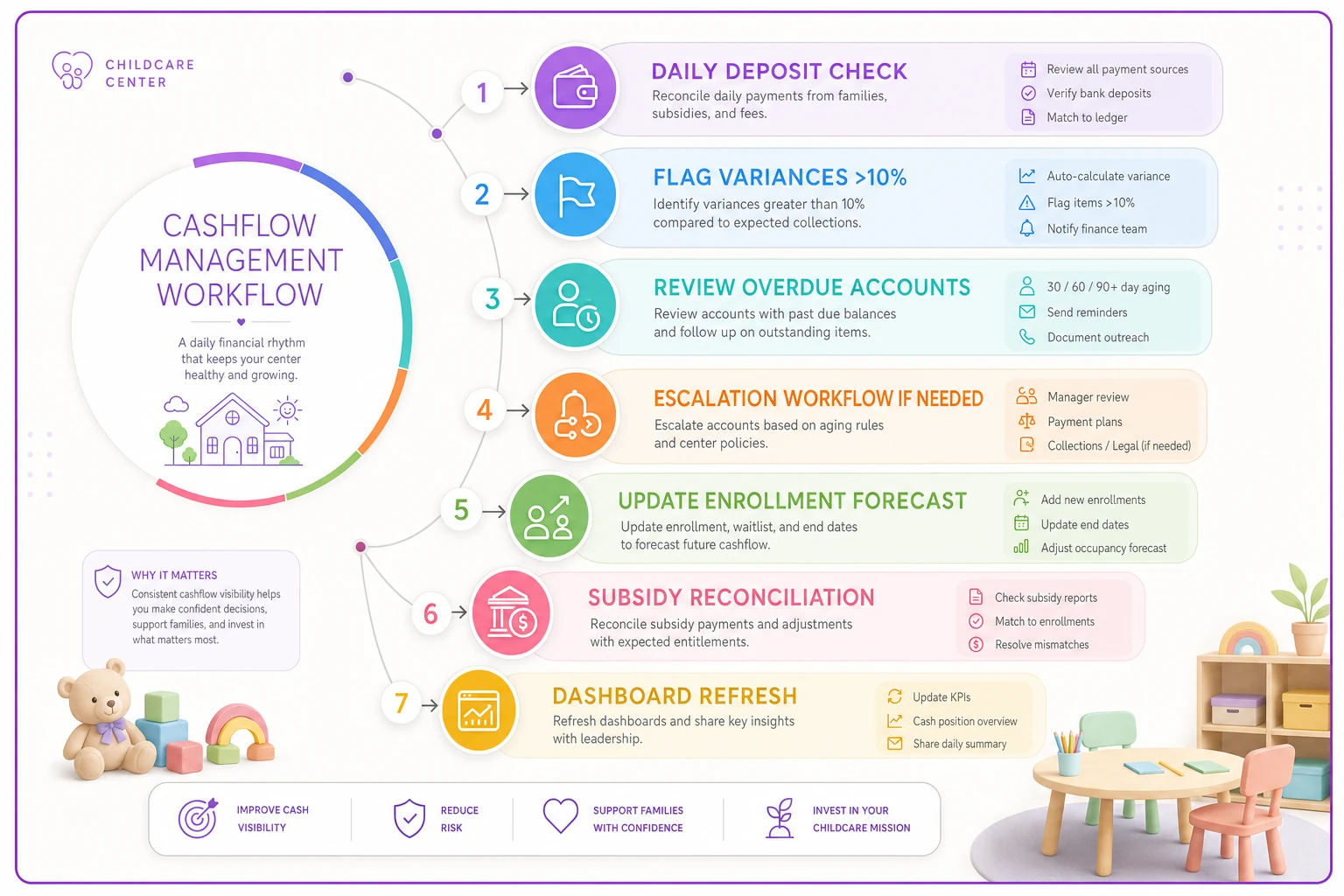
Running this as a structured daily habit—rather than a monthly fire drill—is what separates centers that feel financially stable from ones that don't.
The steps themselves aren't complicated. The discipline to do them consistently is where most centers fall short.
Cashflow becomes predictable through operational discipline
Centers with stable cashflow don't have secret formulas or massive reserves. They have operational discipline that creates predictability out of what would otherwise be chaos.
They know their numbers—not just monthly totals but daily rhythms. They've built buffers for known risks, automated what can be automated, and created workflows for what can't. Most importantly, they treat cashflow management as an operational priority rather than an accounting afterthought.
Getting from cashflow crisis to stability typically takes six to nine months of consistent process implementation. But centers that commit to it see real changes—directors stop waking up anxious about making payroll, stop making desperate short-term decisions that compromise program quality, and start making actual strategic choices about growth.
Your families depend on your center's stability. Your staff need predictable paychecks. Building strong cashflow controls isn't about becoming obsessed with money—it's about creating operational systems that make money predictable enough that you can stop thinking about it constantly and focus on what you actually opened a childcare center to do.
The frameworks here provide that foundation. Implementation takes real effort. But the alternative—managing one financial crisis after another—takes far more energy and produces far worse outcomes.
The frameworks here provide that foundation. Implementation takes real effort. But the alternative—managing one financial crisis after another—takes far more energy and produces far worse outcomes.
Ready to elevate your childcare management?
Join hundreds of childcare providers using Totsyly to save time, improve communication, and grow their centers.