


Most childcare directors can tell you their enrollment number off the top of their head. Ask them how much revenue is supposed to hit the bank this month versus what actually arrives, and the answers get vague fast. That gap — between the moment a family fills out an intake form and the moment cash clears, subsidies reconcile, and forecasts hold up — is where money quietly disappears.
It doesn't disappear dramatically. Nobody steals it. It leaks through mismatched fields, contract terms that never made it into billing, subsidy authorizations that expired without anyone noticing, and pro-rations calculated three different ways by three different people. A center running at 90% occupancy can still lose the equivalent of four or five full-time tuition slots a year without a single empty chair.
This article is about the operating model that connects those dots — intake fields → contract terms → billing triggers → subsidy authorizations → forecasting — and the governance (SLA matrix, reconciliation templates) that keeps the whole chain honest. Not tips. A system.
Why the leak happens: your data doesn't flow, it gets re-entered
There's a pattern that shows up in almost every center that grows past one or two classrooms. Enrollment, billing, and subsidy are handled by different people using different tools, and data gets re-typed at each handoff instead of flowing through.
A family enrolls. The front desk captures the start date, schedule (full-time, three-day, drop-in), tuition rate, sibling discount eligibility, and subsidy status. That information lives in the enrollment folder. Then someone — often the director or a bookkeeper — reads that folder and sets up the billing profile in a separate system. Then a third person handles subsidy paperwork with the state agency, tracking authorization periods and copay amounts in yet another spreadsheet.
Every one of those re-entries is a chance to introduce a mismatch. And mismatches don't announce themselves. A child enrolled for four days but billed for three won't trigger an alarm. A subsidy authorized for 20 hours a week but scheduled for 30 just means the family owes the difference — except nobody bills them for it, because the billing profile was built off the authorization, not the actual schedule.
The core insight: revenue leakage isn't a billing problem. It's a data lineage problem. If the same field means different things in three systems, your money is already gone — you just haven't found it yet.
Mapping the chain: what each stage owes the next
Think of your enrollment-to-finance flow as a relay race where each runner has to hand off the exact right baton. If intake captures a schedule as "MWF" but billing needs an hourly count for subsidy math, the baton gets dropped at the first handoff.
Simplify your childcare center’s daily operations.
Totsyly helps you manage enrollments, staff, and communications efficiently so you can focus on care.
- Streamlined enrollment & waitlist management
- Automated billing & payment tracking
- Staff scheduling & attendance monitoring
No credit card required
Here's what actually has to travel down the chain, stage by stage.
Stage 1 — Intake fields. This is your source of truth, and most centers under-build it. The intake form should capture, in structured (not free-text) fields:
-
Enrollment start date and any planned end date
-
Exact weekly schedule by day, not just "full-time"
-
Assigned classroom / age group (this drives ratio and rate)
-
Base tuition rate and the reason for that rate
-
Discount eligibility (sibling, staff, military, corporate partner)
-
Subsidy status
agency, authorization number, authorized hours, copay
-
Billing cycle preference and payment method on file
The mistake here is letting intake be a PDF that gets scanned and filed. Free-text schedules ("some Tuesdays") and missing subsidy fields are the root cause of most downstream leakage.
Stage 2 — Contract terms. The signed agreement should be generated from the intake fields, not written separately. When the contract says "$1,240/month, 5 days, sibling discount 10%," those exact values need to be the same values that drive billing. If someone types the contract in Word and someone else builds the billing profile from memory, you've got two sources of truth and they will drift.
Stage 3 — Billing triggers. This is where terms become money. Each contract term should map to a specific billing event:
-
Monthly tuition → recurring charge on cycle date
-
Registration fee → one-time charge on enrollment
-
Late pickup → per-incident charge tied to sign-out timestamp
-
Pro-ration → calculated rule for mid-month starts, not a manual guess
-
Subsidy copay → the family's portion, billed separately from the agency portion
Stage 4 — Subsidy authorizations. Subsidy is where leakage gets brutal, because the money comes from two payers (the agency and the family) and the rules change. Authorizations expire. Copays get recalculated. Hours get capped. If your billing doesn't know the authorization end date, you'll keep billing the agency portion after the authorization lapses — and the agency simply won't pay it. Now you're eating tuition and you don't find out for 60 days.
Stage 5 — Forecasting. Your forecast is only as good as the four stages above. If contracts and billing are aligned and subsidy dates are tracked, forecasting becomes arithmetic: expected tuition plus expected subsidy reimbursement, minus expected attrition, adjusted for scheduled starts. If those stages are misaligned, your forecast is fiction and you're managing cash by looking at the bank balance — which is always a month behind reality.
Here's a simple workflow view of that chain.
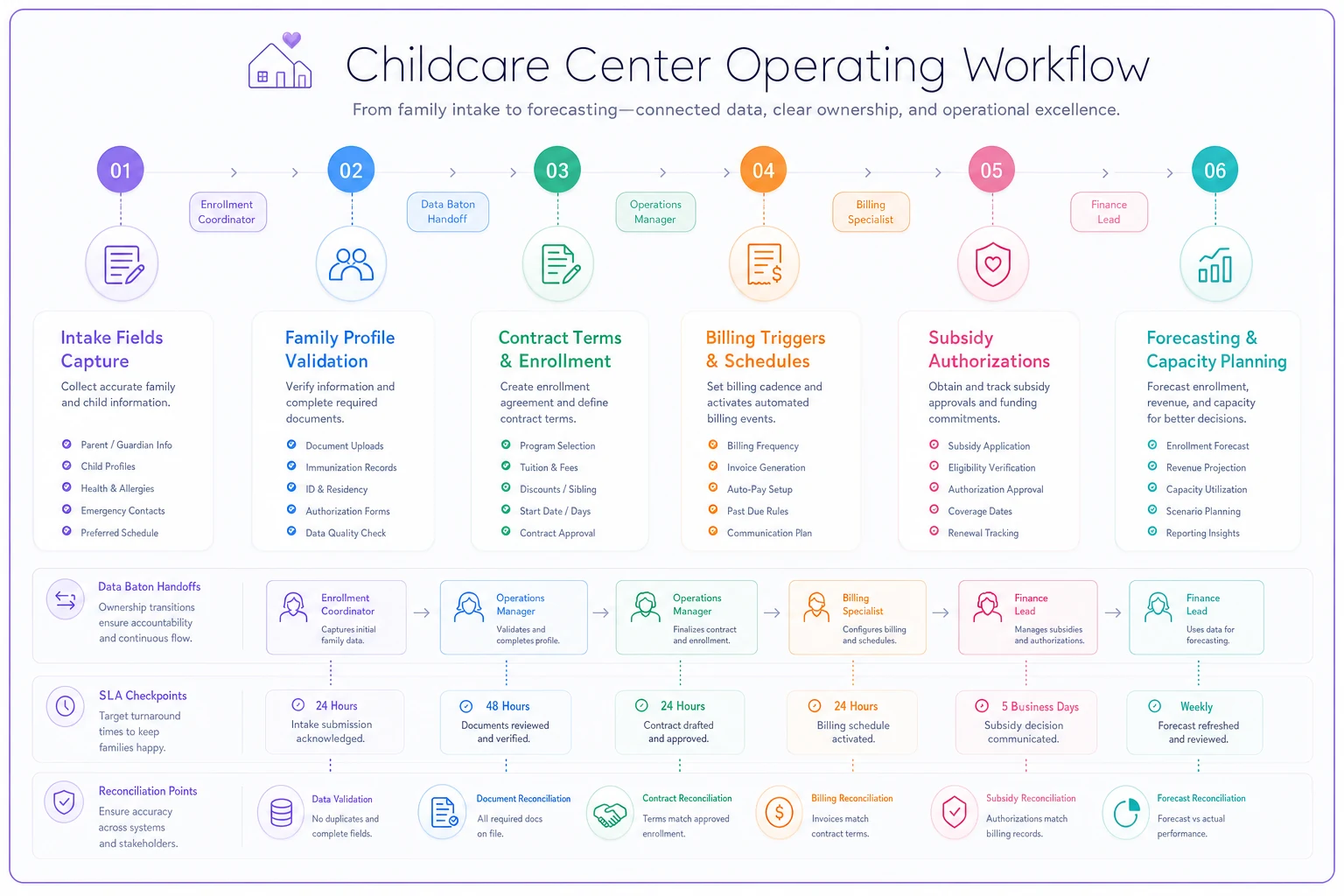
If intake, contract, billing, subsidy, and forecasting are visualized as connected stages with clear owners and checkpoints, the failures look less like mysteries and more like correctable process gaps.
The mapping table: one field, one meaning, all the way down
Below is the kind of field-lineage map that stops re-entry errors. The point is that a single field carries a consistent meaning and format across every stage, so nobody has to interpret it.
| Intake field | Contract term | Billing trigger | Subsidy dependency | Forecast input |
|---|---|---|---|---|
| Weekly schedule (by day) | Days/week + rate tier | Recurring monthly charge | Authorized hours vs. scheduled hours | Committed monthly revenue |
| Start date | Effective date | Pro-rated first charge | Auth start date must precede | Ramp timing |
| Base tuition rate | Contract rate line | Recurring amount | Agency portion vs. family copay | Revenue per slot |
| Discount eligibility | Discount line item | Adjusted recurring amount | N/A (discounts rarely apply to copay) | Net revenue per slot |
| Subsidy auth number | Referenced in contract addendum | Split billing (agency + family) | Auth end date triggers review | Reimbursement forecast |
| Planned end date | Termination clause | Stop-billing date | Auth closure | Attrition/churn input |
The value of a map like this isn't the table itself — it's the enforcement. When intake captures "authorized hours" and billing checks scheduled hours against it, the mismatch surfaces at enrollment instead of at reconciliation two months later.
The SLA matrix: who owns each handoff and how fast
A data map tells you what flows. An SLA matrix tells you who is responsible and by when — which is what actually prevents the "I thought Sarah handled that" gap. In a single-classroom center one person does everything, so this feels unnecessary. The moment you hit two or three classrooms and split the roles, handoffs are where things fall through.
| Handoff | Owner | Deadline | Failure signal |
|---|---|---|---|
| Intake form → verified, complete | Enrollment lead | Within 1 business day of signing | Missing subsidy or schedule fields |
| Contract generated → signed | Director | Before first attendance day | No signed contract on start date |
| Contract → billing profile built | Billing admin | Within 2 business days of signing | First cycle charge doesn't match contract |
| Subsidy auth → tracked with end date | Subsidy coordinator | Same week as enrollment | Auth expiring within 30 days, no renewal filed |
| Monthly billing → reconciled to expected | Billing admin | Within 5 days of cycle close | Actual receipts vary >2% from expected |
Name the failure signal in measurable terms so it can be monitored and alerted automatically.
The failure-signal column is the part people skip, and it's the most important one. An SLA without a defined failure signal is just a wish. When you can name exactly what a broken handoff looks like, you can catch it before it becomes a write-off.
Reconciliation: the monthly check that turns "we're probably fine" into a number
Reconciliation is the discipline of comparing what should have happened to what did. Most centers never do it formally, which is why leakage compounds. They look at the bank balance, it seems okay, and they move on. But the bank balance can't tell you about the family who's been under-billed by $80/month since September, or the subsidy claim that got rejected and never re-filed.
-
Contract vs. billing. Pull every active contract's expected monthly charge. Compare to what was actually billed. Any variance is either an intentional adjustment (documented) or a leak (fix it). This catches schedule changes that never made it to billing.
-
Billing vs. receipts. Compare what was billed to what was collected. Aging balances feed straight into your collections process — and how you handle that matters, because aggressive collection loses families while passive collection loses money. A structured, humane approach to overdue tuition (walked through in detail in this progressive collections workflow) keeps both intact.
-
Subsidy expected vs. subsidy received. This is the reconciliation almost nobody runs, and it's the leakiest. Compare the agency reimbursement you expected (authorized hours × rate) to what actually landed. Rejected claims, capped hours, and lapsed authorizations all show up here — usually as a stubborn gap that's been sitting there for months.
Centers that reconcile monthly find leaks measured in hundreds of dollars. Centers that only reconcile at tax time find leaks measured in thousands, and by then most of it is unrecoverable.
A real scenario: a two-site preschool finds the missing 6%
A preschool group with two sites, roughly 140 children total, kept feeling like revenue was softer than enrollment suggested. Occupancy hovered around 88–90% across both locations, but cash never quite matched the projection. The director assumed it was late payments.
-
About 9 families had schedule changes (moving from 3 days to 4, or 5 to 3) that were updated in the classroom roster but never in billing — some over-billed, most under-billed, netting a loss.
-
Two subsidy authorizations had lapsed 6–7 weeks earlier. The kids kept attending, the agency stopped paying, and nobody caught it. That alone was close to $2,800 in unreimbursed care.
-
A handful of pro-rated first-month charges had been calculated by hand and consistently rounded down in the family's favor.
Add it up and the leak was somewhere around 5–6% of monthly revenue — call it $4k–$5k a month across both sites, most of it recoverable once the handoffs were fixed. The occupancy dashboard never would have shown it, because the chairs were full. The leak lived entirely in the data chain between intake and finance. This is exactly why forecasting deserves its own operational discipline, something worth building alongside a broader tuition, refunds, and forecasting playbook.
When this level of structure actually makes sense
Not every center needs a formal field-lineage map and an SLA matrix on day one. If you're a single-classroom program where the owner enrolls, bills, and handles subsidy personally, the whole chain lives in one head and the handoff risk is low. Building heavy governance there is overkill.
-
You've split enrollment, billing, and subsidy across two or more people
-
You run more than one site and need forecasts you can trust to compare locations
-
Subsidy makes up a meaningful share of your revenue (more than 20–25% or so)
-
You've been surprised by cash more than once despite steady enrollment
One thing worth saying clearly: if you try to implement all of this at once while also migrating systems or during a peak enrollment month, you'll make things worse, not better. Governance layered onto chaos just creates more chaos. Build the intake field structure first, get one clean reconciliation cycle done, then add the SLA deadlines. Sequencing matters more than completeness.
The checklist to pressure-test your own chain
Run through this. Every "no" is a probable leak point.
-
- [ ] Does your intake form capture schedule by day, not just full-time/part-time?
-
- [ ] Is subsidy authorization number and end date a required intake field?
-
- [ ] Is the signed contract generated from the same values used to build billing?
-
- [ ] Does a schedule change in the classroom roster automatically flag a billing review?
-
- [ ] Do you have a defined owner and deadline for each handoff in the chain?
-
- [ ] Do you reconcile contract-vs-billing every month?
-
- [ ] Do you reconcile subsidy-expected-vs-received every month?
-
- [ ] Does anyone get alerted when a subsidy authorization is within 30 days of expiring?
-
- [ ] Is your monthly forecast built from committed contracts, or from last month's bank balance?
If you got through that list and checked everything, genuinely — your operation is in better shape than most. Most centers find three or four unchecked boxes, and each one is a real dollar amount.
Where software quietly earns its place
You can run all of this with spreadsheets and calendar reminders, and plenty of small centers do. The reason leakage persists is that manual chains rely on people remembering to check handoffs during the busiest weeks of the year — which is exactly when they don't.
This is where an AI-assisted operational platform actually helps: not by doing anything flashy, but by making the boring checks automatic. When intake, contracts, billing, and subsidy tracking share one underlying record, a schedule change in the roster can flag the billing mismatch on its own. An authorization approaching its end date can surface a renewal reminder before the money stops. Reconciliation variances can get pushed to whoever owns that SLA instead of waiting to be discovered.
The goal isn't to remove judgment — it's to remove the silent gaps between handoffs where revenue slips out. If you want a sense of which numbers to actually watch once the chain is clean, the metrics that genuinely move occupancy and retention are a good next read.
The centers that forecast accurately aren't the ones with the fanciest tools. They're the ones where a field captured at intake means the same thing all the way through to the bank, where someone owns each handoff, and where reconciliation is a monthly habit instead of a tax-season panic. Enrollment tells you how many chairs are full. The operating model tells you whether those chairs are actually paying — and closing that gap is usually worth more than filling the next open slot.
Ready to elevate your childcare management?
Join hundreds of childcare providers using Totsyly to save time, improve communication, and grow their centers.