



Every childcare director knows that uncomfortable moment when a parent's card declines at pickup. The awkward shuffle, the promise to "bring cash tomorrow," the mental note you hope you'll actually remember to follow up on. Then tomorrow becomes next week, and suddenly you're staring at $2,400 in outstanding tuition from a family whose kids you genuinely care about.
The collections workflow most centers run feels broken because it forces an impossible choice: maintain healthy cash flow to keep your doors open, or preserve trust with families who make your center feel like a community. Most directors end up bouncing between being too lenient—watching receivables pile up—or too aggressive, losing families over a single missed payment.
What makes childcare collections uniquely hard isn't just the emotional component. It's the operational reality. Parents drop off and pick up daily. Their children have formed real attachments to teachers. Siblings might be enrolled across different classrooms. You can't exactly put a lien on a four-year-old's finger paintings. The standard business collections playbook falls apart fast in this environment.
Why childcare collections go off the rails
The breakdown usually starts small. A parent mentions their employer switched payroll systems and their direct deposit is delayed. Reasonable enough. You make a mental note and move on. But then another family's autopay fails because they got a new debit card. A third family promises to pay "by Friday" but Friday comes and goes.
Before long, you're tracking payment promises on sticky notes, sending individual text reminders at random times, and having increasingly uncomfortable conversations at pickup. Your assistant director is spending three hours every Monday calling families about overdue balances instead of supporting classroom operations.
The real drain happens when collections becomes reactive rather than systematic. Directors end up chasing the family that's three weeks behind while missing the one that just became one week late. Small problems become big problems because there's no consistent escalation path.
Most centers don't actually have a collections problem—they have a workflow problem. The money usually exists. Parents generally intend to pay. But without a clear, progressive system that balances firmness with flexibility, both sides end up frustrated.
The hidden costs of inconsistent collections
When collections breaks down, the damage goes beyond cash flow. Staff morale takes a hit when teachers have to navigate awkward payment conversations with parents they see twice a day. Some teachers start avoiding certain families entirely, which creates weird dynamics at pickup.
Simplify your childcare center’s daily operations.
Totsyly helps you manage enrollments, staff, and communications efficiently so you can focus on care.
- Streamlined enrollment & waitlist management
- Automated billing & payment tracking
- Staff scheduling & attendance monitoring
No credit card required
There's also the fairness issue that quietly eats away at parent satisfaction. When one family gets repeated extensions while another gets charged late fees immediately, word spreads through the parent network fast—parking lot conversations, birthday parties, local Facebook groups. Perceived unfairness in payment policies travels faster than any marketing you could do.
The administrative burden compounds things too. Without clear escalation timelines, directors spend hours every week having the same conversations, sending custom emails, making individual judgment calls about who gets another extension. It's mentally exhausting work that pulls you away from actually running the center.
Then there's the enrollment impact most directors never track. Families rarely say they're leaving because of collections friction—they cite "schedule changes" or "found something closer to home." But look at your withdrawal data and you'll often find a pattern: families who experienced collections friction are noticeably more likely to leave within 90 days, even after the payment issue got resolved.
A progressive collections framework that actually works
The most effective tuition collections workflow follows a transparent, multi-touch escalation that gives families multiple chances to get back on track while protecting the center's financial stability.
Here's the framework:
-
Day 1 (Payment Due) Automated friendly reminder via text and email — "Hi Smith family! Just a quick reminder that October tuition is due today. You can pay through the parent portal or bring a check at pickup. Thanks for keeping us running smoothly!"
-
Day 3
Automated follow-up with payment options — "Good morning! We noticed October tuition hasn't come through yet. Sometimes automated payments fail—it happens! Here are three quick ways to catch up: [payment link] | Text CHECK to confirm you're bringing one | Reply with questions"
-
Day 5
Personal touch from classroom teacher — Instead of making this awkward at pickup, have the lead teacher send a brief note through your communication app: "Hi! Admin asked me to check if you saw the tuition reminder. Let us know if you need anything—we're here to help!"
-
Day 7
Direct call from assistant director — This is where human intervention matters. The assistant director (not the director yet) makes a brief, friendly call: "Hi, this is Sarah from Sunshine Academy. I'm calling about October tuition—wanted to make sure everything's okay and see if we can help with a payment plan if needed."
-
Day 10
Formal notice with clear consequences — Email and printed letter handed discretely at pickup: "Your account is now 10 days past due. We value your family and want to work with you. Please contact us by [date] to arrange payment or set up a plan. Without arrangement, we'll need to suspend care starting [date]."
-
Day 14
Director meeting request — "We need to meet this week to discuss your account and keep [child's name] enrolled. I have availability Monday at 8:30am or Tuesday at 5:30pm. Please confirm, or suggest another time that works."
The structure matters here. Each step escalates slightly in formality without jumping straight to confrontation. Families who intend to pay—which is most of them—will usually act well before Day 14.
Here's a quick visual of the escalation steps.
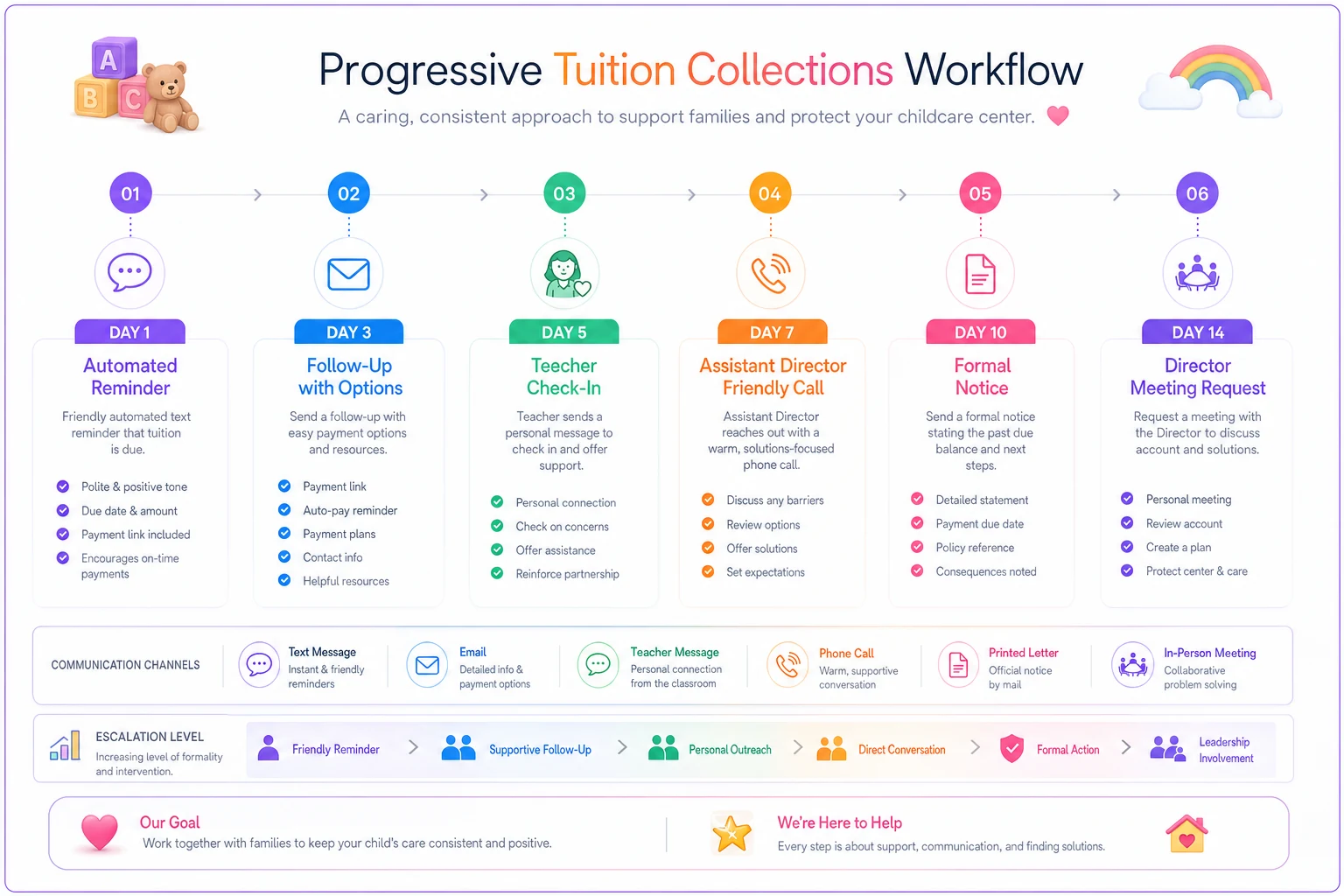
Each step is meant to give families time and options while making the process predictable for staff.
Real templates that preserve dignity while driving action
The language you use matters enormously in childcare. Too corporate and you damage the relationship. Too casual and families don't take it seriously. Here are templates that strike the right balance:
Early-stage SMS (Days 1–5):
"Quick reminder: October tuition was due Monday. Tap here to pay: [link] or reply HELP if something's wrong"
"Hi [Name]! Checking on October tuition (due 3 days ago). Card decline? New payment info? Let us know: [link]"
Mid-stage Email (Days 7–10):
Subject: "Action needed: Tuition for [Child's name]" Hi [Parent name], We haven't received October's tuition yet, and I wanted to personally check in. I know things come up—job changes, unexpected expenses, technical issues with autopay. We're here to work with you.
-
Set up a payment plan (split the balance over 2–3 weeks)
-
Update your payment method
-
Discuss temporary assistance if you're facing hardship
What we need from you:
-
Response by Friday confirming your plan
-
First payment or deposit by Monday
Your family is important to us, but we need communication to make this work. Please reply today or stop by my office at pickup. Best, [Assistant Director name]
Final-stage Formal Notice (Day 14+):
Subject: "Urgent: Suspension of care notice for [Child's name]" Dear [Parent name], This is an official notice regarding your past-due account balance of $[amount], now 14 days overdue. Despite multiple attempts to contact you, we haven't received payment or a response about payment arrangements. While we value your family's place in our community, we cannot continue providing care without addressing this balance.
-
Care will be suspended until the balance is paid
-
Your child's spot cannot be guaranteed after [Date - 7 days]
-
The full balance plus a $50 reinstatement fee will be required to resume care
To avoid suspension, you must either:
-
Pay the full balance by [Date]
-
Pay 50% immediately and establish a written payment plan for the remainder
-
Meet with me personally by [Date] if you're experiencing genuine hardship
I genuinely hope we can resolve this. Please contact me immediately. [Director name] [Direct phone] [Email]
Setting triggers that protect both parties
Clear triggers remove emotion from the process and ensure consistency across all families. Here's a framework that's firm but fair:
Automatic late fee triggers:
-
Day 3
$25 late fee applied (can be waived once per year)
-
Day 7
Additional $10/day begins accruing
-
Day 14
Full late fee amount ($95 total) locked in
Communication triggers:
-
Autopay failure
Immediate text + email
-
Day 1, 3, 5
Automated reminders
-
Day 7
Personal phone call required
-
Day 10
Formal written notice
-
Day 14
Suspension warning
-
Day 17
Care suspended
Suspension and termination triggers:
-
17 days late
Care suspended (child cannot attend)
-
21 days late
Spot released to waitlist
-
30 days late
Account sent to collections agency
-
Any NSF check
Immediate cash-only status for 6 months
-
3 late payments in 12 months
Require 1 month advance deposit
The key is making these triggers transparent from enrollment. Include them in your parent handbook, review them during tours, and reference them consistently. When families know exactly what happens and when, it removes the feeling of arbitrary enforcement—which is where most of the relationship damage actually comes from.
Building payment plans that actually get paid
Sometimes families genuinely need flexibility. The difference between a payment plan that works and one that doesn't comes down to structure and accountability.
Effective payment plan structure:
-
Maximum term
4 weeks to catch up
-
Required down payment
25–50% of balance
-
Weekly payments, not monthly
-
Automatic payment required (no manual checks)
-
Written agreement signed by both parties
-
Clear consequences for missing plan payments
Sample payment plan agreement: "The Smith family owes $1,600 for October tuition. Payment plan terms:
-
$400 due today (Oct 8) via card on file
-
$400 due Oct 15 via automatic charge
-
$400 due Oct 22 via automatic charge
-
$400 due Oct 29 via automatic charge
-
November tuition due Nov 1 as normal
If any planned payment fails:
-
Entire balance becomes immediately due
-
Care is suspended within 24 hours
-
No additional payment plans for 12 months
Agreed: [Parent signature] [Date]
Payment plan red flags:
-
Plans extending beyond 30 days
-
Promises to pay "when tax refund arrives"
-
Third payment plan for the same family
-
Plan payments under $100/week
-
Verbal agreements without documentation
If you're seeing multiple red flags at once, the plan isn't going to work. Better to have the harder conversation now than chase down payments for another month.
When to show flexibility vs. when to stand firm
Not all late payments are equal. Knowing when to bend and when to hold firm protects both your business and your reputation as a reasonable operator.
Show flexibility when:
-
First-time late payment from a longtime family
-
Documented job loss or medical emergency
-
Government subsidy payment delays
-
Clear communication from day one
-
Family proactively proposes a solution
-
Siblings enrolled (higher lifetime value)
Stand firm when:
-
Pattern of late payments (3+ in 6 months)
-
Family goes silent on your communications
-
Previous payment plan was broken
-
Excuses keep changing
-
Other families are watching and expecting the same treatment
-
Balance exceeds one month's tuition
One approach that works well is a "one-time grace" policy. Each family gets one free pass per year where late fees are waived and extra time is granted, no questions asked. After that, policies are enforced consistently. It gives you room for genuine hardships without opening the door to abuse—and it's easy to explain to families because it's clearly defined upfront.
Protecting relationships during difficult conversations
The conversation about overdue tuition doesn't have to destroy the relationship. How you approach it matters more than the message itself.
What works:
-
Starting with concern, not collections
"I noticed your payment hasn't come through and wanted to check if everything's okay with your family."
-
Offering specific solutions
"Would splitting this week's payment into two help? We can run half Thursday and half Monday."
-
Acknowledging the partnership
"We love having Emma here and want to figure this out together."
-
Setting clear boundaries with warmth
"I need to know by 5pm today what the plan is, then we're good to go."
What backfires:
-
Discussing payment at pickup in front of other parents or children. Nothing destroys trust faster than public embarrassment.
-
Threatening consequences you won't enforce. If you say care will be suspended Monday, you have to follow through—otherwise you lose all credibility, and word gets around.
-
Making it personal
"I can't pay my teachers because you haven't paid tuition" might be true but it creates resentment, not resolution.
-
Accepting partial payments without a plan. Taking $200 on a $1,600 balance without agreement on the rest just delays the problem.
How you handle the conversation determines whether you preserve the relationship and reach a resolution.
Technology and systems that streamline collections
The manual collections process most centers run—spreadsheets, sticky notes, random text messages—creates more problems than it solves. Modern childcare operations need systematic approaches that don't rely on anyone remembering to follow up.
Effective collections automation handles the routine touchpoints while freeing staff for the moments that actually require judgment. The first five days of reminders shouldn't require any manual work. Automated texts and emails can handle the friendly nudges, payment links, and basic follow-ups. Your team should only be intervening when a real conversation is needed.
Automate the first five reminder steps so staff only handle exceptions that genuinely need human judgment.
The reconciliation piece is where most centers fall apart. Without clear tracking of who owes what, who's on a payment plan, and who's already received their notices, you get inconsistent enforcement and frustrated families. A proper system tracks every interaction, payment promise, and plan automatically—creating an audit trail that protects both parties.
AI-powered operational software takes this a step further by removing decision fatigue from the process. Instead of agonizing over every late payment, your team follows a clear workflow that runs automatically in the background—payment reminders go out without anyone pushing a button, escalations happen on schedule, and staff only step in when human judgment is genuinely needed. That consistency actually improves family relationships because everyone gets treated the same way.
What actually transforms collections from a constant stress into a manageable process is having all family financial data in one place. When your assistant director can instantly see that the Johnsons have been perfect payers for two years but just hit a rough patch, she can confidently offer flexibility. When she sees the Martins are on their fourth late payment despite multiple plans, she knows to hold firm.
Recovery strategies after suspension or termination
Sometimes, despite best efforts, you have to suspend care or terminate enrollment. How you handle the recovery process determines whether you'll ever see that money—and whether that family will trash your reputation online.
For suspended families returning:
-
Require full balance plus reinstatement fee before first day back
-
Process payment 48 hours before return date
-
Send a "welcome back" message to the child's teachers
-
Monitor the next 3 months closely for any payment issues
-
Document everything in case of future problems
For terminated families with balances:
-
Send final itemized statement within 7 days
-
Offer one last payment plan option (50% down, 30-day term)
-
After 30 days, send formal collections notice
-
After 45 days, report to a collections agency
-
Keep all documentation for small claims court if needed
Collections agency handoff:
When you do need to use a collections agency, make it clean. Send a final notice to the family with the exact date their account will be transferred. Provide the agency with a complete documentation package—enrollment agreement, payment history, all communications. Expected recovery usually runs somewhere between 40–60% of the balance, with agency fees typically around 25–35% of whatever they recover. It's not ideal, but it's better than absorbing the full loss.
Measuring collections effectiveness
Track these metrics monthly to spot problems before they become critical:
| Metric | Target | Warning Sign |
|---|---|---|
| Accounts 7+ days late | <5% | >10% |
| Accounts 14+ days late | <2% | >5% |
| Average days to pay | <3 | >7 |
| Payment plans active | <3% | >7% |
| Recovery rate | >95% | <90% |
| Families lost to collections | <1% | >3% |
Monthly reconciliation checklist:
-
Match all bank deposits to family accounts
-
Review all payment plans for compliance
-
Identify families approaching suspension triggers
-
Audit waived fees for consistency
-
Check automated reminder delivery rates
-
Review staff time spent on collections
-
Calculate total outstanding vs. monthly revenue
When collections is working properly, your receivables stay under 3% of monthly revenue and your staff spends fewer than 5 hours per week on payment issues. If either number is off, something in your workflow needs to change—and it's usually a process gap, not a people problem.
Building a collections culture without being "that" center
The best childcare tuition collections workflow is one families never fully experience because they pay on time. That happens when payment expectations are woven into your center culture from the very first tour.
During enrollment, spend five minutes specifically on payment policies. Show families exactly what happens if payment is late. Walk them through the reminder schedule. Explain the one-time grace policy. When families know what to expect, they're far more likely to communicate proactively when something comes up.
Train your staff to view collections as supporting families, not punishing them. When teachers understand that consistent tuition collection keeps ratios low, supplies stocked, and wages stable, they become partners in the process rather than obstacles.
The centers that handle collections best treat it like any other operational system—documented, consistent, measured, and occasionally adjusted. They don't take late payments personally, but they also don't accept them as inevitable.
Beyond collections: preventing the problem entirely
Most collections problems are preventable with the right operational foundation. When families choose your center, they're committing to a financial relationship that might last several years. Setting that relationship up correctly from day one prevents most issues before they start.
Centers that struggle with collections are usually trying to track everything manually or across multiple disconnected systems—sending payment reminders from personal phones, tracking payment plans in spreadsheets, hoping someone remembers to follow up. It's not that they don't care. It's that their systems can't support consistent execution.
Modern AI-assisted operational platforms connect payment processing, family communication, and financial tracking in one place so nothing falls through the cracks. Families get consistent reminders, staff follows clear workflows, and directors can spot problems while they're still manageable—not after they've already escalated into a suspension conversation.
When your collections workflow runs automatically in the background, your team only steps in when human judgment is actually needed. Your families get consistency and transparency. Your staff gets clear processes that don't require constant improvisation. And your center gets the financial stability that comes from managing collections like the real operational system it is.
Collections stops being a source of constant stress and becomes just another part of running a well-managed center.
Ready to elevate your childcare management?
Join hundreds of childcare providers using Totsyly to save time, improve communication, and grow their centers.