


Most centers don't have a risk problem. They have a connection problem. The incident report lives in one binder, the insurance policy lives in the director's email, the contract families signed lives in a filing cabinet, and the person who actually knows what happened that Tuesday afternoon quit in March. Each piece exists. None of them talk to each other. And that gap is exactly where liability turns from a $500 headache into a claim your carrier fights you on.
A real childcare risk management framework isn't a policy binder. It's the wiring that connects what happened to what you documented to what your policy covers to what your contract says — all in a way you can reconstruct twelve months later without guessing. This post walks through how that wiring works, where it breaks as you grow, and what a functioning version actually looks like.
Start with severity tiers, because everything downstream depends on them
The most common structural mistake is treating every incident the same way. A skinned knee and a suspected concussion trigger the same one-page form, the same casual verbal handoff at pickup, the same "we'll file it later." That flattening is what sinks centers — because when a minor-looking bump becomes a legal matter three weeks later, there's no differentiated record showing you took it seriously.
Severity tiers fix this by forcing a decision at the moment of the incident: how serious is this, and what has to happen next? The tier isn't just a label. It's a switch that turns on specific documentation, notification, and escalation requirements.
Here's a workable tier structure most centers can adapt:
| Tier | Example incidents | Documentation required | Notification window | Escalation / claim path |
|---|---|---|---|---|
| 1 – Minor | Skinned knee, small bruise, brief crying after fall | Standard incident log entry, staff signature | Verbal at pickup + same-day written | Director review weekly |
| 2 – Moderate | Bite breaking skin, fall needing ice/observation, allergic reaction (mild) | Full incident form, witness statement, photos of area/environment | Parent notified within 1 hour, written same day | Director notified same day; logged in risk register |
| 3 – Serious | Head injury, suspected fracture, injury needing outside medical care | Full form + witness statements + timeline + photos + supervisor narrative | Parent immediately, before pickup | Director + owner notified; carrier put on notice within 24–48h |
| 4 – Critical | Hospitalization, missing child, allegation of abuse, serious medical event | Everything above + incident preservation (freeze schedules, statements same day) | Parent immediately; regulatory body per state rules | Attorney + carrier engaged immediately; nothing discarded |
The tier assignment matters more than people realize. Staff consistently under-tier incidents — to avoid alarming parents or creating extra paperwork. A bite that broke skin gets logged like a scratch. Then infection sets in, the parent's pediatrician starts asking questions, and your record says "minor." Now your own documentation is working against you.
Pro-tip: Require tier selection before a form can be submitted to prevent under-tiering.
The fix isn't lecturing staff to take things more seriously. It's making the tier a required field before the form can be closed, with clear examples attached to each level so it's not a judgment call made in a stressful moment. If you already have a solid intake flow — and if you don't, the end-to-end incident workflow breakdown is the place to start — tiers slot right on top of it.
The documentation-to-claim chain nobody tests until it's too late
Here's where things break quietly. You have incident reports. You have insurance. But when a Tier 3 event actually happens, does your documentation contain what your carrier needs to defend the claim? Most centers have never checked, because they've never had to file.
Simplify your childcare center’s daily operations.
Totsyly helps you manage enrollments, staff, and communications efficiently so you can focus on care.
- Streamlined enrollment & waitlist management
- Automated billing & payment tracking
- Staff scheduling & attendance monitoring
No credit card required
A claim adjuster isn't reading your incident form for empathy. They're looking for a timeline, supervision ratios at the moment of injury, environmental conditions, witness accounts, prior related incidents, and proof of notification. If your form captures three of those six, your carrier is working with a partial hand — and partial hands settle high.
-
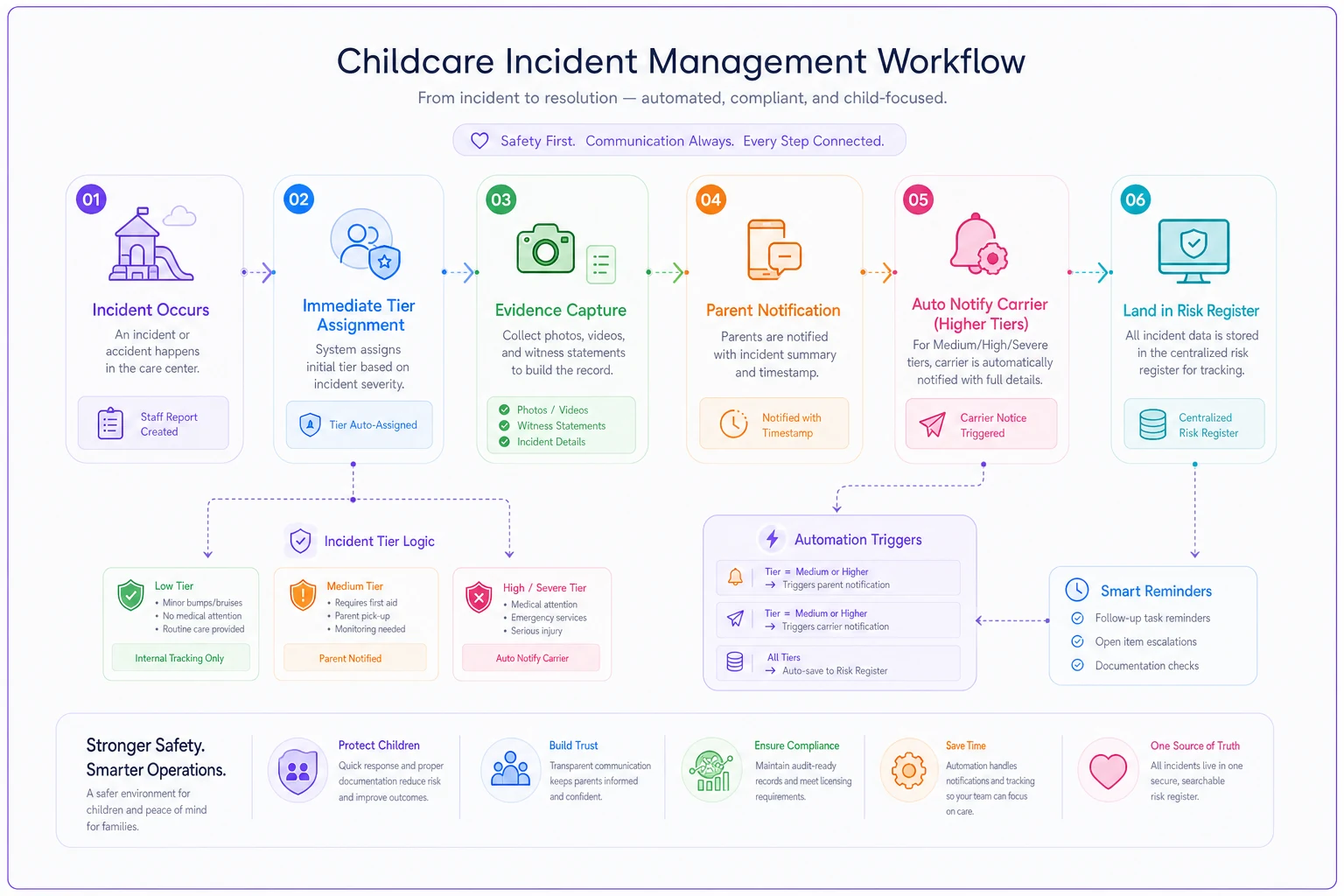
Incident occurs → tier assigned within minutes, not at end of shift.
-
Evidence captured while fresh → photos of the area, not just the injury; who was supervising; ratio at that moment; what the child was doing.
-
Witness statements collected same day — separately, before staff talk through what happened over lunch. Aligned memories look coached later.
-
Parent notification logged with timestamp — not "we told them at pickup" but a recorded written communication.
-
Tier determines carrier action — Tiers 3 and 4 mean the carrier goes on notice before you know whether a claim is coming. Late notice is one of the top reasons claims get denied.
-
Everything lands in the risk register so patterns surface before they become lawsuits.
The piece most administrators miss: carrier notice timing is a coverage condition, not a courtesy. Many policies require "prompt" notice of any event that could reasonably lead to a claim. Wait until the parent actually threatens to sue, and you've potentially voided coverage on the exact event that needed it most. Tier 3 and above should automatically trigger a notice decision — even if you're 90% sure nothing will come of it.
Policy limits: the numbers most centers guess at
Ask ten directors what their general liability limits are and roughly half will say something like "I think a million?" That vagueness is the problem. Coverage decisions get made once, at opening, by whoever found the cheapest quote, and never revisited as the center grows from 40 kids to 120.
A functioning framework ties recommended limits to your actual exposure. Some rough anchors that work for small-to-mid centers:
-
General liability $1M per occurrence / $2M aggregate is a common floor, but any center over roughly 80 children or running transportation should be looking harder at that aggregate number.
-
Professional / abuse & molestation coverage This is the one that gets skipped and the one that ends centers. Sublimits here are often far lower than your GL — sometimes $100k when your GL is $1M. Read the sublimit, not the headline number.
-
Umbrella Once you're multi-classroom or multi-site, an umbrella layer ($1M–$5M) is usually cheaper per dollar of coverage than raising base limits.
-
Property and business interruption A norovirus outbreak or a fire that closes you for six weeks can be more financially fatal than any single injury claim.
A common scenario worth knowing: a two-site center carries $1M/$2M GL but only a $50k abuse/molestation sublimit. On paper they're insured. In practice, the one category of claim most likely to permanently close both sites is covered at about 5% of their headline limit. Nobody made that choice deliberately — it was buried in the declarations page and never read.
The pattern worth internalizing: your weakest sublimit is your real coverage. Build policy reviews around catastrophic scenarios, not everyday ones.
Contract clauses: where liability gets decided before anything happens
Your enrollment agreement is a risk-management document that most families sign without reading and most centers don't update for years. The clauses in it determine who's responsible when things go sideways — and thin contracts shift risk onto you by default.
A clause checklist worth auditing your current agreement against:
-
Medical authorization — explicit permission to seek emergency care and who pays for it.
-
Authorized pickup and ID verification — tied to your actual pickup procedures, not vaguely worded.
-
Photo/media consent — separate opt-in, because a blanket clause won't hold up.
-
Allergy and medication administration — what you will and won't do, with signed acknowledgment.
-
Illness exclusion policy — clear criteria, because "sick" is where disputes live.
-
Injury acknowledgment — recognition that normal play carries normal risk (does not waive negligence, but sets expectations).
-
Data and records handling — what you collect, keep, and share.
-
Dispute resolution and jurisdiction — quietly one of the most protective clauses you can add.
-
Termination and disenrollment terms — so removing a family for cause doesn't itself become a liability.
The mistake here isn't usually a missing clause — it's a clause that contradicts your actual operations. Your contract says pickup requires photo ID; your staff wave through anyone who looks familiar. Now the contract is evidence you had a standard and didn't follow it, which is worse than having no standard at all. Alignment between the paper and the practice is the whole game.
The quarterly risk register: turning incidents into foresight
Individual incidents are noise. Patterns are signal. A risk register is where you convert scattered events into the handful of things actually likely to hurt you — and it only works on a cadence, not "whenever we get around to it."
Quarterly is the right rhythm for most centers. Monthly is too noisy to see trends; annually is too slow to catch a developing problem. Every quarter, someone owns pulling the incident data, updating the register, and assigning actions with actual dates.
Sample register entries:
| Risk | Likelihood | Impact | Evidence source | Current control | Action / owner | Review date |
|---|---|---|---|---|---|---|
| Playground fall injuries clustering on climber | Medium | High | 4 Tier-2 incidents this quarter, all same equipment | Soft surfacing, supervision | Inspect/replace climber – Facilities lead | Next quarter |
| Medication errors in toddler room | Low | High | 1 Tier-2 near-miss | Double-sign protocol | Retrain + spot audit – Room lead | 30 days |
| Late carrier notice risk | Medium | Critical | 2 Tier-3 events noticed late | New auto-notice rule | Verify trigger works – Director | Next quarter |
| Expired staff CPR certs | Medium | High | HR audit | Renewal tracking | Close 3 lapsed certs – HR | Immediate |
The thing that makes this worth doing: most serious incidents are preceded by near-misses nobody connected. Four Tier-2 falls on the same climber over three months is a Tier-4 waiting to happen. The register is what makes that visible before the ambulance shows up. Centers that skip the cadence aren't just unlucky when the big one hits — they were ignoring warning signs their own records were already writing.
Evidence flows: making it all auditable
None of this holds up if you can't reconstruct it later. The difference between "we handled that well" and "we can prove we handled that well" is evidence flow — where each piece lives, how long you keep it, and who can retrieve it when needed.
The practical structure: incident records, witness statements, notification logs, photos, and carrier correspondence should live together, indexed by incident and tier, with retention periods that meet or exceed your state's requirements and your policy's claim window (often years, sometimes longer for anything involving a minor). Scattered evidence — some in email, some in a binder, some in someone's memory — is functionally no evidence at all when an adjuster or attorney asks for the full file.
This is where records discipline and risk management overlap completely. If your retention and folder structure is already solid, most of your evidence flow is handled — the childcare retention matrix and folder templates walk through exactly how to organize that. And for the highest-severity scenarios involving evacuation or reunification, your reunification and staged messaging playbook is part of the same evidence chain — who was notified, when, and how, all needs to be reconstructable.
This diagram shows the end-to-end evidence flow and the automatic triggers you should design into your system.
Where AI-assisted operational tools genuinely earn their place here isn't in replacing judgment — it's in the connective tissue. Auto-flagging a Tier-3 incident so the carrier-notice reminder fires, surfacing that four falls happened on the same equipment this quarter, catching that a handful of CPR certs are about to lapse before your register review, keeping notification timestamps clean and organized. The framework is the point; software just keeps the pieces from drifting apart as volume grows.
When this level of structure actually makes sense — and when it's overkill
Not every center needs all four tiers, an umbrella policy, and a quarterly register on day one.
This makes sense when: you're past roughly 50–60 children, running multiple classrooms, adding transportation, or operating more than one site. At that scale, informal memory-based risk handling stops working — too many incidents, too many staff, too much turnover for anyone to hold it all in their head.
This is probably overkill when: you're a small home-based program with a handful of children and one or two caregivers. You still need severity awareness, real documentation, and adequate insurance — but a formal quarterly register tracking a dozen risks would be process for its own sake.
Who should not skip it regardless of size: anyone running transportation, water activities, or anyone with even one serious incident in their history. Those exposures don't scale with enrollment — a single event can be catastrophic no matter how small the program is.
A short real scenario
A three-classroom preschool, around 95 children, had what they considered "good" incident reporting — a form, a binder, the works. What they didn't have was tiering or a register. Over about eight months they logged several biting incidents in the same toddler room, treated each as routine, and never connected them. One bite got infected, a parent escalated, and the center went to file a claim only to find their notice was months late on a pattern they should have flagged much earlier.
After that scare they rebuilt around tiers and a quarterly register. The change wasn't dramatic in volume — roughly the same number of incidents. What changed was that the second cluster of anything now surfaced within a quarter, carrier notice on Tier-3 events went out within a day or two instead of never, and their contract finally aligned with their actual pickup and medication practices. When their next real injury happened about a year later, the full file — timeline, ratios, photos, witness statements, timestamped notification — was ready before the adjuster asked for it. The claim closed quietly. That's the entire goal.
A childcare risk management framework isn't about having more forms. It's about making sure the forms, the insurance, the contract, and the patterns all point at the same reality — and that you can prove it when you need to. Severity tiers decide what happens. The documentation chain captures it. Policy limits and contract clauses determine who pays. The quarterly register turns scattered events into foresight. And the evidence flow is what makes the whole thing hold up when someone finally asks you to reconstruct it.
The centers that get hurt worst aren't the ones with the most incidents. They're the ones where every piece existed but nothing connected — and by the time they realized the wiring was missing, it was already a claim.
Ready to elevate your childcare management?
Join hundreds of childcare providers using Totsyly to save time, improve communication, and grow their centers.