



A daycare director in Oklahoma shared something a few years back that I haven't been able to shake. During a tornado warning, they evacuated 85 kids to a church two blocks away. The actual evacuation went fine. Then reunification started. Parents abandoned cars in the street, pushed through the church doors, grabbed random sign-out sheets. One dad drove his truck onto the church lawn because the road was blocked.
Four hours to sort out. Two kids went home with the wrong authorized pickup—divorced parents, custody issues, you can imagine the fallout. Multiple parents threatened legal action. The director quit three months later.
What most childcare reunification procedures miss is pretty simple: parents in emergency mode don't follow instructions. They want their kids. Your carefully laminated emergency binder means nothing when a few hundred terrified parents converge on your evacuation site at the same time.
The custody documentation nightmare nobody talks about
Before getting into evacuation mechanics, the custody situation needs addressing because it's genuinely dangerous if you skip over it.
Roughly a third of your enrolled families have some form of custody arrangement that affects who can pick up. Restraining orders. Specific pickup windows. Court-mandated supervised exchanges. During normal operations, your front desk handles these daily. During an evacuation, everything falls apart.
Traditional reunification logs assume every adult showing up has equal right to collect a child. That assumption causes serious problems. Custody flags need to be embedded directly into your evacuation materials, not sitting in a filing cabinet back at the center.
Here's what typically happens:
-
Non-custodial parent hears about evacuation through social media
-
Shows up at reunification site claiming some kind of emergency override
-
Stressed staff member doesn't have custody docs on hand
-
Child gets released to the wrong person
-
Legal nightmare follows
The fix requires building custody nuances into your evacuation kit from day one, not scrambling to remember restrictions while parents are screaming at you.
Why typical evacuation maps create bottlenecks instead of flow
Most centers grab a generic evacuation map template, mark their building exits, draw arrows to the site, and call it done. That's like giving someone directions to a stadium without mentioning the parking situation.
Simplify your childcare center’s daily operations.
Totsyly helps you manage enrollments, staff, and communications efficiently so you can focus on care.
- Streamlined enrollment & waitlist management
- Automated billing & payment tracking
- Staff scheduling & attendance monitoring
No credit card required
Real evacuation mapping needs three distinct layers:
Layer 1: Staff movement patterns Your teachers need routes that don't cross each other. When Miss Sarah's two-year-olds are moving down the main hallway, Miss Jennifer's infants should be taking the side exit. Crossing evacuation streams creates pile-ups.
Layer 2: Parent approach zones Parents come from three directions: those already at the center, those coming from work, those coming from home. Each group needs different staging areas at your evacuation site. Otherwise you get the Oklahoma church lawn situation.
Layer 3: Emergency vehicle access Fire trucks and ambulances need clear paths. Your evacuation routes can't block their access points. Obvious in theory, but most evacuation sites get chosen for proximity, not traffic flow.
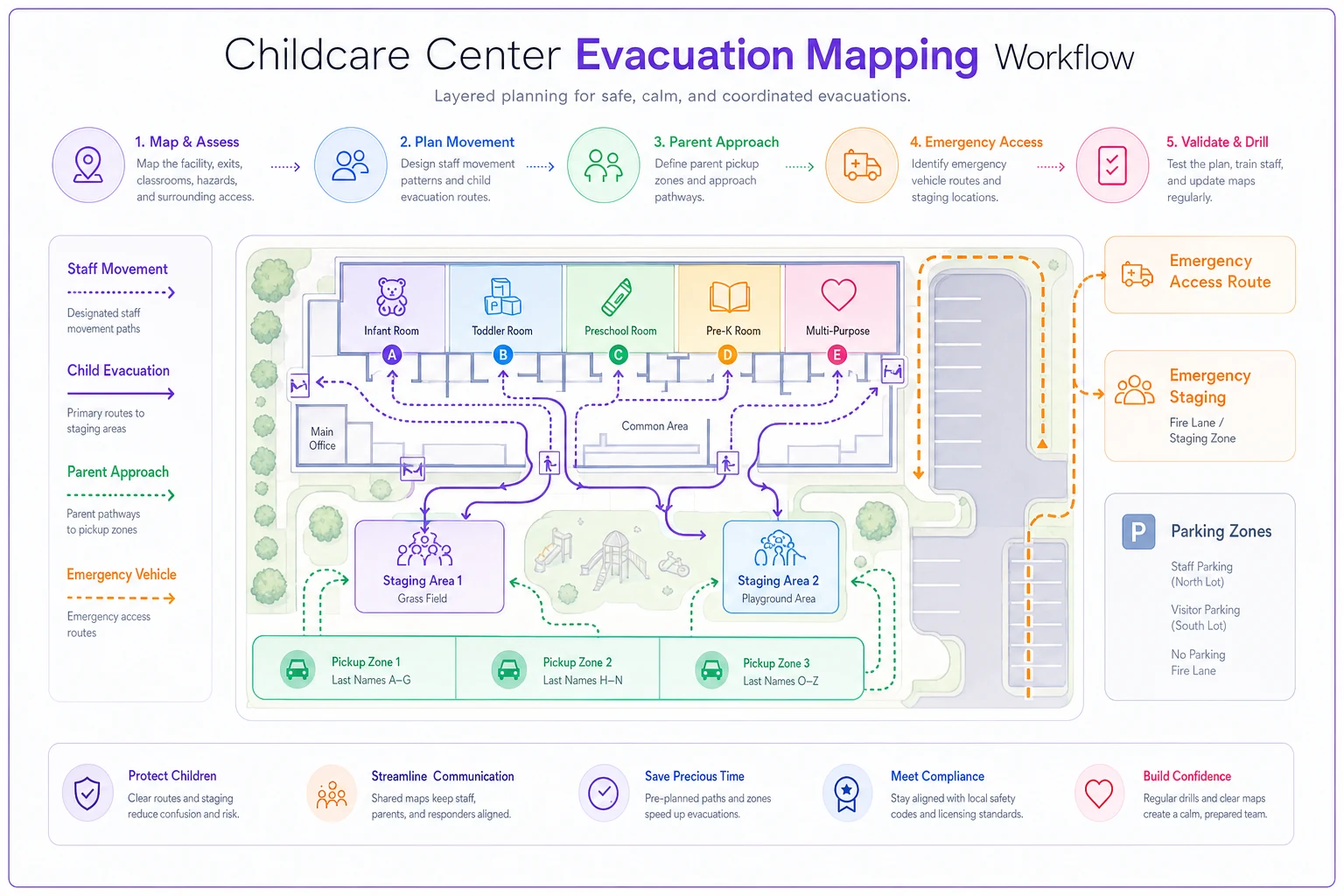
This map visualizes how the three layers interact during an evacuation.
Maps should be color-coded by classroom, laminated, and attached to evacuation backpacks. Digital copies are near-useless when cell towers are overloaded and nobody can load anything.
Building role cards that work when your assistant director is at Costco
Role assignments typically look like this:
-
Director
Incident Commander
-
Assistant Director
Parent Communication
-
Lead Teacher
Student Accounting
-
Support Staff
Supplies and First Aid
Fine, except your assistant director is at Costco buying snacks when the evacuation starts. Now what?
Effective role assignments use capability matching, not title matching. Instead of "Director does X," you need "Person with building keys and parent contact database access does X." That might be your director, your office manager, or your most senior teacher on shift.
A more realistic structure:
Red Badge (anyone with master keys):
-
Grab evacuation binder
-
Ensure all rooms cleared
-
Lock facility
-
Coordinate with first responders
Blue Badge (anyone with parent communication access):
-
Send staged messages
-
Update social media
-
Handle incoming calls
-
Document parent arrivals
Green Badge (teachers with current CPR):
-
Medical kit management
-
Injury assessment
-
Medication administration
-
Special needs support
Yellow Badge (any available staff):
-
Crowd control at staging areas
-
Clipboard management
-
Sibling coordination
-
Traffic direction
Assign backup capability leads on each shift and record them on the daily roster so roles transfer smoothly when people are absent.
Staff wear colored lanyards daily so everyone already knows their evacuation role before anything happens. When half your team is out sick, the remaining staff still know exactly what they're responsible for.
The staged messaging system that prevents parent panic
Blast texting "EVACUATION IN PROGRESS" to hundreds of parents simultaneously is asking for chaos. They'll flood your phone lines, race to the center, and create traffic hazards for emergency vehicles.
Staged messaging means different groups get different information at different times:
Stage 1 (0-5 minutes): Leadership notification Board members and key administrators get a simple "Evacuation initiated, updates following" message. They need awareness but shouldn't rush to the scene.
Stage 2 (5-10 minutes): Parent preparation "Non-emergency evacuation in progress. Children are safe and moving to [Location]. Reunification will begin at [Time]. Please DO NOT come to the center. Wait for reunification instructions."
Stage 3 (15-20 minutes): Reunification instructions
-
Infants
2:00-2:15
-
Toddlers
2:15-2:30
-
Preschool
2:30-2:45
-
Pre-K
2:45-3:00
Stage 4 (20+ minutes): Public communication Social media updates for extended family, media, and community members who'd otherwise clog communication channels.
This approach spreads arrivals across 60-90 minutes instead of everyone showing up in the first ten.
Why alphabet parking beats first-come chaos
A center in Phoenix tried something after their parking lot became impassable during a fire drill reunification. They assigned parking zones by last name, same concept as elementary school pickup lines.
A-F parks in the church lot G-L uses street parking on Maple M-R takes the bank parking across the street S-Z goes to the library lot one block over
Parents know exactly where to go without thinking. No circling, no double-parking, no abandoned vehicles blocking emergency access. The reunification team knows roughly where each family will approach from, which makes child release smoother.
Some centers add colored cones or flags marking each zone so parents can navigate from a distance. The whole setup costs maybe $100 in supplies and prevents genuine mayhem.
The reunification log that handles custody, medical, and legal requirements simultaneously
Generic sign-out sheets don't work during evacuations. You need documentation that proves who picked up each child, what time they left, whether authorization was verified, any medical incidents that occurred, and whether custody restrictions were honored.
Here's what an operational reunification log actually needs:
| Child Name | Classroom | Pickup Person | ID Verified | Time | Custody Flag | Medical Note | Staff Initial |
|---|---|---|---|---|---|---|---|
| Emma S. | Toddler 2 | Mom (Sarah S.) | Yes | 2:22pm | None | Inhaler given 2:15 | KM |
| Liam P. | Pre-K | Dad (John P.) | Yes | 2:47pm | See file* | None | BT |
| Olivia M. | Infant | Grandma (authorized) | Yes | 2:18pm | None | Formula needed | KM |
*Custody flags don't spell out restrictions publicly—they remind staff to check documentation before releasing the child.
The log travels in triplicate: one copy stays with the evacuation team, one goes to the director, one gets filed for licensing documentation. Some centers use carbonless forms, others pre-print and photocopy after.
Communication breakdown: when carriers fail and parents panic
Cell towers get overwhelmed during area-wide emergencies. Your carefully planned text messaging system becomes useless when networks can't handle the traffic.
Backup communication requires old-school thinking:
-
Physical signs at the evacuation site entrance
-
Bullhorns for crowd communication
-
Pre-printed parent letters in evacuation bags
-
Designated runners between staging areas
-
Ham radio operators (local emergency amateur radio clubs are more useful than people realize)
One center maintains a Facebook Live protocol where they stream updates even when individual messages won't send. Parents can watch the stream for information when calls and texts both fail.
The sibling problem everyone forgets until it happens
Jessica has a two-year-old in Toddler Room A and a four-year-old in Pre-K Room C. During evacuation, these kids end up in completely different staging areas with different teachers. Mom arrives and has to bounce between locations collecting both kids while holding up two separate lines.
Sibling coordination needs to happen during evacuation, not at reunification. Centers that handle this well use buddy systems—older siblings' teachers know who has younger siblings and manually group them once everyone reaches the safe zone. Takes an extra five minutes during evacuation and saves a lot of chaos at pickup.
Evacuation bags should include sibling lists by classroom. Teachers can quickly identify that Emma's younger brother is in Miss Janet's class and coordinate before parents arrive.
Measuring success beyond "everyone got home safe"
After your next evacuation drill, actually track these:
Time measurements:
-
Last child leaving building
target under 3 minutes
-
Arrival at safe zone
target under 8 minutes
-
First successful parent pickup
target under 20 minutes
-
Last parent pickup
target under 90 minutes
Quality indicators:
-
Parents who went to wrong location first
-
Custody documentation issues
-
Missing medications or supplies
-
Communication failures
-
Traffic incidents or near-misses
Staff performance:
-
Role cards properly executed
-
Evacuation bags complete and accessible
-
Headcounts matched at all checkpoints
-
Documentation properly completed
Centers doing this well run monthly tabletop exercises and quarterly full drills—not the state-minimum annual fire drill, but actual reunification practice with real participation.
When software helps prevent reunification chaos
The operational complexity of managing evacuation procedures while maintaining custody compliance and coordinating parent communication is genuinely a lot. It's why more centers are turning to childcare management platforms that include evacuation modules built specifically for this.
These systems keep real-time enrollment data, custody documentation, and parent contact information in cloud-based storage accessible from any device. During an evacuation, staff can pull up custody flags, medical needs, and authorized pickup lists from their phones instead of lugging paper binders through a parking lot.
AI-powered platforms can automate the staged messaging piece—knowing which parents to contact when, based on your predetermined arrival windows, without someone manually calling groups in alphabetical chunks. That's the kind of operational lift that actually matters when you're managing a live evacuation.
Digital reunification logs also remove a lot of risk. Staff can verify authorization, flag custody concerns, log timestamps, and create a clean audit trail that holds up to licensing reviews or legal challenges without scrambling through handwritten sheets afterward.
Some platforms integrate with local emergency management systems and can automatically notify fire departments of evacuation status while providing real-time headcounts to first responders.
It's not a replacement for good process—it's what makes consistent process actually executable under pressure.
Reunification is about process discipline, not hero moments
The Oklahoma director who quit after that tornado evacuation wasn't incompetent. She just relied on individuals making good decisions in the moment instead of systematic processes that don't require heroics. When hundreds of parents converge on your evacuation site, no amount of calm leadership substitutes for staged arrival times, pre-assigned parking zones, and custody-aware reunification logs.
Your next evacuation might be a drill, or it might be the real thing. Either way, parents will judge your entire operation based on those 90 minutes. The difference between smooth reunification and parking lot pandemonium comes down to preparation, documentation, and the discipline to follow processes when every instinct says just get these kids to their parents.
Start with fixing one piece. Maybe it's the alphabet parking zones. Maybe it's building custody flags into evacuation bags. Maybe it's switching from blast texts to staged messaging. Pick one, implement it before your next drill, and build from there.
The goal isn't perfection. It's avoiding the preventable disasters that turn evacuations into litigation, custody violations into lawsuits, and capable directors into career-change statistics.
Ready to elevate your childcare management?
Join hundreds of childcare providers using Totsyly to save time, improve communication, and grow their centers.