


Most childcare centers don't think of themselves as procurement operations. But by the time you're running a full-day program with 80 to 120 kids, you're quietly managing a small stack of vendor relationships: the food service company, the janitorial crew, the pest control contractor, the HVAC maintenance folks, the playground inspector, maybe a curriculum supplier and a diaper delivery service. Each one has a contract (or worse, doesn't), an invoice cycle, an insurance situation, and a performance level that either helps your day run smoothly or quietly makes it harder.
The problem is that vendor management in childcare almost never gets built as a system. It gets built as a pile of one-off decisions. Someone signed the food contract three directors ago. The cleaning company's certificate of insurance expired eight months back and nobody noticed. Invoices get approved because "that looks about right." And when something goes wrong — a food safety complaint, a slip-and-fall on a floor that wasn't cleaned to spec, a facilities vendor who disappears for two weeks — you find out how weak your governance actually was.
This is a walkthrough of how vendor governance breaks in real centers, and how to build controls that hold up as you grow. Keeping it focused on the two categories that cause the most operational pain: food and facilities. They're the ones tied most directly to safety, licensing, and daily operations.
Why vendor governance quietly falls apart in childcare
Here's the pattern almost every growing center follows.
At one site, vendor management lives in the director's head. She knows the food guy personally, she remembers when the pest contract renews, she eyeballs the janitorial invoice and knows if it's off. It works because one person is holding the whole picture.
Then a second site opens, or the director leaves, or enrollment jumps and she's suddenly buried in staffing and licensing. The informal system evaporates. Nobody at Site B knows the food vendor's terms. The new assistant director approves invoices she has no baseline for. And because there was never a written scorecard or a standard set of contract clauses, every vendor relationship runs on different, undocumented rules.
What we've seen across a lot of multi-site operators is that the failure isn't dramatic — it's slow leakage. A food vendor bills for 92 meals a day when your average daily attendance is 78. A facilities contract auto-renews at a 9% increase because nobody flagged the renewal window. A cleaning company's coverage lapses and you don't discover it until an incident forces you to pull their COI. None of these are catastrophes on their own. Together, over a couple of years, they add up to real money and real exposure.
The root cause is that childcare leaders are trained on child development and compliance, not procurement. Vendor governance defaults to "trust the relationship" instead of "trust the process." Relationships are great — but they don't survive turnover, and they definitely don't scale.
Start with the RFP, even a lightweight one
You don't need a corporate procurement department to run a decent vendor selection process. But you do need to stop choosing food and facilities vendors based on a single quote and a good phone call.
Simplify your childcare center’s daily operations.
Totsyly helps you manage enrollments, staff, and communications efficiently so you can focus on care.
- Streamlined enrollment & waitlist management
- Automated billing & payment tracking
- Staff scheduling & attendance monitoring
No credit card required
The point of an RFP in a small childcare operation isn't bureaucracy — it's forcing apples-to-apples comparison and surfacing the stuff vendors don't volunteer. A vendor who's cagey about their insurance limits or won't commit to response times during the sales process is telling you exactly how they'll behave once you've signed.
A practical RFP checklist tuned for childcare food and facilities vendors:
-
Scope specifics — For food
number of meals/snacks per day, dietary accommodation capacity (allergies, religious, texture-modified), CACFP compliance if you participate, delivery windows. For facilities: exact square footage, frequency of service, what's included vs. billed separately, after-hours availability.
-
Insurance and licensing — General liability limits, workers' comp confirmation, any professional or pollution liability relevant to the trade, plus proof of any trade licenses (food handler certs, pest applicator license, etc.).
-
Response and remediation times — How fast they respond to a problem, and what happens when they miss.
-
Staffing and background checks — Whether their people enter your building during operating hours, and whether they're background-checked. This matters enormously and gets overlooked constantly.
-
References from other childcare or school clients — Not restaurants or offices. Childcare has different rules and different stakes.
-
Pricing structure and escalation terms — Fixed vs. variable, what triggers increases, and the renewal/notice terms.
-
Termination and transition — How you exit, notice required, and what they'll do to hand off cleanly.
Get termination and transition terms agreed before signing so you don't get locked in when performance slips.
That last point is underrated. The easiest time to negotiate a clean exit is before you sign. A vendor who makes it painful to leave has leverage over you for the entire relationship.
The contract clauses that actually protect you
This is where childcare-specific governance diverges hard from generic small-business advice. Your vendors operate in a building full of children, and your licensing body and your insurer both care deeply about that. A handshake or a one-page service agreement doesn't cut it.
Below are the clauses that matter most, why they matter, and sample language you can adapt. Have your attorney review before using — this is a starting point, not legal advice.
| Clause | Why it matters in childcare | What to require |
|---|---|---|
| Insurance requirements | If a vendor's work causes harm, you want their coverage responding first, not yours. | Minimum limits, additional insured status, certificate on file before work begins |
| Indemnification | Shifts liability for the vendor's negligence back to the vendor. | Vendor indemnifies your center for claims arising from their work or personnel |
| Background checks & personnel | Anyone in a building with children needs to be vetted. | Vendor warrants all on-site personnel are background-checked per state childcare rules |
| Compliance with licensing | A food vendor's mistake can become your licensing violation. | Vendor agrees to comply with applicable childcare licensing and health codes |
| Service level standards | Gives you teeth when performance slips. | Defined response times and remedies for failure |
| Termination for cause | Lets you exit fast if safety is at risk. | Immediate termination right for safety/compliance breaches |
| Data & confidentiality | Some vendors touch enrollment or family info. | Confidentiality and, where relevant, data-handling obligations |
A few sample clauses to give you a sense of the language:
Insurance / Additional Insured: > "Vendor shall maintain Commercial General Liability insurance with limits of no less than $1,000,000 per occurrence and $2,000,000 aggregate, and shall name [Center Legal Name] as an additional insured. Vendor shall provide a Certificate of Insurance prior to commencing services and shall provide updated certificates upon renewal. Vendor shall notify Center in writing at least thirty (30) days prior to any cancellation or material reduction in coverage."
Indemnification: > "Vendor shall indemnify, defend, and hold harmless [Center Legal Name], its owners, officers, employees, and agents from any claims, damages, losses, or expenses, including reasonable attorneys' fees, arising out of or resulting from the negligent acts, omissions, or willful misconduct of Vendor or its personnel in the performance of this Agreement."
Personnel / Background Checks: > "Vendor warrants that all personnel assigned to perform services on Center premises during operating hours have completed background screening consistent with applicable state childcare licensing requirements. Vendor shall provide documentation of compliance upon request."
Termination for Cause: > "Center may terminate this Agreement immediately upon written notice if Vendor's performance creates a health or safety risk to children or staff, or if Vendor fails to maintain required insurance or licensing."
The single most common gap is the missing additional insured endorsement. Centers collect a certificate of insurance, feel covered, and never realize the certificate alone doesn't put them on the vendor's policy. The additional insured status is what actually pulls their coverage in front of yours when a claim hits.
Build a vendor scorecard tied to how the center actually runs
Contracts protect you legally. Scorecards keep vendors honest operationally. Most centers have neither, and they especially lack the second.
A vendor scorecard doesn't need to be fancy. It needs to be consistent and tied to metrics that reflect real operational impact — not vague satisfaction. The mistake people make is scoring vendors on "how nice are they" instead of "did they do what the contract says and did it affect our day."
A workable structure — score each vendor quarterly, 1–5 on each dimension:
-
On-time delivery within the contracted window
-
Meal count accuracy vs. attendance
-
Dietary/allergy accommodation accuracy (this one should carry extra weight)
-
Food quality and temperature at delivery
-
Responsiveness to issues and corrections
-
Documentation completeness (labels, CACFP paperwork if applicable)
For a facilities/janitorial vendor:
-
Task completion vs. the agreed checklist
-
Quality of work (spot-check a few areas weekly)
-
Reliability / no-show rate
-
Response time on urgent issues
-
Compliance items current (insurance, licenses, background checks)
-
Communication on schedule changes
The key thing: tie at least two scorecard dimensions directly to your operations KPIs. If your allergy-incident rate ticks up, your food vendor's accommodation-accuracy score should reflect it. If parents complain about bathroom cleanliness during tours — and tour experience affects enrollment — your janitorial score should capture that. When the scorecard connects to metrics leadership already watches, it stops being a chore and starts being a management tool.
A quarterly scorecard also transforms renewal conversations. Instead of "we feel like the service slipped," you walk in with two years of scored data showing meal-count accuracy dropped from 96% to 88%. That's a negotiation you can actually win.
Invoice reconciliation: where the money actually leaks
If contracts are the front door and scorecards are the ongoing check-in, invoice reconciliation is the part everyone skips — and it's where the quiet money loss happens.
The core problem is that childcare invoices, especially food, are usually variable. You're billed per meal, per delivery, per service visit. And the person approving the invoice rarely has the underlying operational data in front of them to check it. Invoices get approved on vibes.
-
Pull the source data. For food, that's daily attendance by classroom. For facilities, that's the service checklist or completion log.
-
Match invoice quantities to source data. Compare billed meals/visits against what actually happened, not against the roster or the contract's assumed frequency.
-
Flag variances above a threshold. Set a tolerance — anything more than 5% off triggers a closer look instead of scrutinizing every line.
-
Verify contract rates. Confirm the per-unit price matches the contract. Rate creep on renewals is common and easy to miss.
-
Check compliance status before payment. No current COI on file? That's a hold, not an approval.
-
Document the review. A simple approval note ("reconciled to attendance, variance 2%, approved") creates an audit trail.
The reconciliation problem connects directly to your broader financial controls. If you're already thinking about how money moves through the center — and you should be — it's worth reading how we frame that in the operational playbook for tuition, refunds, and forecasting. Vendor spend and revenue integrity are two sides of the same cash-management system.
Here's a simple visual of the reconciliation workflow.
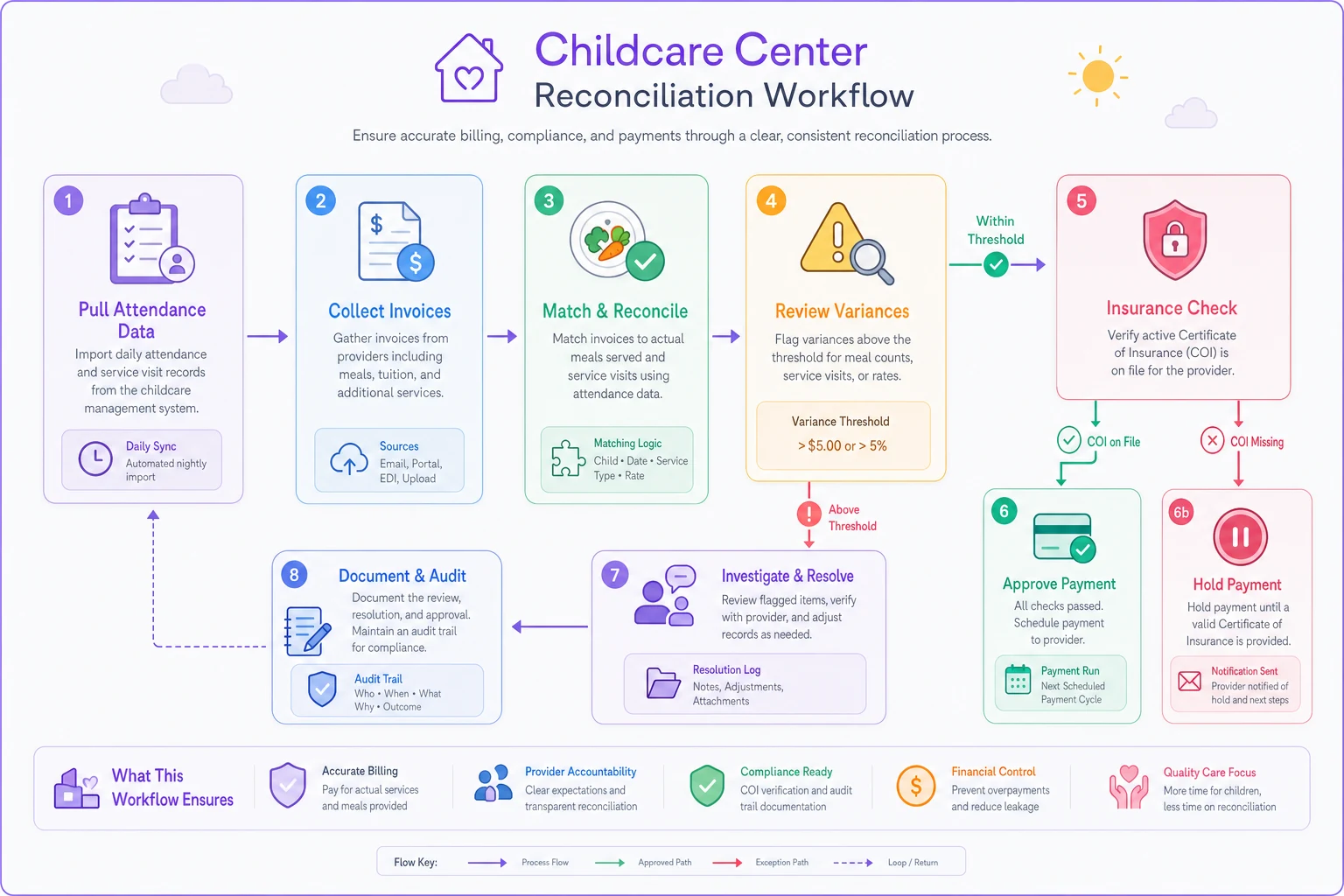
The reconciliation workflow that catches this without adding hours of admin:
What breaks specifically at scale
Everything above is manageable at one site with an engaged director. The interesting failures happen when you grow.
At two to three sites, the first thing that breaks is consistency. Site A negotiated great food terms; Site B is paying 12% more for the same vendor because a different person signed. No standard contract template means every location is a separate legal and financial reality. When you eventually try to consolidate vendors for volume pricing, you discover you can't even compare what you're currently paying.
The second thing that breaks is compliance tracking. One director can remember when the pest contract renews and when the COIs expire. Nobody can hold that in their head across five vendors times four sites — twenty relationships, each with renewal dates, insurance expirations, and background-check documentation. This is where centers get burned: a lapsed certificate discovered only after an incident, or an auto-renewal that locked in a price hike because the notice window passed silently.
The third is invoice review discipline. When one bookkeeper handles four sites, "reconcile every invoice against attendance" quietly becomes "approve if it looks reasonable." The controls that existed on paper stop happening in practice, precisely when the dollar volume is highest.
This is where centralizing vendor information into a real system stops being optional — not because software is magic, but because the human memory that ran your single-site vendor management doesn't scale to multi-site. AI-assisted operational platforms help here in a specific, unglamorous way: they can watch for renewal windows and expiring certificates and surface them before they become problems, and they can flag invoice variances against your attendance data automatically instead of relying on a tired bookkeeper to catch a 6% overbill buried on line 14. The value isn't flashy automation — it's that the controls actually run every time instead of only when someone remembers.
If you're already consolidating systems across sites, think about vendor data as part of that larger picture. The same care that goes into a clean technology migration applies to centralizing contracts, COIs, and vendor performance history — get it structured once, and you stop re-solving the same governance gaps at every new location.
A real scenario
A three-site preschool operator — roughly 240 kids total — brought in a new operations lead who noticed the food and janitorial spend didn't line up between sites. No standard contract, no scorecard, and invoices approved by three different admins on gut feel.
Over about a quarter, the team did three things: built one standard vendor agreement with proper insurance and indemnity clauses, started reconciling food invoices against daily attendance, and put every COI and renewal date into a single tracked calendar.
The reconciliation alone surfaced consistent overbilling on meal counts at two of the three sites — invoices were built off enrollment, not attendance. Correcting that saved somewhere in the range of $9k–$12k annually. They also caught a janitorial contract about to auto-renew at an increase and renegotiated it flat. Two vendors had insurance that had lapsed without anyone knowing — a gap that could have been genuinely dangerous if an incident had occurred first.
Nothing about it was dramatic. No single fix was a game-changer. But the combination turned vendor management from a blind spot into a controlled part of operations, and it paid for the effort several times over in the first year.
When to formalize this — and when not to
If you're a single small center under 40 kids with two well-established vendors, a full RFP process every renewal is overkill. What you do need even at that size: proper insurance and indemnity clauses on file, and a basic attendance-vs-invoice check on your food billing. Skip the quarterly scorecard ceremony; just keep the certificates current and the contracts real.
Formalize the whole system — RFPs, scorecards, structured reconciliation, centralized tracking — when you hit any of these:
-
More than one site, or a second site on the horizon
-
Vendor spend on food and facilities exceeding a few thousand a month
-
Turnover in the person who "just knows" the vendor relationships
-
A licensing or insurance scare that exposed a documentation gap
Who should not over-engineer this: a tiny in-home or micro-center where the owner is on-site daily and personally handles everything. Adding heavy process there creates friction without meaningful risk reduction. Governance should scale to your actual exposure, not to a template.
Bringing it together
Vendor governance in childcare isn't really about vendors — it's about whether your center runs on documented processes or on one person's memory. Food and facilities are the categories where that distinction has the highest stakes, because a weak contract or an unreviewed invoice translates directly into safety exposure and quiet financial leakage.
The centers that handle this well don't treat contracts, scorecards, and invoice reconciliation as three separate chores. They treat them as one connected system: you select vendors with a real process, you bind them with clauses that actually protect the building, you measure them against the KPIs you already care about, and you reconcile what they bill against what actually happened. Each piece reinforces the others. And when you grow, that system is what lets you add a fourth or fifth site without discovering six months later that a certificate lapsed or a vendor has been overbilling you the whole time.
Ready to elevate your childcare management?
Join hundreds of childcare providers using Totsyly to save time, improve communication, and grow their centers.