

Most centers don't fail at incident communication because they don't care. They fail because the decision gets made under pressure, by whoever happens to be holding the phone, with no shared understanding of what "honest" actually requires in that moment. A toddler bites another toddler. A classroom gets evacuated for a gas smell. A staff member notices a bruise that wasn't there at drop-off. Each of these pulls three forces in different directions at once: the ethical duty to be open with families, the legal exposure that comes from saying too much, and the privacy rights of every other child and family touched by the event.
When those three forces collide without a framework, you get the two failure modes that cause almost all the damage. Either the center over-shares and creates liability it didn't need to, or it under-shares and families find out through the parking lot grapevine — which is worse than any honest disclosure would have been. The goal here isn't a script. It's a decision structure that makes the right call repeatable no matter who's on shift.
The real problem isn't the incident — it's the window
The ethical quality of an incident communication is determined almost entirely in the first 90 minutes, before anyone has had time to think clearly. That's the window when administrators feel maximum pressure to either say something reassuring (and risk being wrong) or say nothing (and risk looking like they're hiding).
This is where good centers quietly dig their own holes. A director gets a call at 2:15 about a playground fall. By 2:30 she's texted the parent "he's totally fine, just a little bump" — before the full extent is known. At 4:00 the child's wrist is clearly swollen and the family is now re-reading that "totally fine" text as either incompetence or a cover-up. Nothing was hidden. But the timing of the certainty created the breach of trust.
The ethical principle underneath this is simple but rarely operationalized: communicate what you know, when you know it, at the confidence level you actually have. The problem is that "confidence level" is a judgment call, and judgment calls made by stressed humans without a tier structure drift wildly from person to person.
Three principles that should govern every disclosure
Before any decision tree, staff need a shared ethical spine. These aren't abstract values — each one translates into a concrete communication behavior.
Simplify your childcare center’s daily operations.
Totsyly helps you manage enrollments, staff, and communications efficiently so you can focus on care.
- Streamlined enrollment & waitlist management
- Automated billing & payment tracking
- Staff scheduling & attendance monitoring
No credit card required
-
Proportional transparency. The depth of disclosure should match the severity and the family's direct stake. The parent of the injured child gets everything. The parents of witnessing children get far less. The whole-classroom email gets less still. Over-disclosure to uninvolved families is itself an ethical failure because it exposes other children's information.
-
Privacy symmetry. You cannot name, describe, or implicitly identify another child in any communication — ever. This sounds obvious until you realize how often "the other child involved" leaks through context ("the boy who sits next to Mia"). Symmetry means every family gets the same privacy protection you'd want for your own.
-
Honest uncertainty. It is more trustworthy to say "we don't yet know the full extent and we'll update you by 5pm" than to project false calm. Naming what you don't know is a transparency behavior, not a weakness.
Centers that get incident communication right treat these three as non-negotiable constraints the messaging has to satisfy — not nice-to-haves. Everything downstream is just applying them consistently.
The decision tree: who hears what, when
Most communication disasters come from sending the wrong depth of information to the wrong audience at the wrong time. A simple branching logic prevents most of it.
Step 1 — Severity classification (within 15 minutes). Before deciding anything about messaging, classify the incident:
-
Tier 1 — Minor small bumps, scrapes, brief emotional upset. No medical attention beyond first aid.
-
Tier 2 — Moderate anything requiring more than basic first aid, a bite that breaks skin, a fall with uncertain extent, a ratio lapse, a medication timing error.
-
Tier 3 — Serious / reportable injuries needing outside medical care, any suspected abuse or neglect, elopement, evacuation events, or anything triggering a licensing report.
Step 2 — Determine the affected-family map. For the classified tier, identify three audiences: the directly involved family, adjacently involved families (witnesses, same incident scene), and the broader community (classroom or center-wide). Most incidents only require the first.
Step 3 — Set the timing obligation. This is where tiers drive the clock:
| Tier | Directly involved family | Adjacent families | Broader community | Internal/licensing |
|---|---|---|---|---|
| Tier 1 | At pickup, verbal + written note | Not notified | Not notified | Logged same day |
| Tier 2 | Within ~1 hour, phone call | Only if directly affected | Only if operationally relevant | Director notified immediately; written report same day |
| Tier 3 | Immediately, by phone | Factual, privacy-safe notice same day | Same-day written communication | Licensing per state timeline; counsel looped before broad messaging |
The table isn't the point — the routing discipline is. The mistake that comes up most often is a Tier 1 bump getting a center-wide email (over-disclosure, panic, privacy drift) or a Tier 3 event getting handled like a Tier 1 ("we'll mention it at pickup").
A quick visual of the routing and timing helps.
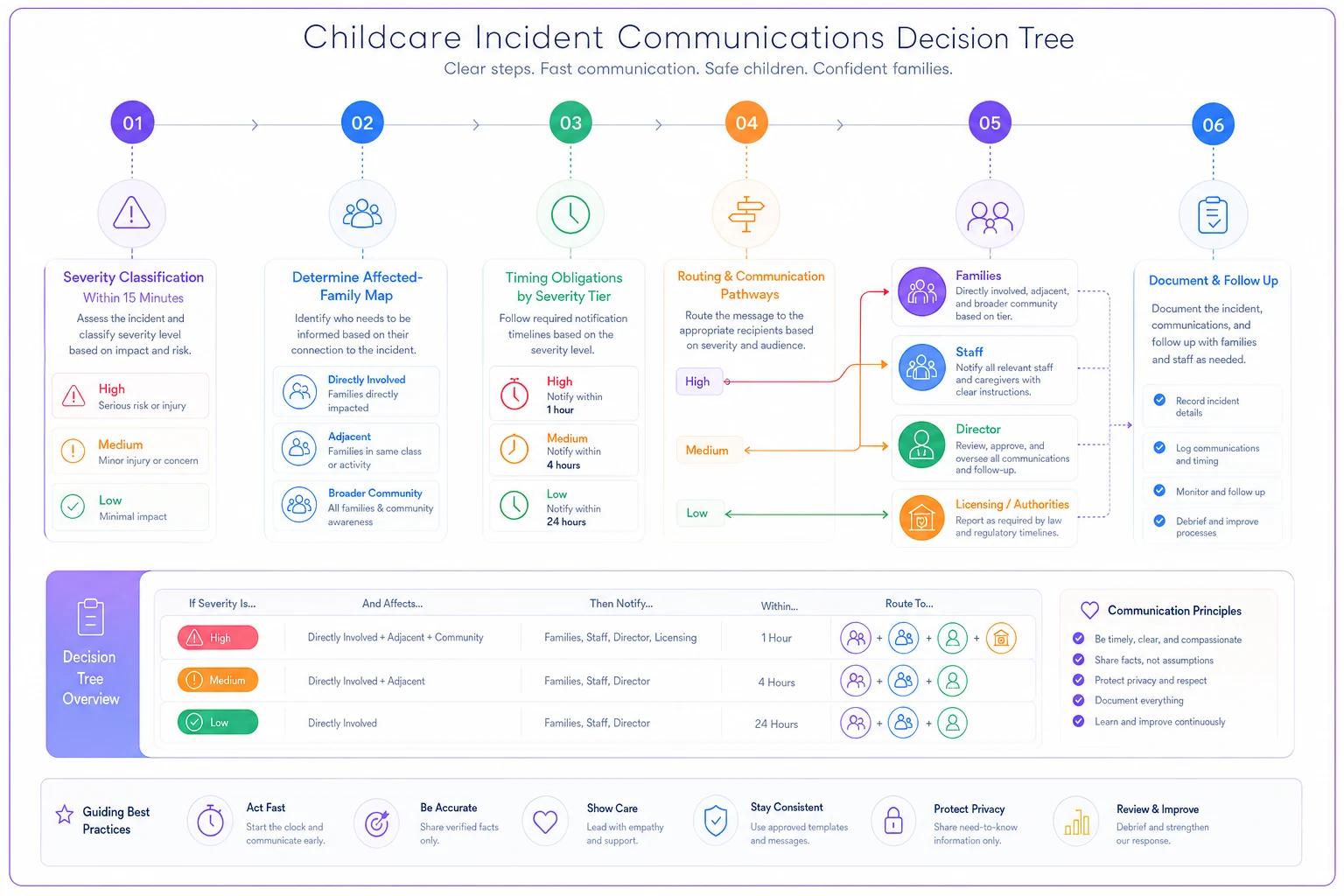
The classification step is what prevents both.
What goes *in* the message — and what never does
Timing solves half the problem. Content solves the other half. The ethical and legal lines run through the same sentences, which is why pre-approved templates matter so much — they let staff communicate under stress without improvising their way into liability or a privacy breach.
-
What happened — factual, observable, no speculation about cause or fault.
-
What we did — the specific response and care provided.
-
Current status — honest, including what remains uncertain.
-
What happens next — follow-up, timeline for updates, who they can reach.
-
Documentation reference — that a written incident report exists and how to access it.
Notice what's missing: no apology that admits fault, no theory of how it happened, no reference to any other child, no editorializing. "Ethan was climbing and fell from the second rung; staff applied ice and monitored him; his left wrist is swollen and we recommend you have it checked" is both completely honest and liability-aware. "We're so sorry, Ethan shouldn't have been up there, the aide wasn't watching" is honest in spirit but creates exposure and assigns blame before any review.
The never-list
Keep this visible wherever incident decisions get made:
-
Never name or describe another child involved.
-
Never speculate on cause or assign fault in the initial communication.
-
Never promise an outcome you don't control ("he'll be fine").
-
Never communicate a Tier 2+ event by text alone — voice first, writing second.
-
Never send center-wide messaging on a serious incident before leadership and, when relevant, counsel have reviewed it.
This content discipline connects directly to the broader parent-facing incident communications protocol with legal-aligned messaging templates — the templates there give you the exact language slots so staff aren't drafting from scratch at the worst possible moment.
Governance checkpoints: who has authority to speak
Unclear authority is the single most common structural weakness. When everyone can communicate, no one owns consistency. When only the director can communicate, Tier 1 bumps wait hours for a response they never needed.
-
Tier 1 classroom lead handles it directly, using the standard pickup note. No approval needed.
-
Tier 2 director or designated manager makes the family call. Lead teacher drafts the written report; director reviews before it's shared.
-
Tier 3 director owns all external communication. No staff member communicates independently. Broad messaging passes a two-person review — typically director plus owner or counsel.
Keep laminated authorization cards with the tier rules and phone scripts so deputized staff can act quickly and correctly.
The checkpoint most centers skip is the pre-communication pause on Tier 3 — a mandatory 20-to-30-minute hold before any community-wide message goes out, used to confirm facts, verify privacy symmetry, and align the written and verbal versions. That short pause prevents the contradictory-messages problem where the phone call says one thing and the email says another.
This authority structure sits inside your wider childcare risk-management framework for incidents, insurance, and liability controls — communication authority and insurance/liability posture have to be designed together, not bolted on after an event.
When over-communicating is actually the mistake
There's a cultural belief in a lot of centers that "more transparency is always more ethical." It isn't. Proportional transparency means that broadcasting incident details to families who have no direct stake is a privacy failure dressed up as openness.
When broad communication makes sense: operational events that affect everyone — an evacuation, a facility closure, an exposure situation where other families genuinely need to act. Here, silence is the ethical failure.
When it's a bad idea: a single-child injury, a conflict between two children, a staff conduct matter under review. Pulling the whole community into these does nothing but expose private information and manufacture anxiety.
Who should NOT be making these calls solo: a new assistant director in their first few months, or any staff member during an active, still-unfolding Tier 3 event. These are exactly the moments where the tier structure and authority checkpoints exist to carry the weight so a single stressed judgment doesn't define the center's integrity.
A real scenario
A mid-sized preschool — roughly 90 kids, three sites under one owner — had a pattern where incident calls went out inconsistently depending on which director was on duty. One site over-emailed; another under-communicated and kept getting complaints that families "found out from other parents." Over about a term, they logged around 40 reportable-enough-to-notify incidents, and roughly a quarter generated a secondary complaint about the communication itself, not the incident.
They implemented the tier classification, the audience-routing table, and the three governance checkpoints — no new technology at first, just laminated cards and a 45-minute staff training. Over the following few months, communication-related complaints dropped to a couple of isolated cases, both traced to a staff member skipping the classification step. The incidents didn't decrease. The second injury — the trust damage from bad communication — mostly disappeared. That's the real return.
Where this connects to the rest of your operation
Incident communication doesn't live in isolation. The same decision discipline governs how you'd handle a data exposure, which is why this framework sits naturally alongside an operations-first data-breach playbook — a breach is just an incident with a different subject, and the timing/content/authority logic maps almost one-to-one.
As centers scale from one site to several, the informal "the director just knows how to handle it" approach breaks completely. What was tribal knowledge in a single location becomes an inconsistency problem across sites, and inconsistency is what regulators and plaintiffs' attorneys notice. This is the stage where centralizing your incident logs, templates, and tier definitions in a shared operational system stops being a convenience and becomes a governance requirement — so every site classifies the same event the same way and the right people are looped in automatically rather than by memory.
The framework's whole purpose is to take the hardest communication decisions in your operation and make them boring — predictable, consistent, and defensible. When a family is upset and a clock is running, you don't want creativity. You want the structure to have already decided who speaks, when, to whom, and with what words, so the only thing left to do is tell the truth carefully.
Ready to elevate your childcare management?
Join hundreds of childcare providers using Totsyly to save time, improve communication, and grow their centers.