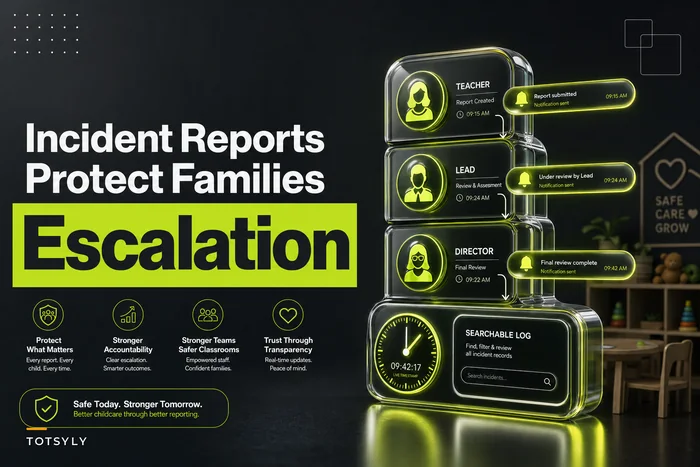

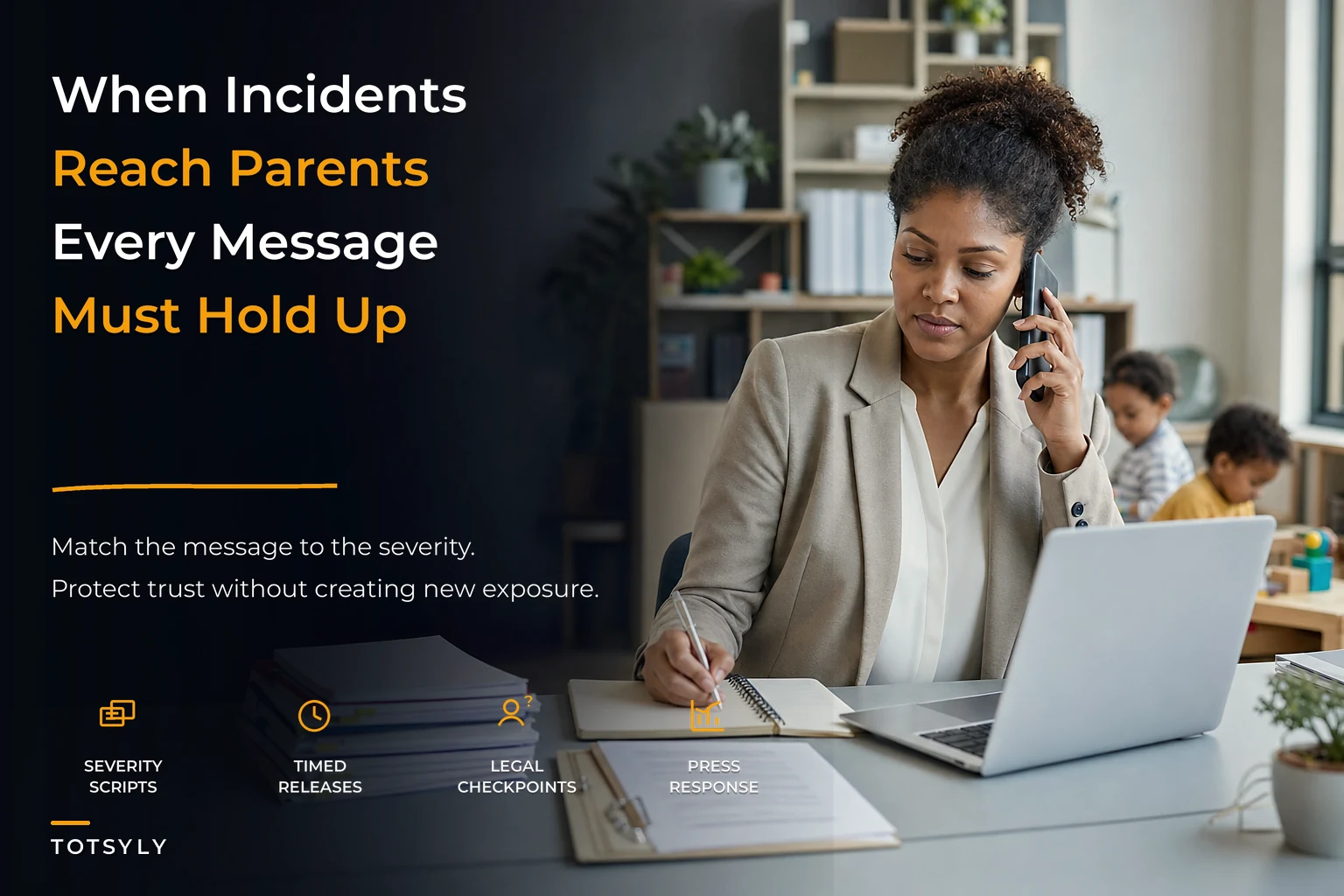

The gap most centers don't notice until it hurts them isn't in how they document incidents. It's in how they talk about them afterward. You can have flawless incident reports and still torch a family relationship — or hand a lawyer ammunition — with a poorly worded text message sent by a director at 5:47 PM while trying to close for the day.
That's the real weak point. The moment between "something happened" and "here's what we're telling families" is almost always improvised. And improvised communication under stress is where reputational damage and legal exposure both live.
This is about building the layer that sits on top of your documentation: a childcare incident communications protocol that decides who gets told what, when, and in what tone — based on how serious the incident actually is. Not one message template for everything. A tiered system.
Why one-size messaging quietly fails
Most centers have exactly two communication modes: the casual "just so you know, Mason bumped his head today" handoff at pickup, and full crisis mode when something serious happens. Nothing in between.
The problem is that incidents don't come in two flavors. They come in a spectrum, and the middle of that spectrum is where centers get burned. A minor bite gets over-explained and scares a parent into thinking their kid is unsafe. A moderate injury gets under-communicated and the parent finds out the full picture at urgent care that evening — now they feel misled. Same center, same staff, two opposite failures, both from not calibrating the message to the situation.
What tends to happen is that the tone of the first message sets the entire trajectory of the parent's reaction. A calm, specific, appropriately-scaled notification keeps things calm. A vague message that doesn't match what the parent later learns creates suspicion — and suspicion is what turns an incident into a complaint, and a complaint into a licensing call or an attorney's letter.
The other failure is inconsistency across staff. When five different teachers write incident messages in five different voices, you've lost control of your legal position. One says "we're so sorry, we should have been watching more closely" — that's an admission. Another says "these things happen" — dismissive. A third over-shares clinical detail she isn't qualified to give. Each one creates exposure, and none of them meant any harm.
Severity tiers: the backbone of the whole system
Before you write a single template, you need a shared definition of severity. Not a vibe — a written classification everyone uses the same way.
Simplify your childcare center’s daily operations.
Totsyly helps you manage enrollments, staff, and communications efficiently so you can focus on care.
- Streamlined enrollment & waitlist management
- Automated billing & payment tracking
- Staff scheduling & attendance monitoring
No credit card required
Here's the structure that holds up well in real operations:
| Tier | Example incidents | Who's notified | Timing | Approval needed |
|---|---|---|---|---|
| Tier 1 – Minor | Small bump, minor scratch, mild behavioral moment, brief separation distress | Affected child's parent only | At pickup or same-day message | Lead teacher can send |
| Tier 2 – Moderate | Injury needing first aid, a bite that broke skin, a fall being monitored, minor illness onset | Affected parent(s), director notified | Within 1–2 hours, before pickup | Director reviews before send |
| Tier 3 – Serious | Head injury, possible fracture, allergic reaction, injury requiring outside medical care | Affected parent(s) immediately by phone, director leads | Immediately, phone first | Director + written follow-up |
| Tier 4 – Critical / multi-family | Evacuation, exposure event, injury involving multiple children, anything media-worthy or reportable to licensing | All affected families, staff, possibly all families, licensing | Immediate, coordinated | Owner/legal review before external messaging |
The value here isn't the table itself — it's that everyone at the center agrees in advance what tier something falls into. When staff don't have to decide "is this a big deal?" under pressure, they stop under- and over-reacting. The classification does that work for them.
One pattern worth naming specifically: centers consistently misclassify head injuries as Tier 2 because the child "seemed fine." Any head impact should default to Tier 3 for communication purposes. The medical picture can change hours later, and you want documentation showing the parent received a phone call — not a casual note tucked into their pickup folder.
Pre-approved parent notifications (so nobody drafts under pressure)
The core principle: staff should almost never write incident communications from scratch. They should be selecting and completing pre-approved templates that leadership has already vetted.
When a teacher writes freehand after a stressful incident, three things go wrong at once — she's rushed, emotionally rattled, and untrained in liability language. Pre-approved templates remove all three problems. The teacher's only job becomes filling in the specific facts.
A Tier 1 template might read:
> "Hi [Parent], quick update on [Child]'s day. During [activity], [he/she] had a minor [scratch/bump] on [location]. We cleaned it and [Child] was comfortable and back to playing shortly after. No action needed on your end — just wanted you to know. Happy to chat at pickup."
Notice what it does and doesn't do. It states facts. It doesn't apologize excessively, doesn't speculate on cause, doesn't make promises. Warm without being defensive.
A Tier 2 template shifts in tone and adds structure:
> "Hi [Parent], I want to let you know about something that happened this afternoon before you arrive for pickup. [Child] [what happened] at approximately [time]. Our staff responded by [action taken]. [Child] is [current status]. We've documented everything and [Director name] is available if you'd like to talk through it. Please let us know if you have any questions."
The building blocks that belong in every moderate-and-above template:
-
What happened, in plain factual language
-
When it happened (approximate time is fine)
-
What staff did in response
-
The child's current condition
-
A named point of contact
-
An open invitation to talk
What deliberately does not belong in written notifications: fault, speculation about how it could have been prevented, medical diagnoses staff aren't licensed to make, or the names of other children involved.
For serious tiers, the first contact should be a phone call — and the written version follows after to confirm what was discussed. This sequencing matters legally. A written record that says "as we discussed by phone at 3:15 PM" is far stronger than a text message a parent claims they never saw. The documentation side of this connects directly to your broader end-to-end incident workflow that protects families and limits liability — the communication layer only works if it's pulling from clean, timestamped facts.
The legal-alignment checklist
Before any Tier 3 or Tier 4 message goes out externally, it should pass a short review. This isn't bureaucracy — it's the difference between a message that closes an incident and one that opens a lawsuit.
-
[ ] Does the message state facts only, with no admissions of fault or negligence?
-
[ ] Have we avoided the words "sorry we didn't," "should have," "our mistake," or "negligent"?
-
[ ] Is every claim about the child's condition something we can actually verify?
-
[ ] Have we avoided naming or describing any other child involved?
-
[ ] Does it identify a single point of contact instead of multiple voices?
-
[ ] Is the timing documented — when we called, when we sent?
-
[ ] For reportable incidents, has licensing notification been handled separately and correctly?
-
[ ] Has the appropriate approver (director/owner) signed off before it went out?
One nuance people consistently miss: expressing care is not the same as admitting fault. "We're so sorry this happened and we understand how upsetting this is" is empathetic and legally safe. "We're so sorry, we should have caught this sooner" is an admission. Train staff on that exact distinction, because their instinct under stress is to soften with self-blame — and self-blame is precisely what creates exposure.
Press inquiry protocols (yes, even small centers need this)
Most administrators assume media contact is a big-city, big-chain problem. Then a Tier 4 incident happens, a parent posts in a local Facebook group, a reporter sees it, and suddenly someone with no training is holding the front desk phone with a journalist on the other end.
The single most important rule: no staff member speaks to media, ever, except one designated person. Every other staffer's script is one sentence: "I'm not able to speak to that — let me take your name and number and have our director follow up." That's it. That one sentence prevents the vast majority of media damage, because the damage almost always comes from an untrained person saying something quotable in the wrong direction.
> "The safety of the children in our care is our highest priority. We are aware of the situation, are cooperating fully with the appropriate authorities, and have been in direct contact with the affected family. Out of respect for the privacy of the children and families involved, we won't be sharing further details publicly."
That statement buys time, signals responsibility, and shares nothing that can be weaponized. It's deliberately boring — and boring is exactly right in a press context.
One practical thing to avoid: never let "no comment" be the answer. It reads as guilt. The holding statement is your no-comment — it just sounds cooperative instead of evasive.
Timing: the part everyone gets wrong
Getting the message right doesn't matter much if it arrives after a parent has already pieced things together on their own. The most common trust-breaker isn't a badly written notification — it's a parent learning about something after they've picked up their child and gone home.
The sequencing that holds up in practice:
-
Stabilize and document first. No communication goes out until the child is safe and someone has captured the basic facts. A message sent before you have the story straight forces corrections later, and corrections destroy trust faster than almost anything else.
-
Classify the tier using your written definitions.
-
Notify at the tier-appropriate speed. Tier 1 can wait for pickup. Tier 2 must reach the parent before pickup. Tier 3 and 4 are immediate phone calls.
-
Confirm receipt. For Tier 2 and above, you need to know the parent actually saw it. A read receipt or a callback matters.
-
Follow up in writing after any phone conversation to lock in the record.
-
Debrief internally so the same incident type goes more smoothly next time.
The hidden cost of getting timing wrong shows up weeks later. A parent who found out late tells a few other parents. Those parents start reading every future notification with suspicion. Your communication credibility is a bank account, and late notifications are withdrawals that are hard to put back.
Staff and parent Q&A scripts
After a Tier 3+ incident, staff will get cornered — at pickup, in the parking lot, in the group chat. Without scripts, they either say too much or freeze and look evasive. Both are bad.
-
When asked for details they shouldn't share "I want to make sure you get accurate information, so [Director] is the right person for those details — let me connect you."
-
When asked about another child "I'm not able to share anything about other children, but I completely understand wanting to know your own child is safe, and I can help with that."
-
When a parent is visibly upset "I hear you, and this is really important. Let me get [Director] so we can give you the full picture and the time this deserves."
For the director's Q&A, prepare honest answers to the predictable questions: What exactly happened? Was my child supervised? What are you changing? That last one is worth thinking through carefully. The answer should be forward-looking without conceding past fault: "We've reviewed exactly what happened and here's the adjustment we're making going forward."
A real scenario
A two-classroom preschool with around 55 enrolled kids had a Tier 3 situation — a fall on the playground that turned out to be a hairline fracture. The teacher, meaning well, texted the parent immediately: "So sorry, [Child] fell and I feel terrible, we should've had someone closer to the climber." The parent went straight from worried to angry, mentioned the message to a lawyer, and the center spent several weeks and a chunk of legal fees managing a situation that a factual first message would have contained.
After that, they built a tiered protocol — classifications, pre-approved templates, a legal checklist for Tier 3+, and a one-line media deflection script. The next serious incident, roughly four months later, was handled with a phone call from the director first, a factual written follow-up, and a calm in-person conversation at pickup. The family stayed enrolled. The director's reflection afterward was basically: same severity, completely different outcome, because nobody was improvising.
That's the whole point. The injury you can't always prevent. The communication failure you absolutely can.
When this level of structure makes sense — and when it's overkill
Build the full tiered system if: you have more than one classroom, multiple staff members who might be first to communicate, or you've had even one incident that got tense. Once more than a couple of people are capable of sending a parent message, inconsistency becomes your biggest risk.
A lighter version is fine if: you're running a very small home-based program where the owner personally handles every parent communication. You still want the legal-alignment checklist and the media deflection line, but you probably don't need elaborate delegation rules.
Who should not skip this entirely: any center in a competitive local market where reputation drives enrollment, and any multi-site operation. At scale, the failure isn't one bad message — it's a dozen directors each communicating differently, so a family at one location gets a wildly different experience than a family at another. Multi-site operators especially need shared templates and tier definitions, because your brand's trustworthiness is only as strong as your least-careful location.
Where this connects to the rest of your operations
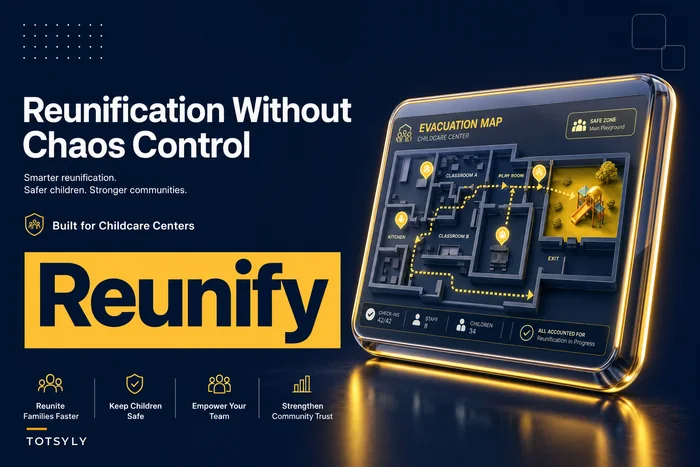
This protocol doesn't stand alone. It sits on top of your documentation and alongside your emergency procedures. A Tier 4 event — an evacuation, for example — needs both the staged, coordinated family messaging in your reunification and staged parent messaging plan and the media and legal layer described here. The two work together: reunification handles the logistics of getting kids back to families safely; the communications protocol handles what you say to families, staff, and the public around it.
Here's a quick visual of the workflow the communication layer should follow.
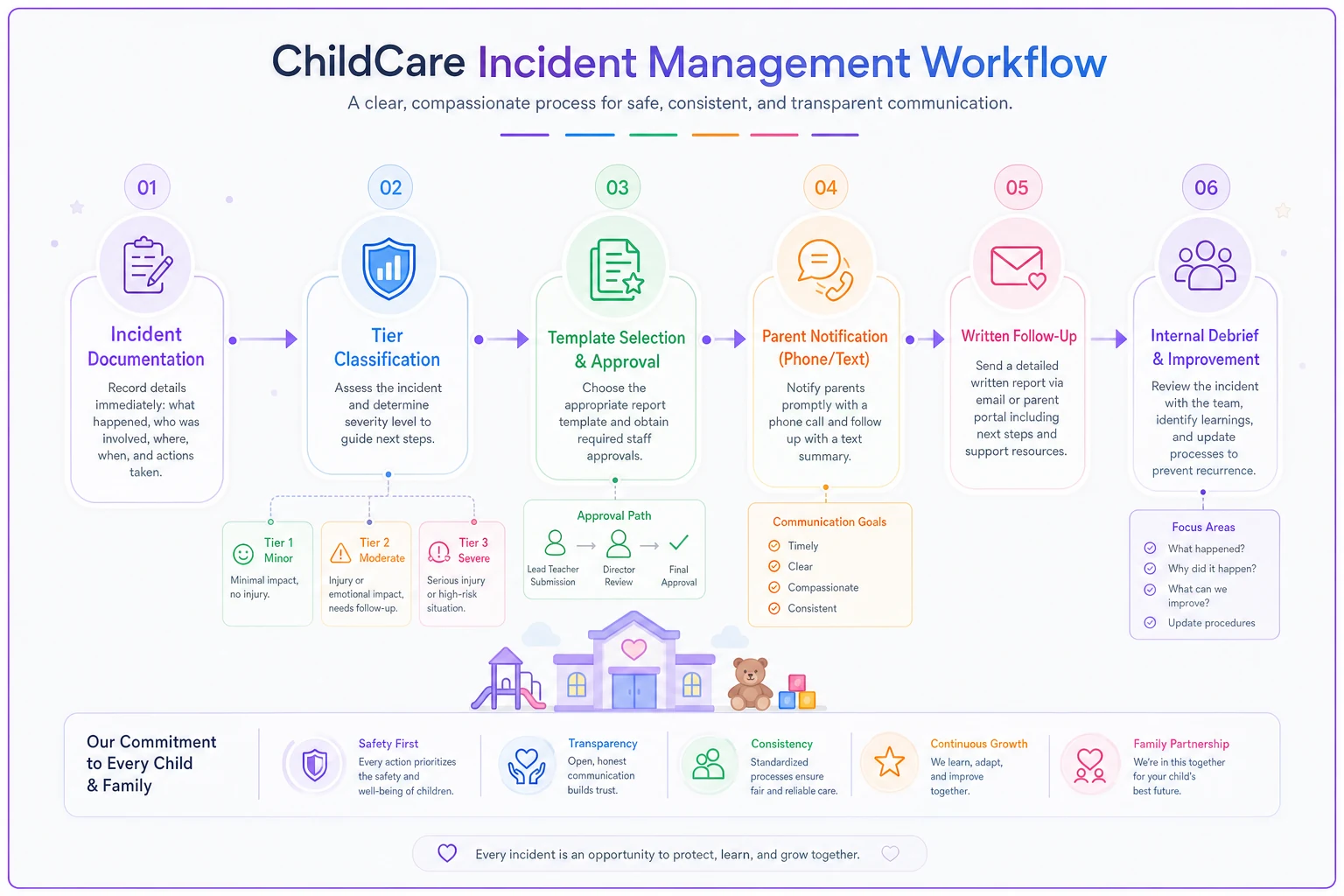
Where centralized systems genuinely help is keeping all of this consistent under stress. When your incident documentation, tier classifications, and pre-approved templates live in one place — instead of scattered across a teacher's phone, a director's memory, and a printed binder nobody can locate during an emergency — the right message gets to the right family at the right speed without anyone drafting from scratch. That's the difference between a protocol that exists on paper and one that actually holds up on the worst day.
Closing thought
The centers that come through incidents with their reputations and legal standing intact aren't the ones that never have incidents. They're the ones who decided, calmly and in advance, exactly what they'd say and who'd say it. Improvisation feels caring in the moment and reads as chaos afterward. A tiered communications protocol takes the hardest decisions off the table — what to say, to whom, how fast — by making them before the pressure hits, so your staff are executing a plan instead of guessing. Build it now, while nothing's on fire. That's the only time you can build it well.
Ready to elevate your childcare management?
Join hundreds of childcare providers using Totsyly to save time, improve communication, and grow their centers.