

Somewhere between 20% and 35% of consent forms are still "pending" a full week after a child's first day. Photo release, field trip authorization, medical consent, sunscreen, water play, emergency pickup — the list is long, and parents treat it roughly like the terms-and-conditions box nobody reads.
The problem isn't that parents don't care. It's that most centers ask for consent at the worst possible moments, in the wrong format, with no real confirmation that the person signing is actually the authorized guardian. And when consent is incomplete, you're exposed — a child can't go on the field trip, can't be photographed for the newsletter, and in a worst case, you've got a legal gap during an actual emergency.
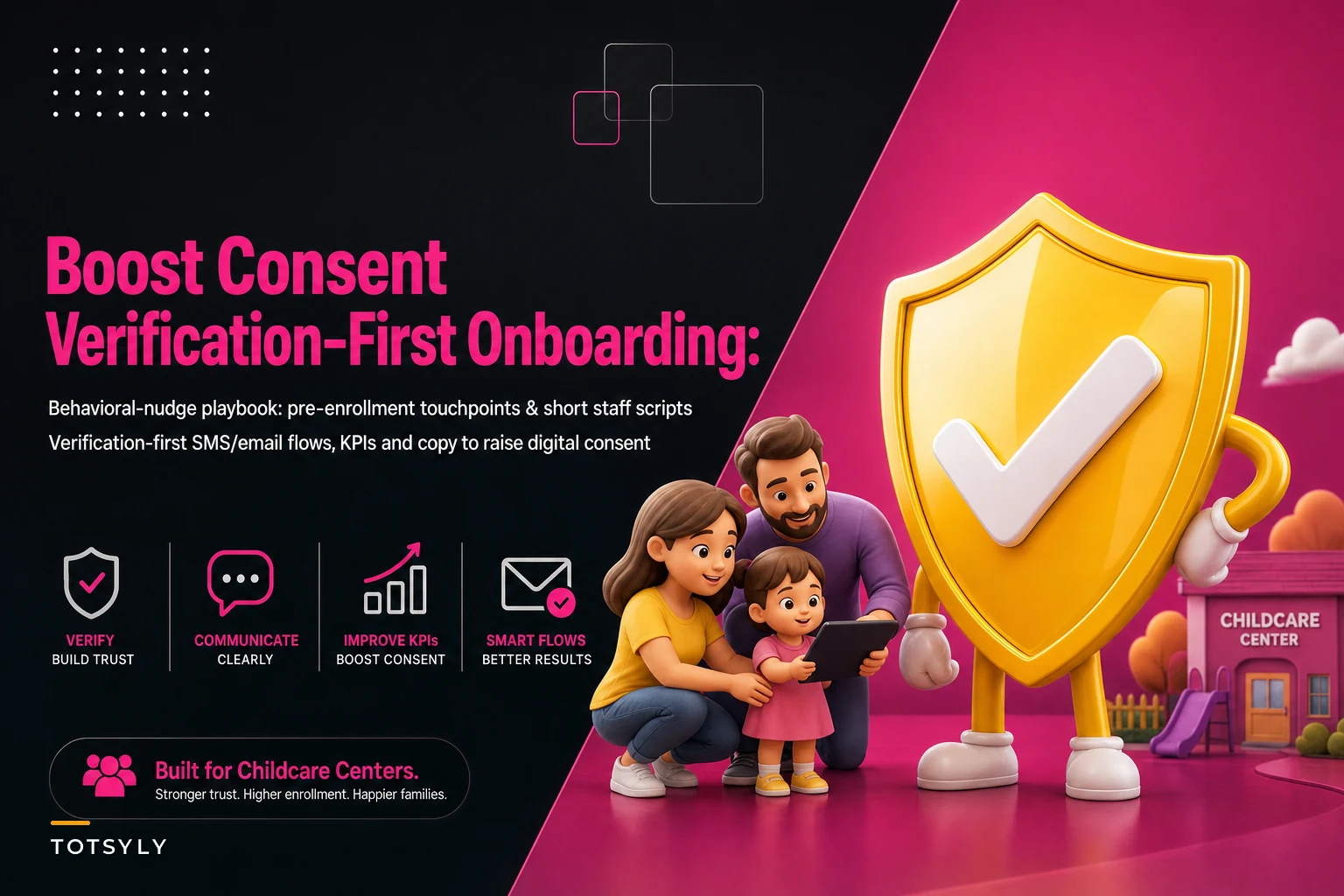
This piece is narrowly about one thing: raising digital consent onboarding childcare completion rates using behavioral nudges and verification-first flows. Not a broad intake guide — just the specific mechanics of getting consent signed, verified, and logged before day one, with scripts and messages you can copy straight into your system.
The real reason consent lags: you're asking at low-intent moments
Walk through how consent usually gets collected and the failure points jump out pretty quickly.
A family tours in March, puts down a deposit, and gets a 14-page PDF emailed to them "to fill out before you start in September." Six months of silence. In August, an admin sends a reminder. The parent opens it on their phone, can't sign a PDF on mobile, tells themselves they'll do it on a laptop, and forgets. First day arrives. Now a staff member is chasing signatures in the lobby while also trying to settle a crying toddler.
The core issue is an intent mismatch. The moment of highest parental intent is right after they commit — deposit paid, spot confirmed, relief and excitement still fresh. That's when they'll sign almost anything. Instead, most centers wait months, then pile everything into one overwhelming packet at the worst possible time.
The second issue is verification. A lot of centers accept any signature from any email address that happens to have the form link. No check that the person signing the medical consent is the legal guardian versus a grandparent who forwarded it. For most forms that's a minor annoyance. For medical authorization and emergency pickup, it's a liability you don't want to discover during an actual incident.
What "verification-first" actually means here
Verification-first flips the usual order. Instead of collect signature → hope it's valid → maybe verify later, you confirm identity up front, then route consent requests to the verified guardian, then log everything with a timestamp and audit trail.
Simplify your childcare center’s daily operations.
Totsyly helps you manage enrollments, staff, and communications efficiently so you can focus on care.
- Streamlined enrollment & waitlist management
- Automated billing & payment tracking
- Staff scheduling & attendance monitoring
No credit card required
-
Verify the guardian at the point of enrollment commitment (phone + email confirmation is enough for most centers).
-
Split consent into tiers instead of one giant packet.
-
Send each tier at the right moment with a specific, short ask.
-
Nudge on a fixed cadence with escalating specificity.
-
Log completion with timestamp, IP/device, and which guardian signed.
The workflow looks like this:
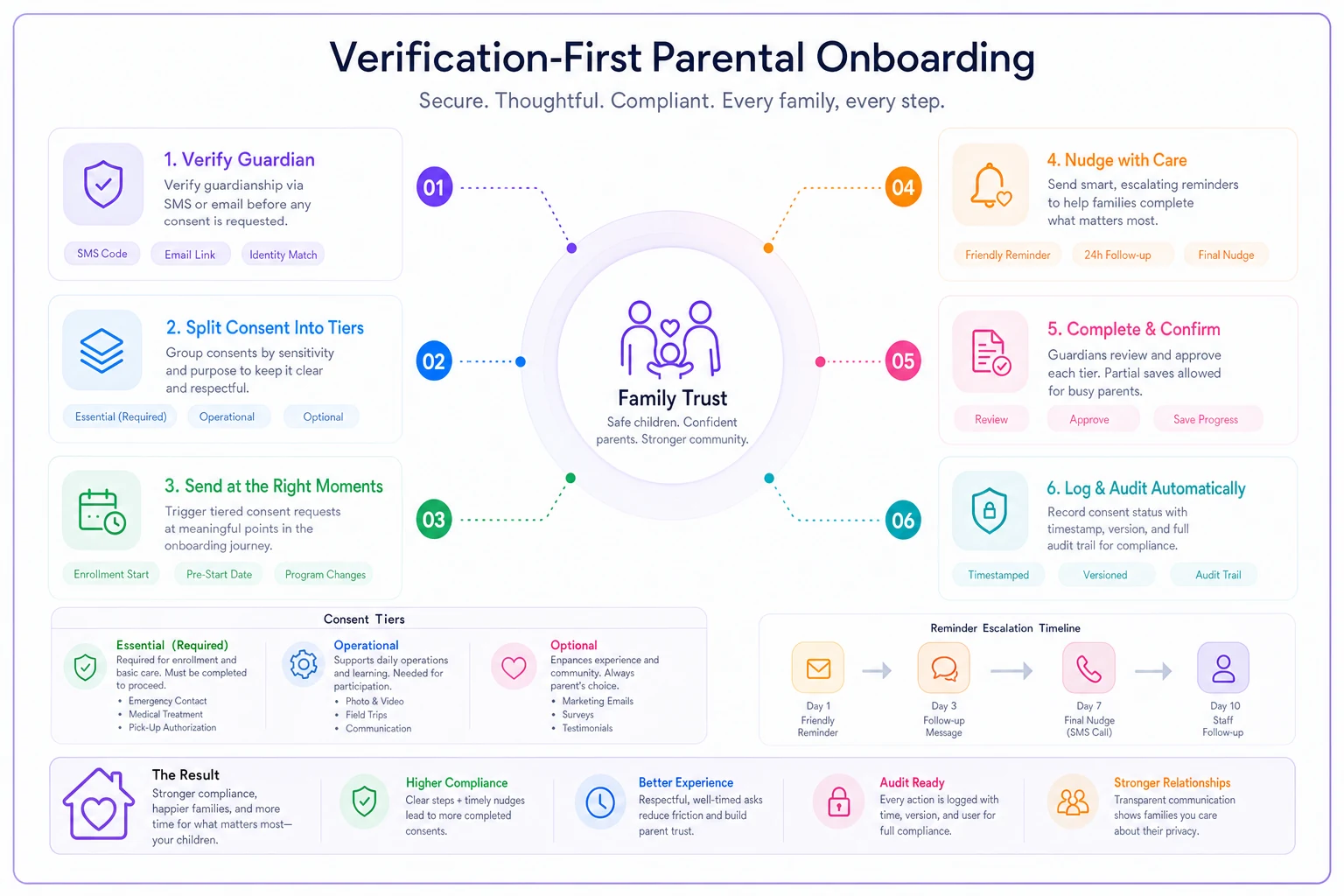
It builds naturally on the same principles behind a verification‑first digital intake workflow — confirming who someone is early removes friction and rework down the line. For consent specifically, verification does two jobs: it protects you legally, and it actually increases completion, because a parent who's already confirmed their identity feels like the process is official and worth finishing.
The rest of this article covers the operational detail for each of those steps.
Split your consent into tiers — stop sending the 14-page packet
The single biggest completion killer is bundling. When everything arrives at once, the hardest form (usually medical) blocks the easiest ones, and the whole packet sits untouched.
Break it into three tiers based on urgency and effort:
| Tier | Forms included | When to send | Why it's grouped this way |
|---|---|---|---|
| Tier 1 — Immediate | Photo/media release, communication preferences, handbook acknowledgment | Within 24 hrs of deposit | Low effort, high intent moment, builds momentum |
| Tier 2 — Pre-start | Emergency contacts, pickup authorization, medical consent, allergy/dietary | 3–4 weeks before start date | Requires info parents may need to look up |
| Tier 3 — Activity-based | Field trips, water play, sunscreen, off-site walks | Rolling, as activities get scheduled | Context-specific; signing in advance feels premature |
The insight most centers miss: Tier 1 completion creates a "foot in the door" effect. A parent who signs the quick photo release within a day is dramatically more likely to finish Tier 2, because they've already engaged with your system and it felt easy. Front-load the wins.
Centers that switch from a single packet to this tiered approach typically see pre-start completion move from around 65% to the high 80s within a couple of enrollment cycles — mostly because medical consent stops blocking everything else.
The pre-enrollment touchpoints that prime consent
Before the first consent request goes out, a couple of small touchpoints make a real difference.
Touchpoint 1 — The commitment confirmation. When a parent pays the deposit, the confirmation message should set the expectation that enrollment happens in short, manageable steps. One line does the work: "You'll get a few short forms over the next several weeks — most take under two minutes each. First one's coming tomorrow." That reframes consent from a dreaded packet into something bite-sized.
Touchpoint 2 — The verification step. Right after the deposit, confirm the guardian's phone and email. A simple SMS code or email confirmation link. This feels standard to parents (every app does it now) and quietly establishes that your process is legitimate. It also catches typos in contact info before they break every downstream message — a surprisingly common cause of "I never got the forms."
These two touchpoints tie directly into broader family engagement cadences that improve retention. Consent is one thread in the ongoing relationship with a family, and a smooth start sets the tone for a lot of what follows.
Copy-and-paste: the verification-first email flow
Here's a flow you can adapt directly. Keep each message short, single-purpose, and mobile-first.
Email 1 — Tier 1, sent within 24 hours of deposit > Subject: Welcome! Your first (quick) step 🎉 > > Hi [First Name], > > So glad [Child's Name] is joining us at [Center Name]! > > To get started, we just need three quick acknowledgments — photo preferences, how you'd like us to reach you, and the family handbook. It takes about two minutes on your phone. > > 👉 [Complete Tier 1 — 2 minutes] > > That's all for now. We'll send the next step a few weeks before [Child]'s start date. > > — [Your Name], [Center Name]
Email 2 — Tier 2, sent 3–4 weeks before start > Subject: Let's get [Child's Name] ready for [Start Date] > > Hi [First Name], > > [Child]'s start date is coming up on [Date]. We need a few details to keep them safe and cared for: emergency contacts, who's authorized for pickup, and medical/allergy info. > > You may want to grab your doctor's info before you start — otherwise it's pretty straightforward. > > 👉 [Complete Tier 2] > > Questions on anything medical? Reply here or call us at [number].
Email 3 — Nudge, sent 4 days later if Tier 2 incomplete > Subject: Quick nudge — one form left for [Child's Name] > > Hi [First Name], > > You're almost done! We still need [specific missing item, e.g., "medical consent and emergency contacts"]. This one matters because we can't [specific consequence, e.g., "administer any medication or respond to an allergy without it on file"]. > > 👉 [Finish now — under 3 minutes]
The nudge works because it names the specific missing form and the specific consequence. Generic "please complete your forms" reminders get ignored. "We can't respond to an allergy without this" gets action.
Short in-person scripts for the stragglers
Some parents won't finish digitally no matter how clean the flow is. For those, a 30-second conversation at drop-off closes the gap — but only if staff already know the exact missing item.
Front desk script (parent arrives, consent incomplete): > "Morning! Before you run — I've got [Child]'s file open and we're just missing the medical consent. Takes about a minute on this tablet, and then [Child]'s fully set for anything that comes up. Want to knock it out now?"
-
The staff member already knows the exact missing form — no "let me check what you need."
-
A tablet is ready. No "go home and do it."
-
The framing is about the child being ready, not about paperwork compliance.
For the parent who says "I'll do it tonight": > "Totally fine — I'll text you the direct link to just that form right now so it's at the top of your phone. Takes under a minute whenever you get a sec."
Send it while they're standing there. A real-time link outperforms "it's somewhere in your email" by a wide margin.
Low-friction verification that doesn't annoy people
Verification can easily tip into friction that kills completion. The goal is enough confirmation for legal defensibility without turning sign-up into a bureaucratic slog.
What works at the right friction level:
-
Email + SMS confirmation at enrollment (one time, establishes the verified guardian).
-
Named-signer capture — the form records exactly which guardian signed, not just "a parent."
-
Timestamp + device logging automatically, invisible to the parent.
-
Re-confirmation only for high-stakes forms — medical and pickup authorization get a single extra "I confirm I am the legal guardian/authorized" checkbox. Photo release doesn't need it.
What creates too much friction:
-
Requiring uploaded ID photos for every form (fine for pickup authorization, overkill for sunscreen consent).
-
Forcing account creation before viewing the form.
-
Multi-step logins every single time.
Match verification intensity to the actual stakes of the form: keep quick checks for low-risk items and reserve extra confirmation only for medical/pickup authorization.
Match verification intensity to the actual stakes of the form. Over-verifying low-risk consent is the fastest way to tank your completion numbers while gaining nothing legally.
KPIs worth tracking — so you know if any of this is working
Track these four and nothing more:
-
Tier 1 completion rate within 48 hours — your momentum signal. Target: 85%+.
-
Full pre-start completion by start date — the headline number. Target: 90%+.
-
Average time-to-complete per tier — if a tier is dragging, the form is too long or the ask is unclear.
-
In-person catch-up rate — how many families need the lobby script. Rising numbers mean your digital flow is leaking somewhere upstream.
A quick diagnostic: if Tier 1 completion is strong but Tier 2 lags badly, your problem is form length or missing-info friction (parents don't have the doctor's details handy), not engagement. If Tier 1 itself is weak, the problem is upstream — bad contact info, unverified emails, or a confusing first message.
A short real scenario
A two-site preschool, around 140 enrolled families, was running the classic single-packet approach. Consent completion by the first day hovered around 60–65%, and the office manager was spending a solid chunk of every late-August week chasing signatures by phone and in person.
They made three changes: verified contact info at deposit, split consent into the three tiers above, and swapped generic reminders for specific-consequence nudge messages. Same software, same staff, existing form tool.
By the next fall intake, pre-start completion was sitting in the high 80s to low 90s, and in-person catch-up dropped to a handful of families per cohort instead of dozens. The office manager got back the better part of a week of August. Not a dramatic transformation — just a leak that stopped.
When this approach makes sense (and when it doesn't)
It makes sense when you have rolling or seasonal enrollment, multiple consent types, and an office team spending real hours chasing paperwork. The tiering and verification pay for themselves quickly in reclaimed admin time and reduced liability exposure.
It's overkill when you're a very small home-based program with a handful of families you onboard face-to-face anyway. In that case, a single well-run sit-down covers it — building a multi-tier digital flow would be more work than the problem warrants.
One group that genuinely should not over-engineer this: centers still struggling with basic contact-data accuracy. If half your parent emails bounce, fix that first. No nudge flow survives wrong contact info. Verification-first actually helps here, since confirming email and phone up front is what catches those errors before they cascade into everything else.
The thing most centers get backwards
Consent completion gets treated as a parent-compliance problem — "why won't families just fill out the forms?" It's really a timing and routing problem on your end. Ask at high-intent moments, split the load, verify the guardian once, and nudge with specifics rather than generic reminders.
The parents were always willing. The process was just asking them wrong, at the wrong time, in a format that worked against them. Get the sequence right and the numbers move — fewer scrambles at the front desk, cleaner files when a licensing visit or an actual emergency hits, and an office team that gets its Augusts back.
The parents were always willing. The process was just asking them wrong, at the wrong time, in a format that worked against them. Get the sequence right and the numbers move — fewer scrambles at the front desk, cleaner files when a licensing visit or an actual emergency hits, and an office team that gets its Augusts back.
Ready to elevate your childcare management?
Join hundreds of childcare providers using Totsyly to save time, improve communication, and grow their centers.