


You run a 68-child preschool. Enrollment looks stable at 92% occupancy. But underneath that steady number, families are churning faster than you realize. By the time a family decides to leave, they've already been mentally checked out for weeks—sometimes months. The enrollment forms get pulled, the last tuition payment clears, and suddenly you're scrambling to fill another spot while wondering what went wrong.
Engagement tends to drop off gradually, then all at once. Parents stop reading newsletters. They skip conferences. They rush through drop-offs without chatting with teachers. These aren't just busy parents being busy—they're early warning signs of families drifting away from your program. Most centers never see it coming because they don't have a family engagement system they can actually measure and act on.
Centers that keep families engaged through structured touchpoints tend to retain around 85% of their enrollment year-over-year. Centers running on autopilot, sending the occasional newsletter when someone remembers? They're lucky to hit 70%. That gap is real, and it compounds fast.
The engagement gap nobody talks about
Walk into any childcare center at 8:15 AM and watch the drop-off rush. Parents hurrying kids through the door, barely making eye contact with staff, signing in on the clipboard without stopping. Teachers managing six arrivals at once while trying to comfort a crying toddler. Directors handling a phone call about late tuition while greeting families. This daily chaos isn't just stressful—it's where engagement quietly dies.
Most centers think family engagement means throwing a few events each year. Maybe a fall festival, a Mother's Day tea, holiday concerts. Between those big moments? Radio silence except for incident reports and tuition reminders. Parents become ATMs who drop off kids. Teachers become babysitters. The relationship erodes until switching to another center feels like no big deal.
The real problem runs deeper than missed communication. It's about cadence and consistency. Families need regular, meaningful touchpoints that make them feel connected to what's happening in those 9 hours their child spends at your center. Not flood-them-with-information overwhelming. Not ghost-them-for-weeks absent. The sweet spot sits somewhere between those extremes, and most centers never quite find it.
Think about your own center. When was the last time a parent got positive news about their child that wasn't tied to a payment or problem? How many weeks pass between meaningful conversations with each family? If a parent hasn't attended an event or conference in three months, who notices? Who follows up?
What real engagement actually looks like
Engagement isn't about volume—it's about rhythm. A well-run family engagement system has three distinct cadences working together: daily touchpoints, weekly connections, and milestone moments. Miss any layer and families start drifting.
Simplify your childcare center’s daily operations.
Totsyly helps you manage enrollments, staff, and communications efficiently so you can focus on care.
- Streamlined enrollment & waitlist management
- Automated billing & payment tracking
- Staff scheduling & attendance monitoring
No credit card required
Daily cadence happens at transitions. Not elaborate conversations—just intentional moments of connection. A teacher sharing one specific thing about a child's day at pickup. A morning greeting that uses the parent's name. A quick photo in the app showing their kid engaged in an activity. These micro-touchpoints take seconds but compound over months.
Weekly rhythms create predictability families can count on. Every Thursday, parents get a classroom newsletter with next week's themes. Every Monday, they receive their child's learning portfolio update. Every Friday afternoon, teachers send one positive observation about each child home. Families start expecting these touchpoints. When communication becomes predictable, engagement follows.
A quick visual of how these cadences connect:
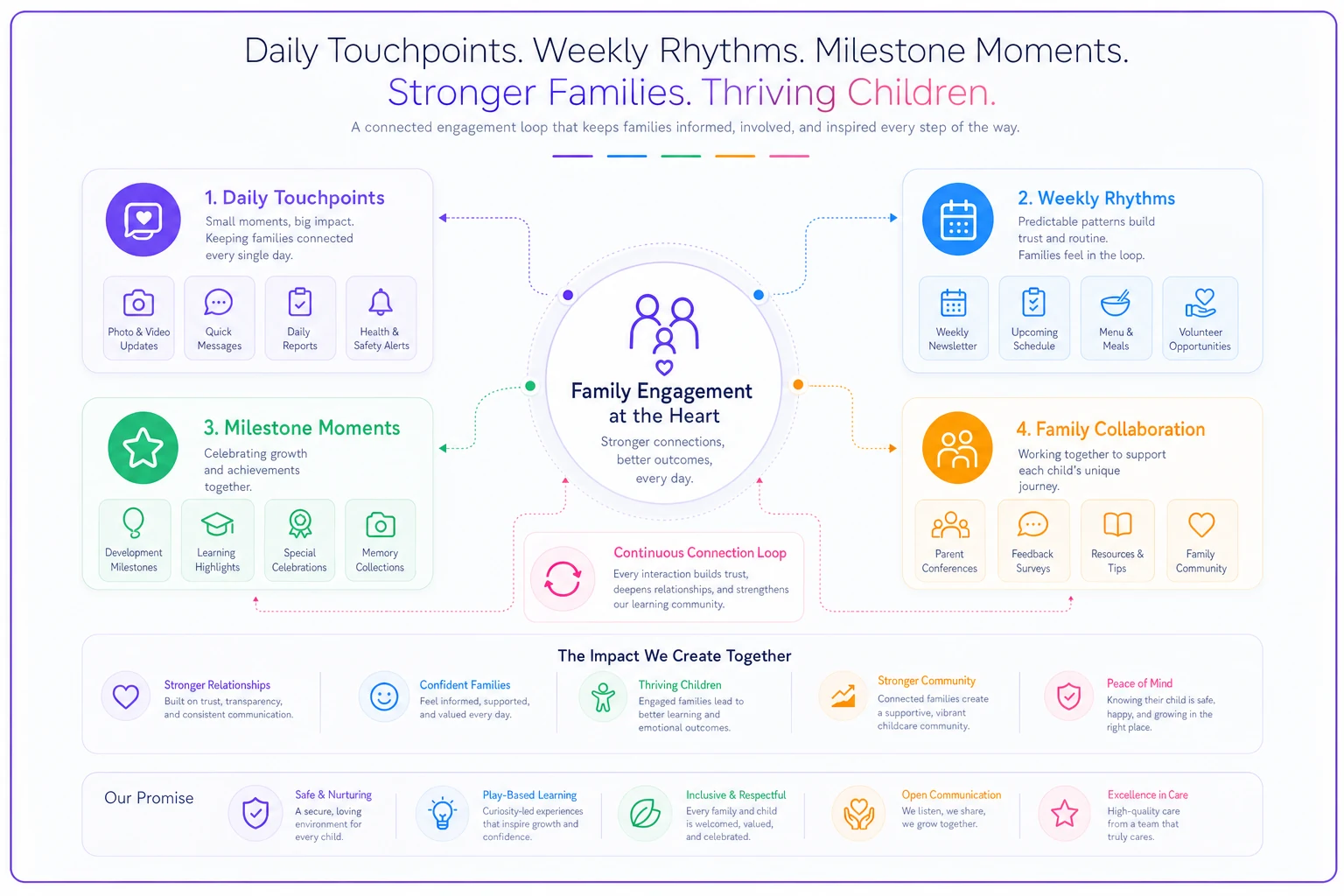
Milestone moments mark progress and celebrate growth. Monthly parent coffees. Quarterly conferences with developmental assessments. Semi-annual family nights tied to curriculum themes. These bigger touchpoints give context to all those daily and weekly interactions.
Centers mess up the execution when they treat these cadences as separate initiatives instead of one connected system. The daily greeting should reference something from the weekly newsletter. The newsletter should build toward the monthly coffee chat. The coffee chat should preview the quarterly conference. Everything connects, building momentum toward deeper engagement.
The measurement problem that breaks most systems
"We have great family engagement" means nothing without data. You need concrete metrics that predict which families might leave before they've made the decision. Most centers track the wrong things—event attendance, newsletter open rates, survey responses. These backwards-looking metrics tell you what already happened, not what's about to happen.
Better metrics focus on engagement frequency and depth:
Touch Point Ratio: How many meaningful interactions does each family have per month? Count everything—conversations at pickup, responses to classroom updates, event attendance, conference participation. Families averaging fewer than 8 touchpoints monthly are often at risk.
Response Rate: When you share something about their child, how often do parents respond or engage? A parent who stops responding to positive observations or classroom updates is usually pulling away.
Depth Score: Are families moving deeper into your community or staying on the periphery? Track progression from basic compliance (dropping off on time) to active participation (volunteering for events) to advocacy (referring other families).
Consistency Patterns: How regular is each family's engagement? Wild swings—super engaged one month, absent the next—can signal underlying issues worth checking on.
One director I know in Phoenix started tracking these metrics in a basic spreadsheet—nothing fancy. Within a couple of months, she could predict with reasonable accuracy which families would leave at the end of the term. More importantly, her team had time to have real conversations before families had already made up their minds.
Building escalation paths before you need them
Engagement drops for lots of reasons—job changes, financial stress, developmental concerns, personality conflicts with staff. Your family engagement system needs clear escalation paths for different scenarios.
Start with engagement tiers:
| Tier | Details |
|---|---|
| Highly Engaged (roughly 25% of families) | Attend most events, respond to communications, actively participate in their child's learning. These families need recognition and, where it makes sense, leadership opportunities. |
| Moderately Engaged (around 50% of families) | Follow basic expectations, occasionally attend events, respond when directly asked. They need consistent nurturing to prevent sliding into disengagement. |
| At-Risk (about 20% of families) | Minimal interaction beyond drop-off/pickup, skip conferences, don't respond to communications. These families need proactive outreach sooner rather than later. |
| Disengaged (roughly 5% of families) | Actively avoiding interaction, past-due on paperwork or payments, possibly already shopping around. These need director-level attention fast—within 48 hours if possible. |
For each tier, create specific response protocols. When a Highly Engaged family misses two events in a row, the classroom teacher makes a casual check-in call. When a Moderately Engaged family stops responding to weekly updates, the lead teacher schedules a coffee chat. When an At-Risk family skips a conference, the director makes personal contact within 24 hours.
The goal isn't surveillance—it's catching small shifts in engagement patterns and responding proportionally before they become decisions.
Templates that actually drive connection
Generic newsletters and robotic updates kill engagement faster than silence. Every communication needs to feel personal while being scalable across dozens or hundreds of families. That means templates with structure but room for personalization.
The Weekly Classroom Connection follows this format:
-
Opening with one specific moment from the week (not generic "we had fun learning")
-
Three bullet points of next week's focus areas with how parents can reinforce at home
-
One photo featuring 3-4 different children each week (rotating through the class monthly)
-
A specific question or prompt for parent response
-
Clear action item (bring recycled materials, practice counting to 20, read any book about animals)
The Positive Contact Template for daily touchpoints: "Wanted to share a bright spot from today—[specific observation about what the child did]. This shows growth in [developmental area]. You might notice [related behavior] at home too. Would love to hear if you're seeing similar things!"
The Concern Conversation Starter for addressing issues: "I've noticed [specific behavior] happening [frequency] over the past [timeframe]. I wanted to check in about [contextual question—sleep, changes at home, etc.]. Could we find 15 minutes this week to brainstorm strategies that work both here and at home?"
Rotate the children featured in the weekly photo so every family sees their child regularly.
Each template creates an opening for two-way dialogue. Engagement isn't broadcasting—it's conversation.
When good intentions hit operational reality
Every center wants better family engagement until they realize what it actually requires. Teachers already stretched thin managing ratios. Directors juggling compliance and enrollment. Nobody has time for another initiative that might or might not work.
This is where some form of automation becomes essential, not optional. AI-assisted operational platforms can handle the repetitive logistics while humans focus on meaningful connection—automated reminders for teachers to send daily updates, scheduled newsletter templates that pull in classroom activities, engagement tracking that flags at-risk families without someone manually combing through spreadsheets every week.
One center dealing with roughly 40% annual turnover implemented automated daily photo shares, weekly newsletter scheduling, and engagement scoring through their management platform. Teachers spent the same amount of time on family communication—but that time shifted toward actual conversations instead of chasing logistics. Turnover dropped noticeably within six months. Not because of the technology itself, but because the technology gave staff breathing room to focus on relationships that actually matter.
The workflow looks something like this: Every morning, teachers get a quick prompt showing which families haven't had positive contact in the past week. Two minutes, a few updates sent. Every Thursday, the weekly newsletter auto-populates with that week's activities and photos—teachers add personal observations and send. Every month, the system flags families whose engagement dropped, triggering a simple check-in.
Without something managing the logistics, even the best engagement plan falls apart by week three. With it, engagement starts to feel like a routine instead of an extra burden.
The compound effect of consistency
Retention doesn't improve overnight. It takes around 90 days of consistent engagement cadences before families notice a real difference. Six months before it becomes embedded in your culture. A full year before you see meaningful financial impact from reduced turnover.
But when it clicks, the results do compound. Engaged families refer other engaged families. Teachers spend less time onboarding new families and more time deepening relationships with existing ones. Directors stop having retention emergency meetings and start planning program improvements.
The math isn't complicated. If you're running a 75-child center with high annual turnover, you're replacing a significant chunk of families every year. Each departure carries real costs—lost revenue, marketing to fill the spot, staff time spent onboarding a new family. Cut turnover meaningfully through better engagement and those costs drop, often enough to fund another part-time hire or a long-overdue playground upgrade.
More importantly, stable enrollment means stable classrooms. Teachers build deeper relationships with families they see for years, not months. Children benefit from consistency in peer groups. Your center builds a reputation for being a place families stay.
Making it stick when everything else is on fire
The biggest challenge isn't designing an engagement system—it's maintaining it when crisis hits. Teacher calls out sick. State inspection next week. Three families behind on tuition. Suddenly those daily touchpoints and weekly newsletters feel like luxuries you can't afford.
That's exactly when engagement matters most. Families notice when communication drops during stressful periods. They wonder if the center is struggling. They start looking at other options "just in case." An engagement system that only works when everything's perfect isn't a system—it's wishful thinking.
Build your engagement system with failure points in mind. If a teacher is absent, who sends the daily updates for that classroom? If the director is handling a crisis, who monitors engagement metrics? If the usual newsletter writer is on vacation, what's the backup?
Some centers create engagement teams—one teacher from each classroom plus an administrator—who share responsibility. Others designate an "engagement lead" with a few hours of admin time weekly to coordinate efforts. The structure matters less than having clear ownership and backup plans.
Set minimum viable engagement levels for rough periods. Daily photos might become every-other-day. Weekly newsletters might become bi-weekly. Parent coffees might get postponed. But something continues—maintaining that thread of connection even when operations are strained.
A realistic implementation path
Forget trying to launch everything at once. Start with one classroom as a pilot. Pick your strongest teacher who already has decent parent relationships. Give them the tools and templates to implement daily touchpoints and weekly updates. Track what works, what breaks, what takes too much time.
Month 1: Daily positive contacts for every family at least twice weekly. Just quick texts or verbal comments at pickup. Track who's getting contacted and how they respond.
Month 2: Add weekly classroom updates. Nothing fancy—three things we learned, two upcoming activities, one way parents can help. Send every Thursday like clockwork.
Month 3: Layer in monthly parent coffees. Fifteen minutes before pickup on the first Friday. Coffee and cookies in the lobby. No agenda except connection.
Month 4: Expand to a second classroom while refining the process based on three months of learning.
By month 6, you should have all classrooms running the basic engagement cadence. By month 9, add milestone moments and engagement tracking. By year one, you have a complete system families actually notice and value.
It won't go perfectly. Some teachers will resist the templates. Some parents won't respond no matter what you do. A few things that seem like great ideas will flop in practice. That's normal—adjust and keep going.
Beyond retention to reputation
The best childcare centers don't just retain families—they create advocates. Parents who post unsolicited positive reviews. Who recommend you to friends without being asked. Who don't flinch at tuition increases because they genuinely understand the value.
That level of loyalty doesn't come from perfect facilities or even perfect staff. It comes from consistent, meaningful engagement that makes families feel seen and valued—not as customers or revenue sources, but as actual partners in their child's development.
Every interaction either builds or erodes trust. Every communication either deepens or weakens connection. Every day, families are quietly deciding whether to stay or start looking elsewhere.
The question isn't whether you need a family engagement system. It's whether you'll build one deliberately or let something haphazard evolve in its place. The families in your center deserve the former. So does your business.
Ready to elevate your childcare management?
Join hundreds of childcare providers using Totsyly to save time, improve communication, and grow their centers.