

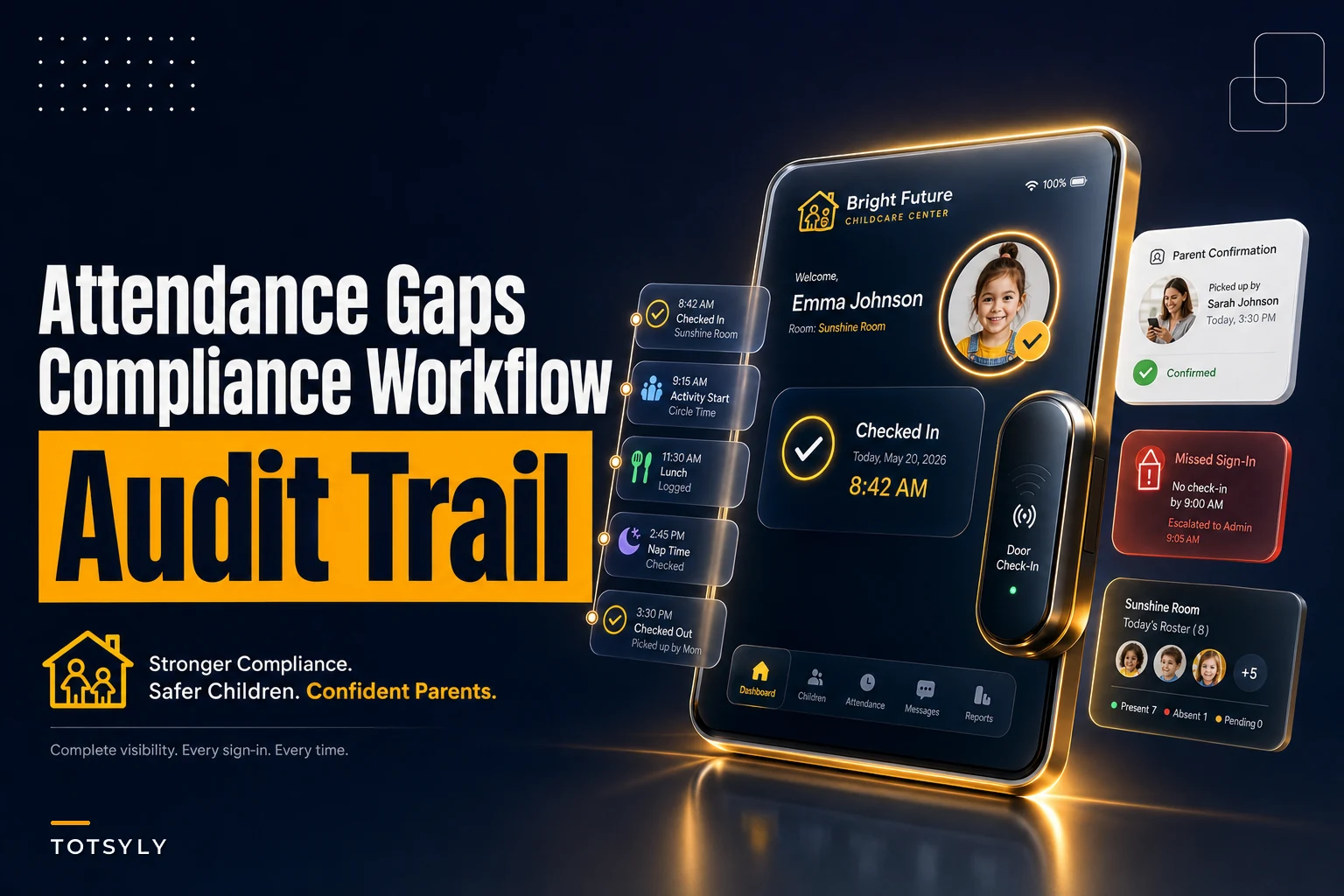

Most attendance problems in childcare aren't about kids showing up. They're about what the record says when someone asks a question three weeks later.
A licensor walks in, pulls a random Tuesday, and asks you to prove which teacher was in Room 3 with those nine toddlers at 9:40 that morning. A parent calls, upset, certain they signed their daughter out at 5:15 but the pickup fee shows she left at 5:40. In both cases, the actual events barely matter — what matters is whether your records can answer cleanly, with a timestamp, without someone digging through a stack of paper sheets or scrolling back through a group text.
That gap — between what happened and what you can prove happened — is where most centers quietly carry risk. Here's exactly where attendance records fall apart and how to build a workflow that survives both an audit and an angry email.
Where attendance records actually break
The paper sign-in sheet is still everywhere, and it fails in predictable ways. Not because people are careless, but because the format itself invites the failure.
Morning drop-off hits a rush between 8:00 and 8:45. Three parents are signing in at once, one's holding a kid and a diaper bag, the pen's out of ink, and somebody initials instead of writing a time. By 9:00 the sheet has two illegible entries and one kid whose parent forgot to sign at all because a teacher waved them in while handling a meltdown.
Fast-forward to that afternoon. That same sheet is the official record of who was physically present. If a child was marked present but the sign-in line is blank, you have a child in your care with no documented arrival. For a licensor, that's not a small clerical thing — it's a hole in your chain of custody for a kid.
The second common break is the reconciliation gap. Attendance lives on paper at the classroom door. Billing lives in a different system. Subsidy reporting lives in a third. When those three don't agree — and they rarely do by Friday afternoon — somebody spends an hour hunting down which number is right. A typical situation: the paper sheet shows 22 kids on Wednesday, the billing system shows 24 (two were marked absent but actually came), and the subsidy claim went out based on the billing number. That's a reporting discrepancy you'll have to explain if it gets flagged.
Why this keeps happening even at well-run centers
It's tempting to blame training or discipline, but the real issue is that attendance gets treated as a single moment instead of a series of events that each need to be captured.
Simplify your childcare center’s daily operations.
Totsyly helps you manage enrollments, staff, and communications efficiently so you can focus on care.
- Streamlined enrollment & waitlist management
- Automated billing & payment tracking
- Staff scheduling & attendance monitoring
No credit card required
An attendance record isn't just "present or absent." For it to actually hold up, it needs to capture:
-
Arrival — who dropped off, at what time
-
Room assignment — which classroom, which staff
-
Movement — if the child transferred rooms midday
-
Departure — who picked up, at what time, and whether that person was authorized
Paper sheets capture maybe the first and last of those, badly. Everything in the middle lives in people's heads. So when a question comes in about the middle — "was my son in the two-year-old room or the transition room when he got the scratch?" — there's no record, just recollection.
The other reason this persists: the cost is invisible until it isn't. Nobody notices a messy sign-in sheet until the morning an inspector pulls it, or the afternoon a custody dispute means pickup authorization suddenly matters a great deal. The failure is rare but expensive, which is exactly the kind of risk centers tend to underinvest in.
What a complete attendance workflow actually covers
A solid childcare attendance tracking workflow isn't just a better sign-in sheet. It's a defined sequence where every step produces a timestamped record, confirmations go out automatically, and exceptions have a named path instead of a shrug.
-
Check-in capture. Parent or authorized adult signs the child in via a device at the door — tablet, kiosk, or a parent's phone. The entry records the exact time, the name of the person signing in, and the assigned classroom. No blank lines possible, because the system won't close the entry without them.
-
Automated arrival confirmation. Within a minute or two, the parent gets a confirmation — "Maya checked in at 8:12 AM, Room 3." This does two things: it gives the parent a receipt, and it surfaces errors immediately. If a parent gets a confirmation for a child they didn't drop off, you find out now, not during an audit.
-
Room-level roster. Each classroom has a live list of exactly who's present and which staff are assigned. This is your ratio check in real time, and it's your answer to the "who was in Room 3 at 9:40" question.
-
Midday movement logging. When a child moves rooms — naptime consolidation, a transition group, going home sick — that movement gets logged with a timestamp. This is the step almost everyone skips, and it's the one that saves you during an incident investigation.
-
Missed sign-in escalation. If a child is expected (enrolled, scheduled, not marked absent) but hasn't been checked in by a set cutoff, the system flags it. A staff member gets prompted to confirm: is this child absent, or is there a child physically here who wasn't signed in?
-
Check-out capture with authorization check. At pickup, the person signing out is matched against the authorized pickup list. Timestamp recorded. If the person isn't on the list, it stops and routes to the escalation path.
-
End-of-day reconciliation. The day's attendance is locked and compared against billing and scheduling before anyone goes home. Discrepancies get resolved the same day, while memories are fresh, instead of Friday afternoon.
That missed sign-in escalation in step five is the piece that turns attendance from a record into a safety control. A child who's present but unsigned is the exact situation that leads to a miscount during an emergency evacuation. Catching it by 9:30 instead of never is the whole point.
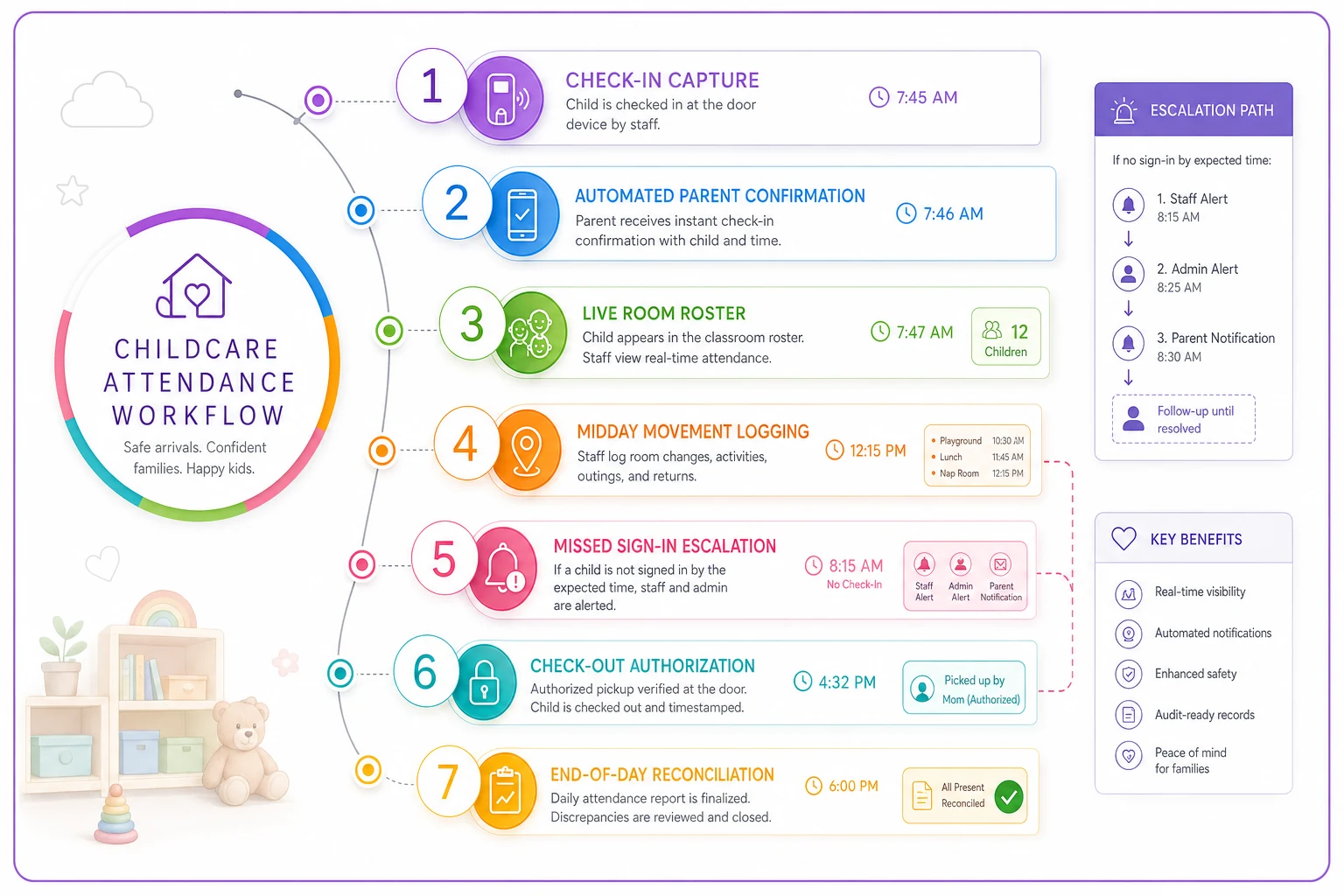
Here's a simple visual of the process so you can see how each step hands off to the next and where the escalation points are.
Paper vs. timestamped digital workflow
The difference isn't convenience — it's what you can prove when it matters.
| Scenario | Paper sign-in sheet | Timestamped digital workflow |
|---|---|---|
| Inspector asks who was present at a specific time | Reconstruct from the sheet, hope times are legible | Pull exact roster with staff assignments for that minute |
| Parent disputes a pickup time | Your word vs. theirs | Timestamped record with name of person who signed out |
| Child present but not signed in | Often unnoticed until end of day, sometimes never | Flagged at the cutoff, resolved within the hour |
| Unauthorized pickup attempt | Depends on staff recognizing the issue | Blocked at check-out, routed to escalation |
| Attendance vs. billing mismatch | Found Friday, if ever | Caught at daily reconciliation |
| Ratio verification during the day | Manual head count | Live room roster always current |
Worth noticing in that table: the paper column isn't wrong because people are lazy. It's wrong because it relies on humans catching problems in real time while they're also supervising children. The digital column works because the catching is built into the process, not dependent on someone noticing.
The exceptions that break everything — and the SOPs that handle them
A workflow is only as good as how it handles the weird cases. Attendance is full of them, and "use your judgment" is not a documented procedure a licensor will accept. Each exception needs a short, written SOP that any staff member can follow.
-
Child arrives but parent doesn't complete sign-in. Staff member completes a staff-initiated check-in, notes the reason ("parent in a rush"), and the system still sends the parent a confirmation. The record is never left blank.
-
Expected child never arrives, no absence reported. After the cutoff, the missed sign-in flag triggers. SOP: designated staff attempts contact with the parent. For a subsidy-funded or compulsory-attendance program, this contact attempt itself may need documenting — so the log captures the call time and outcome.
-
Unauthorized person attempts pickup. Check-out stops. SOP
staff does not release the child, verifies against the authorized list, and contacts the primary guardian. The attempt is logged with a timestamp regardless of outcome.
-
Custody-restricted pickup. Flagged pickups (court orders, restricted parties) need to surface at check-out, not live in a binder someone forgot to check. The SOP ties the flag to the child's record so it appears automatically.
-
Device or system down. Yes, you need a paper fallback — but the SOP should require that paper entries get entered into the system before end of day, so the timestamped record stays complete and reconciliation still happens.
Log the call time and outcome for missed sign-in attempts so subsidy-funded programs have the necessary documentation.
The pattern across all of these: the exception produces a record, and the record is timestamped. A center that can show "here's exactly what happened when our normal process didn't apply" is in a dramatically stronger position than one relying on staff memory of an unusual day.
When this level of rigor actually makes sense — and when it's overkill
This makes sense when:
-
You accept subsidy or public funding, where attendance directly drives reimbursement and audits are routine
-
You run multiple sites and can't personally verify records at each one
-
You've had a custody dispute, a miscount, or a licensor finding related to attendance
-
Your pickup authorization situations are complex — lots of custody arrangements, rotating authorized adults
This is probably overkill when:
-
You're a small single-room home-based program where the provider personally greets every family and the "roster" is nine kids they know by name
-
Your parent base genuinely can't or won't use a device at drop-off, and forcing it creates more gaps than it closes
Even in those cases, though, one piece is worth keeping: the timestamped check-in and check-out with authorization matching. The midday movement logging and automated reconciliation can wait. The arrival/departure record with who-signed-them-out is the part that protects both the child and you, and it's the part memory fails on first.
A real scenario
A two-site preschool, around 110 kids across both locations, was running paper sheets with attendance re-keyed into billing a couple times a week. The recurring pain: subsidy claims kept getting flagged for small mismatches between claimed days and documented attendance, and each flag meant a day or two of someone reconstructing records from sheets.
They moved to a timestamped check-in/check-out process with automated parent confirmations and an end-of-day reconciliation step. Two things changed that actually mattered.
First, the subsidy mismatches dropped to near zero, because the number being claimed was the same timestamped number parents had already received a confirmation for — there was no second re-keyed version to disagree with the first. The reconstruction scramble basically disappeared.
Second, and they didn't expect this one: parent disputes about pickup times stopped. Before, there were a handful of "I was here at 5:30, not 5:45" conversations a month tied to late fees. Once parents were getting a timestamped check-out confirmation on their phone, those arguments ended — the record was right there in their own text history.
The administrator put it plainly: they weren't tracking attendance better, they were just no longer re-tracking it three different times.
Where this fits with the rest of your compliance picture
Attendance records don't live in isolation. They feed your ratio compliance, your billing, your subsidy claims, and they become evidence in any incident or custody situation. A gap in attendance quietly becomes a gap in all of those downstream.
If your drop-off and pickup procedures are solid but your record of who actually came and went is shaky, you've secured the door and left the logbook blank. The two have to work together. Start with the timestamped capture at both ends of the day, add the missed sign-in escalation so no present child goes undocumented, and write down the exception SOPs before you need them — because the morning an inspector pulls a random Tuesday is not the morning to be inventing a procedure.
The centers that handle attendance well aren't the ones with the strictest staff. They're the ones who stopped relying on anyone to remember, and built a process where every arrival, movement, and departure leaves a mark on its own.
Ready to elevate your childcare management?
Join hundreds of childcare providers using Totsyly to save time, improve communication, and grow their centers.