

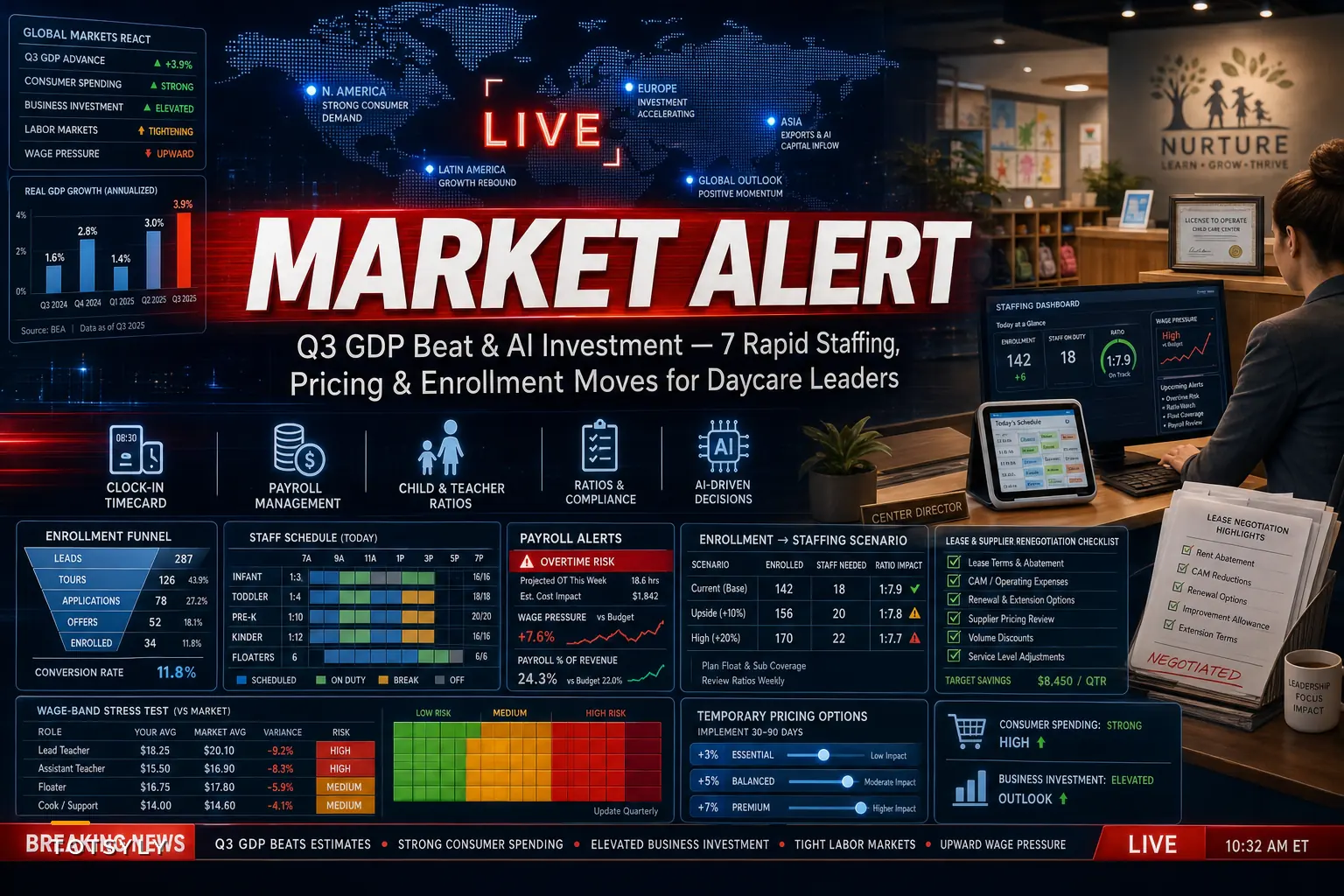

The advance read is in: U.S. real GDP grew at a 3.4% annualized pace in Q3 2026, according to the Bureau of Economic Analysis, with the boost coming from stronger consumer spending and a notable jump in business investment — particularly information-processing equipment. Reuters, covering the same week's data, flagged the mix of resilient demand and heavier tech investment against still-mixed inflation signals.
For a daycare or preschool, that headline splits into two very different realities. The spending side is tailwind: families with steady income keep paying tuition and are less likely to pull a child mid-year. The investment side is headwind — when local employers, especially tech-adjacent ones, ramp up hiring and wages, your assistant teachers and floaters suddenly have more options at better pay. And childcare can't absorb wage shocks the way a restaurant can trim hours or a retailer can cut inventory. Your labor is tied directly to ratios. You can't understaff your way to savings without breaking the law or the center.
So this isn't really about GDP. It's about what you do in the next 60–90 days when demand holds but your wage floor just moved. Below are seven moves, ordered roughly by how fast they protect you.
1. Lock down your at-risk staff before someone else does
The first casualties of a hot local labor market aren't your lead teachers — they're the people one rung below. Assistant teachers, aides, kitchen staff, part-time floaters. These are the most poachable, because competing employers can match or beat their pay without needing credentials. In practice, churn almost always starts at the $15–$19/hour band, not the salaried band.
The mistake most centers make is treating retention like an annual-review event. When a warehouse or logistics outfit opens nearby at $2 more an hour, you don't have until spring. You have weeks.
A practical triage:
-
Rank every hourly employee by replacement difficulty. Who holds a credential you'd struggle to re-hire? Who's cross-trained across two classrooms? Those people get attention first.
-
Identify flight-risk signals. Picking up fewer extra shifts, new reluctance to close, vague "something came up" callouts clustering on Fridays — these precede resignations more often than people realize.
-
Have the conversation before the counteroffer. A mid-cycle, off-schedule check-in that acknowledges the market directly ("I know pay is competitive out there right now — here's where you stand with us") buys more loyalty than a surprise raise after they've already got an offer letter.
The deeper issue a strong economy exposes is that most centers have no deliberate ladder. Pay bumps happen when someone threatens to quit, which teaches everyone that threatening to quit is the only way to get a raise. Fixing that is a structural project — we've laid out the full approach in our breakdown of childcare compensation and career-ladder strategy. If you only have bandwidth for one deeper read this quarter, make it that one.
2. Build a float pool now, while you can still afford to
When wage competition tightens, callout coverage gets brutal. The people you used to call for a last-minute fill now have steadier jobs and won't pick up. If your coverage plan is "text the group chat and hope," a hot market will expose it quickly.
Simplify your childcare center’s daily operations.
Totsyly helps you manage enrollments, staff, and communications efficiently so you can focus on care.
- Streamlined enrollment & waitlist management
- Automated billing & payment tracking
- Staff scheduling & attendance monitoring
No credit card required
A real example: a two-site center running around 28 classroom staff was losing roughly 3–4 shifts a week to callouts. They were covering them by pulling the director into ratio — which quietly killed admin time, delayed billing, and let enrollment follow-ups slip. The cost wasn't the callout itself. It was everything that didn't get done because leadership was stuck in a toddler room.
Building a float pool before you're desperate means:
-
Recruiting 2–4 flexible, pre-vetted, pre-trained people who want variable hours — retirees with ECE backgrounds, parents wanting part-time work, students on education tracks.
-
Keeping their credentials, background checks, and orientation current continuously, not scrambling when you need them.
-
Guaranteeing them a minimum monthly commitment so they don't drift to a competitor between calls.
Keep floaters' credentials and orientation current so you can call them without scrambling when a shift opens.
Centers almost always wait until they're short before recruiting floaters — which is exactly when the labor market is tightest and the available people are already gone.
3. Re-run your pricing math — demand can absorb more than you think, but not blindly
Resilient consumer spending is the part of this report worth being optimistic about. Families are generally in a position to pay, and mid-year disenrollment driven by affordability tends to ease when incomes feel stable.
That does not mean a flat across-the-board increase. The risk in a strong-spending environment is reading "demand is strong" and overcorrecting — raising tuition in a way that pushes your most price-sensitive families out while leaving money on the table with families who'd have paid more anyway.
A smarter frame is to separate your price moves by segment:
| Segment | Price sensitivity | Recommended move |
|---|---|---|
| Infant room (high demand, hard to staff) | Low | Modest increase; this is your scarcest, costliest care |
| Full-time preschool | Medium | Inflation-aligned increase, communicated early |
| Part-time / drop-in | Low–Medium | Premium pricing; these cost you ratio flexibility |
| Subsidy-dependent families | High | Hold or minimal; protect enrollment stability here |
| Waitlisted-demand slots | Lowest | Where new-enrollment pricing should rise first |
The insight most operators miss: pricing power is highest where your waitlist is longest, and that's almost never your part-time slots. Raise new-enrollment rates on in-demand rooms before you touch the rates of existing, loyal families. It protects retention and your reputation at the same time.
When a tuition increase is actually a bad idea
If your center has had quality complaints, recent turnover visible to parents, or a licensing issue in the past six months, a price increase right now reads as charging more for less. Fix the operational story first. A strong economy doesn't make families tolerate a shaky program — it just gives them more alternatives.
4. Tighten the schedule-to-pay chain before wages climb
There's a hidden cost that gets worse exactly when wages rise: every dollar of payroll leakage now costs more. If your scheduling and your payroll don't reconcile cleanly, you're overpaying on inflated hourly rates, not cheap ones.
In practice, the leaks are mundane:
-
Rounded-up clock-ins that nobody audits
-
Overtime triggered by poor shift planning rather than actual need
-
Floaters paid for a full shift when they covered three hours
-
Manual timesheet entry that quietly adds 1–2% to the payroll run
At a $12k weekly payroll, a 2% reconciliation gap is around $240 a week — roughly $12k a year walking out the door. And that gap grows with every raise you give. Centers that stay margin-healthy in a wage-competition environment are usually the ones whose scheduling data flows into payroll without a human re-keying it, because that's where both errors and time disappear.
Here's a simple workflow to visualize how schedule approvals should feed directly into payroll to prevent leakage.
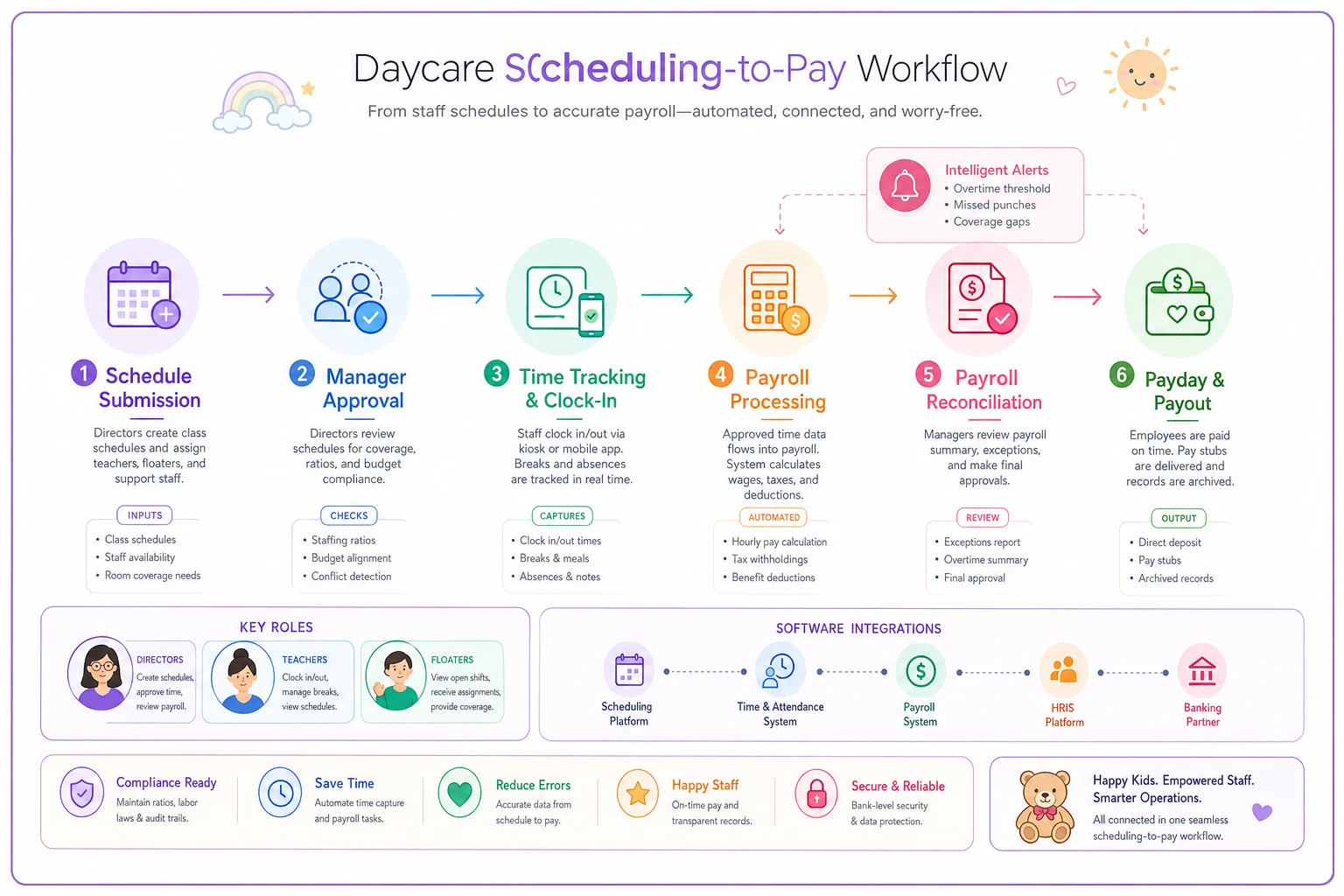
This is one area where operational software earns its keep quietly — not because it's exciting, but because tying approved schedules directly to payroll removes the small, repeated losses that compound when hourly rates go up. You don't notice the fix. You just notice that the payroll run stops surprising you.
5. Convert your waitlist into committed enrollment faster
Strong family demand is only valuable if you capture it before it cools. When consumer confidence is up, families shop more aggressively — they tour three centers instead of one and commit to whoever makes enrollment easy.
The operational failure here is slow follow-up. A tour on Tuesday that doesn't get a personalized response until Monday has usually already lost the family. Speed is the differentiator when demand is high and competitors are equally busy.
A tight conversion rhythm looks like:
-
Same-day follow-up after every tour, with a specific available start date
-
48-hour deadline on held spots, communicated kindly but firmly
-
Weekly touch on waitlisted families so they feel active, not forgotten
-
A simple digital intake that doesn't make families print and scan twelve forms
Centers losing families right now usually aren't losing on price or quality. They're losing on friction. A parent who's ready to commit shouldn't have to chase you to give you money.
6. Renegotiate vendor and supplier contracts while you have leverage
Investment-driven growth puts upward pressure on supplier costs too — food, cleaning supplies, curriculum materials, insurance. The reflex is to just absorb it. Don't.
This is a decent window to renegotiate because your enrollment story is strong, and a vendor would rather lock in a stable, multi-classroom customer than lose you to a competitor. A few moves that tend to work:
-
Consolidate. If you're buying food from two suppliers, bid the combined volume as one contract.
-
Ask for a price-lock. A 12-month fixed rate protects you from mid-year increases even if it's slightly higher upfront.
-
Audit auto-renewals. Contracts that silently renew at a 5–8% bump are where margin quietly erodes.
Most centers negotiate vendors once, at signing, and never revisit it. A changing cost environment is exactly the moment to reopen those conversations.
7. Protect your director's time — it's the resource that collapses first
Every move above competes for the same scarce resource: leadership attention. When the labor market tightens, directors get pulled into ratio, interviewing, retention conversations, coverage scrambles — and the strategic work (pricing, vendor negotiation, enrollment conversion) is the first thing to disappear.
The quiet failure mode is a director spending 15+ hours a week on tasks that software or delegation should handle: chasing timesheets, re-entering enrollment data, manually reconciling attendance to billing. In a strong economy, that's 15 hours not spent on the work that actually protects your margin and your staff.
A short audit worth running this month:
-
[ ] How many hours is leadership spending in classroom ratio weekly?
-
[ ] How much admin time goes to tasks that are manual re-entry?
-
[ ] Which recurring reports does someone build by hand that could be automated?
-
[ ] What's the one coverage gap that keeps pulling the director off task?
Protecting director time isn't a soft goal. It's the enabling condition for everything else on this list. Centers that treat it as optional tend to find out the hard way — usually mid-quarter, when three problems hit at once and there's nobody with bandwidth to handle any of them.
A quick real scenario
A single-site preschool licensed for around 90 kids, running near 85% occupancy, started losing two assistant teachers to a nearby distribution center offering $2.50 more an hour. Their first instinct was a panic raise for everyone — roughly a $40k annual hit they couldn't fully fund.
Instead, they did three things over about six weeks: built a four-person float pool, gave targeted mid-cycle raises to the five hardest-to-replace staff, and raised new-enrollment tuition on their infant and toddler rooms where the waitlist was deepest.
The following quarter, turnover in the at-risk band dropped noticeably, the new-enrollment pricing roughly offset the targeted raises, and the director got back several hours a week once coverage stopped being a daily fire. Not a transformation — just a center that stopped bleeding in the places that mattered.
Where this leaves you
A strong GDP print is a two-edged thing for childcare. The demand side is a gift — take it. The labor side is a threat — get ahead of it. The centers that come out of this quarter stronger won't be the ones that raised every price or matched every wage offer. They'll be the ones that figured out where their pricing power actually sits, who on staff they genuinely can't lose, and which hours of leadership time are being wasted on work that shouldn't need a human at all.
None of that requires predicting the economy. It just requires knowing your own numbers well enough to move before the market forces your hand.
Ready to elevate your childcare management?
Join hundreds of childcare providers using Totsyly to save time, improve communication, and grow their centers.