


Most centers set pay by looking at what the daycare down the street charges, adding a dollar, and hoping that's enough. It almost never is. Not because a dollar doesn't matter, but because pay alone was never the thing keeping your best people in place. Teachers leave for reasons that show up in your budget months before anyone gives notice — no path forward, no recognition for taking on more, and a wage structure so flat that a two-year lead earns roughly what a brand-new hire does.
A real childcare compensation strategy isn't a number. It's a system that connects what you pay to what a role actually costs you when it turns over, and to what you'd save by keeping that person another eighteen months. Once you frame it that way, the math changes what you're willing to spend — and where.
Start with what a departure actually costs you
Administrators consistently underestimate turnover cost because most of it never lands on a single line item. You see the ad you paid for and maybe the sign-on bonus. You don't see the twelve other places the money leaked out.
| Cost component | Realistic range | Where it hides |
|---|---|---|
| Advertising + screening | $150–$400 | Job boards, background checks |
| Interview + admin time | $300–$600 | Director hours pulled off other work |
| Onboarding + training | $1,200–$2,500 | Paid ramp time, mentor time, paperwork |
| Ratio coverage during vacancy | $800–$3,000 | Overtime, floats, agency subs |
| Lost enrollment / family churn | $0–$5,000+ | Families who leave when their teacher does |
| Productivity drag (first 90 days) | $1,000–$2,000 | New hire isn't at full competency yet |
Add it up and a single lead departure runs somewhere between $3,500 and $12,000, depending on how long the seat stays empty and whether families walked. In infant and toddler rooms, where attachment matters most to parents, the enrollment loss piece is the one that quietly does the most damage.
The two biggest costs — ratio coverage and family churn — both get worse the longer the role stays open. Keeping a teacher three extra months isn't worth a flat amount; it compounds because it prevents the expensive tail of a prolonged vacancy. When you frame a raise against that number instead of against the center down the street, an extra $2/hour suddenly looks like a bargain.
Why flat pay structures break as you grow
A single-site center with eight staff can survive on informal pay. The director knows everyone, remembers who's been there longest, and adjusts wages by feel. It's messy but it holds.
Simplify your childcare center’s daily operations.
Totsyly helps you manage enrollments, staff, and communications efficiently so you can focus on care.
- Streamlined enrollment & waitlist management
- Automated billing & payment tracking
- Staff scheduling & attendance monitoring
No credit card required
It stops holding around fifteen to twenty staff, or when you add a second room type. What breaks first is internal fairness. Someone finds out the new hire negotiated their way into $0.75 above a teacher with three years and a CDA. That teacher doesn't quit that day. They quit four months later, and you never connect the two events.
The second thing that breaks is that you lose any real way to reward more responsibility without inventing a one-off deal each time. A teacher steps up to cover openings, mentor new hires, handle a tough parent — and the only tool you have is a spot raise you negotiate privately. Now you've got a dozen private arrangements no one can explain, and every one of them is a fairness landmine.
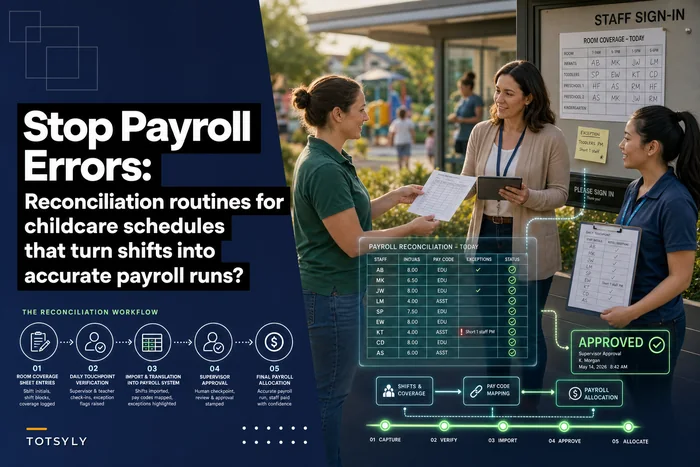
This is the same coordination failure that shows up in scheduling and payroll. When compensation lives in someone's head instead of a defined structure, it produces inconsistency, resentment, and errors that only surface at the worst time. If your pay runs are already a scramble, the fix upstream is structure — the same way reconciliation routines turn schedules into accurate payroll instead of a monthly guessing game.
Pay bands: the structure that makes everything else possible
A pay band is a defined salary range for a role — a floor, a midpoint, and a ceiling. That's it. But adopting them forces you to answer questions you've been dodging: what actually separates a teacher earning the bottom of the range from one earning the top?
-
Assistant / Aide floor to ceiling spread of about $2.50/hour
-
Teacher roughly $3.50/hour spread, overlapping slightly with the top of Assistant
-
Lead Teacher about $4/hour spread, with the floor set above the Teacher midpoint
-
Mentor / Coach a defined premium above Lead, often a flat stipend rather than a full band
The overlaps matter. A strong Assistant near their ceiling should earn more than a brand-new Teacher at their floor — because tenure and competence are worth more than a title change alone. Centers that skip overlap accidentally punish loyalty, paying newcomers into a role above the veterans who trained them.
The other quiet benefit: bands give you a defensible answer during a wage conversation. "You're near the top of the Teacher band — the path to a raise from here is moving into a Lead role, and here's what that requires." That's a very different conversation than "we can't do it right now," which teachers hear as you're done growing here.
Tiered roles: float, lead, mentor
Titles do work in retention, but only when they carry real, visible responsibility and a wage difference people can actually see. Three tiers cover most of what a center needs without turning into corporate ladder theater.
Float. Not a demotion — a specialist. A float who can competently step into any room protects your ratios and is worth paying for. In practice, a reliable float is one of the highest-leverage people on your payroll, because they're the difference between covering a callout in-house and paying agency rates. A defined float role is a core piece of any real staffing blueprint that stops ratio breaches and cuts burnout.
Lead. Owns a classroom's curriculum, parent communication, and the rhythm of the room. The Lead band should sit clearly above Teacher, because the job genuinely is bigger.
Mentor. This is the tier most centers skip, and it's the one that pays back the fastest. A Mentor's job is to make new hires competent faster and keep them from quitting in the first ninety days — which, if you've looked at your data, is where a huge share of turnover actually happens. A mentor who shaves two weeks off ramp time and prevents one early quit has already earned their stipend several times over. This works best when it's tied to a real ramp process, like the one in a day-by-day onboarding checklist with 90-day competency sign-offs.
Each tier solves a different operational cost. Float protects ratios. Lead protects classroom quality and family retention. Mentor protects early-tenure survival. You're not handing out titles — you're placing people against your three biggest turnover expenses.
Cheap non-monetary progression that actually works
You can't out-pay a hospital or a school district, and you shouldn't try. What you can do is make progression feel real between raises, because most disengagement happens in the long flat stretches when nothing changes.
-
First pick of schedule for staff who hit tenure or competency milestones
-
A guaranteed predictable day off — the same weekday every week, which people often value more than an extra fifty cents
-
Naming the mentor role publicly to families and staff, so the recognition is visible
-
A small annual PD budget the teacher controls, even $200–$300, chosen by them
-
A closed classroom-prep day each quarter — paid time to set up without kids present
-
Title progression on the door and in parent emails, well before the top of the band
Tie these perks to clear tenure or competency milestones so they function as true progression, not random favors.
The mistake is treating these as consolation prizes handed out instead of raises. They work when they're attached to the ladder — earned at defined points — not sprinkled randomly to whoever complained most recently. Random perks read as favoritism. Structured perks read as progression.
Modeling the retention impact so you can budget for it
This is where it turns from HR philosophy into a budget decision. You model the return before you spend.
Take a center with 24 staff and an annual turnover rate around 40% — roughly 10 departures a year, which is unfortunately common in this field. At a blended cost of about $5,000 per departure, that's $50,000 a year walking out the door, most of it invisible in your P&L.
Here's a simple workflow to model retention impact in your budget.
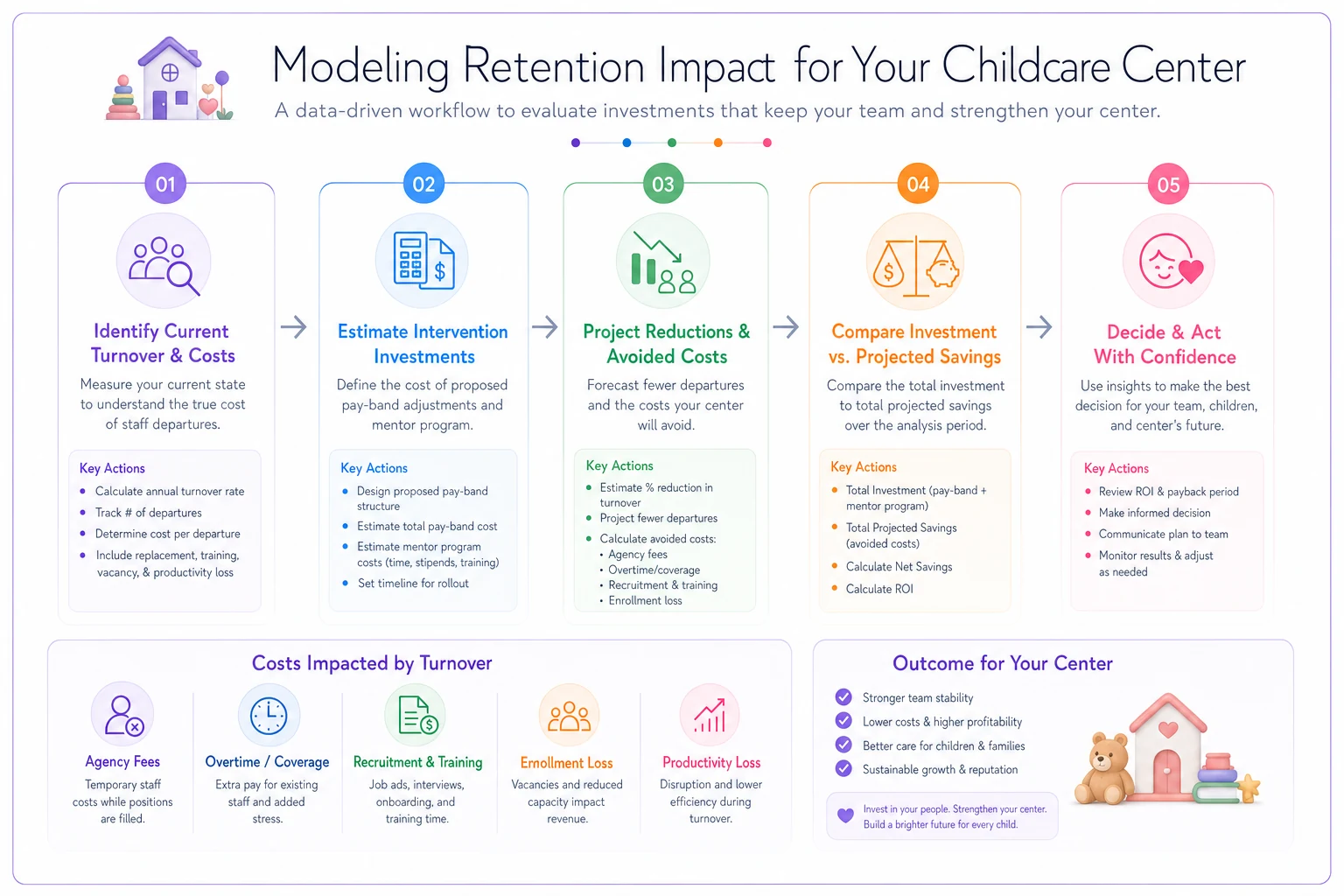
Now suppose restructured bands plus a mentor role and a few non-monetary changes cost you an extra $32,000 annually in wages and stipends. If that structure drops turnover from 40% to 28% — cutting roughly three departures a year — you've saved about $15,000 in hard turnover cost. That looks like a losing trade on paper.
Except it usually isn't, and this is where centers stop the math too early. Retained staff also protect enrollment, cut overtime and agency spend, and free your director from spending a chunk of every week recruiting. Factor in avoided agency premiums (easily $18–$25/hour over your own labor cost) and the enrollment you didn't lose, and the same investment often clears break-even in year one — with the real payoff in year two, when a more tenured team produces a more stable center that families actually notice.
The honest version: not every center will hit those numbers. But you can only find out by modeling your turnover cost against your proposed spend, per tier, before you commit. Budget the structure the way you'd budget an enrollment campaign — as an investment with a projected return, not a cost you tolerate.
A short real scenario
A two-room preschool with about 14 staff was losing 5–6 teachers a year, mostly within the first six months. Pay was flat — everyone within about a dollar of each other regardless of tenure. The director kept raising starting wages to compete, which only widened the resentment among staff who'd been there for years.
They restructured into three bands, carved out one Mentor stipend (around $2,500/year for their most trusted lead), and gave tenured staff first schedule pick. Total added cost landed near $19k for the year. Over the following twelve months, early-tenure quits dropped to two, agency sub spend fell noticeably, and — the part they didn't expect — two families who'd been shopping around stayed, specifically citing that their kids' teachers weren't turning over. The stipend paid for itself before the year was half over.
When this makes sense — and when it doesn't
Do this if you're past about a dozen staff, you're seeing turnover you can't explain by pay alone, or you're regularly paying agency rates to cover gaps. Structure gives you leverage exactly when informal management stops scaling.
Hold off if you're a very small center where the director genuinely knows and adjusts for everyone, and turnover is already low. Formalizing bands too early adds rigidity you don't need yet.
Don't do this if you're not willing to actually fund the ladder. A published band with no budget behind it is worse than no band at all — it's a promise you visibly can't keep, and staff will read it that way.
Keeping the whole thing coordinated as you scale
The reason compensation strategy falls apart isn't the design — it's the upkeep. Bands drift, stipends get forgotten at raise time, promised schedule perks quietly disappear when the calendar gets tight, and six months later you're back to private deals and resentment.
The structure only works if someone can see, at a glance, where each person sits in their band, when they're due for review, and whether the perks you promised actually got delivered. That's a coordination problem, and it's where centralizing your staffing and payroll data does real work — not as a gimmick, but so that pay-band position, tenure milestones, and role tiers live in one place instead of scattered across spreadsheets and memory. When scheduling, competency sign-offs, and payroll all reference the same records, the ladder stays intact under pressure instead of eroding the first busy month.
The compensation strategy is the plan. Keeping it honest over time is the operational part most centers underestimate.
Pay matters. But the centers that hold their people aren't the ones paying the most — they're the ones where a teacher can see, in concrete terms, that staying another year means moving forward, being recognized, and earning more in a way that's fair and visible. Build that structure, model its return against what turnover actually costs you, and the budget conversation stops being about matching the daycare down the street and starts being about protecting the most expensive asset you have.
Ready to elevate your childcare management?
Join hundreds of childcare providers using Totsyly to save time, improve communication, and grow their centers.