



Most childcare directors think their scheduling problems come from staff calling out. That's backwards. The real issue is that your scheduling system treats coverage like a math problem when it's actually a coordination problem.
After spending three months analyzing staffing patterns across 47 centers — ranging from single-site operations with 8 staff to multi-location groups with 120+ employees — the centers maintaining consistent ratios weren't the ones with perfect attendance. They were the ones who built scheduling systems that assumed imperfection.
Here's what actually breaks: You build a schedule that looks great on paper. Monday morning, your infant room lead texts that her kid is sick. You pull your floater. Then a toddler teacher needs to leave early for a doctor's appointment you forgot about. Now you're texting off-duty staff, begging them to come in, while your assistant director covers breaks in three rooms simultaneously.
By Wednesday, everyone's exhausted. By Friday, you're already short for next week because two teachers requested mental health days. The cycle just keeps going.
Why Traditional Shift Templates Create More Problems Than They Solve
The standard approach most centers use — fixed classroom assignments with designated break coverage — works fine until roughly your third hire. After that, it becomes a house of cards.
Centers typically organize schedules around rooms: two teachers in infants from 7-3:30, two from 9-6, one floater bouncing between rooms for breaks. Makes sense on paper. Falls apart in practice.
What actually happens: Your 7am infant teacher has a flat tire. The 9am teacher isn't answering their phone. Your floater is already covering because someone else called out yesterday and you haven't found a replacement. Now you've got six infants, one teacher, and a licensing violation before breakfast.
The deeper problem goes beyond coverage gaps. When teachers only know one age group, you lose flexibility. When floaters bounce randomly between rooms, they never build relationships with kids. When everyone works the same shifts, nobody wants to pick up extra hours.
One center in Michigan completely restructured after getting cited twice in six months for ratio violations. Not because they were understaffed — they had 22 teachers for 85 kids. Their rigid scheduling just meant they couldn't adapt when reality hit.
The Hidden Cost of Burnout Nobody Measures
Everyone talks about turnover rates. Few centers actually measure what happens in the three months before someone quits.
Simplify your childcare center’s daily operations.
Totsyly helps you manage enrollments, staff, and communications efficiently so you can focus on care.
- Streamlined enrollment & waitlist management
- Automated billing & payment tracking
- Staff scheduling & attendance monitoring
No credit card required
The pattern shows up repeatedly: A strong teacher starts taking more sick days. Not dramatically — maybe one extra per month. They stop volunteering for special events. Their energy during circle time drops. Parents start commenting that Miss Sarah seems "off." Then one day, they give notice and you're surprised.
You shouldn't be. The warning signs were there, buried in your scheduling data.
-
Sick days cluster around Mondays and Fridays
-
They stop accepting extra shift offers
-
Break time violations increase (staying in the break room longer)
-
They request schedule changes more frequently
-
Clock-in times drift later
One director in Ohio started tracking these patterns using basic spreadsheet formulas. She identified four teachers heading toward burnout and adjusted their schedules proactively — moved one to part-time temporarily, gave another consistent morning shifts instead of rotating, paired the third with a different co-teacher. Three stayed. One still left, but gave eight weeks notice instead of two.
The fourth teacher who left had been asking for morning shifts for six months because her husband started working nights. The scheduling system showed her as "available all day," so she kept getting assigned closings. Small thing, massive impact.
Building Float Pool Protocols That Actually Work
The typical float pool setup: hire 2-3 part-time floaters, hope they're available when you need them, watch them quit after three months because they never feel part of the team.
There's a better approach — build a structured float system with predictable patterns and actual development paths.
Start with scheduling consistency. Instead of random assignments, build recurring float patterns:
Week 1-2: Primary infant float
-
Monday/Wednesday/Friday
Infant rooms
-
Tuesday/Thursday
Toddler observation and training
Week 3-4: Toddler/Preschool rotation
-
Three days primary assignment
-
Two days shadowing lead teachers
This gives floaters real relationships with kids while maintaining flexibility. More importantly, it creates predictable schedules floaters can actually plan around.
The part most centers skip: designated float advancement tracks. After 90 days of successful floating, offer specialized roles:
-
Break coverage specialist (higher pay, guaranteed hours)
-
Assessment float (helps with developmental screenings)
-
Ratio coordinator (manages real-time coverage adjustments)
A center in Phoenix implemented this after losing six floaters in four months. Their current float team has been stable for 11 months, with two floaters promoted to lead teacher positions.
The critical piece everyone misses is float communication protocols. Floaters need different information than regular staff. Create a float-specific handoff that includes:
-
Room-specific behavior management approaches
-
Current classroom projects and themes
-
Individual child needs for that day
-
Parent communication from morning drop-off
-
Naptime logistics and preferences
Without this context, floaters feel like babysitters. With it, they become genuine team members.
Here's a simple visual of the float scheduling and communication workflow.
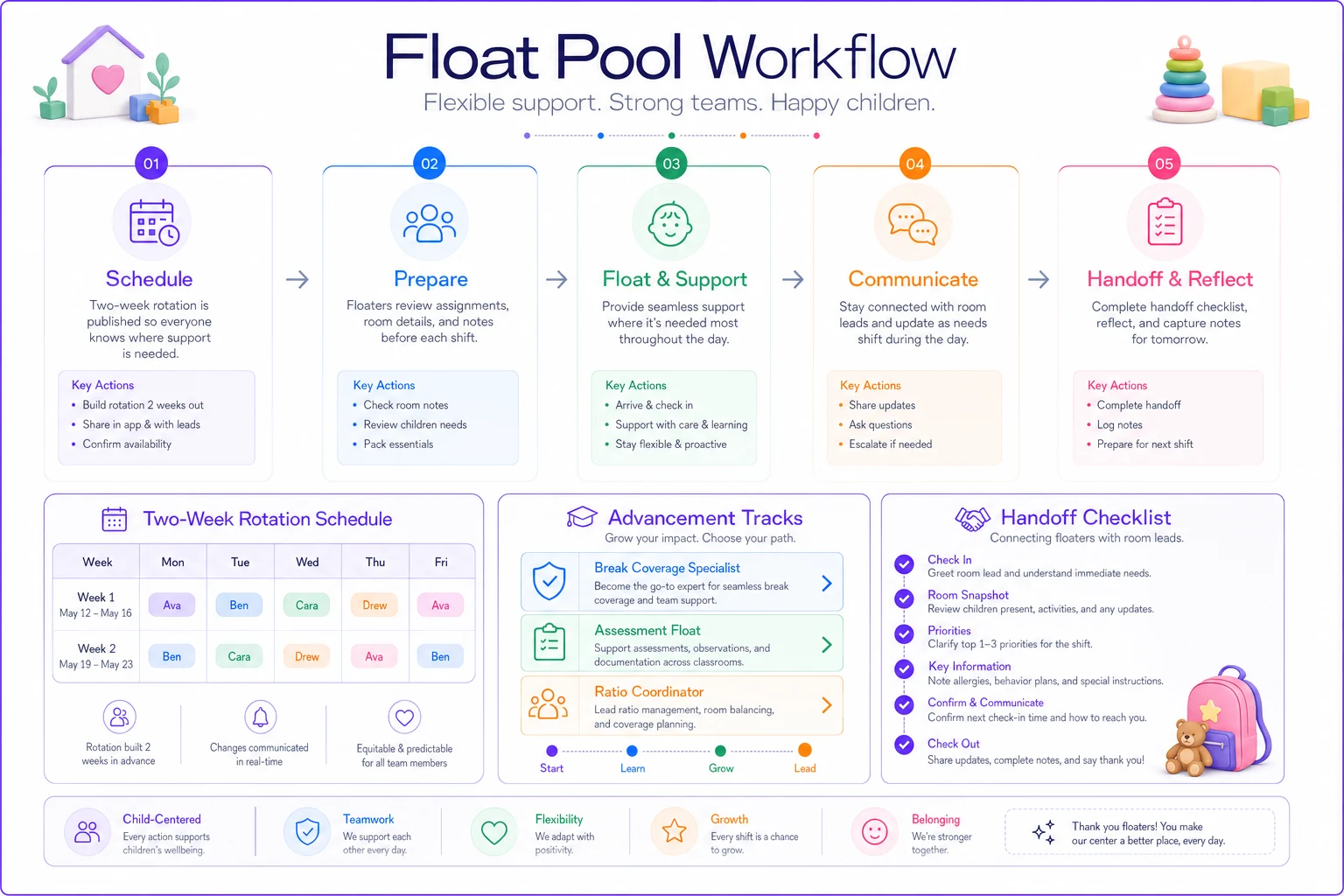
This visual ties together recurring assignments, advancement paths, and the handoff details floaters need to succeed.
Cross-Training Plans That Prevent Single Points of Failure
Most centers claim they cross-train. What they actually do is have someone watch another room for two hours during orientation, then never again until an emergency strikes.
Real cross-training requires systematic rotation and documented competency tracking.
Create quarterly rotation schedules where every teacher spends one full day in a different age group. Not observing — actually teaching. Document what they struggle with. Build training from those gaps.
A 60-child center in Colorado runs this schedule:
| Quarter | Infant Teachers | Toddler Teachers | PreK Teachers |
|---|---|---|---|
| Q1 | 2 days in toddlers | 2 days in PreK | 2 days in infants |
| Q2 | 1 day PreK, 1 day floater | 2 days in infants | 1 day toddlers, 1 day floater |
| Q3 | Full week different room | Full week different room | Full week different room |
| Q4 | Choice rotation | Choice rotation | Choice rotation |
The Q3 full-week rotation sparked resistance at first. Teachers worried about "their" kids. But something interesting happened — behavioral issues dropped around 18% in the month after rotation. Kids adapted to different teaching styles. Teachers brought fresh perspectives back to their primary rooms.
You also discover unexpected strengths. That quiet infant teacher might be amazing with challenging preschool behaviors. Your energetic toddler teacher might have incredible patience for infant feeding schedules.
Document competencies specifically:
-
Can maintain ratio independently
Yes/No
-
Knows emergency procedures for age group
Yes/No
-
Comfortable with age-specific curriculum
Scale 1-5
-
Parent communication confidence
Scale 1-5
-
Specific training needs identified
[List]
This isn't just about coverage. It's about building operations that don't collapse when your infant room lead takes maternity leave.
The KPI Framework That Predicts Problems Before They Hit
Standard metrics centers track: ratio compliance, overtime hours, turnover rate. These tell you what already went wrong.
Predictive metrics that actually matter:
-
Coverage Flexibility Score (Number of staff certified in multiple rooms) / (Total staff) × 100 Target: Above 70%. Below 50% means you're one bad flu season from crisis.
-
Schedule Stability Index (Shifts worked as scheduled) / (Total shifts scheduled) × 100 Sounds simple. Reveals everything. If this drops below 85%, you're heading for burnout. Below 75%? You're probably already losing people.
-
Last-Minute Coverage Rate (Shifts filled with <24 hours notice) / (Total shifts) × 100 Keep this under 10%. Higher means your system relies on heroics, not process.
-
Float Utilization Efficiency (Float hours in assigned rooms) / (Total float hours scheduled) × 100 Should be 75-85%. Lower means poor planning. Higher means you're burning out floaters.
Track these weekly, not monthly. Problems compound fast in childcare.
One center built a simple dashboard around these four metrics. Within two months, they figured out that Tuesday and Thursday afternoon coverage consistently required last-minute fills. Turned out their part-time staff all had college classes those days. Simple fix once identified: hire specifically for those slots instead of hoping existing staff would cover.
The Retention Problem Everyone Misdiagnoses
Directors assume staff leave for better pay. Sometimes that's true. But plenty of teachers have taken pay cuts just to escape chaotic scheduling.
The real retention killers:
-
Unpredictable schedules — Not knowing your hours until Sunday night destroys work-life balance. Teachers with kids can't arrange childcare. Students can't plan classes. Everyone feels disrespected.
-
Unfair distribution — The same three people always cover difficult shifts. The same teachers always get preferred hours. Resentment builds slowly, then explodes.
-
No advancement path — Working the same toddler room for three years with no change except a $0.50 annual raise. People need growth, even if they love what they do.
-
Invisible effort — Covering extra shifts, mentoring new staff, handling difficult parents — none of it recognized or rewarded.
A center in Texas cut turnover from 67% to 28% with three changes:
-
Published schedules three weeks out, no exceptions
-
Created a "shift bid" system where tenure earned first choice of schedule preferences
-
Implemented quarterly "impact bonuses" for non-monetary contributions
The shift bid system was controversial at first. Senior teachers grabbed prime morning shifts, newer staff got afternoons. But knowing you'd eventually earn better hours motivated people to stick around. Afternoon staff even formed their own culture and started preferring later shifts.
Technology and Automation: Where It Helps and Where It Doesn't
The scheduling software market for childcare is flooded with tools that solve the wrong problems. Most optimize for mathematical ratio compliance, not operational reality.
What technology should handle:
-
Ratio calculations across rooms
-
Overtime tracking and warnings
-
Shift swap requests and approvals
-
License expiration reminders
-
Time-off request workflows
What humans must handle:
-
Reading emotional exhaustion
-
Balancing personality conflicts
-
Supporting personal crises
-
Building team culture
-
Making exceptions for good reasons
Centers that actually succeed with scheduling automation use it to eliminate administrative burden, not replace human judgment. Their directors spend less time calculating ratios and more time checking in with staff.
AI-assisted platforms can be genuinely useful for pattern recognition — spotting when specific combinations of call-outs tend to create cascade failures, or identifying which staff pairings consistently run smoother rooms. One platform flagged that putting two specific teachers together in toddlers reduced behavioral incidents by around 40%. Nobody knew why. The pattern was just there.
The trap is over-automating. One center automated everything — schedule generation, shift assignments, even break rotations. Staff felt like cogs. Turnover doubled in six months. They pulled back, using automation for logistics while keeping human oversight for anything that affected morale.
Building Your Custom Childcare Staff Scheduling Blueprint
Stop trying to copy other centers' schedules. Your staff, families, and rhythms are unique. Build your blueprint from your actual reality.
Start with a two-week scheduling audit:
-
Track every schedule deviation
-
Note why each change happened
-
Document who covered and how
-
Measure impact on other rooms
-
Record staff feedback daily
Patterns show up fast. Maybe your Monday mornings are always chaotic because half your families drop off late. Maybe your Thursday afternoons are overstaffed because you haven't adjusted for enrollment changes. Maybe your best infant teacher secretly hates mornings but has never said anything.
From that data, build your core protocols:
-
Standard Operating Patterns - Which rooms need extra coverage and when - Which staff combinations work best - When floaters are most needed - How breaks actually flow
-
Escalation Protocols - Who to call first for each room - When to merge classrooms - Which ratios can flex briefly - When to call families for early pickup
-
Development Pathways - Clear progression from floater to lead - Cross-training requirements for advancement - Schedule preferences earned through tenure - Recognition for coverage contributions
-
Recovery Protocols - How to rebuild after a rough week - When to bring in temporary help - How to support burned-out staff - When to reduce enrollment temporarily
The blueprint isn't static. Review monthly, adjust quarterly, overhaul annually.
Making It Sustainable When Resources Are Tight
Small centers assume they can't implement sophisticated scheduling systems. They're half right — they can't use the same systems as large centers. They need something better fitted to their scale.
For centers under 50 children:
-
Focus on radical cross-training. Every person knows every room. Yes, even the director. Create pride in versatility rather than specialized expertise. Run "switch days" where everyone works different positions. It makes coverage automatic instead of emergency.
-
Use simplified metrics. Track just two numbers
weekly schedule stability and monthly overtime hours. If stability stays above 80% and overtime stays below 5%, you're in good shape.
-
Build reciprocal coverage agreements with nearby centers — not for regular staffing, but for real emergencies. The center down the street sends their floater for your licensing visit when three staff get COVID. You return the favor during their accreditation week.
For centers with 50-100 children:
Invest in one exceptional float coordinator. Not just another floater — someone who owns the entire coverage system. They track patterns, build relationships, handle scheduling conflicts, and essentially become your operations insurance. Pay them accordingly.
Create classroom partnerships. Pair rooms formally: Infant A always covers Infant B first. Toddler 1 partners with Toddler 2. Preschool rooms rotate coverage. This builds predictability and real relationships between teaching teams.
For multi-site operations:
Build regional float pools that work across locations. Monday at the north campus, Wednesday at the south. Gives floaters variety and directors flexibility. Requires strong communication protocols, but it pays off during crisis periods.
Implement graduated autonomy. New sites get prescriptive scheduling templates. After six months of stable operations, they earn flexibility to adjust. After a year, they can propose entirely new models. This prevents chaos while encouraging people to actually think about improvements.
The Uncomfortable Truth About Perfect Ratios
Nobody says this publicly, but perfect ratio compliance at all times is mathematically impossible with standard staffing models and real human behavior.
The question isn't whether you'll face ratio challenges. It's how you'll manage them safely and legally when they happen.
Smart centers build in buffers:
-
Staff at 10% above minimum requirements
-
Maintain enrollment at 95% of licensed capacity
-
Create "surge capacity" protocols for brief transitions
-
Document everything when flexibility is needed
One director put it plainly: "We staff assuming someone's always out. When everyone shows up, we do enrichment activities, deeper cleaning, more one-on-one time. When someone's out, we maintain quality without scrambling."
This costs more upfront but saves significantly on overtime, turnover replacement, licensing violations, and plain old director stress.
The math isn't complicated. Adding one extra floater might run $32,000 annually. One serious ratio violation can cost $10,000 in fines, plus reputation damage. Two good teachers quitting from burnout costs another $15,000 in replacement and training. The buffer pays for itself.
Your Next 30 Days
The perfect childcare staff scheduling blueprint doesn't exist. But the right blueprint for your center does — it's hiding in your operational patterns.
Start with one change. Pick the biggest pain point from this framework, whether that's float protocols, cross-training, or basic metrics tracking. Implement that one thing fully before adding more.
Most centers fail at scheduling transformation because they try to change everything at once. Staff get confused, systems break, everyone reverts to old patterns within two weeks.
Build momentum through incremental wins instead. Fix float coverage this month. Add cross-training next month. Implement metrics the month after. By month six, you've rebuilt your entire scheduling operation without anyone feeling overwhelmed.
The centers thriving despite staffing challenges aren't the ones with perfect attendance or unlimited budgets. They're the ones who built systems assuming imperfection and got really good at managing it.
Your teachers want predictability more than perfect schedules. Your families want consistency more than specific teachers. Your business needs sustainability more than short-term coverage heroics.
Build your childcare staff scheduling blueprint around those realities, and both ratios and retention will improve on their own.
Build your childcare staff scheduling blueprint around those realities, and both ratios and retention will improve on their own.
Ready to elevate your childcare management?
Join hundreds of childcare providers using Totsyly to save time, improve communication, and grow their centers.