



Most childcare centers treat onboarding like paperwork. Get the background check done, run through policies, throw them in a classroom. Then wonder why turnover is brutal in the first year, parents start complaining about inconsistent care, and licensing citations pile up over documentation gaps nobody caught.
The real cost isn't just the money you'll spend replacing a teacher who quits after three months. It's the operational chaos that spreads through your center when people aren't properly prepared. Parents notice when their child's new teacher doesn't know allergy protocols. State inspectors definitely notice when required training documentation is missing. And your veteran teachers burn out covering for someone who never really learned the job.
A proper childcare staff onboarding checklist isn't about checking boxes. It's about building operational stability. Every skipped step in those first 90 days creates problems that compound. The teacher who never learned proper diaper documentation becomes a compliance risk. The one who missed ratio training causes coverage nightmares. The assistant who doesn't understand parent communication protocols creates trust issues that quietly spread through your community before you even realize what's happening.
One director in Ohio told me she lost three teachers in 60 days one spring—not because they were bad hires, but because nobody had ever shown them what a normal week was actually supposed to look like. They were just absorbing chaos and eventually stopped showing up.
Day 1–7: The foundation most centers completely botch
Your new hire shows up Monday morning. HR hands them a stack of papers, points them toward a classroom, and hopes for the best. By Friday, they're overwhelmed, confused, and already questioning whether this job is worth the pay.
The first week determines whether someone becomes an asset or a liability. But most centers waste it on administrative tasks instead of operational integration. They focus on getting signatures instead of building confidence.
Here's what typically happens: New teacher arrives at 8am. Gets handed the employee handbook, W-4, I-9, emergency contact forms. Sits alone in the break room filling out paperwork until noon. Quick tour of the facility. Shadows the lead teacher for a couple hours. Gets asked to help with naptime supervision despite not knowing sleep check protocols. Goes home exhausted and anxious.
That teacher just spent a full week in your building without learning a single critical operational workflow. They don't know your incident reporting system. They can't properly execute transition procedures. They have no idea how to handle a parent concern or document a behavioral observation. You've created a warm body for ratio compliance—not a functional team member.
A structured first week looks completely different. Monday morning starts with operational context, not paperwork. Your new teacher needs to understand how their classroom fits into the broader center. Which rooms they'll cover breaks for. How transition times affect building-wide ratio compliance. Where supplies live and how ordering works.
Background checks and fingerprinting should be in motion before day one. Most states require 30–45 days for full clearance, but provisional approval often comes within 72 hours. Centers that wait until after hiring to initiate these checks end up paying someone who can't be alone with children, which forces other teachers into constant supervision and quietly wrecks normal workflows.
Initiate background checks before day one to avoid provisional supervision gaps.
The childcare staff onboarding checklist for week one needs sign-offs for specific competencies, not just attendance. Can they properly execute hand hygiene protocols—demonstrated, not just read about? Do they understand mandatory reporting requirements, walked through with real scenarios rather than just signed off on a form? Can they identify and respond to common allergic reactions, practiced with actual EpiPen trainers instead of a video? Every skill needs observable demonstration and documented verification. "Reviewed handbook" means nothing to a licensing officer. "Demonstrated proper diaper changing procedure three times with supervisor verification" actually holds up.
Days 8–30: Building classroom confidence without overwhelming
The second through fourth week is when bad onboarding really shows its teeth. Teachers who got rushed through week one start making mistakes that affect children's safety and parent satisfaction.
Simplify your childcare center’s daily operations.
Totsyly helps you manage enrollments, staff, and communications efficiently so you can focus on care.
- Streamlined enrollment & waitlist management
- Automated billing & payment tracking
- Staff scheduling & attendance monitoring
No credit card required
Most centers make two critical errors during this phase. They either throw new teachers into full responsibility too quickly—leading to overwhelm and real mistakes—or they keep them in perpetual shadow mode, which prevents actual skill development.
The rushed approach plays out like this: by day 10, the new teacher is alone during naptime. They don't fully understand sleep check procedures but figure it out as they go. They miss a check at 2:15pm. A parent picks up early and finds their child in a position that violates safe sleep guidelines. Now you have a trust issue, a potential licensing violation, and a teacher who feels like a failure. That's not an unlikely scenario—that's something that happens.
The perpetual shadow approach creates different problems. Week three and your new teacher is still following the lead teacher around. They haven't independently managed a transition, led circle time, or handled a parent concern. The lead teacher is exhausted. When you finally need the new hire to cover a sick day in week four, they're completely unprepared and everyone in the building feels it.
Effective onboarding during days 8–30 uses graduated responsibility with specific benchmarks. Week two focuses on routine mastery—the new teacher leads morning arrival with supervision, handles one transition independently, manages snack time alone. Each activity has clear success criteria and a documented sign-off.
Week three adds complexity. They handle a full morning routine including breakfast, bathroom breaks, and circle time. They document their first incident report with a review. They conduct their first parent communication about a minor concern. Still supervised, but leading rather than following.
Week four tests independence. They manage naptime alone while a supervisor observes via camera or window. They handle an afternoon transition between outdoor play and snack without support. They complete daily sheets and developmental observations independently. Each milestone gets documented with specific competency verification.
The childcare staff onboarding checklist for this phase needs to capture nuance. Not just "completed incident report" but "accurately documented timeline, used objective language, identified all involved parties, followed notification protocol." Not just "managed naptime" but "completed all sleep checks on schedule, positioned children according to guidelines, responded appropriately to an early waker, maintained ratio during bathroom assistance."
Background check timelines often create complications during this period. If full clearance hasn't arrived by day 20, you need contingency protocols already in place—not day-of scrambling. Can they close alone? What about field trips? Who provides supervision during break coverage? These need clear decision trees, documented before the situation arises.
Days 31–60: The make-or-break competency demonstrations
Month two separates teachers who will thrive from those who will struggle indefinitely. This is when gaps in your onboarding process turn into expensive, visible problems. A teacher who can't handle challenging behaviors independently disrupts multiple classrooms. One who doesn't understand health protocols becomes a liability during flu season.
Most centers stop structured onboarding after 30 days. The new teacher is "trained enough" and gets absorbed into daily operations. Then the problems show up slowly—they handle a biting incident incorrectly and three families complain, they miss medication administration training and can't support a diabetic child, their classroom falls behind developmental goals because nobody actually taught them how to plan curriculum.
Days 31–60 need to focus on scenario mastery, not routine repetition. Your new teacher can probably handle a normal Tuesday by now. But what about when two teachers call out sick and ratios are tight? What about when a child has a seizure during outdoor play? What about when a parent demands documentation for an incident their child wasn't even involved in?
Competency demonstrations during this phase should replicate actual challenges. Set up a scenario where ratios are off and they need to quickly reorganize classrooms. Have them work through a practice emergency evacuation with an unexpected complication thrown in. Give them a difficult parent conversation roleplay about a sensitive behavioral concern. This isn't comfortable for anyone, but it's a lot better than their first time experiencing it being the real thing.
Documentation becomes more sophisticated here too—not just task completion but decision-making quality. When they reorganized classrooms for ratio compliance, did they consider nap schedules? Did they communicate the changes to parents proactively? Did they update attendance tracking? These higher-level competencies are what separate adequate teachers from genuinely good ones.
This phase also needs to test their ability to support broader center operations, not just their assigned classroom. Can they properly receive a food delivery and update temperature logs? Do they know how to submit supply orders? Can they access and interpret child development assessments to identify concerns? These skills prevent the kind of fragility that makes centers fall apart when things go sideways.
The childcare staff onboarding checklist for days 31–60 should include cross-functional validations. The cook signs off that they understand allergy protocols and special diet procedures. The assistant director confirms they can properly complete subsidy attendance sheets. The curriculum coordinator validates their lesson planning meets standards. Multiple sign-offs ensure nothing falls through the cracks, and they also distribute the onboarding burden so it doesn't all land on one lead teacher.
State licensing requirements often have specific benchmarks around the 45-day mark. Many states require documented competency assessments before teachers can be counted in ratios without restriction. Missing these deadlines doesn't just create a compliance problem—it cascades into scheduling issues when you can't use new staff for coverage the way you planned.
Days 61–90: Advanced skills and independent operation
The final month of onboarding determines long-term success. A teacher who reaches 90 days with solid competency validation becomes a stable part of your operation. One who limps through with gaps becomes a permanent burden that other staff quietly resent covering for.
Most centers don't have a formal plan for days 61–90. The teacher is considered fully trained and gets treated like veteran staff. But this is actually when the most complex operational skills need to be built—leading parent conferences, managing classroom budgets, training new assistants, coordinating with specialists for children with IEPs.
One director described it well: "We used to assume that if someone made it to 60 days, they were fine. Then we started actually documenting what happened between day 60 and 90 and realized we had teachers who'd been with us for years who still didn't know how to handle a custody dispute at pickup. Nobody had ever formally covered it."
Real operational readiness at 90 days means that teacher can handle anything within their scope without escalating everything. Not perfectly, but competently. They can manage a difficult conversation when a family is dismissed for non-payment. They can coordinate with early intervention specialists during an evaluation. They can identify and document suspected abuse with appropriate reporting.
The competency checklist for this phase should cover scenarios most teachers won't face in their first three months but absolutely need to be prepared for. How to properly document and report an injury requiring medical attention. How to handle a custody dispute during pickup. How to manage classroom supplies when the center's budget is frozen. How to maintain ratios during a lockdown drill.
Technology competency matters here too. By day 90, they should be fluent in your management systems—not just basic attendance tracking but generating reports for parents, analyzing classroom trends, identifying developmental concerns through assessment data. Centers running AI-powered operational software with built-in workflow tracking tend to find this phase smoother. Teachers can work through processes without affecting live data, and competency tracking happens through system usage rather than relying on someone remembering to check a box at the end of a chaotic week.
The 90-day evaluation should be comprehensive and forward-looking. Not just "meets expectations" but specific assessments tied to what comes next. Is this teacher ready to help train others? Can they handle lead responsibilities if needed? What would prepare them for advancement? This evaluation becomes the foundation for both retention planning and succession preparation.
The complete 90-day childcare staff onboarding checklist
Below is a phase-by-phase breakdown of competencies, tasks, and required sign-offs. Every item should be documented with a date and verifying supervisor, not just initialed as complete.
| Phase | Focus Area | Key Competencies | Sign-Off Required |
|---|---|---|---|
| Days 1–7 | Operational foundation | Hand hygiene, mandatory reporting, allergy response, ratio awareness | Lead teacher + director |
| Days 8–30 | Routine mastery | Independent transitions, incident reports, parent communication, naptime protocols | Lead teacher |
| Days 31–60 | Scenario mastery | Ratio reorganization, emergency response, behavior management, cross-department procedures | Assistant director + specialist staff |
| Days 61–90 | Independent operation | Parent conferences, IEP coordination, custody protocols, system fluency | Director |
Use this quick visualization to map responsibilities and sign-off points across the four onboarding phases.
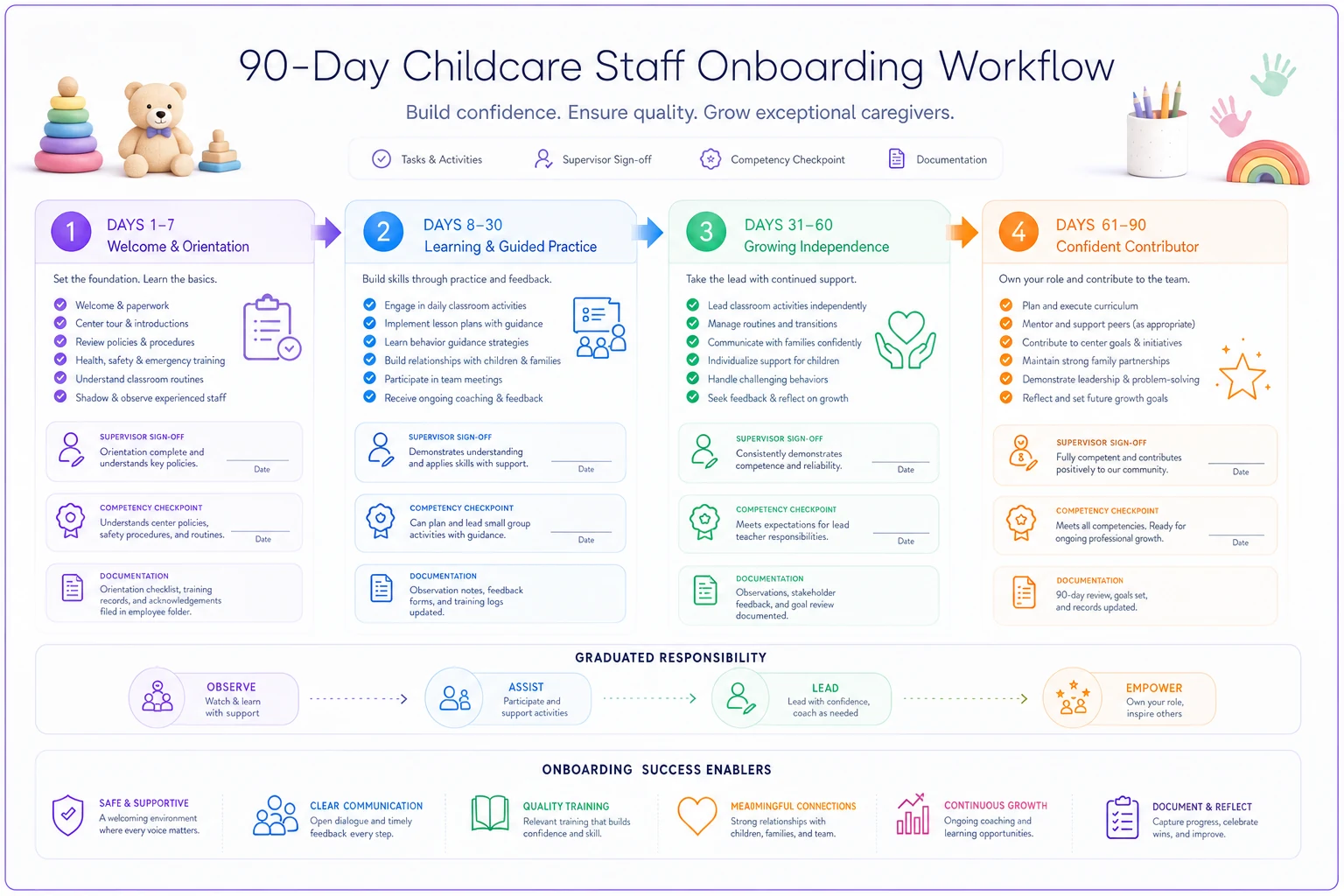
Days 1–7 checklist:
-
Background check and fingerprinting initiated
-
Emergency procedures reviewed with scenarios
-
Hand hygiene protocol demonstrated (minimum 3 observed instances)
-
Allergy response practiced with EpiPen trainer
-
Mandatory reporting obligations reviewed with written examples
-
Classroom ratio rules explained and confirmed
-
Supply location and ordering process walkthrough
-
Incident reporting system introduced
Days 8–30 checklist:
-
Morning arrival led independently with supervisor present
-
Full snack routine completed alone
-
First incident report written and reviewed
-
Naptime sleep checks completed on schedule (documented)
-
First parent communication handled, notes reviewed afterward
-
Transition between two activities managed independently
-
Daily observation sheets completed without prompting
-
Background check status confirmed; contingency plan in place if pending
Days 31–60 checklist:
-
Ratio reorganization scenario completed
-
Practice emergency evacuation with unplanned complication
-
Difficult parent conversation roleplay conducted
-
Food delivery received and temperature logs updated
-
Supply order submitted correctly
-
Developmental assessment interpreted and concern identified
-
Subsidy attendance sheet completed accurately (assistant director sign-off)
-
Allergy and special diet protocols confirmed with kitchen staff (cook sign-off)
-
Lesson plan reviewed against curriculum standards (curriculum coordinator sign-off)
-
Licensing competency benchmark documentation completed if applicable
Days 61–90 checklist:
-
Parent conference led independently
-
Custody dispute at pickup scenario practiced
-
Injury documentation and reporting walkthrough completed
-
Lockdown drill ratio management demonstrated
-
Management system report generated for parent
-
Classroom assessment data reviewed and trend identified
-
Budget or supply management task completed independently
-
Early intervention coordination process reviewed
-
90-day comprehensive evaluation completed with forward-looking goals
This structure gives you something concrete to work from rather than relying on whoever happens to be supervising that week to remember what needs covering.
The real cost of weak onboarding workflows
Centers with poor onboarding typically see turnover rates in the range of 35–40% within the first 90 days. For every three teachers you hire, at least one won't make it through probation. At roughly $3,000–$4,000 per hiring cycle—recruiting, training time, productivity loss during the gap—that adds up fast across a single year.
The operational costs run deeper than the dollar figures. When teachers aren't properly prepared, every day brings small failures that compound. They don't complete observations correctly, creating gaps in developmental tracking. They miss early warning signs of behavioral concerns, leading to larger incidents later. They communicate poorly with parents, eroding trust and eventually causing disenrollment.
Strong onboarding with clear competency checkpoints changes these dynamics. Teachers feel confident rather than overwhelmed. They handle challenges independently rather than constantly pulling someone away from their own classroom. They become contributors to operational stability rather than sources of disruption.
The childcare staff onboarding checklist isn't just documentation—it's your operational foundation. Every competency validation, every sign-off, every structured practice session builds toward teachers who strengthen rather than strain your center.
Making this process systematic is where the right tools matter. AI-powered operational platforms can track competency development automatically, flag when someone is falling behind schedule, and make sure nothing gets missed during busy periods when a director is stretched thin. They turn onboarding from a compliance exercise into actual capability building.
Your next hire is either going to strengthen or stress your operation. The difference isn't just the person you choose—it's the process you put them through. A clear, milestone-driven onboarding workflow with documented competencies at every phase creates teachers who thrive. Anything less creates problems that ripple through your center for months.
Ready to elevate your childcare management?
Join hundreds of childcare providers using Totsyly to save time, improve communication, and grow their centers.