

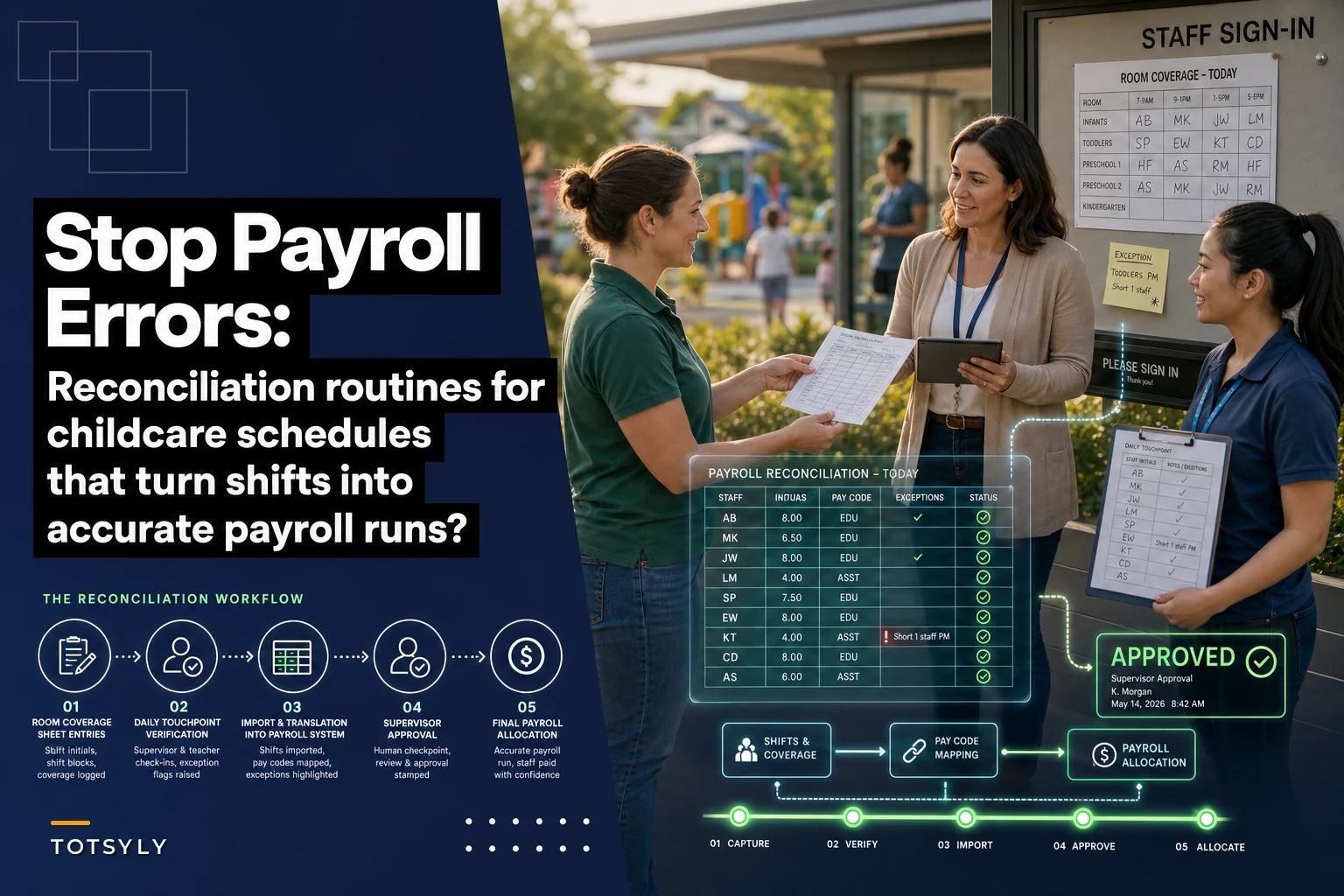

Childcare payroll should be simple. Track who worked, multiply hours by rate, cut checks. That clean equation falls apart fast once you factor in how a daycare actually runs.
The hidden complexity of childcare payroll that breaks most centers
Teachers float between rooms to maintain ratios. Part-timers cover unexpected gaps. Split shifts happen when enrollment fluctuates mid-day. Overtime kicks in during staff shortages. Training hours mix with regular hours. Break coverage creates fractional time entries. The schedule you planned Monday looks nothing like what happened by Friday.
Most centers discover payroll reconciliation childcare problems only after running payroll. An assistant teacher notices her check is short four hours. A floater sees she wasn't credited for covering the toddler room. The lead teacher questions why her planning time wasn't included. By then you're dealing with frustrated staff, manual corrections, and sometimes labor board inquiries.
The damage goes beyond immediate corrections. Staff start doubting every paycheck. They track their own hours defensively. Trust erodes. Good teachers leave for centers with "better payroll systems." Meanwhile you're spending somewhere between six and eight hours every pay period just fixing discrepancies.
Why childcare scheduling creates unique reconciliation nightmares
The fundamental problem isn't your payroll software or even your scheduling system. It's the gap between how childcare actually operates and how traditional timekeeping works.
Simplify your childcare center’s daily operations.
Totsyly helps you manage enrollments, staff, and communications efficiently so you can focus on care.
- Streamlined enrollment & waitlist management
- Automated billing & payment tracking
- Staff scheduling & attendance monitoring
No credit card required
Standard businesses have employees who clock in, work a shift, clock out. Clean data flows from timecard to payroll. Childcare doesn't work that way. A teacher might start in the infant room at 7am, move to preschool at 10am when ratios allow, cover someone's lunch at noon, then float back to infants when a parent picks up early. Each transition is a data point that could easily get lost.
State regulations compound everything. Different rooms often carry different ratio requirements, which means different staffing costs. An employee in the infant room at a 4:1 ratio represents a different operational cost than when they're in the preschool room at 10:1. Some states require higher-qualified staff for certain age groups, triggering different pay rates for the same employee depending on room assignment.
Then there's the daily chaos. Parents arrive late, requiring overtime authorization. A teacher calls in sick, forcing rapid reassignments. A child has a medical emergency, pulling multiple staff from their assigned rooms. Each deviation from the planned schedule creates another reconciliation point.
The scheduling software shows one reality. The timeclock shows another. The actual coverage logs show a third. Finding the truth between those three sources manually takes hours and still leaves room for disputes.
The Monday morning reconciliation routine that catches problems early
Centers that reconcile daily catch significantly fewer payroll errors than those who wait until payroll processing day. That pattern shows up consistently once you start paying attention to it.
Start each Monday by pulling three reports: planned schedule from the previous week, actual clock-in/out times, and room coverage logs. Don't wait for perfect data. Even rough reconciliation beats discovering problems two weeks later.
Create a simple exception report that flags obvious discrepancies. Look for:
-
Teachers scheduled but never clocked in. This often means last-minute coverage changes that weren't documented. Maybe Sarah called in sick and texted the director, but nobody updated the scheduling system.
-
Clock times exceeding scheduled hours by more than 15 minutes. Usually someone stayed late for a parent or covered an unexpected gap. These are legitimate overtime situations that need documentation.
-
Room assignments that don't match timecard locations. The schedule said Jennifer was in toddlers, but she badged into the infant room system. This typically happens during ratio coverage but needs tracking for accurate cost allocation.
-
Multiple clock-ins without corresponding clock-outs. Classic sign of someone covering multiple rooms or forgetting to clock out during transitions. These create phantom hours that inflate payroll.
Time-box the Monday reconciliation to 20 minutes so it stays focused on obvious exceptions rather than minute-by-minute perfection.
The goal is making this a 20-minute Monday morning routine, not a massive investigation. You're looking for patterns and problems, not perfecting every minute. Document what you find, get quick clarifications from floor supervisors, then move on.
Daily touchpoints that prevent discrepancy accumulation
The Monday reconciliation catches last week's problems. Daily touchpoints prevent this week's problems from happening.
Around 10am, have your assistant director or lead teacher do a quick schedule audit. Takes three minutes. They walk through and confirm who's actually in each room versus who the schedule says should be there. Any discrepancies get noted in a simple log — nothing fancy, just "Maria covering for Tom in toddlers 10am-12pm."
End-of-day reconciliation happens during the 5pm-6pm wind-down when most kids have left. The closing supervisor spends about five minutes reviewing:
-
Who worked overtime (anyone over 8 hours)
-
Any unplanned room changes
-
Tomorrow's potential issues based on today's absences
This isn't about perfect documentation. You're building a paper trail that makes weekly reconciliation possible. The assistant who covered someone's bathroom break for 15 minutes might seem trivial, but those segments add up to hours of disputed time by month's end.
The communication piece matters too. Staff need to know these checks happen daily. When they see you actively tracking coverage and assignments, they're less likely to dispute payroll later. They trust the system captures their work accurately.
Exception reporting templates built for childcare's reality
Generic exception reports miss the nuances of childcare operations. You need templates that reflect your specific patterns.
The Ratio Coverage Exception Report Tracks when staff moved between rooms to maintain legal ratios. Columns include: Employee Name, Original Assignment, Temporary Assignment, Time Range, Reason (ratio maintenance, break coverage, emergency). Why it matters: a teacher who spends two hours in the infant room should potentially receive infant room pay rates if your center differentiates. Without tracking these movements, you're either consistently overpaying or underpaying.
The Overtime Authorization Matrix Lists every instance where someone exceeded 8 hours or 40 weekly hours. Shows: Employee, Scheduled Hours, Actual Hours, Variance, Authorization Status, Authorizing Manager. The authorization status is crucial for protecting against labor claims. "Unauthorized" doesn't mean unpaid — it means you need to investigate why the overtime happened and whether process changes could prevent it.
The Float Staff Reconciliation Sheet Float staff break traditional payroll reconciliation because they don't have fixed assignments. Track: Date, Float Employee, Rooms Covered, Time in Each Room, Total Hours, Verification Source (supervisor signature, system log, etc.). Floaters often get shortchanged because their hours are hard to track across multiple rooms. This report ensures every hour gets captured and attributed correctly.
| Report | What It Tracks | Why It Matters |
|---|---|---|
| Ratio Coverage Exception | Room transitions for ratio compliance | Prevents overpay or underpay by room |
| Overtime Authorization Matrix | Hours exceeding daily/weekly limits | Documents authorization for labor claims |
| Float Staff Reconciliation | Hours across multiple rooms | Ensures floaters don't get shortchanged |
| Training Hours Tracker | Training vs. regular hours | Avoids unnecessary overtime costs |
Many centers accidentally pay overtime rates for training hours that could've been scheduled during regular time. This visibility helps you optimize training schedules around payroll impacts.
The Wednesday approval checkpoint that stops problems from reaching payroll
Wednesday becomes your defensive line against payroll errors. By mid-week, you have enough data to spot problems but still have time to fix them before Friday payroll processing.
-
Assistant directors receive their preliminary hours report by noon Wednesday. It shows each employee's accumulated hours for the week so far, plus projected hours based on the remaining schedule. Anyone trending toward overtime gets flagged.
-
Department leads have until 3pm to review and approve their team's hours. They're not approving final payroll — they're confirming hours look reasonable based on what actually happened. "Yes, Sarah did work that double shift Monday." "No, Tom wasn't here Tuesday — he swapped with Michael."
-
Discrepancies get investigated immediately, not Friday afternoon when payroll is due. The employee who claims they worked but doesn't show in the system? You have two days to figure out if they forgot to clock in or if there's a scheduling mix-up.
-
By 4pm Wednesday, you lock in acknowledgment that the first three days have been reviewed. Not the hours themselves — those can still be edited — but confirmation that someone actually looked at them. This creates accountability. If a discrepancy surfaces later, you know exactly which supervisor signed off and when.
This checkpoint also surfaces scheduling problems before they compound. That teacher approaching overtime by Wednesday? You can adjust Thursday and Friday coverage to avoid the hit. The float teacher with only 12 hours so far? You know they're available for additional shifts without triggering overtime.
Turning room transitions into trackable payroll data
Room transitions are the biggest black hole in childcare payroll reconciliation. A teacher might make three or four room changes daily, each one a potential tracking failure.
The solution isn't forcing teachers to clock in and out of every room — that disrupts child care and creates resistance. Instead, build transition tracking into existing routines.
Room coverage sheets posted by each door become your source of truth. Simple grid: time slots down the left, staff names across the top. When someone enters to cover, they initial their box. When they leave, they note the time. Takes two seconds, becomes habit quickly.
Here's a simple workflow for translating room transitions into payroll entries.
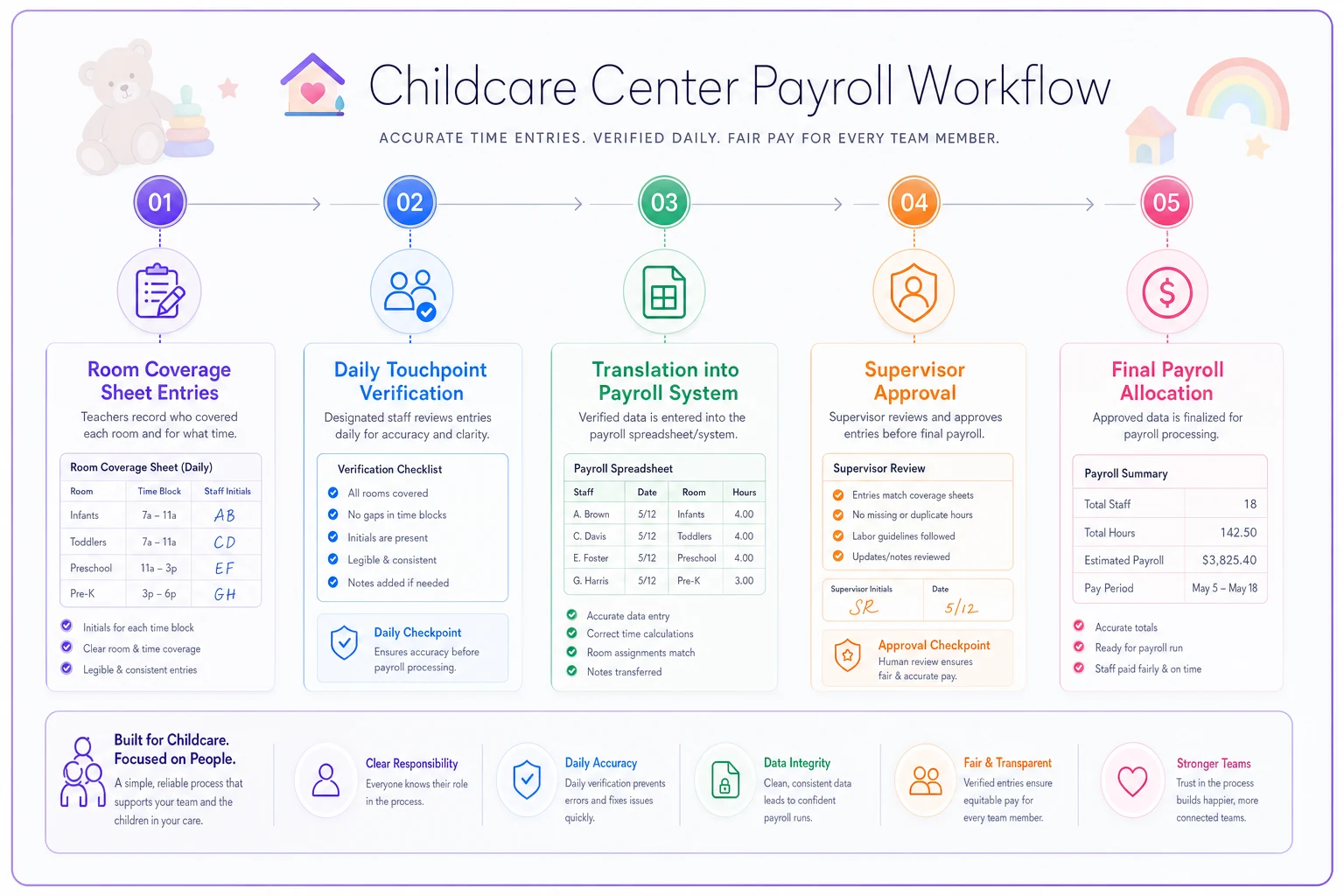
But sheets alone don't solve reconciliation. You need a translation layer between paper logs and your payroll system. That happens during the daily touchpoint routine. The closing supervisor doesn't just review the sheets — they enter transitions into a simple spreadsheet or operational system. Five minutes of data entry prevents hours of confusion later.
For centers using badge systems or biometric scanners, you can automate much of this. But even automated systems need human verification. The scanner might show Jennifer entering the toddler room at 10am, but only she knows whether she was providing ratio coverage or just dropping off supplies. Context matters for accurate payroll allocation.
Some centers resist tracking at this level, thinking it's overkill. Consider the alternative though: a teacher works 30 hours weekly, spending roughly 10 of those hours floating between rooms. Without tracking, you're guessing at labor costs per classroom. With tracking, you know exactly which programs are consuming resources — and that data drives better scheduling decisions well beyond payroll accuracy.
Dispute resolution workflows that preserve staff relationships
Even with solid reconciliation routines, disputes happen. How you handle them determines whether they become trust-building moments or relationship-ending conflicts.
Document everything from day one, but don't weaponize it. When a teacher says "I worked those hours," your response shouldn't be "prove it." It should be "let me pull up our records and let's figure out what happened together."
The investigation usually follows the same path:
-
Check the primary source — usually timeclock data. If the employee claims they worked but no clock record exists, check if they badged in at all that day. Sometimes the morning clock-in fails but they were clearly present (multiple witnesses, appear in activity photos, signed forms).
-
Verify with room coverage logs. Does their name appear on any room sheets? Even if they forgot to clock in, their initials on coverage sheets prove presence.
-
Confirm with supervisors. Not interrogation-style questioning — collaborative fact-finding. "Jennifer says she covered toddlers Tuesday morning. Do you remember seeing her?" Supervisors often remember details that didn't get documented.
If discrepancies remain after investigation, err on the side of the employee for small amounts. Fighting over two hours damages a relationship worth far more than the $30-40 in question. Document the resolution thoroughly, though. Patterns of repeated discrepancies might indicate either system problems or intentional time manipulation.
For larger disputes, involve the employee in creating the solution. "How can we prevent this confusion next time?" Often they'll suggest reasonable fixes — texting supervisors when coverage changes, taking photos of paper timesheets, that kind of thing.
Automation opportunities without losing human oversight
The right operational software transforms payroll reconciliation from a manual nightmare into a mostly automated process with human verification at key points. But automation in childcare requires careful implementation.
Start with the obvious: connecting scheduling software to timeclock systems. When the schedule says Maria works 7am-3pm and she clocks in at 7:02am, that's an automatic match — no reconciliation needed. But when she clocks in at 6:45am, the system flags it for review. Maybe she's covering for someone, maybe something else is going on.
Automated exception reporting eliminates the manual report-pulling routine. Every morning, supervisors receive their exception list: who didn't clock in, who worked overtime, who changed rooms. Instead of hunting for problems, they're reviewing a curated list.
Room transition tracking benefits a lot from automation too. Teachers use a tablet at room entrances or wear simple proximity badges. The system logs entries and exits automatically, calculating time spent in each room. You still need human verification though — the system knows Jennifer entered the infant room at 10am, but only she knows whether she was providing ratio coverage or just retrieving supplies.
The real power comes from pattern recognition. AI-powered operational platforms can identify that Tom consistently clocks in 15 minutes early on Tuesdays — probably legitimate since he opens that day, but worth confirming once. Or flag that overtime always spikes when certain supervisor combinations work together, which might mean they're not coordinating coverage effectively.
What automation shouldn't do: make final decisions about disputed hours, automatically deny overtime, or replace human judgment on edge cases. The goal is reducing manual data entry and calculation, not eliminating human oversight of a fundamentally human process.
Centers using operational platforms with built-in automation report cutting reconciliation time significantly — some by more than half. But the bigger win is accuracy. When you're not manually calculating hours and transitions, transcription errors disappear. When exception reports are automatic, you catch problems before they compound.
Building reconciliation into weekly operational rhythm
Reconciliation only works when it becomes routine, not a special project. The most successful centers build it into their operational rhythm so naturally that skipping it feels wrong.
Monday morning starts with the previous week's reconciliation. While teachers are settling in, administrators spend 20 minutes reviewing exceptions and documenting findings. It becomes as routine as checking email.
Wednesday afternoon brings the approval checkpoint. Department leads know that 2pm-3pm Wednesday is payroll review time. They plan their classroom coverage accordingly. It's on the calendar, it's expected, it happens without reminders.
Friday morning, before processing payroll, there's a final sweep. Not deep reconciliation — that already happened. Just verification that Wednesday's approvals still look correct and nothing major emerged Thursday.
This rhythm creates predictability for staff too. They know their hours get reviewed Monday and Wednesday. If there's a problem with their timecard, they'll hear about it within days, not at the end of the month. That quick feedback loop prevents small misunderstandings from becoming major disputes.
The routine also surfaces operational patterns you might otherwise miss. Overtime consistently spiking the third week of each month? That's probably when multiple staff tend to use vacation days, forcing others to cover. Monday transitions always messy? Maybe weekend staff don't update the coverage board before leaving. These insights drive process improvements well beyond payroll accuracy.
Measuring success: from constant disputes to payroll confidence
You know reconciliation routines are working when the frantic Friday payroll calls stop. When teachers stop keeping their own defensive time logs. When "payroll problems" disappears from staff meeting agendas.
A few key metrics worth tracking:
| Metric | Baseline (Before) | Target (After 3 Months) |
|---|---|---|
| Payroll disputes per period | 5–7 | Under 2 |
| Dispute resolution time | ~45 minutes each | Under 10 minutes |
| Weekly payroll processing time | 8–10 hours | 3–4 hours |
| Staff paycheck confidence | Low | Noticeably higher |
Ask staff directly: "How confident are you that your paycheck accurately reflects hours worked?" It's a simple question and the answers shift noticeably within a few months of getting reconciliation right.
The real success shows up in retention and culture, though. When staff trust payroll, they trust management. When paychecks are accurate, people feel valued. Those soft benefits matter more than the time savings, even though both are real.
One pattern worth noting: centers that get payroll reconciliation right tend to handle other operational challenges well too. The discipline it requires — attention to detail, routine execution, proactive problem-solving — those habits improve everything from ratio maintenance to parent communication.
From reactive fixes to proactive accuracy
Payroll reconciliation in childcare will never be as clean as retail or office environments. The complexity is baked in — constant transitions, regulatory requirements, the daily unpredictability of caring for young children.
But that complexity doesn't mean payroll has to be a disaster. Daily reconciliation routines, proper exception reporting, and smart automation can turn payroll from a bi-weekly crisis into something predictable and manageable.
Centers that struggle with payroll reconciliation aren't necessarily disorganized. They're usually just trying to force childcare operations into generic timekeeping systems that weren't built for this environment. Once you build reconciliation routines that actually account for childcare's patterns, accuracy follows.
Start with Monday morning reconciliation. Add Wednesday approval checkpoints. Build simple exception reports that flag your specific problems. Document room transitions in whatever way fits your center. These aren't massive organizational changes — they're small operational habits that compound into real improvements.
Don't lose sight of why it matters beyond compliance and cost control either. In an industry dealing with high annual turnover, getting paychecks right is one of the clearest ways to show your teachers that their work is seen and valued. Every hour spent building better reconciliation routines saves dozens of hours in dispute resolution and replacement costs — and builds the kind of operational foundation that lets you focus on what you're actually there to do.
Start with Monday morning reconciliation. Add Wednesday approval checkpoints. Build simple exception reports that flag your specific problems. Document room transitions in whatever way fits your center. These aren't massive organizational changes — they're small operational habits that compound into real improvements.
Ready to elevate your childcare management?
Join hundreds of childcare providers using Totsyly to save time, improve communication, and grow their centers.