

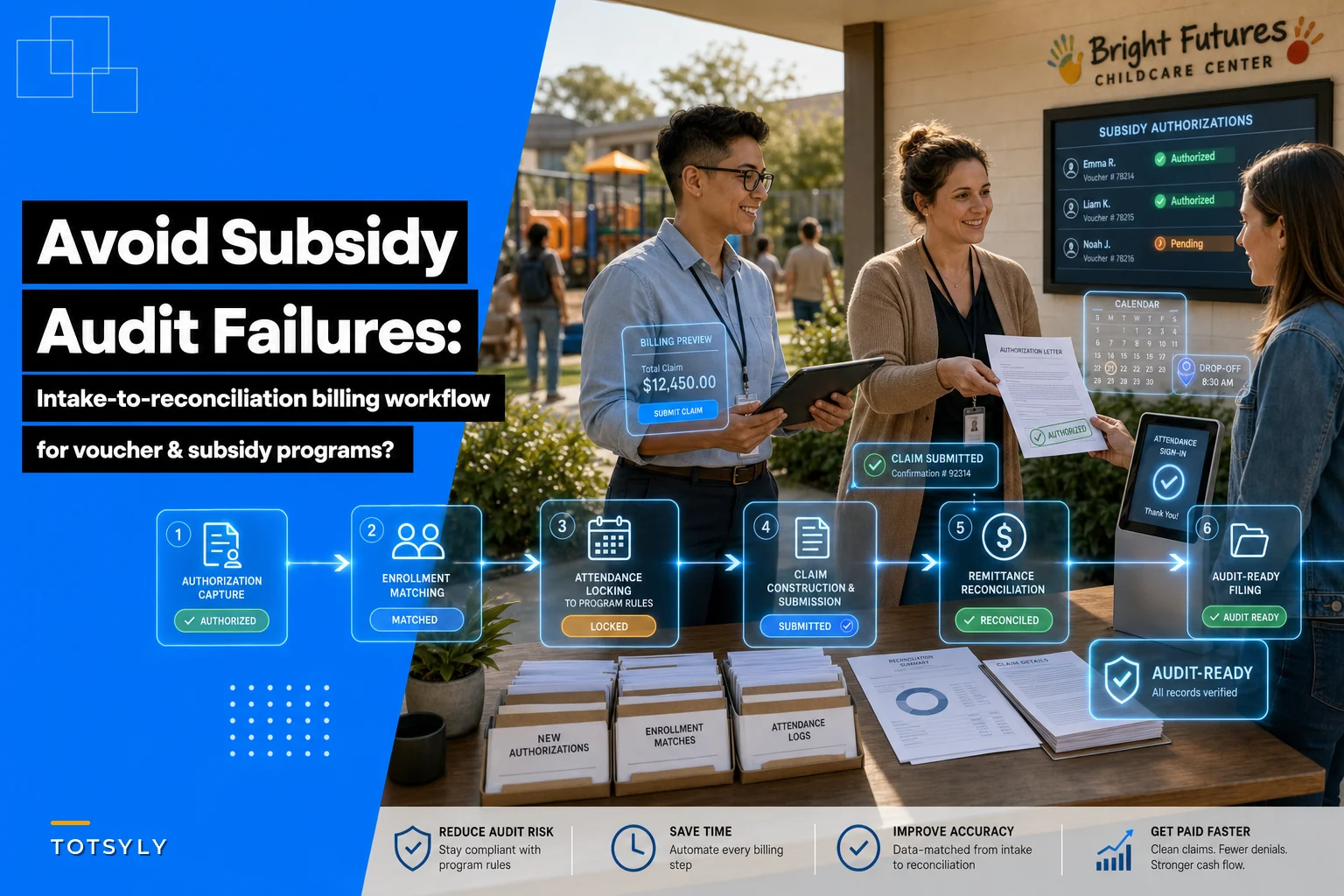

Most centers don't fail subsidy audits because they committed fraud. They fail because someone billed three weeks against an authorization that expired on the 14th, or because the attendance sheet says a child was present 21 days and the state portal shows 18, and nobody caught the gap until the recoupment letter showed up.
Subsidy money is slow, finicky, and governed by rules that shift per county, per program, sometimes per caseworker. The programs go by different names depending on where you operate — CCDF, voucher, scholarship, Title XX, state pre-K — but the operational failure modes are almost identical. The authorization doesn't match the billing period. The co-pay collection falls apart. Attendance records don't tie out to what you invoiced. And when the audit comes, there's no clean trail connecting the authorization to the attendance to the claim to the payment.
This post is about building that trail on purpose — from the moment a subsidized family walks in to the moment you reconcile the deposit — so the audit is a formality instead of a crisis.
Where subsidy billing actually breaks
The money doesn't disappear in one big event. It leaks at the seams between steps, and each seam has a predictable failure.
Authorization intake. A family brings in a voucher dated to start the 1st, but the child's first day is the 8th. Someone bills from the 1st. Or the authorization covers full-time care and the child attends part-time — nobody flags the mismatch. The most common version: the authorization is approved for a specific number of units or days per week, and the center bills attendance without ever checking the claim against that cap.
The co-pay / family share. Subsidy almost never covers 100%. There's a parent portion, and that portion is where margin quietly dies. Centers either forget to bill it, bill it inconsistently, or let it slide for families they like. When the state audits, they can ask you to prove you collected the required family share. If you waived it without documentation, that's a finding — and in some programs, waiving the co-pay improperly can jeopardize the whole authorization.
Attendance capture. This is the big one. Subsidy pays for attendance, absences, or enrollment depending on the program's rules, and those rules are specific. Some programs pay for a set number of absent days per month. Some require a signature at drop-off and pick-up. Some reimburse enrollment regardless of attendance up to a threshold. If your attendance records don't match the rule you billed under, you lose.
Billing cadence. Subsidy portals have submission windows. Miss the window and you wait a full cycle — or forfeit the claim entirely. Centers that bill private tuition monthly often try to force subsidy onto the same calendar, then scramble when the county wants claims submitted by the 5th for the prior month.
Reconciliation. The payment arrives weeks later, frequently for a different amount than you claimed, with a remittance that's cryptic at best. Nobody matches the payment back to the claim. The variance just sits there. Multiply that across 30 subsidized kids over a year and you've got thousands in unreconciled drift.
The intake-to-reconciliation workflow
Here's the full chain, step by step. The goal is that every dollar you eventually get paid can be traced backward to an authorization document and forward to a reconciled deposit.
Simplify your childcare center’s daily operations.
Totsyly helps you manage enrollments, staff, and communications efficiently so you can focus on care.
- Streamlined enrollment & waitlist management
- Automated billing & payment tracking
- Staff scheduling & attendance monitoring
No credit card required
-
Capture the authorization as structured data, not a PDF in a folder. The moment a family hands you a voucher, record: program name, authorization number, approved start and end dates, approved care level (full/part time), approved units or days per period, family share amount, and caseworker contact. These fields drive every downstream check. A scanned PDF buried in a shared drive helps nobody when billing day comes.
-
Set the authorization window as a hard constraint. The start date is the earliest billable day. The end date triggers a renewal alert before it lapses, not after. Build in a 30-day lead on renewals — caseworkers are slow, and a gap in authorization means you're providing free care.
-
Reconcile authorization against actual enrollment at the start. Approved full-time but child attends three days? Flag it. Either the schedule changes or the authorization needs to be amended. Billing full-time units for a part-time child is one of the cleanest ways to earn a recoupment.
-
Collect the family share on the same cadence as the subsidy claim. Don't let the co-pay float on a separate track. If you're claiming for March attendance, the March family share should be invoiced and tracked in the same cycle. If a family can't pay, document the arrangement — don't just quietly waive it.
-
Lock attendance to the program's reimbursement rule. Know whether you're being paid on attendance, enrollment, or a hybrid, and capture exactly what that rule requires. If the program needs signed daily records, the signature is part of your billing evidence, not a side formality.
-
Build the claim from attendance, then check it against the authorization cap before submission. This is the single most valuable step. Before anything leaves your hands, the claimed units get compared against the approved units. Over the cap? Trim it and flag it — don't submit it and wait for the clawback.
-
Submit inside the program's window, and log the submission. Date, amount, units claimed, who submitted. If the portal gives a confirmation number, capture it. That's your proof the claim went out on time.
-
Reconcile every remittance against its claim. When payment lands, match it line by line: claimed amount, paid amount, variance, and reason. A short remittance with no explanation becomes a to-do, not a shrug.
-
File the full chain together. Authorization → attendance → claim → remittance → reconciliation note, all linked. When the auditor asks about one child in one month, you pull one packet.
Here's a simple visual of the workflow.
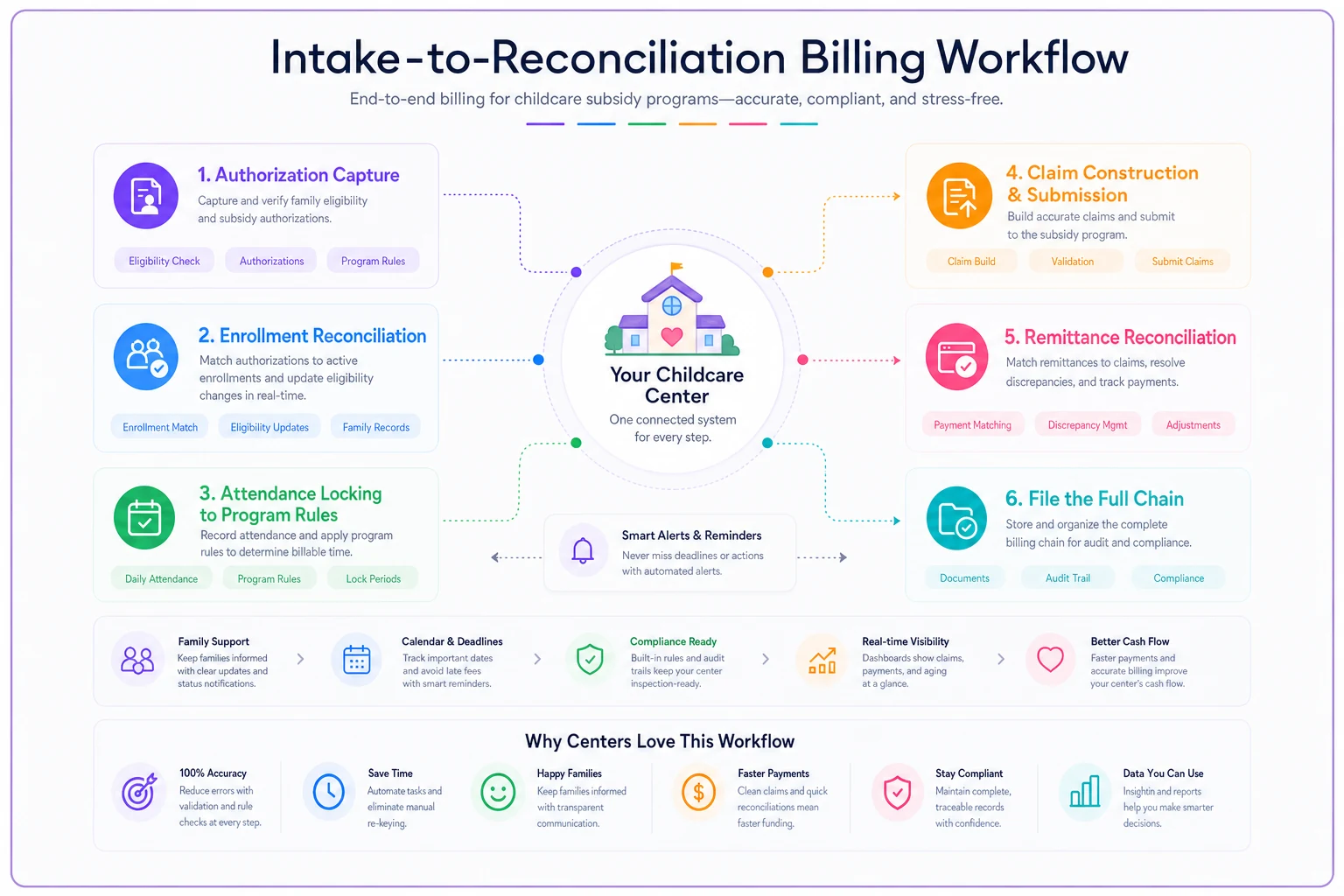
Reconcile every remittance against its claim.
A reconciliation template that actually ties out
The reason reconciliation gets skipped is that people try to do it in their heads or in a messy spreadsheet with no variance logic. A workable template has a row per child per billing period and columns that force the match:
| Child | Period | Auth units | Attended units | Claimed units | Expected pay | Paid amount | Variance | Reason | Status |
|---|---|---|---|---|---|---|---|---|---|
| A.R. | Mar | 20 days | 19 days | 19 days | $684 | $684 | $0 | — | Closed |
| T.M. | Mar | 22 days | 22 days | 22 days | $792 | $720 | -$72 | 2 days denied, absence cap | Appeal filed |
| J.K. | Mar | 15 days | 16 days | 15 days | $540 | $540 | $0 | Attended over auth, trimmed | Closed |
The value here isn't the table itself — it's the variance and reason columns. A variance with a blank reason is an open investigation. The "Status" column keeps denials and appeals from vanishing into the pile. Centers that lose subsidy revenue aren't usually the ones with high denial rates; they're the ones who never follow up on denials because nobody tracked them in the first place.
Notice the J.K. row: attended 16 days, authorized for 15, claimed 15. That's the discipline that keeps you out of trouble. You don't bill what you didn't have authorization for, even if the child was physically there.
Audit-prep: what the packet needs to contain
When the audit notice arrives, you don't want to be reconstructing anything. The prep work happened during the workflow. Your job at audit time is assembly. For each selected child and period, the packet should hold:
-
The authorization document showing approved dates, level, units, and family share
-
Any renewal or amendment documents covering the period
-
Attendance records in the format the program requires (signatures, timestamps, whatever applies)
-
The submitted claim with its submission date and confirmation
-
The remittance advice showing what was paid
-
The reconciliation note explaining any variance between claimed and paid
-
Proof of family-share invoicing and collection (or a documented arrangement)
If you can produce those seven things for any child the auditor names, you pass. Findings almost always come from a missing link — an attendance record that doesn't match the claim, a family share nobody can show was billed, a claim against an authorization that had already expired.
A real scenario
A two-site center running roughly 35 subsidized children across a county voucher program and a state scholarship was losing money nobody could quite explain. Private-pay tuition reconciled fine. Subsidy was a black hole.
When they actually sat down and reconciled a quarter by hand, the picture came together. About a dozen claims had been short-paid over three months — absence days denied, a couple of authorizations that had lapsed mid-month without anyone noticing, one child billed full-time who'd dropped to part-time in February. Nobody had appealed anything because nobody had matched payments to claims. The unrecovered variance ran somewhere in the $4k–$5k range for the quarter, and that didn't even count the family-share amounts that had quietly been waived.
The fix wasn't complicated. They built structured authorization records, set renewal alerts 30 days out, and started reconciling every remittance against its claim using the template above. Within two billing cycles, the lapsed-authorization gaps stopped entirely — those are 100% preventable once you're watching end dates. Short-pays didn't vanish, but now they got appealed, and a meaningful chunk came back. More importantly, when a monitoring visit hit a few months later, the reviewer pulled four children and the packets came out clean the first time.
The outcome that mattered most wasn't the recovered dollars. It was that the director stopped dreading the mail.
Where software earns its place — and where it doesn't
A lot of this can run on a disciplined spreadsheet and a calendar reminder if you've got one site and ten subsidized kids. The manual version works until volume breaks it. Where AI-assisted operational platforms genuinely help is in the parts humans forget: flagging an authorization 30 days before it lapses, catching when claimed units exceed approved units before submission, surfacing remittance variances automatically instead of waiting for someone to notice.
The useful framing is that automation shouldn't make billing decisions for you — subsidy rules are too jurisdiction-specific and too prone to change for that. What it should do is enforce the checks you already know you need and refuse to let claims go out when the data doesn't tie. That's the difference between a tool that reduces errors and one that just moves them somewhere else.
Pro-tip: Systematize once you're managing more than one program, multiple sites, or roughly 15 subsidized children.
When it makes sense to systematize this: more than one program, more than around 15 subsidized children, or more than one site. Once you're juggling different reimbursement rules and submission windows, the manual version stops scaling and the gaps start appearing.
When it doesn't: a single program, a handful of kids, one caseworker you know by name. A clean spreadsheet and a renewal reminder will carry you, and you shouldn't over-engineer it.
The one habit that prevents most findings
Reconcile the payment against the claim, every cycle, with the variance written down. Almost every audit failure and almost every dollar of leaked subsidy revenue traces back to a gap between what you claimed and what you got paid that nobody ever examined.
The authorization intake, the family-share discipline, the attendance matching — all of it feeds that reconciliation step. Get the chain connected once, keep it connected every cycle, and the audit becomes what it's supposed to be: someone confirming records you already have in order.
The authorization intake, the family-share discipline, the attendance matching — all of it feeds that reconciliation step. Get the chain connected once, keep it connected every cycle, and the audit becomes what it's supposed to be: someone confirming records you already have in order.
Ready to elevate your childcare management?
Join hundreds of childcare providers using Totsyly to save time, improve communication, and grow their centers.