

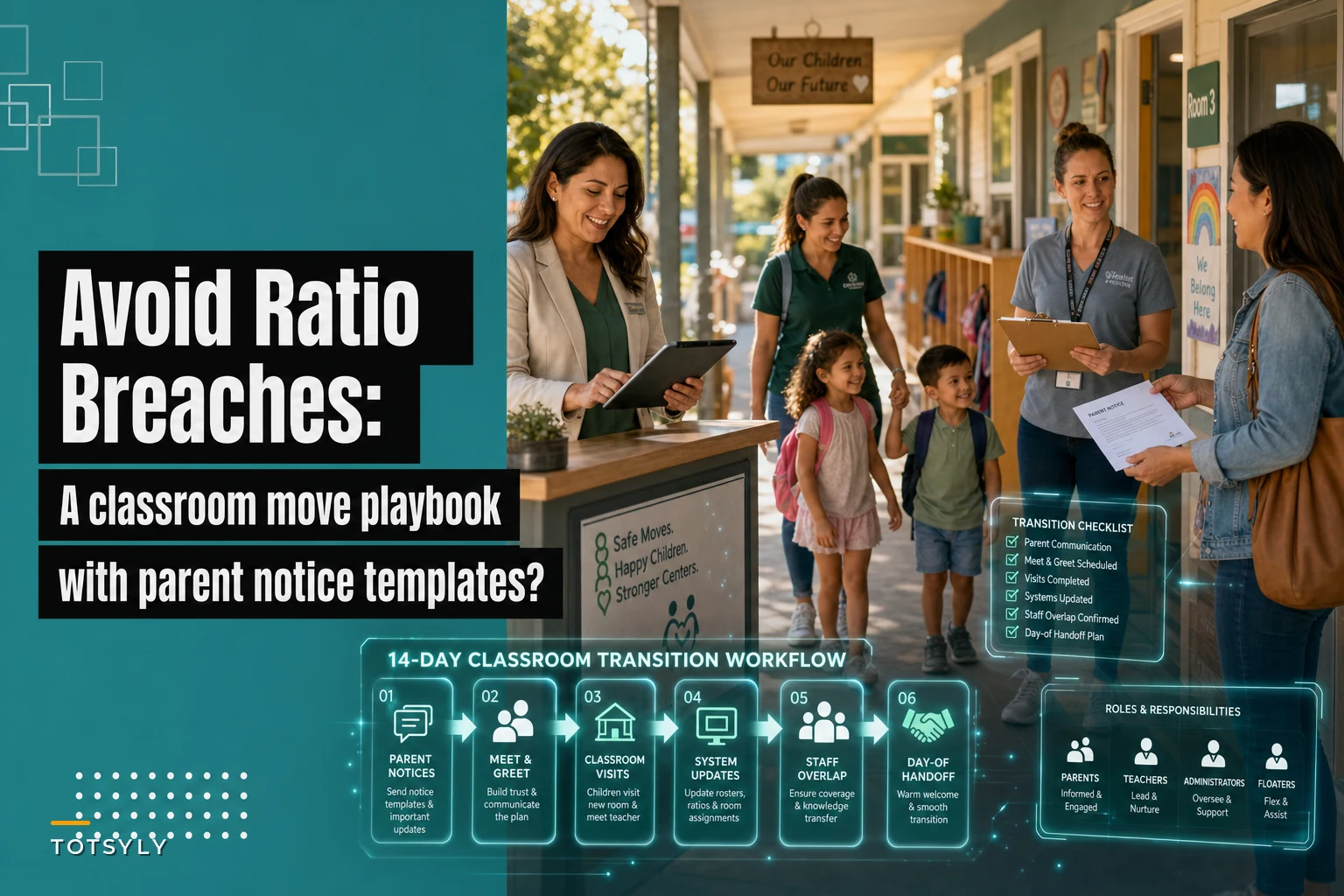

Classroom transitions in childcare happen constantly. Kids age out, enrollment shifts, new rooms open. Yet most centers handle these moves with sticky notes and verbal handoffs that create ratio violations, parent confusion, and staff scrambling.
The real mess happens in the overlap periods. You've got a three-year-old moving from toddlers to preschool next Monday. The toddler room needs that spot for a waitlisted family. Preschool's already at 19 kids with two teachers. Add one more child without adjusting staff, and you're suddenly non-compliant. Meanwhile, nobody told the afternoon floater about the change, parents show up confused about pickup locations, and your attendance tracking shows the child in two rooms simultaneously.
Why classroom transitions turn into compliance disasters
The core problem isn't the move itself — it's the coordination cascade that follows. Each classroom transition touches roughly 12–15 different operational checkpoints, from ratio calculations to emergency contact updates to meal counts. Miss any single one, and you're either violating regulations or creating parent trust issues.
Take ratio calculations. When Little Learners moved seven children from their two-year-old room to the newly opened older-twos classroom, they thought they'd planned perfectly. New room had proper staffing, old room adjusted schedules. What they missed: the transition happened gradually over two weeks to help kids adjust. During those overlap days, children spent mornings in the new room and afternoons in the old room. Their tracking system couldn't handle split-day assignments, so staff manually tracked on paper. Licensing showed up on day three. The inspector pulled attendance records and found multiple ratio violations — not because staff weren't present, but because the paper tracking didn't match the digital system. Some kids appeared in neither room during transitions. Others showed in both simultaneously. The center got written up for inadequate supervision documentation, even though every child was properly supervised.
The cascade effect of poor transition planning
Classroom transitions create operational ripples that extend way beyond the immediate move. Here's what typically breaks:
Simplify your childcare center’s daily operations.
Totsyly helps you manage enrollments, staff, and communications efficiently so you can focus on care.
- Streamlined enrollment & waitlist management
- Automated billing & payment tracking
- Staff scheduling & attendance monitoring
No credit card required
Staffing assignments get scrambled. You plan teacher coverage based on current enrollment. Move five kids, and suddenly your 7 AM opener in the toddler room has only three children while the preschool teacher manages 14 alone until 8 AM. The floater who usually covers toddler breaks now needs to be in preschool, but nobody updated the break schedule.
Parent communication turns into chaos. Parents need at least five different updates for a smooth transition: initial notice, transition timeline, new teacher introduction, room location changes, and any schedule adjustments. Send these piecemeal through different channels — some via email, others on bulletin boards, a few verbal reminders — and half your parents miss critical information.
Billing and subsidy reporting breaks. Different age groups often have different rates. Move a child mid-month, and you need prorated billing adjustments. If they're on state subsidy, the age category change might affect reimbursement rates. Many centers don't catch these until month-end reconciliation, leading to weeks of corrections and confused parent invoices.
Emergency preparedness gets compromised. Your evacuation plans, emergency cards, and allergy charts are all organized by classroom. During transitions, critical information sits in limbo between rooms. The EpiPen for the transitioning child might still be in the old classroom while the child is already in the new one. Emergency contact cards get shuffled between folders.
Building a bulletproof transition framework
The centers that avoid chaos treat transitions like planned operational events, not casual moves. After watching a lot of centers navigate this, the ones that do it well follow remarkably similar protocols.
Start with clear transition criteria that everyone understands. Age alone isn't enough. You need developmental readiness markers, space availability triggers, and ratio impact assessments. A solid criteria checklist might include:
-
Child meets minimum age for new classroom
-
Demonstrates developmental milestones for target age group
-
New classroom has sustainable space (not just a temporary opening)
-
Transition maintains compliant ratios in both rooms
-
Family schedule aligns with new classroom hours
-
Any special needs accommodations transfer properly
Use a standardized checklist for every transition to avoid missed steps.
Map your transition timeline working backward from the move date. Most successful transitions follow a 14-day runway:
Visualize this workflow to keep everyone aligned.
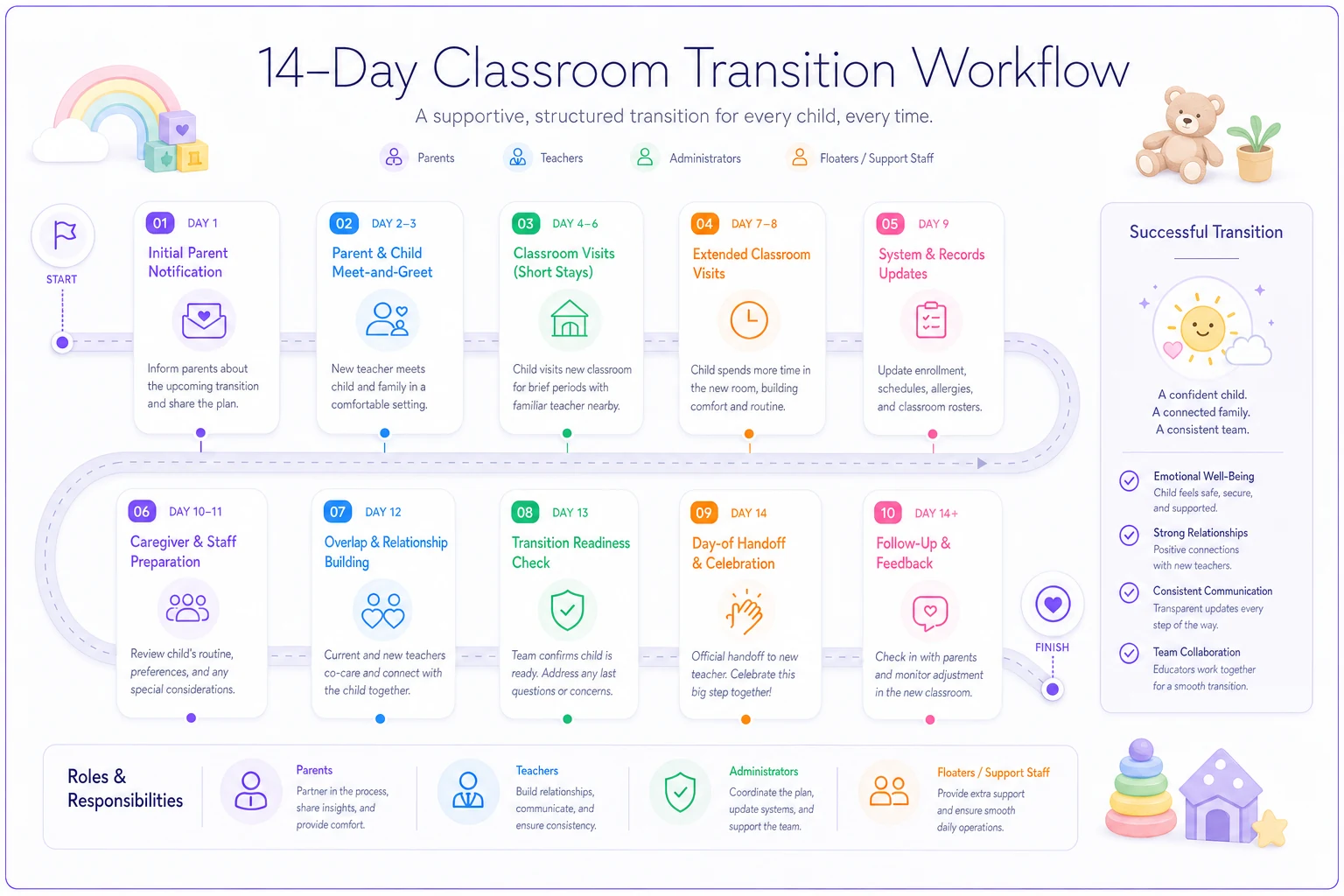
Day -14: Initial parent notification goes out. Not just an email — a formal transition letter with timeline, new teacher bio, and what to expect. Include a response form so parents acknowledge receipt.
Day -10: Host a parent-teacher meet and greet. Even 15 minutes helps parents feel comfortable with the change. The new teacher should have basic information about each transitioning child — their interests, comfort items, any specific needs.
Day -7: Children begin visiting the new classroom. Start with 30-minute visits during their happiest time of day, usually mid-morning. The familiar teacher stays initially, then gradually steps back.
Day -3: Update all operational systems. Attendance rosters, emergency cards, meal counts, billing codes, staff assignments. Run a mock day on paper to catch any gaps before they become real problems.
Day 0: Full transition with extra support. Have a floater available to help children who struggle with the change. The previous teacher should do a warm handoff at drop-off if needed.
The parent communication framework that prevents meltdowns
Parent anxiety about classroom transitions often exceeds the children's. They worry about regression, new teacher relationships, different routines. Poor communication amplifies all of that and creates friction that didn't need to exist.
A structured communication sequence addresses concerns before they arise. Here's a template sequence that tends to cut parent complaints significantly:
Initial Transition Notice (Email + Physical Letter)
> Dear [Parent Name], > > We're excited to share that [Child] will be transitioning to the [Classroom Name] on [Date]. This move reflects [Child's] growth and readiness for new challenges. > > Over the next two weeks, we'll help [Child] get comfortable with:
-
New teachers
[Names and brief bios]
-
New friends and classroom environment
-
Updated daily schedule (attached)
-
Age-appropriate activities and learning goals
> [Child] will begin short visits to the new room starting [Date]. We'll monitor their comfort level and adjust as needed. > > Please confirm you've received this notice by [Date]. Contact [Administrator] with any questions or concerns.
Transition Week Update (Mid-week check-in)
> [Child] has been visiting the [New Classroom] this week and [specific positive observation]. Tomorrow they'll [next step in transition]. > > Reminder: Starting Monday, drop-off and pickup will be in Room [Number]. The entrance is [specific directions].
Post-Transition Follow-up (End of first week)
> [Child] has completed their first week in [New Classroom]. [Specific observations about adjustment]. We'll continue supporting their transition and will update you on their progress.
Staff scheduling adjustments that maintain ratios
The scheduling puzzle during transitions requires real coordination. You can't just move bodies around — you need to account for break coverage, specialized certifications, and relationship continuity.
A real example: Rainbow Academy needed to transition six children from older toddlers to preschool. Simple math suggested moving one teacher with them would maintain ratios. But that teacher was the only toddler staff member with infant CPR certification, required for the younger children who napped in the adjoining room. Moving her would leave the toddler room non-compliant during naptime.
The solution required a three-phase staff adjustment:
Phase 1: Cross-train the preschool assistant teacher in infant CPR (two weeks before transition)
Phase 2: Overlap staffing during transition week, running slightly over budget but ensuring compliance
Phase 3: Formalize the new structure once children fully adjusted
This kind of planning seems excessive until you face a licensing violation or a panicked parent complaint. The extra coordination effort pays off in avoided crises.
Documentation requirements that inspectors actually check
Licensing inspectors focus heavily on transition periods because that's when documentation gaps appear. They're looking for proof that ratios were maintained, parents were informed, and children's records moved properly.
Create a transition tracking sheet for each child that follows them through the process:
| Checkpoint | Date Completed | Staff Initials | Notes |
|---|---|---|---|
| Parent notification sent | |||
| Parent acknowledgment received | |||
| Emergency cards transferred | |||
| Medical forms updated in new room | |||
| Billing adjustment processed | |||
| Attendance system updated | |||
| Cubby/supplies moved | |||
| Nap mat assigned | |||
| Meal count adjusted | |||
| First day in new room | |||
| One-week follow-up complete |
Keep these sheets for at least one year. Inspectors particularly scrutinize transitions involving children with special needs, subsidy recipients, or any child with documented behavioral concerns.
Technology and tracking systems for smoother transitions
Manual tracking of classroom transitions creates inevitable gaps. Even the most organized administrator can't simultaneously update a dozen different rosters, adjust billing codes, and make sure all emergency information moves properly.
This is where operational software makes a real difference. Childcare management platforms with built-in automation can trigger entire transition workflows from a single entry. Change a child's classroom assignment, and the system automatically updates attendance rosters, adjusts billing, notifies relevant staff, and generates parent communications.
The real value is in preventing the cascade failures. When Bright Beginnings implemented automated transition workflows, they eliminated the vast majority of ratio violations during moves. The system wouldn't allow a child to be assigned to a room that would exceed ratio limits. It automatically flagged when special certifications were needed and tracked the gradual transition schedule.
AI-assisted scheduling can also help predict bottlenecks before they happen. The platform can analyze a transition plan and identify that moving four children on the same day will create a coverage gap during lunch breaks three days later — then suggest staggering the transitions or adjusting float teacher schedules ahead of time.
Recovery protocols when transitions go wrong
Despite careful planning, some transitions fail. The child who seemed ready melts down completely in the new environment. Parents object strongly after the move. Staff dynamics in the new room create unexpected friction.
Quick recovery prevents small issues from becoming major disruptions. First, establish clear rollback criteria. If a child shows severe regression — refusing meals, extended crying beyond typical adjustment, toileting accidents after being trained — you need a path backward. That doesn't mean giving up at the first rough day, but it does mean recognizing when something genuinely isn't working.
A modified transition plan that extends the adjustment period often helps. Maybe the child spends only mornings in the new room for another week. Maybe they keep their nap mat in the old room as a comfort bridge. Some children need their previous teacher to do drop-offs in the new room for several days.
For parent objections, schedule an in-person conference rather than trying to resolve it through email. Usually, parents just need to voice their concerns and hear the reasoning. Showing them the developmental assessments and explaining the long-term benefits resolves most resistance.
Seasonal patterns and batch transitions
Most centers fall into reactive transition patterns — moving children individually as needs arise. This creates constant disruption and makes staff planning nearly impossible.
The most operationally efficient centers batch transitions around natural break points: end of summer, after winter break, sometimes at spring break. The advantages are pretty clear:
-
Parents expect changes at these times
-
Staff can be oriented on new rosters during breaks
-
Children transition as cohorts, maintaining some peer relationships
-
Billing adjustments align with natural payment cycles
-
Documentation updates happen in focused bursts rather than constantly
The batch approach requires more upfront planning but dramatically reduces ongoing operational friction. Instead of managing 30 individual transitions spread across the year, you handle three coordinated moves.
Making classroom transitions a competitive advantage
Most parents don't think about classroom transitions when choosing a center — until they experience a chaotic one. Then it becomes a defining factor in their satisfaction and whether they'd ever recommend you.
Centers that excel at transitions use them as relationship-building moments. They celebrate the growth milestone, involve parents in the process, and demonstrate that they actually have their act together operationally. When parents see a smooth, well-communicated transition, it gives them confidence in the whole program.
Some centers create simple transition ceremonies — a five-minute gathering where the child gets a certificate, takes a photo with both teaching teams, and officially "graduates" to the new room. Parents genuinely love these moments, children feel acknowledged, and staff morale gets a small boost from celebrating growth rather than just processing paperwork.
The real cost of poor transition management
Beyond compliance risks and parent frustration, chaotic classroom transitions create measurable financial damage. When Kiddie Garden analyzed their operations, they found poor transition management was costing them roughly $18,000 annually:
-
Staff overtime during scrambled coverage (around $6,500)
-
Lost enrollment from frustrated parents leaving ($8,000 in annual tuition)
-
Administrative time on corrections and reconciliations (120+ hours per year)
-
Licensing citations requiring corrective action plans ($3,500 in consultation and documentation)
The investment in proper transition protocols — better training, systematic processes, or operational software — pays for itself by preventing those losses. More importantly, it transforms a consistent stress point into something that actually strengthens your program's reputation.
Classroom transitions in childcare will always require careful orchestration. The difference between chaos and smooth operations is systematic planning, clear communication, and coordinated execution. The centers that handle this well aren't just avoiding headaches — they're building the kind of operational trust that keeps families enrolled and staff from burning out.
Ready to elevate your childcare management?
Join hundreds of childcare providers using Totsyly to save time, improve communication, and grow their centers.