


Most daycare centers offer sibling discounts without doing the math first. You know the scenario — a family enrolls their second child, you apply your standard 10% discount, everyone's happy. Until you realize three months later that between multiple sibling families, mid-month enrollments, and various discount combinations, your margins dropped from 18% to 11%. The problem isn't offering discounts. Families with multiple children genuinely need the help, and keeping siblings together makes operational sense. The problem is how discounts compound with pro-ration rules, creating situations where you're essentially running at a loss for certain families while maintaining healthy margins for others.
Why standard discount structures fail in practice
A sibling discount policy usually starts simple. Second child gets 10% off. Maybe 15% for the third. Sounds reasonable until you layer in reality.
Take a center charging $1,400 monthly for infants and $1,200 for preschoolers. Family A enrolls an infant and preschooler on the 1st. With your 10% sibling discount on the younger child, they pay $2,480 monthly. Clear enough.
Family B enrolls the same aged children on the 15th. You pro-rate that first month — half of $1,400 plus half of $1,080 (the discounted preschool rate). They pay $1,240 for that partial month. But things get messy fast. Your billing software might apply the discount before pro-rating. Or after. Or it might pro-rate each child separately then apply discounts. Each method produces a different number.
Multiply that across 40 families with varying enrollment dates, discount eligibility, and age transitions throughout the year. The variance between actual revenue and projected revenue becomes substantial — often $3,000 to $5,000 monthly for a 60-child center.
The compound effect nobody tracks
What really destroys margins is how discounts interact with everything else. Staff still need to maintain ratios whether a family pays full price or discounted rates. Rent, insurance, utilities — none of that changes based on your discount levels.
Simplify your childcare center’s daily operations.
Totsyly helps you manage enrollments, staff, and communications efficiently so you can focus on care.
- Streamlined enrollment & waitlist management
- Automated billing & payment tracking
- Staff scheduling & attendance monitoring
No credit card required
A center in Colorado had eight families with multiple children enrolled. Their policy seemed generous but manageable: 10% off the second child, 15% off the third. They calculated this would reduce revenue by roughly 4% overall, which felt fine against their 22% operating margin.
Six months later, their margin had dropped to 14%. The discount percentage wasn't really the issue. It was everything piling on top: Mid-month enrollments created constant pro-ration calculations. Staff spent hours each month reconciling accounts, often making errors that favored families just to avoid awkward conversations. Some families had figured out that enrolling mid-month maximized the pro-rated period. And the center hadn't thought through how discounts would apply when pricing shifted during summer camp season.
The most damaging discovery — their highest-utilizing families, the ones requiring extended hours and the most resources, were also receiving the deepest discounts. Meanwhile, single-child families who picked up early and needed almost nothing extra paid full price.
Building a discount matrix that protects margins
The fix isn't eliminating sibling discounts. It's building a structured approach based on your actual cost basis and operational complexity.
Start with your true per-child cost breakdown:
| Cost Category | Infant | Toddler | Preschool |
|---|---|---|---|
| Direct staff costs | $780 | $520 | $390 |
| Facility allocation | $180 | $180 | $180 |
| Supplies/food | $140 | $120 | $110 |
| Admin overhead | $150 | $150 | $150 |
| Total cost | $1,250 | $970 | $830 |
If you charge $1,400 for infants, your gross margin per child is $150 — roughly 11%. A 10% discount ($140) nearly wipes out your margin on that second infant. Blanket percentage discounts fail precisely because they ignore that margin structures vary significantly across age groups.
The pro-ration rules that actually work
Pro-ration adds its own layer of complexity. Standard daily pro-ration — monthly rate divided by calendar days — seems fair until February rolls around with 28 days and daily rates suddenly spike. Some centers use a flat 30-day divisor, but then families start asking why they're paying for days that don't exist.
The cleanest approach: weekly pro-ration with defined enrollment windows.
-
Enrollments from the 1st–7th
Full month charged
-
Enrollments from the 8th–14th
75% of monthly rate
-
Enrollments from the 15th–21st
50% of monthly rate
-
Enrollments from the 22nd–end
25% of monthly rate
This eliminates daily calculation confusion and sets clear expectations. Families know exactly what they'll pay based on their start date. Staff spend far less time calculating and explaining pro-ration math.
Weekly pro-ration reduces billing disputes and simplifies handling months with different day counts.
Apply the same structure in reverse for withdrawals. It prevents families from leaving early in the month after they've already used most of the services.
Creating approval workflows that prevent margin erosion
Without clear workflows, directors end up approving discounts reactively — during tours when families push back on pricing, or when someone threatens to leave. That's not a policy, it's just pressure management.
Automatic approval (front desk can process):
-
Standard sibling discount per published policy
-
Military discount if documented
-
Staff discount per employee handbook
Director approval required:
-
Any deviation from published discount percentages
-
Combining multiple discount types
-
Hardship requests
Board/owner approval required:
-
Discounts exceeding 20% total
-
Free or severely reduced tuition
-
Scholarship allocations
Visualizing the approval flow helps keep everyone aligned.
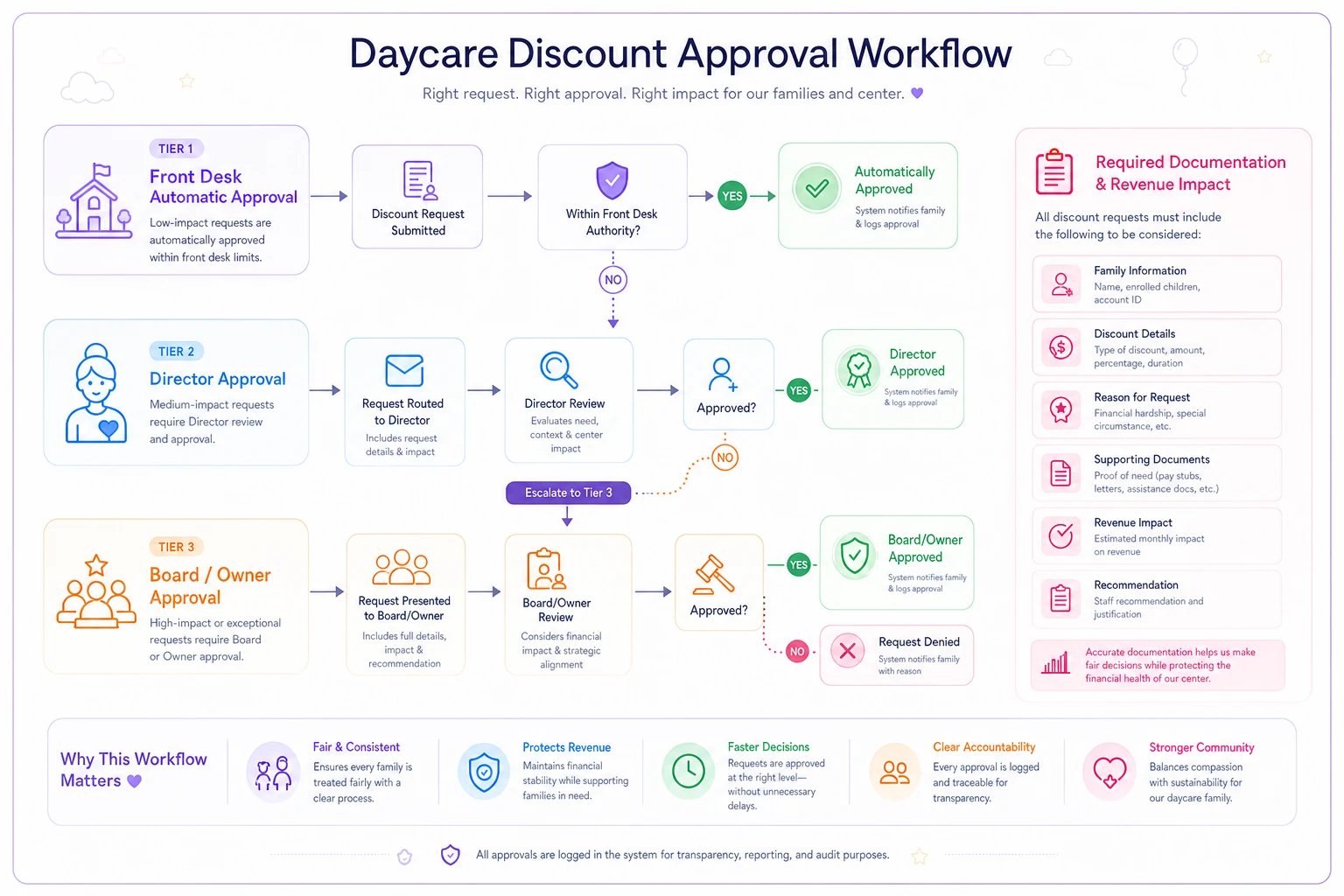
Every discount approval should document the revenue impact. If a director approves an extra 5% for a family, they need to calculate and record what that costs annually. This creates accountability and slows discount creep before it becomes a real problem.
Tracking actual revenue impact
Most centers track enrollment obsessively but ignore what discounts are actually doing to revenue. You need both to understand your financial position.
Build a simple monthly tracking sheet:
| Metric | Target | Actual | Variance |
|---|---|---|---|
| Full-price equivalent seats | 58 | 52 | -6 |
| Average discount per family | 4.5% | 7.2% | +2.7% |
| Revenue per enrolled child | $1,180 | $1,094 | -$86 |
| Discount dollars given | $3,200 | $5,140 | +$1,940 |
That last line tends to shock directors. A 10% discount on a $1,200 tuition seems minor. But across 15 families receiving various discounts, you might be giving away $5,000+ monthly — $60,000 a year. That's enough to hire another part-time teacher or finally replace the playground equipment you've been putting off.
The fairness factor families actually care about
Families don't necessarily want the deepest discount. They want to feel the system is fair. Hidden or inconsistently applied discounts cause more friction than slightly higher prices with clear, published rules.
Put your full discount matrix where families can see it. Include:
-
Exact percentage for each additional sibling
-
How discounts apply across age groups
-
Pro-ration calculation method
-
Which child receives the discount (oldest, youngest, or highest tuition)
-
How discounts interact with other offers
When families understand the rules upfront, they stop trying to negotiate exceptions. And most actually appreciate the transparency, even if your discounts are a bit lower than a competitor advertising bigger numbers but applying them inconsistently.
Building sustainability into your discount model
The most operationally sound centers tie discounts to behaviors that actually reduce costs — not just to family size.
Prepayment discount: Families who prepay quarterly receive 3% off. Improves cash flow and cuts collection work.
Consistent schedule discount: Families maintaining the same schedule for six or more months receive 2% off. Makes staffing significantly easier to plan.
Early pickup discount: Families consistently picking up before 4:30pm receive a $50 monthly credit. Directly reduces late-shift staffing needs.
These targeted discounts reward behaviors that genuinely lower your operating costs. Sibling discounts don't do that — they don't change your ratios, your staff hours, or your fixed expenses.
When to revisit your discount structure
Review your sibling discount policy annually, but certain signals shouldn't wait:
-
Operating margin drops below 15% — you're one unexpected expense away from real stress.
-
Discount dollars exceed 8% of gross revenue — discounts have become a major line item.
-
More than 40% of families receive some form of discount — you've essentially created a lower unofficial price point.
-
Staff are spending 10+ hours monthly on discount calculations and disputes — the administrative drag is eating real productivity.
Staff are spending 10+ hours monthly on discount calculations and disputes — the administrative drag is eating real productivity.
Implementing changes without losing families
Changing discount policies feels risky. Families budget around your current rates, and nobody likes surprises. But maintaining unsustainable discounts risks the whole operation.
-
Month 1–2
Analyze current discount impact. Calculate exactly how much revenue you're losing and which families carry the deepest discounts.
-
Month 3
Announce that discount policies will be reviewed and updated for the following school year. Give families at least six months notice.
-
Month 4–5
Gather feedback through surveys and informal conversations. Some families care more about quality and stability than discount depth.
-
Month 6
Publish the new discount structure — effective immediately for new enrollments, and at the next enrollment period for existing families.
-
Month 9
Roll out the new structure across all families.
This gives families time to adjust while protecting your current year revenue.
Technology's role in discount management
Manual discount tracking inevitably produces errors. Calculations get done differently by different staff members, approval steps get skipped, and informal exceptions accumulate quietly. AI-powered operational software handles the complexity automatically — calculating pro-ration consistently, enforcing approval workflows, and tracking the revenue impact of every discount applied.
These platforms also catch the informal discounts that creep in. When a parent mentions financial hardship during pickup, a well-meaning staff member might waive a late fee or reduce a registration charge on the spot. Small gestures, but they add up. Automated billing systems keep every discount inside the established approval process.
The better platforms also let you model scenarios before committing. Want to see how dropping from 10% to 8% sibling discount affects annual revenue? Or whether prepayment discounts could offset sibling discount losses? Running those numbers against your actual enrollment data takes seconds instead of a manual spreadsheet exercise.
Making the numbers work long-term
A properly structured sibling discount policy does three things: it supports families with multiple children, keeps your operation financially sustainable, and reduces the administrative complexity that quietly burns staff time every month.
Centers that hold up long-term don't necessarily offer the deepest discounts. They offer clear, consistent policies that balance family needs with operational reality. They track the actual dollar impact of every discount. They tie reductions to behaviors that genuinely reduce costs. And they use systems that enforce consistency instead of relying on whoever happens to be at the front desk that day.
Your sibling discount policy directly affects whether you'll be financially healthy in five years or scrambling to make payroll. Getting the structure right — proper matrices, clear approval workflows, reliable tracking — pays off every single month through protected margins and less time spent cleaning up calculation errors.
The goal isn't to squeeze every dollar from families. It's to build a model where families receive fair, predictable discounts and your center maintains the margins needed for quality care, staff retention, and keeping the lights on. Get that balance right, and both sides of the equation hold up over time.
Ready to elevate your childcare management?
Join hundreds of childcare providers using Totsyly to save time, improve communication, and grow their centers.