


That gut-drop when your phone buzzes before dawn. Another callout. And not just any callout—your lead infant room teacher, the one holding the critical 1:4 ratio for eight babies arriving between 7:00 and 7:30 AM.
You've got 73 minutes to solve this without breaking state licensing ratios, disrupting three other classrooms, or calling parents to keep their kids home. One absence, handled badly, can crater your entire morning.
Most centers handle last-minute staff scheduling in childcare through panicked group texts and whoever answers first. That's how you end up with your toddler teacher covering infants when she's not infant CPR certified, your floater stuck in pre-K all day, and your assistant director on the floor instead of handling the state inspection prep that actually needed to get done today.
The cascading ratio nightmare nobody talks about
State licensing ratios aren't suggestions—they're legal requirements with real financial consequences. In Pennsylvania, you need 1:4 for infants, 1:5 for young toddlers, 1:6 for older toddlers, and 1:10 for preschoolers. Break these ratios for 20 minutes during a surprise inspection and you're looking at citations, potential fines, and a permanent mark on your licensing record that parents can find online.
The operational reality that licensing documents don't capture: maintaining ratios during callouts isn't just about having enough bodies in the building. Your substitute pool might show six names, but only two are infant-qualified. Your part-time floater works Tuesday/Thursday only. Your on-call list has five people, three of whom have standing commitments before 8:30 AM.
Centers typically lose somewhere between 12 and 18 percent of their operating days to ratio stress—not from actual understaffing, but from poor absence management. That's roughly three days a month where directors spend their entire morning shuffling staff like a sliding puzzle, each move creating another gap somewhere else.
The financial hit compounds fast. When you can't maintain ratios, you either turn families away at drop-off (losing $60–80 per child per day) or you call in emergency coverage at premium rates—$22–28/hour versus your normal $15–18. A single badly managed callout can cost $300–400 between lost revenue and overtime.
Why traditional coverage plans fail at 5:47 AM
Most centers build elaborate coverage charts that look great on paper. Teacher A covers Teacher B, who covers Teacher C, creating a neat chain of responsibility. These plans work perfectly until Teacher A is the one who calls out, or Teacher B is already covering for someone else, or Teacher C is in the middle of planning time that parents were promised wouldn't get disrupted again.
Simplify your childcare center’s daily operations.
Totsyly helps you manage enrollments, staff, and communications efficiently so you can focus on care.
- Streamlined enrollment & waitlist management
- Automated billing & payment tracking
- Staff scheduling & attendance monitoring
No credit card required
The standard on-call rotation falls apart just as quickly. Staff agree to be "on-call" but interpret it differently. Some think it means available if not busy. Others assume they'll get 24-hour notice. Nobody wants to be on-call during their kid's soccer tournament or their mother-in-law's visit.
Even when on-call staff respond immediately, the logistics are a problem. They need 30–45 minutes to get ready and commute. Meanwhile, your 7:00 AM arrivals are stacking up in the lobby because you can't legally put them in classrooms without proper ratios. Parents are frustrated, kids are melting down, and the morning routine is already gone.
Float staff seem like the answer until you realize one floater can't cover three simultaneous absences. And floaters bouncing between rooms all day creates its own chaos—different routines, different behavior management styles, confused kids wondering why Miss Sarah is here but also somehow not here.
Building your minute-by-minute decision tree
Start with exact trigger points, not vague "early morning" windows. A callout at 5:30 AM requires different actions than one at 6:15 AM. Your decision tree needs branches for each 15-minute window between 5:00 and 7:00 AM, because available options change fast.
5:00–5:30 AM callout protocol:
-
Send immediate group text to Tier 1 responders (staff who live within 15 minutes and have historically responded to early calls)
-
Set 5-minute response timer
-
If no response, activate Tier 2 (part-time staff who've explicitly agreed to emergency coverage)
-
Set 3-minute response timer
-
If no response, move to ratio consolidation plan
-
Text all families in affected classroom about potential delayed opening
5:30–6:00 AM callout protocol:
-
Skip group text, go straight to direct calls
-
Call top three matches based on certification level, distance from center, and historical response rate
-
While calling, have assistant director begin room consolidation prep
-
If no coverage by 5
45, initiate "controlled arrival" protocol
6:00–6:30 AM callout protocol:
-
Immediate director-on-floor coverage
-
Pull qualified float from their planned room
-
Activate parent communication script for modified programming
-
Begin staggered arrival requests for non-essential families
Most centers miss this: your decision tree needs parallel tracks, not just sequential steps. While you're calling substitutes, someone else should be prepping room consolidation. While you're texting families, your assistant should be adjusting the breakfast service plan.
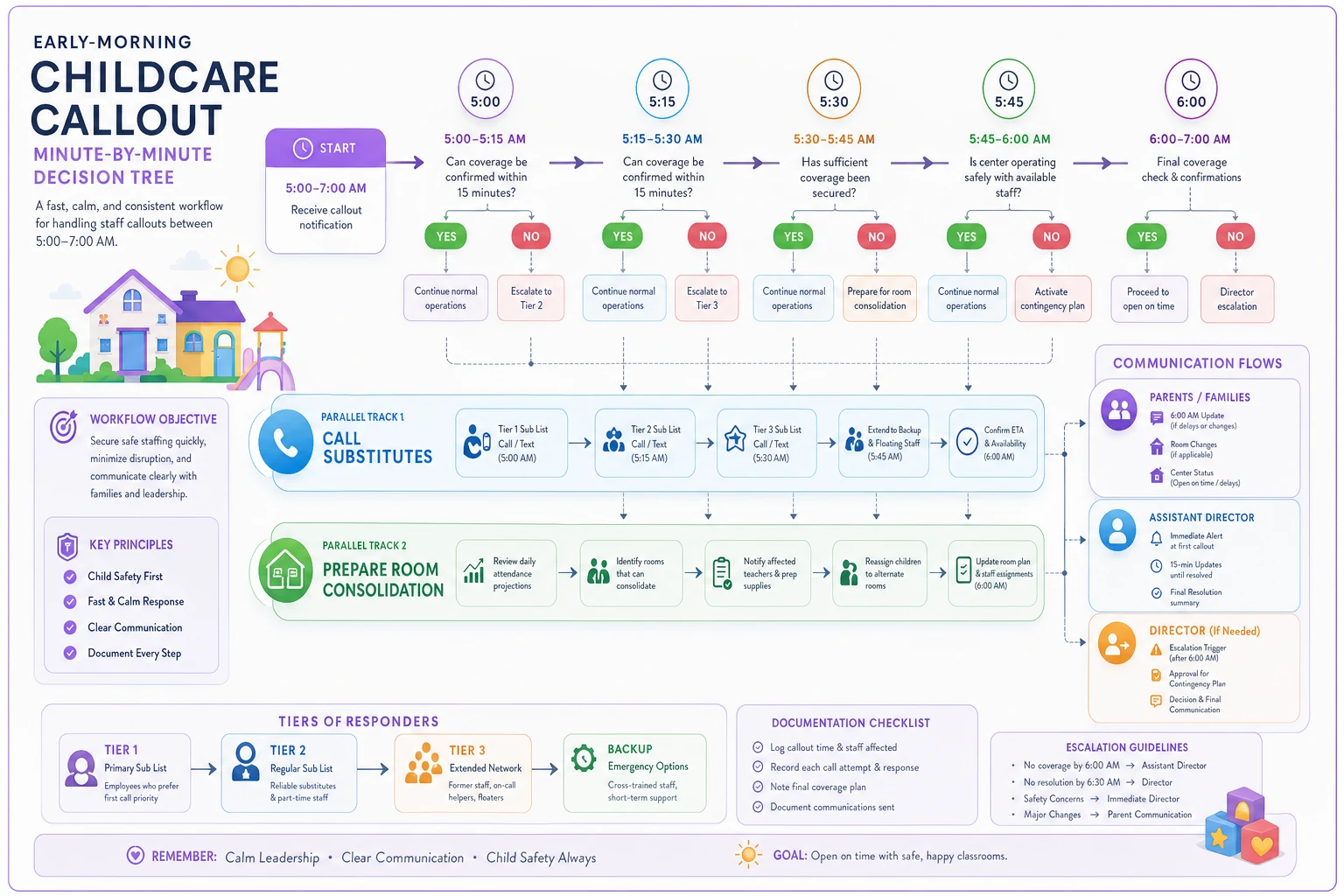
This diagram shows the parallel tracks and timing decisions in a single view.
The shift-swap protocol that actually works
Traditional shift swapping falls apart because it requires real-time negotiation during crisis moments. Pre-negotiate swap agreements during calm periods instead—document them in a simple grid.
Create swap pairs based on complementary schedules. Your 7–3 teacher pairs with your 9–5 teacher. When the early teacher calls out, the late teacher automatically shifts to 7–5 for overtime pay, no morning negotiation needed. The agreement is already in place before anyone gets sick.
-
Swap coverage pays time-and-a-half for the extra hours
-
Staff who swap get first choice of holiday scheduling
-
Three successful swaps earn a paid personal day
-
Swap partners can trade shifts freely without approval for the next month
Track everything in a shared spreadsheet—who owes whom a swap, when swaps were completed, current balances. Public visibility creates social pressure to actually honor agreements.
One detail that gets missed: swaps must be certification-matched. Your infant teacher can swap with another infant-certified teacher, not just anyone available. Build your pairs with that in mind, even if it limits flexibility.
Float rules that prevent the musical chairs disaster
Your floater isn't actually floating if they're stuck in the toddler room every day because Miss Jennifer is chronically late. Real float coverage requires clear rules about deployment.
First rule: floaters cannot be assigned to cover predictable gaps. If Teacher A has physical therapy every Tuesday morning, that's a scheduling problem, not a float situation. Floaters are for unexpected absences only.
Second rule: maximum float duration is two hours per room per day. After two hours, you need a different solution. This stops the floater from becoming a phantom employee who technically works everywhere but creates stability nowhere.
Third rule: floaters follow the room's established routine, not their own preferred approach. Document core routines—circle time format, transition songs, nap procedures—in a one-page guide posted in each room. Floaters read and follow.
| Situation | Float Priority | Maximum Duration |
|---|---|---|
| Ratio breach imminent | Immediate | Until resolved |
| Lead teacher absence | Within 30 min | 2 hours |
| Assistant absence | Within 1 hour | Half day |
| Lunch coverage | Scheduled | 30 minutes |
| Planning time coverage | Scheduled | 45 minutes |
Your float schedule should be public and updated in real time. Parents notice when the floater seems to live in their child's room. They also notice when ratios feel thin because the floater is stretched too far.
On-call rotations that staff will actually follow
The typical on-call system fails because it treats all on-call shifts the same. Tuesday morning at 6 AM is not the same as Wednesday at 10 AM. Your rotation needs to reflect that.
Tier A (Hardest): Monday–Friday, 5:30–8:30 AM Tier B (Moderate): Monday–Friday, 3:00–6:00 PM Tier C (Easiest): Mid-day coverage, 10:00 AM–2:00 PM
Staff earn different points for different tiers. Covering a Tier A shift earns 3 points, Tier B earns 2, Tier C earns 1. Points convert to real rewards: 10 points equals a paid day off, 5 points gets preferred parking for a month, 3 points means leaving 30 minutes early on a Friday.
Build your monthly rotation with explicit response times:
-
Primary on-call
must respond within 5 minutes, arrive within 45 minutes
-
Secondary on-call
must respond within 10 minutes if primary doesn't answer
-
Tertiary on-call
activated only for multiple simultaneous callouts
Pay matters here too. On-call staff who don't get called in should still get something—maybe $25 for being available during a Tier A shift. Those who do respond get overtime rates plus a $50 appearance bonus. That cost is nothing compared to losing families over ratio violations.
Parent communication scripts that preserve trust
Parents understand that staff get sick. What erodes trust is poor communication that makes the center feel chaotic. Your communication protocol needs multiple tracks based on how bad the situation actually is.
Green status (coverage secured, minimal disruption): "Good morning! Miss Taylor is out sick today. Miss Rodriguez from our pre-k team will be leading the toddler room. She knows your children well from playground time and is excited to spend the day with them. Regular schedule and activities continue as planned."
Yellow status (coverage secured, some modification): "Good morning families. We have two staff absences this morning and are implementing our coverage protocol. Your child's core teacher team remains in place, but we'll be combining groups for morning circle time and afternoon activities. Ratios remain fully compliant. If you have flexibility to arrive after 8:30, it would help us maintain smaller group sizes during breakfast."
Red status (struggling for coverage): "Important update: We're experiencing unusual staff absences today and implementing our emergency coverage plan. While we can maintain legal ratios, the quality of programming may be affected. If you have backup care options for today, we encourage you to use them. Families who must bring children will be accommodated, but please prepare for modified activities and possible combined age groups."
Never minimize. Parents can tell when you're scrambling—they see the director in the classroom, the unfamiliar faces, the slightly off energy. Transparency keeps trust intact. Pretending everything is fine does the opposite.
The compliance safety net everyone forgets
Your coverage protocol means nothing if you can't prove you maintained ratios during an absence crisis. State inspectors don't care that you tried hard—they want documentation.
Build a parallel documentation system that captures:
-
Exact callout time
-
Who was notified and when
-
Each coverage attempt with timestamps
-
Final coverage solution
-
Ratio counts at 15-minute intervals during the crisis period
-
Parent notifications sent
A center in Ohio got hit with $3,500 in fines because they couldn't prove they maintained ratios during a morning their director described as "covered but hectic." The inspector's report noted an inability to demonstrate compliant ratios between 7:15 and 8:45 AM.
Keep physical backup sheets in each classroom—simple grids where staff initial every 30 minutes confirming ratio compliance. Yes, it's redundant with your normal attendance tracking. That's the point. Redundancy protects you during inspections.
Making the protocol work with your actual humans
The best protocol fails if your team won't follow it. Staff need to understand not just what to do, but why each step matters. Run monthly drills—practice a fake callout at 5:45 AM during a staff meeting, not actually at 5:45 AM.
Show them the math. When callouts are handled poorly:
-
Center loses $300–400 per incident
-
Director spends 3 hours fixing cascading problems
-
Parent trust erodes, affecting retention
-
Staff morale tanks, affecting their own attendance
-
Licensing risk increases
When the protocol works:
-
Coverage secured within 20 minutes
-
Minimal parent disruption
-
Staff feel supported, not abandoned
-
Director can focus on operations instead of crisis management
Track how well each incident was handled with a simple callout report card. Not to shame anyone—to find where the protocol breaks down. Maybe your 5:30 AM process works fine but your 6:45 AM process is still a mess. Maybe infant room callouts go smoothly but pre-k creates chaos. Data helps you fix the right things.
The technology piece
Manually managing this protocol during a live crisis is genuinely hard. You're trying to check certification records while calling substitutes while updating parents while watching ratios. That's where AI-powered operational software starts to make real sense.
The right platform can automatically trigger your decision tree based on callout timing, send texts to the right tier of responders, track who's responded, log everything for compliance, and push parent updates based on your pre-written scripts. What takes 45 minutes of frantic phone calls can happen in 10 minutes of structured execution.
Prioritize automating your Tier A triggers and logging responses first so the highest-risk windows are handled fastest.
More importantly, it captures patterns over time. Maybe Tuesday mornings see significantly more callouts. Maybe certain staff pairs shouldn't be scheduled together because when one calls out, the other usually does too. Maybe your weekend on-call staff have a poor response rate and need a different approach entirely. That kind of pattern recognition is hard to do manually when you're buried in daily operations.
The software isn't magic—it's faster execution of a protocol you've already designed. But when you're racing against the clock at 5:47 AM, that speed matters.
Learning from the centers that never scramble
Some centers seem to never have coverage crises. They're not lucky—they're proactive. They maintain a bench of three or four per-diem staff who work one shift per month just to stay connected. They slightly overstaff on historically difficult days. They track absence patterns and address chronic issues before they become acute.
One center in Detroit runs "shadow shifts" where substitutes come in during calm periods to learn routines, meet the kids, and understand expectations. When called for emergency coverage, they already know the drill. The monthly cost in those shadow shifts saves far more in crisis management.
Another center created "grandparent volunteers"—retired community members who can't be counted in ratios but provide extra hands during transitions, freeing certified staff to maintain proper coverage where it legally counts. They're not solving the ratio problem directly, but they're reducing the chaos that makes ratio management harder.
The protocol is just the beginning
Your decision tree and shift-swap system will handle the majority of callout crises. The other situations will still require creativity, flexibility, and sometimes accepting that today won't be perfect. That's fine—perfect isn't the goal. The goal is maintaining legal ratios while minimizing disruption to children, families, and your remaining staff.
Test your protocol monthly. Refine it based on real incidents. Share it with parents so they know you have a plan. Train new staff on it during onboarding, not during their first crisis.
Last-minute staff scheduling in childcare isn't about having enough staff in general—it's about having the right staff available at the right moment, with the right certifications and the right information. Your protocol should solve for all of those, not just headcount.
The next time your phone buzzes at 5:47 AM, you won't feel that gut-drop. You'll know exactly what happens next. You'll execute your protocol, maintain your ratios, and maybe actually finish your coffee before it goes cold. That's the difference between scrambling and having a real system—and your families will notice.
Ready to elevate your childcare management?
Join hundreds of childcare providers using Totsyly to save time, improve communication, and grow their centers.