


Most centers don't lose enrollment because families suddenly disappear. They lose it because the work that prevents a dip happens two or three months too late. By the time an admin notices September looking thin, the summer tour requests have already gone cold, the toddler room that fed the preschool class already graduated out, and the two teachers who could've covered growth already accepted jobs elsewhere.
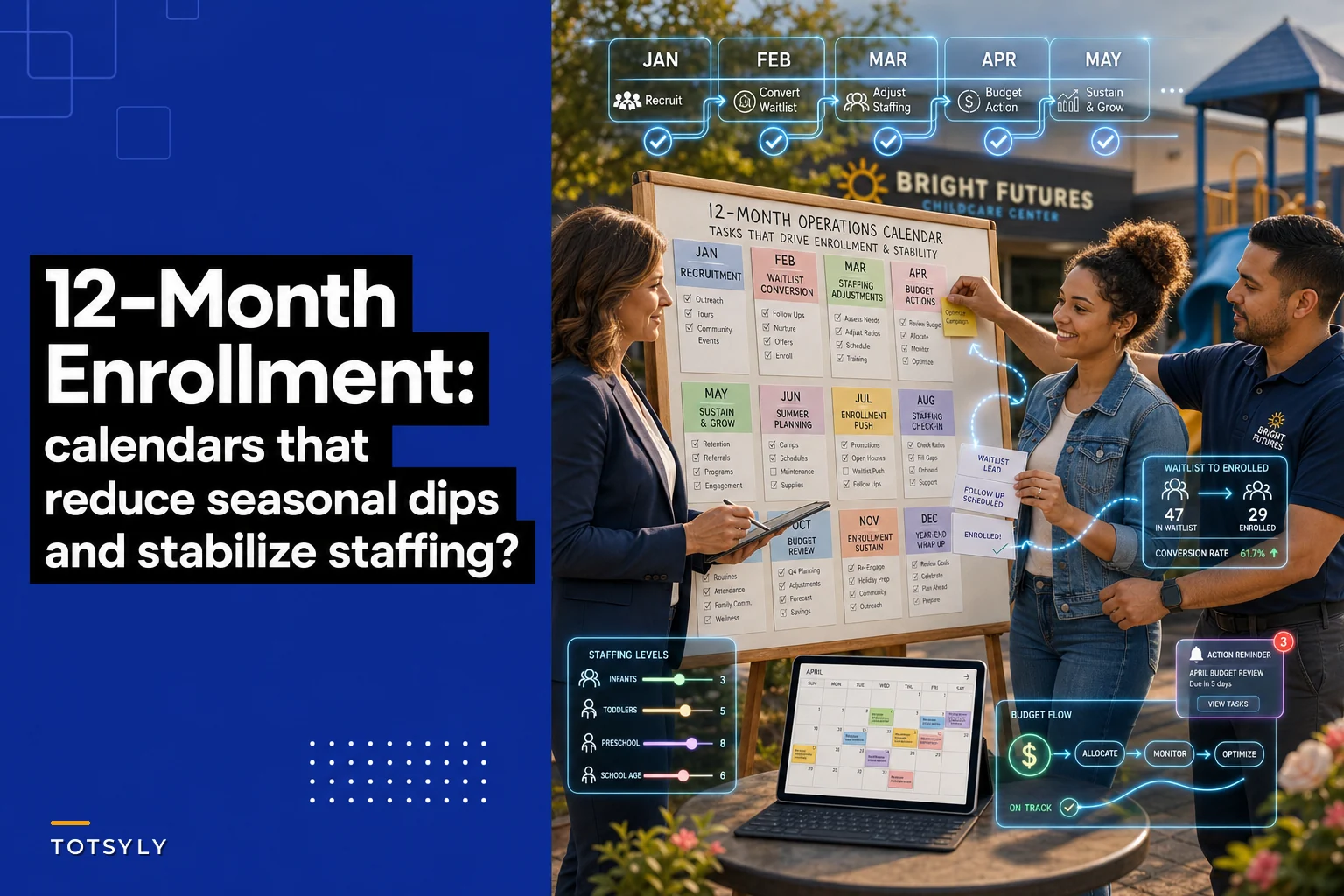
The fix isn't a better marketing push. It's a seasonal enrollment calendar for childcare that spreads the right tasks across the right months, so recruitment, waitlist conversion, staffing changes, and budget moves all line up instead of fighting each other. Below is a month-by-month breakdown you can adapt, built around how enrollment actually flows in a typical center — not a generic template.
Why enrollment feels unpredictable (even when it isn't)
Enrollment at most daycares and preschools is far more seasonal than owners admit. The pattern usually looks something like this:
-
A big intake wave in August–September tied to the school-year mindset
-
A quieter secondary bump in January as families reset after the holidays
-
A slow bleed through late spring and summer as pre-K kids age out and some families drop for vacation months
The reason it feels random is that the causes and effects are separated by months. A weak May tour schedule shows up as an empty room in August. An underfilled infant room in fall shows up as a starved toddler room the following spring. Admins react to the symptom in the month it appears, which is almost always too late to change the outcome.
A typical example: a center notices its preschool room sitting at 14 out of 20 spots in September. They scramble to advertise. But the real problem started in April, when nobody tracked which toddlers were aging up and which families hadn't confirmed they were staying. The calendar approach forces you to act on the cause month, not the symptom month.
The core idea: task the calendar, not the goal
"Increase enrollment" is not a task. It's a wish. What actually stabilizes a center is a set of small, dated, assignable actions — the kind you can hand to a specific person with a due date. The calendar below breaks the year into recruitment work, waitlist conversion, staffing adjustments, and budget actions, because those four levers move together whether you plan them to or not.
Simplify your childcare center’s daily operations.
Totsyly helps you manage enrollments, staff, and communications efficiently so you can focus on care.
- Streamlined enrollment & waitlist management
- Automated billing & payment tracking
- Staff scheduling & attendance monitoring
No credit card required
Here's the year at a glance:
| Quarter | Recruitment focus | Waitlist / conversion | Staffing action | Budget action |
|---|---|---|---|---|
| Jan–Mar | Re-open tours after holidays | Convert Jan inquiries fast | Confirm spring aging-up plan | Set tuition for next school year |
| Apr–Jun | Peak tour season | Lock fall commitments | Post fall roles early | Model summer cash dip |
| Jul–Sep | Fill remaining fall gaps | Backfill from waitlist | Onboard before Sept rush | Adjust for actual enrollment |
| Oct–Dec | Nurture, don't push | Warm the spring pipeline | Plan holiday coverage | Review margins, plan raises |
The table is a skeleton. The value is in the specific tasks inside each month.
January–March: reset and lock next year's foundation
January inquiries are underrated. Families who reach out right after the holidays tend to convert faster because they've usually just had a rough stretch of juggling work and kids over the break. The mistake centers make is treating January like a slow month and letting those inquiries sit for a week before responding.
Taskable items for these months:
-
First week of January — respond to every holiday-period inquiry within 24 hours and schedule tours. These are warm leads that go cold fast.
-
By end of January — finalize next school year's tuition. Waiting until spring to decide pricing means you can't quote confidently to families touring in April.
-
February — map every child expected to age up into a new room by September. This one list drives almost everything downstream: which rooms open, which rooms tighten, and where you'll need staff.
-
March — send re-enrollment confirmations to current families for the coming school year. Every "yes" here is a spot you don't have to sell later; every "no" is a gap you now have five months to fill instead of five days.
The aging-up map in February is the single most valuable artifact in the whole calendar. Centers that skip it end up surprised twice — once when a room empties out and once when the receiving room overflows. If you're managing transitions between rooms, that same map also protects your ratios, which is worth handling deliberately rather than in a panic.
April–June: peak season, where the year is won or lost
This is tour season, and it's where the most common failure hides. Centers get busy with tours and forget that a tour is not a commitment. A booked tour that never converts into a signed agreement is just a nice conversation.
In practice, this usually happens when there's no clear next step after the visit. A family walks through, loves it, says "we'll be in touch," and the center considers that a win. Three weeks later that family enrolled somewhere that followed up the next morning with a deposit link.
Taskable items:
-
April — post your fall staffing roles now, before you technically need them. Good early-childhood teachers are usually gone by June. Hiring in August for a September start is how centers end up over-relying on substitutes and stretching ratios.
-
May — set a hard follow-up rhythm on every tour
same-day thank you, 48-hour check-in, one-week decision nudge. Track which stage each family is in.
-
May–June — collect deposits to convert soft interest into real commitments. A verbal "we're planning to enroll" has roughly the reliability of a coin flip until money changes hands.
-
June — build your summer cash model. Enrollment usually dips over summer even when fall looks strong, and payroll doesn't dip with it.
That summer cash gap catches new operators off guard almost every year. You're paying near-full staffing to hold rooms for fall while collecting reduced summer tuition. Knowing the number in June instead of discovering it in July is the difference between a planned dip and a scramble.
July–September: fill the gaps and absorb the rush
By July you know your real fall numbers, not your hoped-for ones. The gap between the two is your July–August project. This is when a maintained waitlist earns its keep — not the stale list nobody's called in months, but an active pipeline where families have been kept warm.
A quick reality check on waitlists: a name on a list from March means almost nothing by July. Life moved. They found care elsewhere, changed jobs, or moved neighborhoods. The centers that convert waitlists well are the ones that touched those families every few weeks — which is worth treating as its own deliberate process rather than an afterthought.
Taskable items:
-
July — call every waitlisted family for rooms with gaps. Confirm they're still looking and still qualify for the age band you need.
-
August — front-load onboarding. Every new family that starts in September but wasn't fully processed in August becomes a first-week fire drill.
-
August — finalize classroom staffing assignments and make sure new hires have completed onboarding before the rush, not during it. A teacher learning your systems while managing twelve new kids is a rough combination.
-
September — reconcile actual enrollment against your budget model and adjust. This is your first real checkpoint on whether the year's plan is holding.
Treat the waitlist as an active pipeline by touching families every few weeks so recent contacts convert better than older names.
Onboarding both families and staff in the same two-week window is genuinely hard, and it's where a lot of quality slips. Spreading that work into August is the most controllable variable you have.
October–December: the quiet quarter that builds next year
October through December feels calm, and that's exactly the trap. The instinct is to relax because rooms are full. But this quarter is when you either build next January's pipeline or let it evaporate.
Families touring in fall are usually not looking for immediate spots — they're planning ahead. Pushing them hard for a quick decision doesn't work. A light-touch check-in every few weeks keeps you top of mind for when they're actually ready.
Taskable items:
-
October — review your year-to-date margins now that enrollment has stabilized. This is when you can see clearly whether your tuition and staffing math actually worked.
-
November — plan holiday coverage early. Staff take time off, family schedules get chaotic, and coverage planned in November beats coverage improvised in mid-December.
-
December — set your raise and retention budget for the coming year. Good teachers get recruited over the holidays too; a January retention conversation with no budget behind it is just talk.
-
December — warm your spring inquiry pipeline with a simple "planning for the new year?" touch to fall tour families.
Families touring in fall are usually not looking for immediate spots — they're planning ahead. Pushing them hard for a quick decision doesn't work. A light-touch check-in every few weeks keeps you top of mind for when they're actually ready.
A real scenario: how the calendar changes an outcome
Consider a mid-sized preschool with around 85 licensed spots across infant, toddler, and preschool rooms. Historically they ran full September through winter, then watched enrollment slide to the low 70s by late spring and stay soft through summer — a swing of roughly 12–15 kids at the worst point.
The core issue wasn't demand. It was timing. They recruited in August, called the waitlist in September, and only noticed the spring dip when it was already happening. Payroll stayed flat while revenue sagged, and the summer months routinely ran a few thousand dollars short.
After moving to a tasked calendar — aging-up map in February, deposits collected in spring, fall roles posted in April, waitlist touched monthly — the picture shifted. The spring floor rose from the low 70s to around 78–80, and the summer cash gap became something they planned for rather than absorbed by surprise. Nothing dramatic happened in any single month. The improvement came from doing ordinary tasks two or three months earlier than before.
That's the whole point. The calendar doesn't create demand. It stops you from wasting the demand you already have by acting too late.
Where software actually helps (and where it doesn't)
None of this requires software to understand. But keeping it running month after month, across a busy admin's plate, is where most calendars quietly die. The February aging-up map gets forgotten. The May follow-up rhythm slips. The July waitlist calls don't happen because that week was chaos.
This is the practical case for AI-assisted operational tools — not to replace judgment, but to make sure the dated tasks actually surface when they're due. A platform that flags which children are aging up, nudges you when a toured family hasn't been followed up, and reminds you to post fall roles before the market dries up turns the calendar from a document into a working system. The admin still decides; the system just makes sure nothing falls through in month seven when everyone's exhausted.
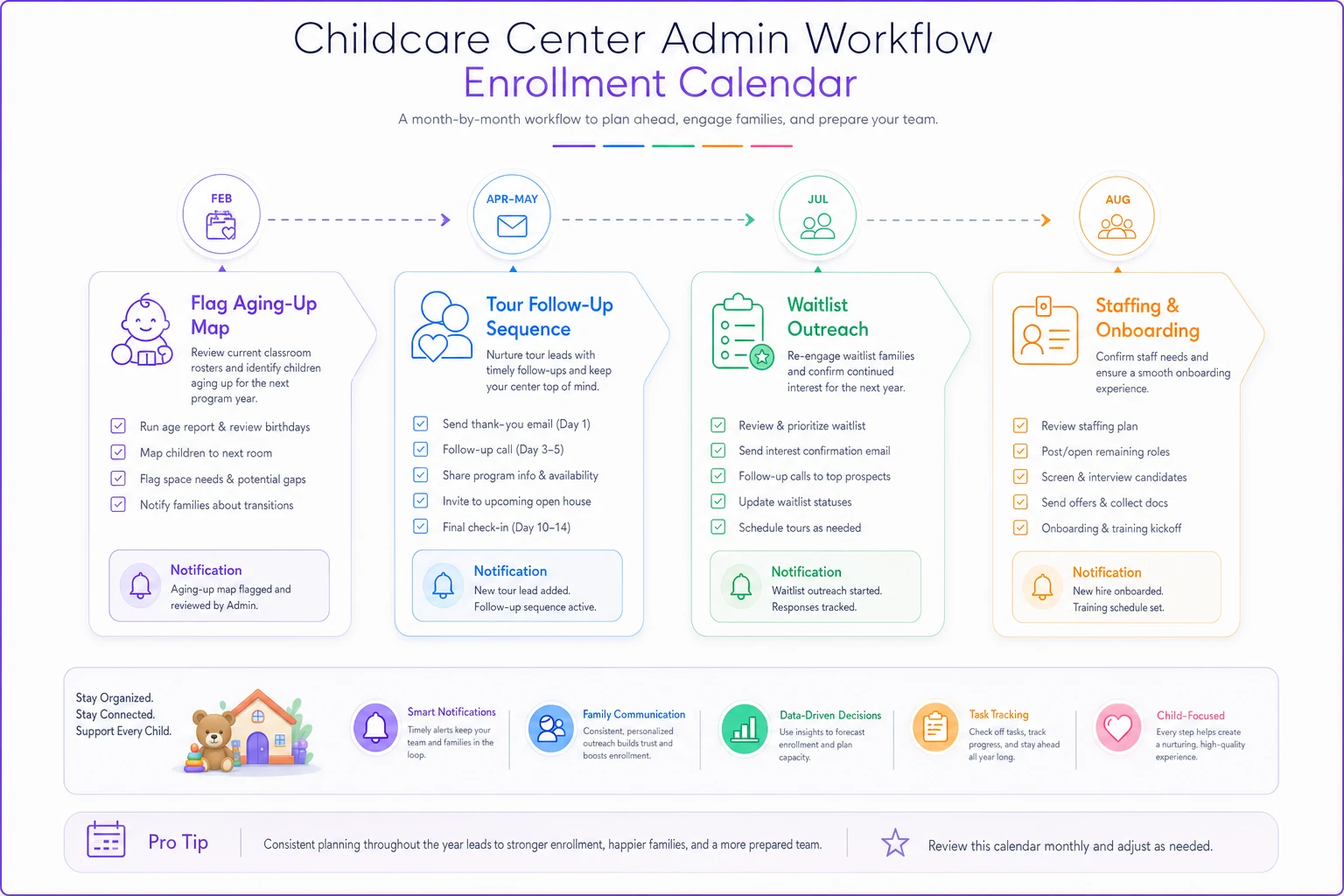
The visual shows how dated tasks and reminders move from a static calendar into a running operational queue so nothing slips in busy months.
The honest boundary: automation won't fix a calendar built on bad assumptions. If your aging-up map is wrong or your tuition math doesn't work, no reminder saves you. Get the plan right first, then use tools to keep it alive.
When this calendar makes sense — and when it doesn't
It makes sense when your enrollment swings noticeably by season, you have more than one age band feeding into another, and you've felt the pain of reacting too late at least once. Multi-room centers benefit most because the aging-up dynamics compound.
It's less critical when you're a very small center with a long, reliable waitlist and almost zero turnover. If families never leave and you turn people away year-round, a full calendar is overhead you may not need — though even then, the February aging-up map is worth keeping.
Who should skip the heavy version: brand-new centers still in their first enrollment cycle. You don't have the seasonal data yet to know your own pattern. Run one year, note when your dips and surges actually hit, then build the calendar around your numbers instead of the generic quarters above.
Bringing it together The centers that feel calm about enrollment aren't the ones with the best marketing. They're the ones doing small, timed tasks months before the results show up — mapping who's aging up in February, collecting deposits in spring, posting roles in April, keeping the waitlist warm in July.
Start with one month. Pick the next one on the calendar, write down the three or four tasks that belong there, and assign each to a real person with a real date. Then do it again next month. A stable enrollment year is just twelve of those, stacked in the right order.
Ready to elevate your childcare management?
Join hundreds of childcare providers using Totsyly to save time, improve communication, and grow their centers.