


Drop-off and pick-up procedures feel simple until something breaks. A grandmother shows up without being on the authorized list. A non-custodial parent arrives mid-custody dispute. Your newest staff member freezes when asked to release a child to someone they don't recognize.
These moments create immediate operational stress that ripples through your entire center. Staff second-guess themselves, parents get frustrated, and you're left managing the fallout while trying to maintain security protocols.
Most centers treat pickup procedures as a compliance checkbox rather than an operational system. They post a sign about ID requirements, train staff once during onboarding, and hope nothing complicated happens. This works fine—until it doesn't. Usually at 5:47 PM when you're short-staffed and dealing with six pickups at once.
Why standard pickup protocols fall apart in real operations
The gap between written procedures and actual daily operations is where most pickup problems start. Your handbook says "check ID for all pickups," but what happens when the same parent picks up every day for three years? Staff relax. It's natural. And that inconsistency becomes your biggest liability risk.
Consider what happened at a center in suburban Atlanta. Clear ID verification procedures, proper signage, regular training. But when a biological father—not on the pickup list due to custody restrictions—arrived during a busy afternoon transition, the floater teacher released the child because "he looked just like her." The resulting custody violation led to a $45,000 legal settlement and cost them their best classroom teacher, who resigned from the stress.
The problem wasn't the written policy. It was the operational implementation. Centers typically have three or four different staff members handling pickups throughout the week, each with their own interpretation of "verify identity" and "authorized pickup." Without specific scripts and escalation steps, you're effectively running four different security protocols depending on who showed up that day.
Staff comfort levels vary wildly when it comes to confronting parents. Your veteran teacher might confidently tell a CEO parent they need proper ID. Your newer assistant might quietly release children to avoid the awkward moment. That inconsistency doesn't just create security gaps—it confuses parents who experience different standards depending on the day.
The afternoon pickup window compounds everything. Between 4:30 and 6:00 PM, you're managing:
-
Multiple simultaneous pickups
-
Staff shift changes
-
Parent questions about the day
-
Children's behavioral challenges at day's end
-
Documentation requirements
-
Custody variations and special arrangements
Without clear operational workflows, staff default to the path of least resistance: releasing children quickly to clear the lobby.
Building ID verification that staff actually follow
Effective ID verification starts with understanding why staff skip checks in the first place. They're not lazy or careless—they're responding to social pressure, time constraints, and unclear expectations. Your procedures need to work within those realities.
Simplify your childcare center’s daily operations.
Totsyly helps you manage enrollments, staff, and communications efficiently so you can focus on care.
- Streamlined enrollment & waitlist management
- Automated billing & payment tracking
- Staff scheduling & attendance monitoring
No credit card required
Start with an "Every Pickup, Every Time" rule, but make it operationally feasible. A two-tier verification system works well here:
Tier 1: Daily Authorized Pickups Parents and guardians on the primary list who pick up regularly. Staff visually confirm identity and match against the pickup list, but don't need to check physical ID every time after initial verification—unless something seems off.
Tier 2: Extended Authorized Pickups Anyone on the extended list—grandparents, babysitters, family friends—requires physical ID verification every time, regardless of familiarity. Even regular caregivers who pick up weekly.
Mount the verification station where it's visible from the lobby so the process becomes the norm rather than a confrontation.
This split reduces friction for daily operations while maintaining security for less frequent pickups. Staff find it easier to enforce because they're not asking the same parent for ID 250 times a year.
Mount a verification station at your pickup area with clear visual cues. Not just a sign saying "ID Required"—an actual station or verification clipboard that makes the process visible and expected. When parents see other parents going through it, it normalizes the process and reduces resistance.
Your verification script matters more than your policy document. Give staff exact words:
"Hi! I'm completing our pickup verification for Emma. Can you confirm you're on our authorized list?"
For Tier 2: "Since you're on our extended pickup list, I need to verify your ID. This helps us maintain consistent security for all our families."
For any hesitation or issue: "Let me grab our administrator to help expedite this. We'll have Emma ready in just a moment."
These scripts remove personal judgment from the interaction. Staff aren't deciding whether to check ID—they're following a visible, consistent process that parents can see happening for everyone.
Scripts that defuse tension while maintaining security
The hardest moments come when you need to deny a pickup. A parent who forgot to add their new nanny to the list. A relative who "drove two hours to surprise" the child. These situations escalate quickly without proper scripting.
Staff need three distinct scripts for pickup challenges:
The Soft Delay Script (for potentially authorized but unverified pickups): "I want to make sure we get [child's name] to you as quickly as possible. Since you're not showing on today's pickup list, I need to verify authorization with our administrator. This usually takes about two minutes. Would you mind having a seat while I confirm?"
This positions staff as helping to expedite, not blocking. It gives a specific timeframe and moves the person away from the pickup area.
The Firm Denial Script (for clearly unauthorized pickups): "I understand this is frustrating. Our security procedures don't allow me to release [child's name] without proper authorization from the enrolled parent. I can help you contact them now to arrange authorization, or they can add you to our system for future pickups. Which would be most helpful?"
This offers a path forward while holding the boundary. Staff aren't just saying no—they're providing solutions.
The Escalation Script (for aggressive or suspicious situations): "I need to follow our security protocol for this situation. Please wait here while I get our director." Then immediately to staff: "Ms. Johnson, we have a Code Yellow at pickup."
Coded language prevents additional escalation while alerting other staff. "Code Yellow" might mean unauthorized pickup attempt. "Code Red" signals immediate security concern. Every staff member needs to know these codes and their response responsibilities.
Train staff on physical positioning during difficult conversations:
-
Keep the sign-out desk between themselves and the person
-
Position themselves with clear exit access
-
Maintain professional but firm body language
-
Never turn their back on an agitated person
-
Keep children away from the interaction area
Monthly role-playing makes these scripts automatic. Run scenarios where staff practice denying pickups to the center director playing an upset parent. Confidence in real situations comes from repetition in practice ones.
The custody dispute minefield
Custody situations are your highest-risk pickup scenarios. A Maryland center faced a $280,000 lawsuit after releasing a child to a biological parent during a contested custody modification. The parent was historically authorized but recently restricted—a change the afternoon staff had no idea about.
Build a Custody Alert System that operates separately from your standard pickup list:
Red Flag Files: Create physical folders—yes, paper—for any child with custody complications. Bright red folders that stay at the pickup desk, containing:
-
Current custody order (relevant pages only)
-
Photos of restricted individuals
-
Specific instructions for this case
-
Emergency contact for the custodial parent
-
Your attorney's contact information
When anyone attempts pickup for a Red Flag child, staff must check the physical folder regardless of who it is. This removes memory-based decisions from the process.
The 24-Hour Rule: Any custody-related change requires 24-hour processing time. Parents can't drop off new restriction paperwork at morning drop-off and expect it enforced that afternoon. This gives you time to review legal documentation, update all systems, brief all staff, and confirm understanding with both parties if appropriate.
Your custody dispute script needs extra care:
"I see there are special instructions for [child's name]'s pickup. Let me review our current documentation to make sure I have the most recent information. This will just take a moment."
Never mention custody disputes, restrictions, or legal issues in front of the child or other families. If you must deny pickup to a biological parent, move the conversation away from children immediately.
Document everything in custody situations. If a restricted parent attempts pickup, record:
-
Date and time
-
Who attempted pickup
-
What identification they provided
-
Exact words exchanged
-
Which staff members were present
-
How the situation resolved
-
Whether law enforcement was contacted
This documentation becomes critical evidence if things escalate legally. Store it separately from standard operational records for quick access if subpoenaed.
Accountability layers that actually protect your center
Real liability protection comes from overlapping accountability systems, not single-point procedures. Your pickup process needs multiple verification layers that catch failures before they become incidents.
Start with the Daily Pickup Log—but make it operational, not just compliant. Each classroom needs a physical log showing:
| Daily Pickup Log Field |
|---|
| Child name |
| Scheduled pickup time |
| Authorized pickup person for today |
| Actual pickup time |
| Staff initials for release |
| Any variations or notes |
What makes this work is the 6:15 PM reconciliation. Every night, your closing supervisor runs through three checks:
-
Physical count
Every child signed out on paper matches empty cubbies
-
System match
Paper logs match your digital system (if you have one)
-
Exception review
Any non-standard pickups get flagged for tomorrow's briefing
This catches errors while memories are fresh and creates a feedback loop for continuous improvement.
Add photographic backup for non-parent pickups. When anyone besides the primary parents picks up, staff take a quick photo of the ID and the person. Photos get deleted after 30 days if no issues arise, but they provide immediate verification if questions emerge later. Parents sometimes push back on this initially, but framing it as "protecting your family's security" usually lands.
Your accountability system should track patterns, not just incidents. If the same staff member repeatedly releases children without proper verification, you know where to focus training. If certain pickup times show more procedural breaks, you can adjust staffing or add support during those windows.
Build a monthly pickup audit into your operations:
-
Pull 10 random pickup records
-
Verify documentation completeness
-
Check that authorized person lists are current
-
Confirm staff followed all procedures
-
Review any reported concerns or near-misses
This 30-minute monthly review catches systematic problems before they become liability events.
When things go sideways: escalation steps
Despite your best procedures, situations will escalate. A divorced parent becomes aggressive when denied pickup. An intoxicated authorized person arrives to collect a child. These moments test your entire operational framework.
Your escalation pathway needs three levels:
Level 1: Supervisor Intervention Any pickup denial or complication immediately triggers supervisor involvement. The front-line staff member doesn't argue or negotiate—they get backup. The supervisor brings authority and distance from the initial interaction, often defusing tension just through their presence.
Level 2: Isolation and Documentation If the situation keeps escalating, move the person away from children and other families. Script: "Let's step into my office where we can discuss this privately and find a solution." Once isolated, begin detailed documentation while another staff member maintains visual supervision of the interaction.
Level 3: External Support Some situations require immediate external help. Call law enforcement if someone:
-
Refuses to leave when denied pickup
-
Makes threats against staff or children
-
Appears intoxicated or impaired
-
Attempts to take a child without authorization
Staff need explicit permission to make this call without running it up the chain first. Every moment counts in true security situations.
Keep an Escalation Communication Tree posted where staff can see it:
-
Who to call first (supervisor)
-
Backup contacts if supervisor is unavailable
-
Emergency services protocol
-
Parent notification process
-
Board/owner notification triggers
Practice escalation scenarios quarterly. Run a drill where someone role-plays an aggressive unauthorized pickup attempt. Time how long it takes to execute each escalation level. These drills reveal gaps in your communication systems and build staff confidence before a real event forces the issue.
Here's a quick visual of the escalation pathway.
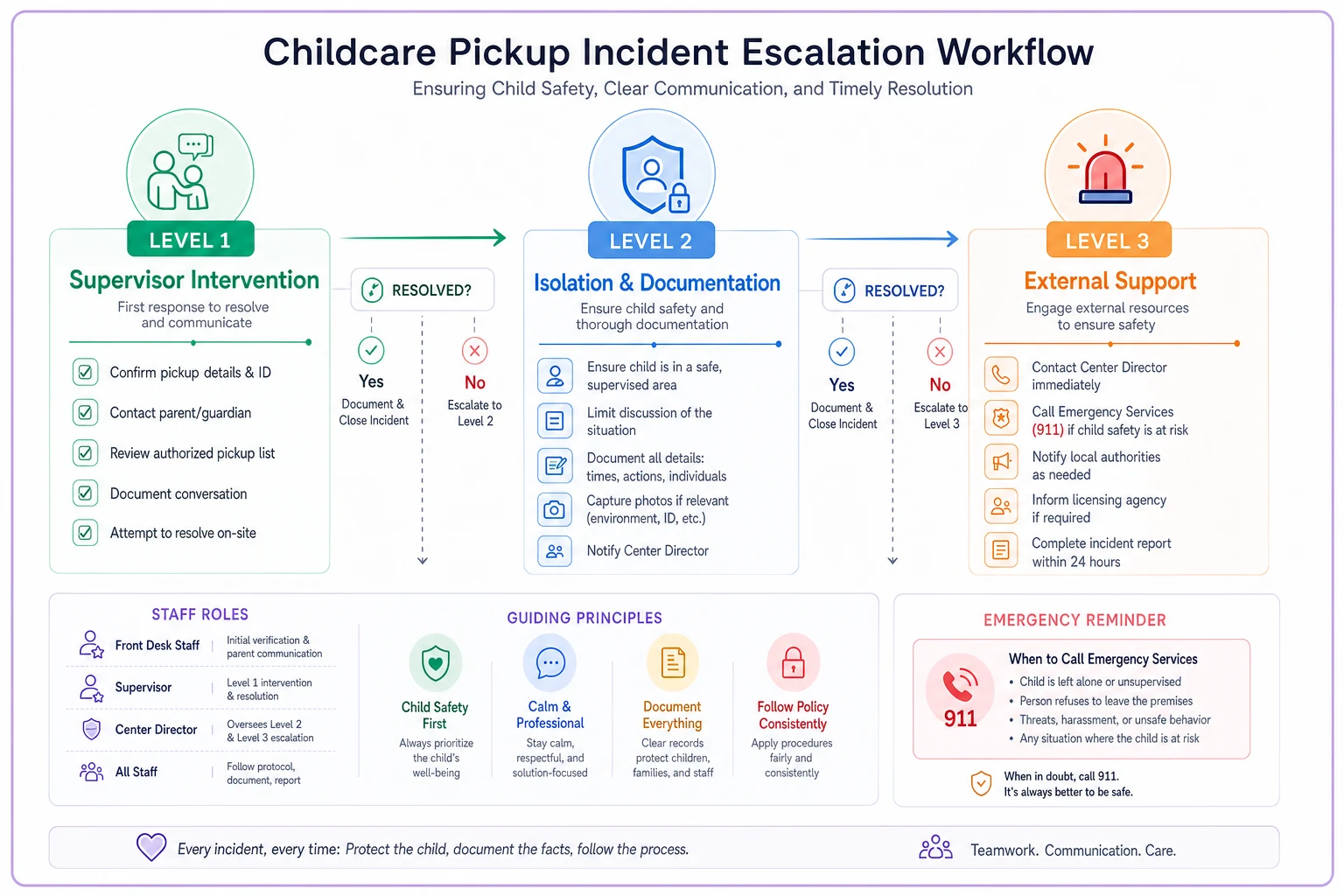
Keep practicing the steps in real-time drills so the visual matches the actions staff take under pressure.
The signage system nobody thinks about
Most centers put up an "ID Required" sign and call it done. But effective signage creates operational flow that makes secure pickups easier, not harder. Your signs should guide behavior before staff intervention becomes necessary.
Position three types of signage:
Preparation Signs (parking lot/entrance): "Pickup Reminders:
-
Have your ID ready
-
Check in at front desk
-
Authorize any pickup changes by 2 PM
These prime parents for the process before they walk in, reducing friction at actual pickup.
Process Signs (at pickup station): "Today's Pickup Verification:
-
✓ Show ID to staff
-
✓ Sign pickup log
-
✓ Collect child's belongings
-
✓ Check for daily reports
This checklist format shows parents exactly what will happen, making the process predictable and professional.
Support Signs (throughout center): "Keeping Your Children Safe:
-
We verify every pickup, every time.
-
Questions? See our Parent Handbook Section 4
-
Add authorized pickups
Use Form PU-2
-
Thank you for your patience with our security procedures.
These reinforce that security procedures exist to protect their children, not inconvenience parents.
What actually makes signage work, though, is consistency with what happens operationally. If your sign says "ID Required" but staff only check sometimes, parents learn to ignore everything on your walls. Every sign must reflect actual daily practice.
Technology integration without losing human judgment
AI-powered operational software can transform pickup procedures from paper-based chaos to streamlined security. But technology should enhance human judgment, not replace it.
Modern childcare management platforms maintain real-time authorized pickup lists accessible from any device. When a parent adds their sister as an emergency pickup via the parent app, every staff member instantly sees that authorization—no more calling the office to check paper lists while families wait.
Facial recognition sounds invasive but works well for verification in practice. Parents and authorized pickups submit photos during enrollment. At pickup, staff can discreetly verify identity through tablet comparison—especially useful for newer staff who don't know all families yet.
Digital signatures create timestamp trails that protect everyone. The parent signs on a tablet, the system records who released the child, and both parties get confirmation. If questions arise later, you have clear records.
Some centers use geofencing to anticipate pickups. When an authorized phone enters the parking lot, the system alerts staff that Mom is arriving for Tommy. This helps during rush periods when multiple pickups hit simultaneously.
But technology fails. Internet drops, tablets die, servers crash. Your manual backup procedures need the same rigor as your primary systems. Staff should be able to execute secure pickups with nothing but paper and vigilance if it comes to that.
The money side: insurance and liability coverage
Your pickup procedures directly impact insurance premiums and coverage. Most general liability policies for childcare centers include specific exclusions for "failure to supervise" and "unauthorized release." These exclusions can leave you exposed for hundreds of thousands in damages.
Review your policy for three critical elements:
Sexual Abuse and Molestation Coverage: Often requires specific pickup procedures including background checks for all authorized adults. Missing these procedures can void coverage entirely.
Professional Liability Coverage: Covers errors in performing childcare services, including pickup mistakes. Insurers often require documented training and consistent procedures to maintain this coverage.
Legal Defense Coverage: Even frivolous lawsuits cost $15,000–50,000 to defend. Make sure your policy covers defense costs from day one, not after deductibles kick in.
Insurance companies increasingly offer premium discounts for centers using verified operational software for pickup procedures. The discount often offsets most of the software cost while providing better protection.
Document your procedures for insurance purposes:
-
Written policies updated annually
-
Staff training records with signatures
-
Incident reports for any pickup complications
-
Regular audit documentation
-
Technology safeguards in place
When incidents occur, documentation becomes your defense. A center in Phoenix avoided a $200,000 lawsuit because they could produce timestamped photos of the unauthorized person being denied pickup, signed staff training records showing procedure knowledge, and complete incident documentation filed within an hour of the event.
Training that sticks: making procedures automatic
Most pickup procedure training happens once during onboarding, then disappears until something goes wrong. This creates dangerous knowledge gaps as procedures evolve and staff memories fade.
Build pickup security into your daily operational rhythm. Start every week with a 5-minute Monday briefing covering:
-
Any custody changes from the weekend
-
New children starting this week
-
Authorized pickup updates
-
Review of any previous week incidents
-
One specific procedure reminder
These short check-ins build competence without overwhelming staff schedules.
Monthly scenario training keeps skills sharp. Present a complicated situation:
"It's 5:45 PM, you're alone at pickup, and a well-dressed woman arrives claiming to be Sophia's aunt. She says Mom called her an hour ago about an emergency and asked her to pick up Sophia. She has no ID but knows both parents' names and Sophia's birthday. What do you do?"
Let staff work through it together. Shared problem-solving builds more confidence than a manager dictating the answer.
Create procedure champions in each room—staff members who get extra training and serve as resources for questions. They're not supervisors. They're peers with deeper knowledge who can give quick guidance without hierarchical pressure.
Training also needs to address the emotional component of denying pickups. Staff naturally want to be helpful and avoid conflict. Role-play helps, but sharing real stories of centers that faced lawsuits from being too accommodating makes the stakes concrete. Following procedures protects children, families, the center, and staff themselves.
Where centers actually improve over time
After running pickup procedures for a few months, patterns emerge. Maybe Tuesday afternoons are chaotic because of soccer practice pickups. Maybe new families consistently struggle with authorization forms. These patterns are where your optimization opportunities are.
Track four metrics monthly:
-
Pickup Time Average
How long from parent arrival to departure with child? If it's consistently over 4 minutes, there's a process problem somewhere.
-
Verification Compliance Rate
What percentage of pickups follow all procedures? Anything below 95% needs immediate attention.
-
Incident Frequency
How often do complications arise? More than two weekly suggests something systematic.
-
Staff Confidence Score
Survey staff monthly on their comfort with pickup procedures. Low scores tend to predict future problems.
Use these metrics to guide improvements. A center in Denver noticed pickup times averaged 7 minutes on Fridays. Investigation revealed the part-time Friday afternoon staff didn't have tablet access to digital records, forcing paper checks for every pickup. Adding one tablet eliminated the bottleneck.
Build parent feedback into the process too. Quarterly surveys asking:
-
How smooth is our pickup process?
-
Do you understand our security requirements?
-
Have you experienced any difficulties?
-
What would make pickup easier while maintaining security?
Parents often suggest simple improvements staff never think of. One center learned parents wanted text alerts when non-routine pickups occurred—"Grandma successfully picked up Jake at 4:15 PM"—providing peace of mind without any security tradeoff.
Creating muscle memory for crisis moments
When a real security situation arises, staff won't have time to check manuals or debate next steps. Their response has to be automatic, built through repetition and clear protocols.
Develop pickup emergency drills similar to fire drills. Once per quarter, run an unannounced scenario:
-
Unauthorized pickup attempt
-
Aggressive parent situation
-
Suspected impairment
-
Custody dispute escalation
Time the response. Document what worked and what didn't. These drills reveal whether your procedures actually hold under pressure.
A "pickup crisis card" that staff can keep in their pockets helps:
-
STOP – Never release a child if uncertain
-
DELAY – "Let me verify this with my supervisor"
-
DOCUMENT – Write down everything immediately
-
ESCALATE – Get help without leaving the area
-
PROTECT – Move children away from conflict
Simple framework. Covers almost any situation without requiring staff to memorize complex decision trees.
The real cost of getting pickups wrong
Beyond lawsuits and insurance claims, failed pickup procedures destroy trust. Parents talk. A single unauthorized release incident spreads through parent networks within hours. Enrollment drops, reputation suffers, and recovery takes years.
A center in suburban Boston released a child to an unauthorized uncle—no harm occurred, the uncle was safe, the child was fine. But the story spread through three local Facebook mom groups within two days. They lost 12 enrollments the following month and spent 18 months rebuilding community trust.
On the flip side, strong pickup procedures become a genuine marketing advantage. Parents choosing between centers increasingly ask about security protocols. Being able to articulate specific procedures—not just vague policies—demonstrates operational competence that justifies premium pricing.
Track the hidden costs of poor procedures:
-
Staff time managing complications
-
Administrator hours handling parent concerns
-
Lost productivity from incident documentation
-
Legal consultation fees for borderline situations
-
Stress-related staff turnover
Most centers find that investing around $2,000 annually in better procedures, training, and technology saves $8,000–12,000 in these hidden costs—while also eliminating catastrophic risk exposure.
Making drop-off and pick-up procedures sustainable
The best pickup procedures eventually run themselves. They become part of your center's culture rather than rules to enforce. Getting there requires thoughtful design that accounts for human behavior, operational flow, and practical constraints.
Procedures succeed long-term when:
-
New staff learn them through observation, not just training documents
-
Parents expect and appreciate verification
-
Technology supports but doesn't control the process
-
Documentation happens naturally, not as an afterthought
-
Updates integrate smoothly without disrupting daily operations
This level of integration takes roughly three months to achieve. Expect some resistance, some mistakes, and gradual improvement. Stay consistent, support staff through the rough spots, and acknowledge security wins publicly when they happen.
Building robust drop-off and pick-up procedures isn't about perfection—it's about layers of protection that catch problems before they become crises. Each element reinforces the others, creating security that feels professional rather than paranoid.
The investment in proper procedures, training, and supporting technology pays off through reduced liability, better parent satisfaction, and staff who actually feel confident in what they're doing. More importantly, it ensures every child leaves with the right person, every time. That's the only metric that truly matters.
Ready to elevate your childcare management?
Join hundreds of childcare providers using Totsyly to save time, improve communication, and grow their centers.