


A waitlist with 40 names on it feels like security. It isn't. Most centers with long waitlists still run below capacity in at least one classroom, and the gap almost never comes from a lack of interested families. It comes from what happens after a parent fills out the inquiry form.
Why a full waitlist doesn't mean full classrooms
The tour that never got scheduled. The follow-up nobody sent. The infant spot that opened in April, offered to a family that already enrolled somewhere else three weeks ago. That's where enrollment leaks, and it's the entire reason the waitlist to enrollment childcare pipeline deserves to be treated like an actual operational process instead of a spreadsheet you glance at when a room empties out.
This post is narrow on purpose. We're not talking about marketing, ad spend, or lead generation. We're talking about the mechanical work of moving a family from "I submitted an inquiry" to "my kid starts Monday" — categorization, timing, segmentation, and the handful of numbers that tell you whether the pipeline is actually working.
The leak usually starts at intake
The pattern in most centers: every inquiry lands in the same bucket. The parent who needs infant care starting next week gets treated the same as the parent scouting preschool options for a kid who turns two next fall. Both get the same generic reply, both get put on "the list," and both eventually go cold because nobody knew how to prioritize them.
Simplify your childcare center’s daily operations.
Totsyly helps you manage enrollments, staff, and communications efficiently so you can focus on care.
- Streamlined enrollment & waitlist management
- Automated billing & payment tracking
- Staff scheduling & attendance monitoring
No credit card required
That's the first fix, and it's a boring one: categorize intake the moment it arrives. Not later, not when someone has time. At intake.
-
Desired start date — this week, this month, or 3+ months out
-
Age/room needed — because a full toddler room and an open infant room require completely different responses
-
Schedule type — full-time, part-time, drop-in (full-time families are worth prioritizing since they fill capacity and stabilize revenue)
-
Readiness signal — did they ask about pricing and availability, or just "send info"?
The reason this matters operationally: a family needing infant care in two weeks is a hot lead you can convert in days. A family planning for next September is a nurture lead you'll lose if you pester them now and lose again if you forget them entirely. Same list, completely different playbooks. When everyone sits in one undifferentiated pile, you end up chasing the wrong families and ignoring the ones ready to sign.
A typical example: a center gets around 25–30 inquiries a month. Maybe 6 of those need care within 30 days. If those 6 aren't flagged and moved fast, three or four will enroll elsewhere before anyone follows up. That's not a waitlist problem. That's a triage problem.
Tag inquiries by start date and room immediately to prioritize follow-up correctly.
A practical small change at intake prevents a lot of downstream leakage.
Segmentation rules that actually change what you do next
Categorizing is useless unless the category changes the action. So build a small set of segmentation rules, and let each segment trigger a different sequence. Keep it simple enough that a front-desk person can run it without a decision-making meeting.
Here's a workable framework:
| Segment | Signal | Primary action | Follow-up cadence |
|---|---|---|---|
| Hot | Start date within 30 days, room available | Offer a tour + enrollment packet same day | Day 0, Day 2, Day 5 |
| Warm | Start date 1–3 months, room available or opening soon | Tour scheduled, hold spot conversation | Day 0, Day 4, then weekly |
| Nurture | Start date 3+ months out | Confirmation + set expectations, minimal touch | Monthly until 60 days out |
| Blocked | Wants a room that's currently full | Waitlist position + realistic timeline | Every 3–4 weeks + trigger when spot opens |
The critical insight most centers miss: the Blocked segment is where the biggest losses hide. These are families who wanted you specifically and got told "we're full." If you don't have a triggered process that reaches out the moment a spot opens, that family is gone. And here's the part people forget — you already know when spots are opening. You have transition schedules, planned withdrawals, kids aging up. That's a predictable pipeline of openings you can match against blocked families before the spot is even officially empty.
One mistake worth avoiding: treating segmentation as a one-time sort. A nurture family who was planning for September in March becomes a hot family in August. The segment has to move as the timeline moves, or you'll be treating a ready-to-enroll parent like a distant maybe.
Here's a simple visual of how intake flows into segments and triggers different sequences.
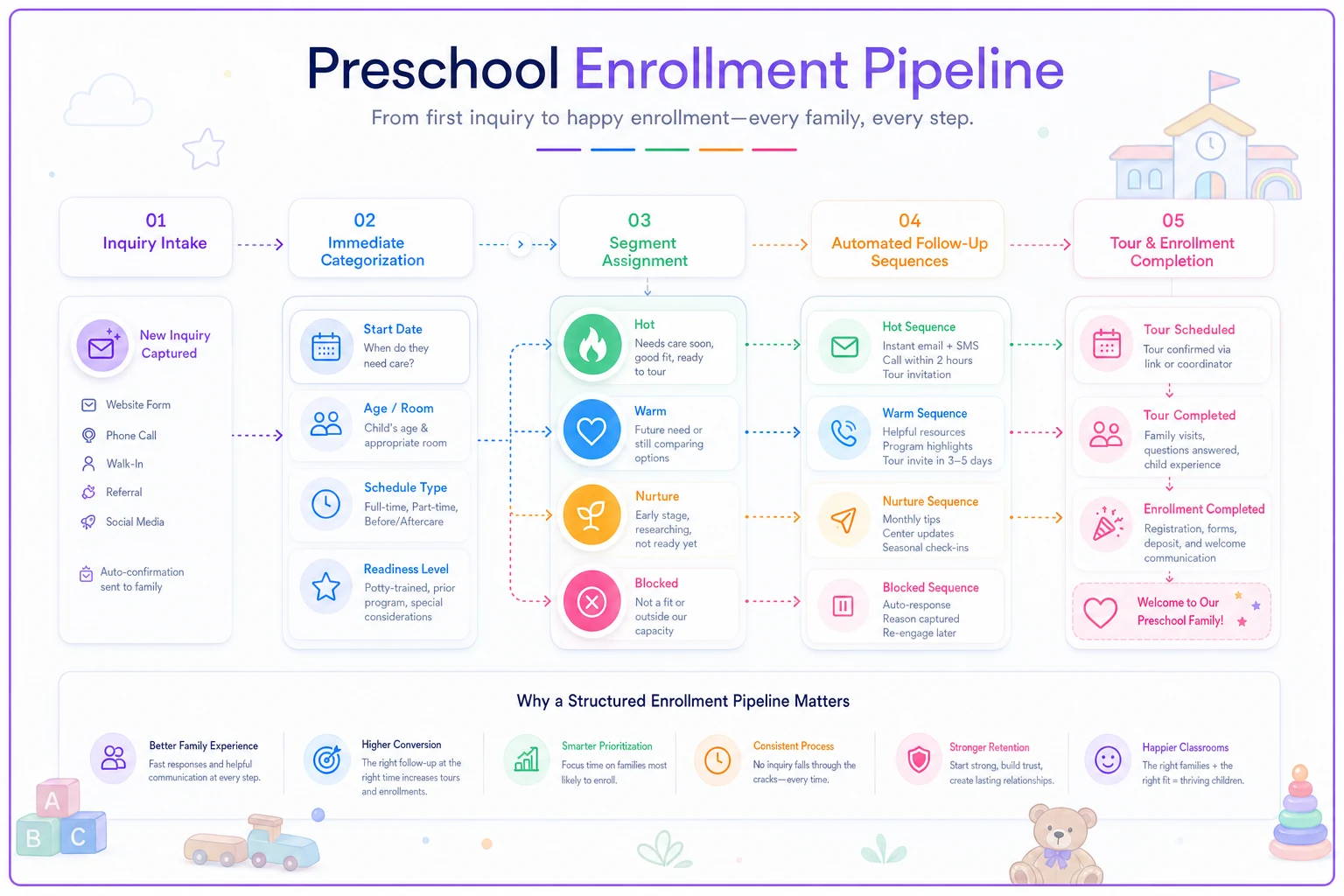
Use the visual to align staff on who does what at each step.
Time-based nudges: the part everyone knows and nobody does
Follow-up is where good intentions go to die. Everyone agrees you should follow up. Almost nobody does it consistently, because it depends on a human remembering, and humans running a classroom during pickup don't remember.
The families you lose to slow follow-up aren't lost because they didn't like you. They're lost because childcare is time-sensitive and a parent solving a "who watches my kid in three weeks" problem will take the first center that responds like it wants them.
The nudge schedule needs to be built around urgency, not a flat "check in every few days for everyone." A hot family should hear from you within hours, then again in two days if they haven't booked a tour. A nurture family getting three emails in a week just feels harassed.
-
Within 2 hours Personal reply confirming availability, with two specific tour time options — not "let me know when works," because that puts the work on them
-
Day 2, no response Short follow-up, restate the open spot, add a soft deadline ("we're holding this through Friday")
-
Day 5, no response Final touch, then move to a slower cadence or mark inactive
The soft deadline in step two is the most underused lever in the whole pipeline. Parents comparing three centers move on the one that creates a reason to decide. Not pressure — clarity. "This spot is available now and we can hold it until Friday" converts dramatically better than "let us know if you're interested."
Where this breaks in real operations: the person who takes the inquiry isn't the person who does the follow-up, the follow-up lives in someone's head, and the "hold until Friday" promise gets forgotten by Friday. This is exactly the kind of repetitive, time-sensitive coordination that's worth handing to an automated workflow — inquiry comes in, gets tagged, the sequence fires on schedule, and a human only steps in for the actual conversation. The automation isn't replacing the relationship. It's making sure the relationship gets a chance to start.
The tour is the conversion event — protect it
Most centers track "inquiries" and "enrollments" and nothing in between, which means they're blind to where families actually drop off. The tour is the single highest-leverage moment in the pipeline. Families who tour convert at a far higher rate than families who don't, and it's not close.
Two numbers matter more than almost anything else:
-
Inquiry → tour scheduled rate — of families who inquire, how many book a tour?
-
Tour → enrollment rate — of families who tour, how many enroll?
If your inquiry-to-tour number is low, the problem is upstream: slow response, bad categorization, no clear offer. If your tour-to-enrollment number is low, the problem is the tour itself, or the follow-up after it — no packet, no next step, no answer on cost.
A common failure: a family tours, loves it, and then nothing happens. No enrollment packet handed over on the spot, no follow-up the next day, no clear "here's how you secure the spot." The center assumes the parent will come back. Half the time they don't, because life got busy and momentum died. Handing over the enrollment paperwork at the tour while enthusiasm is high, and following up within 24 hours, recovers a meaningful chunk of those families.
The conversion metrics worth tracking (and the ones that lie)
You don't need a dashboard with 30 metrics. You need five that tell you where the pipeline is bleeding.
-
Inquiry response time — median hours from inquiry to first personal reply. Under a few hours for hot leads, or you're losing them.
-
Inquiry → tour rate — the top-of-funnel health check
-
Tour → enrollment rate — the closing health check
-
Time-to-enroll — median days from inquiry to enrollment, tracked by segment
-
Waitlist conversion rate — of families who went on the waitlist because you were full, how many eventually enroll when a spot opens?
That last one is the metric almost nobody tracks, and it's the one that exposes wasted demand. If you had 20 families waitlisted for a full room and only 3 enrolled when spots opened, you didn't have a full room problem — you had a follow-up problem. Those 17 families were interested enough to wait, and you let them walk.
The metric that lies: total waitlist size. A big waitlist feels great and tells you almost nothing. A list of 40 names where half have already enrolled elsewhere and nobody's been contacted in three months is not an asset. It's a to-do list you've been ignoring. Clean the list quarterly, mark inactive families, and stop counting ghosts as pipeline.
When a formal pipeline makes sense — and when it's overkill
This isn't worth building for every center. If you run a small in-home program with steady word-of-mouth referrals and rarely have an open spot, a lightweight tagged list is plenty. Over-engineering the process just adds work you don't need.
Where a real pipeline pays for itself:
-
You get more than 15–20 inquiries a month and can't respond to all of them fast
-
You have multiple rooms with different availability, so triage genuinely matters
-
You run at less than full capacity in at least one room despite having interested families
-
You operate more than one site and need a consistent process across locations
Who should not bother with heavy automation: a center where one person handles every inquiry personally, remembers every family, and converts well already. If it's working, systematizing it can strip out the warmth that was doing the converting. Fix the leak, not the thing that isn't broken.
A real scenario
A two-room preschool — one toddler, one preschool class — was running the preschool room at around 80% and had a waitlist of roughly 30 names they were quietly proud of. The problem showed up when we looked at what actually happened to inquiries: replies were going out two to three days late, tours were booked whenever the director had a free afternoon, and the waitlist hadn't been contacted in months.
They changed three things, nothing fancy. Every inquiry got tagged by start date and room the day it came in. Hot leads got a same-day reply with two tour times and a "we can hold this spot" line. And they set a recurring monthly touch for waitlisted families, plus an alert whenever a known withdrawal freed up a spot.
Over the next few months the preschool room filled to capacity and stayed there, and time-from-inquiry-to-enrollment dropped from a couple of weeks to a handful of days for the urgent families. They didn't get more inquiries. They just stopped losing the ones they already had.
The takeaway
A waitlist isn't a pipeline. A pipeline is what you build on top of the waitlist: fast triage at intake, segments that change what you actually do, nudges timed to urgency, and a small set of conversion numbers that tell you where families are slipping away.
Most enrollment gaps aren't demand problems. They're coordination problems — the right family, the right open spot, and a follow-up that never happened. Fix the follow-up, respect the timing, and stop treating a long list of names as if it's the same thing as full classrooms.
A waitlist isn't a pipeline. A pipeline is what you build on top of the waitlist: fast triage at intake, segments that change what you actually do, nudges timed to urgency, and a small set of conversion numbers that tell you where families are slipping away.
Ready to elevate your childcare management?
Join hundreds of childcare providers using Totsyly to save time, improve communication, and grow their centers.