


Your regular teacher calls out sick at 6:47 AM. The substitute you scramble to book hasn't completed their background check renewal. A parent volunteer shows up to help with snack time, but nobody verified their clearances. Then state licensing shows up for a surprise visit.
This exact scenario cost a center in Pennsylvania $4,800 in fines last month.
The problem isn't that childcare centers don't care about compliance—it's that volunteer substitute policy childcare requirements create operational chaos when you're already running on thin margins and skeleton crews. Most centers patch together Google Forms, paper binders, and WhatsApp groups to manage temporary staff vetting. It works until it doesn't.
Why centers keep failing volunteer and substitute compliance
The typical childcare center runs with 8-12 regular staff members and pulls from a pool of roughly 15-20 substitutes and volunteers. That means tracking clearances, training dates, and supervision requirements for around 30 people who aren't even full-time employees.
State requirements vary wildly. Pennsylvania demands FBI clearances, state criminal checks, and child abuse clearances—all expiring on different three-year cycles. Texas requires fingerprinting plus a central registry check. California adds TB testing to the mix. If you operate multiple centers across state lines, you're juggling completely different compliance frameworks for the same role.
Most directors store this information in Excel spreadsheets that nobody updates, physical folders in filing cabinets, email threads with attachments scattered across months, or sticky notes on monitors with expiration dates.
When that morning call comes in, you're rifling through papers trying to figure out if Jessica's clearances are current while parents are dropping off kids and your ratio is already tight.
The hidden operational drain of manual vetting
Beyond the compliance risk, manual vetting processes eat roughly 6-8 hours of administrative time per week for a typical 50-child center.
Simplify your childcare center’s daily operations.
Totsyly helps you manage enrollments, staff, and communications efficiently so you can focus on care.
- Streamlined enrollment & waitlist management
- Automated billing & payment tracking
- Staff scheduling & attendance monitoring
No credit card required
| Task | Weekly Time | Monthly Cost (@$18/hr) |
|---|---|---|
| Tracking clearance expirations | 2 hours | $144 |
| Verifying substitute availability | 1.5 hours | $108 |
| Documenting supervision ratios | 1 hour | $72 |
| Filing/organizing paperwork | 2 hours | $144 |
| Responding to licensing requests | 0.5 hours | $36 |
| Total | 7 hours | $504 |
That's over $6,000 annually just managing temporary staff compliance—not including the actual cost of background checks or the risk of fines.
Building a vetting checklist that actually works
The centers that pass licensing visits without issues all follow a similar pattern. They don't try to track everything—they track what matters for their specific state requirements and operational reality.
Start with your state's non-negotiable items:
-
Criminal background check (state-specific requirements)
-
Child abuse clearance or registry check
-
Reference verification (at least two)
-
Health screening or TB test (if required)
-
Signed confidentiality agreement
-
Emergency contact information
For ongoing compliance, you need clearance expiration tracking with automated reminders 60 days out, annual training verification for CPR and mandated reporter requirements, incident report history, and supervision requirement documentation.
Set automated reminders 60 days before clearances expire to avoid last-minute renewals.
Before every shift, verify current clearance status, required training completion, ratio impact assessment, and parent notification if needed.
Centers that struggle try to track 40+ data points per person. Successful ones track 10-12 critical items and automate the rest.
Creating supervision ratios that protect without paralyzing operations
Most compliance guides won't tell you this: supervision ratios for volunteers aren't just about legal requirements—they're about operational flow. A volunteer who needs constant supervision actually makes your ratios worse, not better.
Consider a typical preschool classroom scenario. You have 1 lead teacher, 1 assistant teacher, 18 four-year-olds, and a state ratio requirement of 1:9.
Adding an unsupervised-eligible volunteer gives you breathing room. Adding a volunteer who requires direct supervision means your lead teacher splits attention between children and the volunteer. Your effective ratio gets worse.
The operational sweet spot uses a tiered approach:
Tier 1: Fully cleared volunteers/substitutes can work independently after orientation, count toward ratio requirements, and access all areas and activities.
Tier 2: Partially cleared volunteers require line-of-sight supervision, cannot be alone with children, and are limited to specific activities like reading, crafts, or playground supervision.
Tier 3: One-time volunteers require constant direct supervision, cannot assist with personal care, and are limited to group activities only.
Centers using this tiered approach reduce supervision-related incidents by roughly 70% while maintaining operational flexibility.
The substitute booking flow that prevents morning chaos
The difference between a smooth substitute placement and a compliance nightmare happens in the 12 hours before they arrive. Most centers wing it. The successful ones have a systematic flow.
The night before (if possible), check tomorrow's attendance projections, identify potential coverage gaps, pre-verify your top 3 substitute options, and send availability checks via text.
Morning of an emergency call-out requires a different approach:
-
Receive call-out and document time and reason
-
Pull pre-verified substitute list
-
Check current clearance status (this must be automated, not manual)
-
Confirm ratio requirements for affected classroom
-
Book substitute with automated confirmation
-
Generate compliance documentation
-
Notify affected classroom staff
When the substitute arrives, they sign in with timestamp, verify identity against the approved list, receive classroom assignment and supervision tier information, and get documented in the daily log.
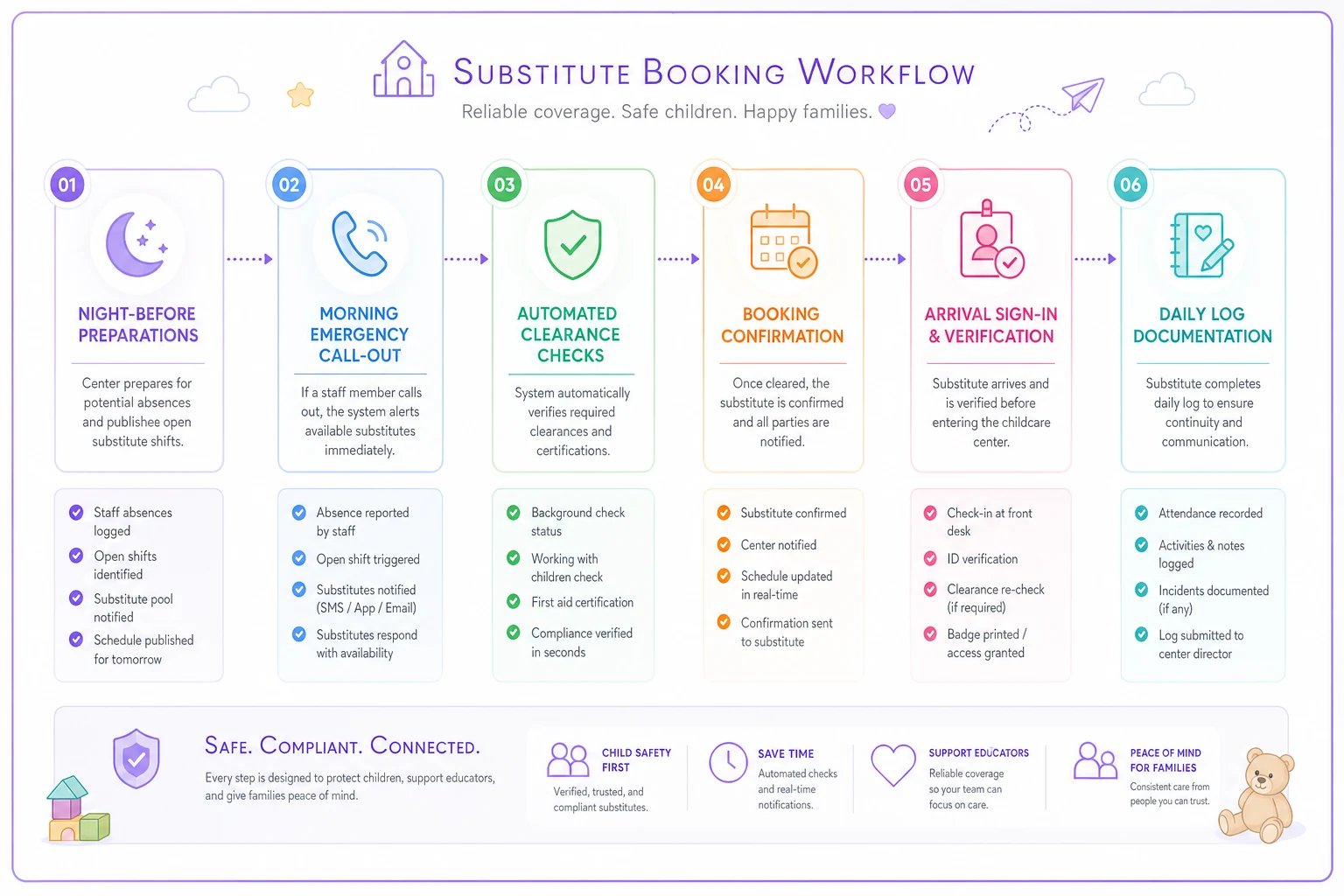
This visual shows the key steps in the booking and verification process.
When manual tracking becomes impossible to maintain
Once you're managing more than 15 temporary staff members, manual tracking breaks. Not because people aren't trying—because the complexity compounds exponentially. Each person has 3-5 clearances, each expiring on different dates, with different renewal processes, across different systems.
A center in Ohio managed 22 substitutes across three locations using a color-coded Excel sheet. Worked perfectly until their administrator went on maternity leave. The replacement missed seven clearance renewals in two months. State licensing issued $11,000 in fines and threatened license suspension.
The breaking points typically happen when your substitute pool exceeds 15 people, you operate multiple locations, you have staff turnover in administrative roles, state requirements change, or you add programs with different compliance requirements.
Building compliance systems with AI-powered operational software
The most successful centers treat compliance tracking like inventory management—continuous, automated, and integrated into daily operations. Not as a separate administrative burden.
AI-assisted operational platforms transform the entire volunteer substitute policy childcare compliance process. Instead of checking spreadsheets, the system automatically tracks clearance expirations, sends renewal reminders, and blocks non-compliant staff from being scheduled. When someone calls out sick, you see only available, cleared substitutes who meet your ratio requirements.
Before automation, directors spend 35+ hours monthly on compliance tracking, experience 3-4 near-misses with expired clearances quarterly, trigger 2-3 days of document scrambling for licensing visits, and need 20-30 minutes per substitute booking instance.
After implementing operational software, compliance tracking becomes an automatic background process, zero clearance expirations get missed, licensing documentation is available instantly, and substitute booking takes under 5 minutes.
One center group in New Jersey eliminated their entire compliance coordinator position after implementing AI-powered tracking—saving $42,000 annually while actually improving their licensing scores.
The real cost of getting volunteer vetting wrong
Beyond fines and licensing issues, failed volunteer vetting creates cascading operational problems. Parents lose trust. Staff feel unsupported. Good substitutes go elsewhere because the process feels chaotic.
A center near Dallas discovered this after a volunteer's expired clearance led to them being removed mid-day during a state visit. The immediate cost: $3,200 fine. The ongoing cost: three families withdrew (roughly $4,500 monthly revenue), two substitutes stopped accepting shifts, and staff morale tanked because they had to cover the sudden gap.
Compliance failures are almost always operational failures in disguise. The clearance didn't suddenly expire. The system for tracking it failed weeks or months earlier.
Making compliance sustainable without burning out your team
Centers that maintain perfect compliance records without exhausting their administrators identify their highest-risk areas and build bulletproof systems around those.
For volunteer and substitute management, you need automated expiration tracking where nobody manually checks dates, tiered access systems where not everyone needs full clearance for every role, pre-verified pools where you vet people before you need them, a single source of truth instead of five different spreadsheets, and instant documentation where licensing requests get answered in minutes, not days.
The operational transformation happens when you stop treating compliance as a checkbox exercise and start treating it as a workflow design problem. When booking a substitute becomes as simple as ordering supplies, when volunteer clearances update automatically, when supervision ratios calculate themselves—that's when compliance stops being a burden and becomes invisible infrastructure.
Your teachers can focus on teaching. Your administrators can focus on families. And when licensing shows up for that surprise visit, you hand them a tablet with everything already organized instead of scrambling through filing cabinets.
Because volunteer substitute policy childcare compliance isn't really about paperwork. It's about building operations that protect children while letting your center actually function. The right systems make both possible without requiring superhuman effort from your already stretched team.
Ready to elevate your childcare management?
Join hundreds of childcare providers using Totsyly to save time, improve communication, and grow their centers.