



The Conference Board's latest read landed on August 25, and it wasn't dramatic — confidence dipped to 89.4 in August from 90.2 in July. What matters for childcare operators isn't the headline number, though. It's the Expectations Index, which slid to 68.2 as families got more nervous about income, jobs, and business conditions over the next six months. You can read the full Conference Board release here if you want the raw data.
The Expectations Index measures how people feel about the near future — and near-future feelings are exactly what drive a parent's decision to commit to a $1,200-a-month tuition contract in September. When families feel shaky about their own income six months out, they don't cancel childcare outright. They do something subtler and harder to plan around: they delay, they downgrade, they ask for flexibility, and they pay a few days later than they used to.
That's the real operational story here. So instead of walking through survey details, below are nine moves that actually protect your fall.
First, understand what "soft confidence" does to a childcare P&L
Enrollment softness in childcare doesn't behave like a cliff. It behaves like a slow leak.
A family that would've enrolled two weeks after touring now takes six. A parent who paid full-time now asks about a three-day schedule. A dual-income household where one job feels uncertain quietly moves their toddler to grandma two days a week and drops from full-time to part-time. None of these are dramatic on their own. But stack fifteen of them across a 90-child center and you've quietly lost the equivalent of eight to ten full-time slots — and your staffing ratios were built assuming those slots were filled.
That's the trap. Your costs are stepped and fixed (you can't run a classroom with half a teacher), but your revenue during a confidence dip erodes in small, uneven pieces. The centers that get hurt are the ones still forecasting off last spring's optimism.
The moves below aren't about panicking. They're about tightening the parts of your operation that soft demand exposes.
The 9 moves, in the order they actually matter
Not all of these are equal. Grouped below by what protects cash first versus what protects enrollment over the season.
Simplify your childcare center’s daily operations.
Totsyly helps you manage enrollments, staff, and communications efficiently so you can focus on care.
- Streamlined enrollment & waitlist management
- Automated billing & payment tracking
- Staff scheduling & attendance monitoring
No credit card required
| Move | Protects | Effort | When it pays off |
|---|---|---|---|
| 1. Re-forecast occupancy weekly, not monthly | Cash | Low | Immediately |
| 2. Lock in tentative families faster | Enrollment | Medium | 2–4 weeks |
| 3. Tighten deposit-to-start conversion | Cash + Enrollment | Low | 3–6 weeks |
| 4. Pre-build your part-time/flex tiers | Enrollment | Medium | 4–8 weeks |
| 5. Get proactive on payment plans | Cash | Low | Ongoing |
| 6. Audit your discount exposure | Margin | Medium | 1–2 months |
| 7. Build a staffing "flex band" | Cost | High | Season-long |
| 8. Shorten your waitlist response time | Enrollment | Low | Immediate |
| 9. Set cash triggers before you need them | Cash | Low | Preventive |
1. Re-forecast occupancy weekly instead of monthly
Most centers run a monthly enrollment count and call it forecasting. During stable times that's fine. During a confidence dip, a month is way too long — you'll find out you're eight kids short in late September when the September staffing decisions were already made in August.
Switch to a rolling weekly view of three numbers: confirmed enrollments, tentative/deposit-paid families, and drop notices. The gap between "tentative" and "confirmed" is your risk zone, and during soft sentiment that gap widens. Watching it weekly means you see the leak while you can still do something about it.
2. Lock in tentative families before doubt sets in
The longer a family sits in "we're thinking about it," the more time reality has to talk them out of it. During confident periods, slow follow-up costs you little. During a nervous period, every extra day a family spends undecided is a day their brain finds a cheaper option.
The fix isn't pressure — it's speed and clarity. A family that tours on Tuesday should have a written summary, exact start date, and a simple next step in their inbox by Wednesday. Vague timelines are where enrollments quietly die.
3. Fix the deposit-to-start gap
A lot of centers celebrate the deposit and then stop paying attention. But there's often a two-to-six-week gap between deposit and first day, and that's where confidence-driven cancellations happen. Someone's hours got cut, the spouse's bonus didn't come through, and the "refundable within 14 days" deposit becomes an easy exit.
Watch this cohort specifically. A short check-in call a week before start — "we've got Mia's cubby ready, anything you need before Monday?" — does two things: it catches wobbling families early, and it makes backing out feel more personal, which reduces silent cancellations.
4. Pre-build flexible tiers before families ask
Most operators resist part-time and flex schedules because they complicate staffing. But during a confidence dip, the choice isn't "full-time vs. part-time." It's "part-time vs. gone." A family nervous about money will keep a three-day slot they'd have abandoned as a five-day commitment.
The mistake is negotiating these one-off at the front desk under pressure, which wrecks your margins and your schedule. Design two or three clean flex tiers in advance, price them so they're slightly less efficient for the family per-day (so full-time stays the better deal), and let your staff offer them as a real product rather than a desperate concession.
6. Audit your discount exposure before you start handing out more
When enrollment gets soft, the reflex is to discount. Fine — but most centers have no idea what their existing discount stack already costs. Sibling discounts, staff discounts, early-pay discounts, loyalty holdovers, that one family the previous director gave 20% off in 2023 that nobody ever revisited.
Before adding a single new promotion this fall, pull every active discount into one list and total the monthly dollar value. It's almost always bigger than leadership thinks. You may find you have more room to retain families through targeted flexibility than through broad price cuts — and broad price cuts are the hardest thing to reverse once families expect them.
Total your active discount dollars before creating any new promotions.
A checklist for your next two weeks
If you do nothing else before fall, run through this:
-
- [ ] Build a weekly occupancy tracker splitting confirmed / tentative / at-risk
-
- [ ] List every tentative family and assign a specific next contact date
-
- [ ] Add a pre-start check-in step for every deposit-paid family
-
- [ ] Draft 2–3 flex/part-time tiers with clean pricing before anyone asks
-
- [ ] Total your current active discount dollars across all families
-
- [ ] Set a payment-plan offer script so front-desk staff aren't improvising
-
- [ ] Define your staffing flex band (min viable coverage per room)
-
- [ ] Set a cash trigger
"if occupancy drops below X%, we do Y"
-
- [ ] Cut waitlist response time to under 24 hours
Where the payment side gets dangerous
Where the payment side gets dangerous
Soft consumer sentiment shows up in tuition timing before it shows up in cancellations. The first signal isn't a family leaving — it's a family that used to pay on the 1st now paying on the 6th. Then the 9th. Then asking to split the month.
The operational danger is that this creeps in unevenly across dozens of accounts, so no single late payment triggers alarm. But collectively your cash timing drifts a week or more. A one-week drift in receivables against fixed payroll dates is how a profitable center suddenly can't make a Friday run.
This is exactly why forecasting and collections have to move together, not in separate spreadsheets owned by separate people. If you haven't already built a disciplined approach to this, the operational playbook for tuition, refunds, and forecasting walks through the mechanics of tying billing timing to your actual cash calendar — the piece most centers skip until they get burned.
The practical version: get proactive on payment plans instead of reactive. A family that's offered a structured split before they miss a payment stays enrolled and pays reliably. A family chased after missing two payments is halfway out the door. Same dollars, completely different outcome — and the difference is entirely in timing and tone.
Where software quietly earns its keep here
The moves above have one thing in common: they all fall apart when your enrollment, billing, and staffing data live in different places.
You can't run a weekly at-risk occupancy view if enrollment is in one system and drop notices are in a director's inbox. You can't spot payment-timing drift across forty families by eyeballing a bank statement. Operational platforms that keep enrollment status, tuition timing, and staffing ratios connected are what make this kind of weekly vigilance actually doable instead of a heroic manual effort every Monday. When sentiment is soft and margins are tight, the centers that see problems early are simply the ones whose information isn't scattered. That's the whole advantage.
Here's a simple view of how these systems should connect.
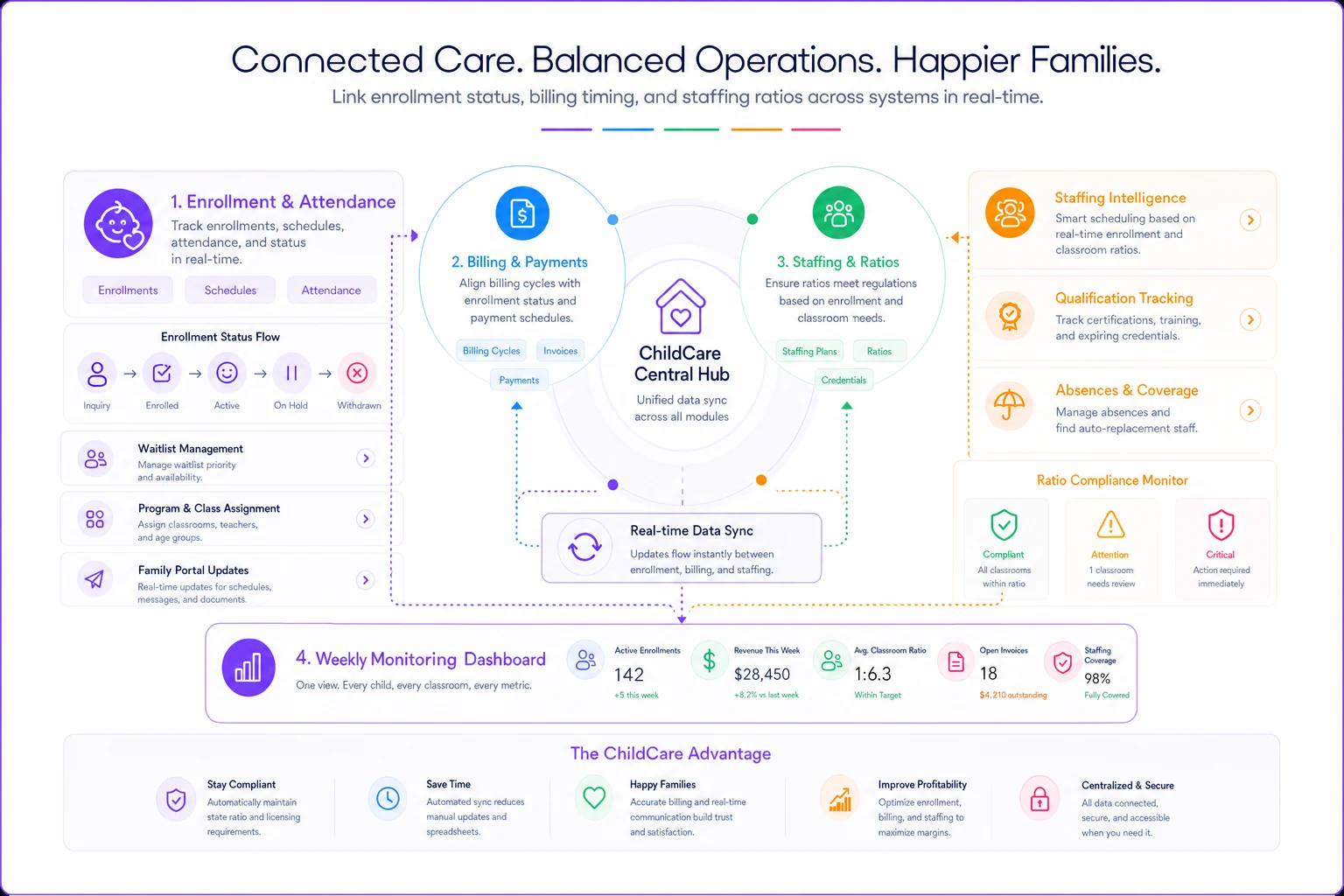
When sentiment is soft and margins are tight, the centers that see problems early are simply the ones whose information isn't scattered. That's the whole advantage.
A real scenario
A mid-sized center — around 85 kids, two locations under one director — went into last fall assuming a repeat of their strong spring. They forecasted monthly and offered payment flexibility only when families asked.
By late September they were roughly six full-time slots short of budget, spread across both sites so neither location's numbers looked alarming on its own. Payroll was set for full rooms. They'd also quietly accumulated somewhere around $9k–$11k in slow-paying accounts that nobody had flagged because each one individually looked minor.
The fix wasn't dramatic. They moved to a weekly occupancy and receivables check, built three part-time tiers, and started offering payment plans proactively to any family that paid late two months running. Over the following season, part-time conversions recovered a few of those lost slots — families who'd otherwise have dropped entirely — and receivables timing tightened back to within a few days of due dates. Not a miracle. Just the leak sealed before it drained anything critical.
The takeaway
A one-point dip in consumer confidence isn't a crisis, and treating it like one will make you overcorrect on price. The Conference Board's August report is really just a reminder that families touring your center this fall are making decisions with a little more hesitation than they were a year ago.
Your job isn't to fix the economy. It's to make sure that hesitation doesn't quietly turn into empty classrooms and drifting receivables while you're still forecasting off last spring's numbers. Tighten the follow-up, watch the weekly gaps, build your flex options before you need them, and get proactive on payments. Do that, and a soft season stays soft instead of becoming a scramble.
Ready to elevate your childcare management?
Join hundreds of childcare providers using Totsyly to save time, improve communication, and grow their centers.