

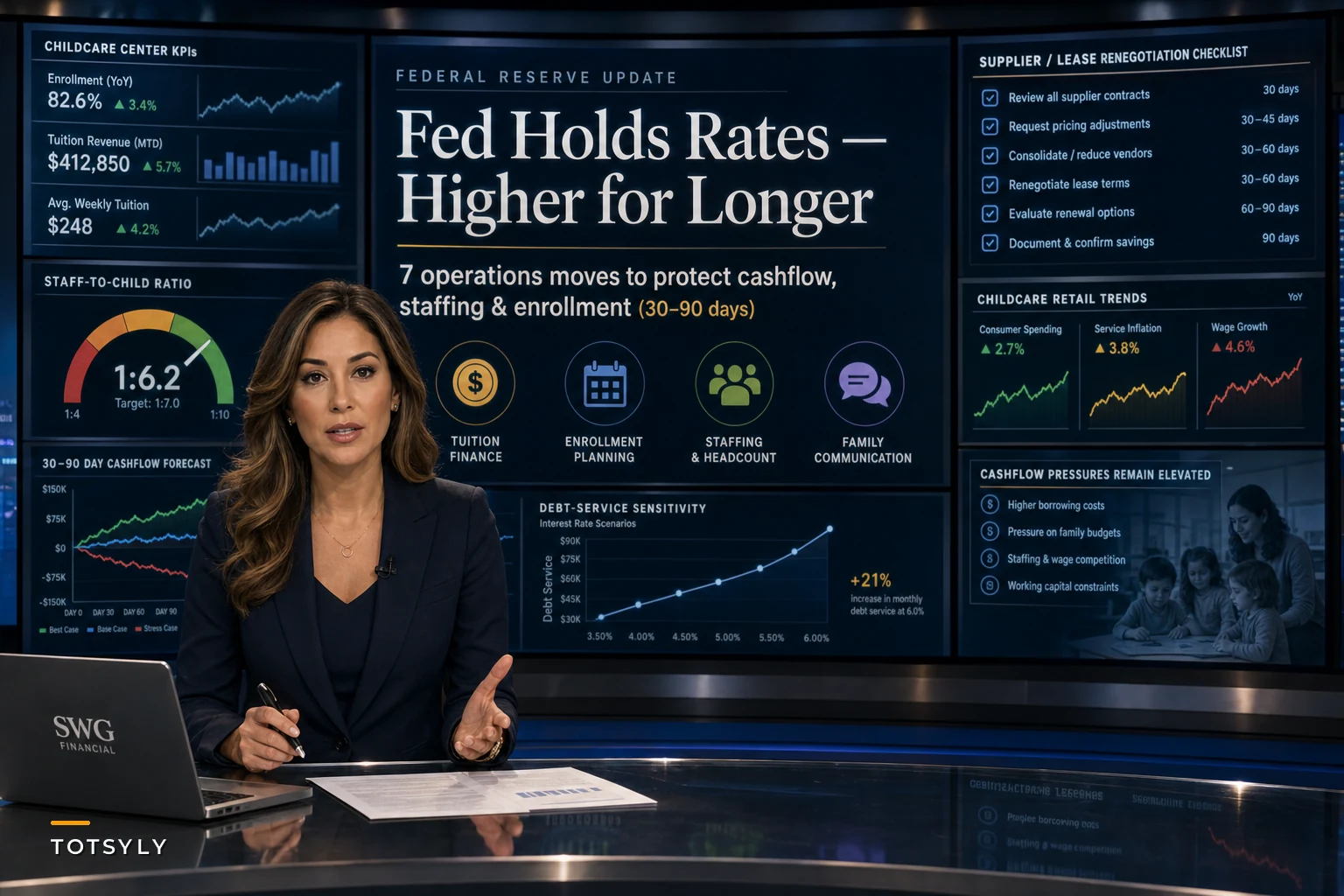

The Fed just held rates at 3.50%-3.75%, and the FOMC statement made it clear we're in higher-for-longer territory through at least early 2027. Three committee members actually pushed for another hike. For daycare centers already running on thin margins, this isn't just another economic headline — it's an operational problem that needs solving now.
Most centers don't realize how exposed they are until the bills start stacking up. Variable-rate facility loans jump overnight. Working capital lines get more expensive. Parents start asking about payment plans they never needed before. The squeeze comes from every direction at once.
What catches centers off guard is how fast the operational problems compound — often faster than the financial ones. A center with solid fundamentals can probably absorb a 2% rate bump on their mortgage. But when families start pulling kids mid-month because they can't swing full tuition, when staff leave for $1.50 more per hour at Target, when your food vendor suddenly wants net-15 instead of net-30 — that's when things actually break down.
Move 1: Shift collections from monthly to weekly touchpoints
Centers running monthly billing cycles are sitting ducks right now. By the time you notice a family is struggling, they're already $1,800 behind and quietly looking at other options.
Weekly payment touchpoints give you early warning. Not weekly billing — that's too aggressive and will annoy everyone. Weekly monitoring of payment patterns.
Every Monday morning, pull three lists:
-
Families who usually pay by the 1st but haven't yet
-
Anyone with declined payments in the last 7 days
-
Families who've recently asked about schedule reductions
Assign a touchpoint owner to each list so follow-ups don't fall through the cracks.
For each family on those lists, assign a touchpoint owner. Not collections calls — check-ins. "Hey, noticed your payment didn't process Tuesday. Everything okay? Want to grab coffee after pickup tomorrow?"
One center in suburban Dallas shifted to this model in May. Their past-due over 30 days dropped from $24,000 to around $8,500. Not because they collected faster, but because they caught problems before families got overwhelmed and made decisions they couldn't walk back. Three families switched from full-time to part-time instead of withdrawing completely — that's roughly $2,100/month in saved revenue.
The administrative load is real, though. Tracking weekly touchpoints across 80+ families means someone's spending 6-8 hours a week on this. But compare that to the 20+ hours you'll burn trying to collect $5,000 from a family that's already gone.
Move 2: Lock in operational credit before banks tighten further
Banks are already pulling back on childcare lending. Not officially — they'll still return your calls. But approval timelines are stretching from 3 weeks to 8 weeks. Credit committees want 18 months of projections instead of 12. And that equipment line you could've gotten at prime + 1.5%? It's closer to prime + 3.5% now.
Simplify your childcare center’s daily operations.
Totsyly helps you manage enrollments, staff, and communications efficiently so you can focus on care.
- Streamlined enrollment & waitlist management
- Automated billing & payment tracking
- Staff scheduling & attendance monitoring
No credit card required
Get three credit facilities in place before conditions get worse:
Working capital line: Target 2 months of payroll, minimum. Even if you've never touched a line of credit. When three families withdraw in the same week or the state delays subsidy payments, this keeps you open.
Equipment financing pre-approval: Get approved for $50,000-$75,000 now, even if you don't need playground equipment until spring. Rates will be higher in 6 months, and approval might not come through at all.
Credit cards with 0% promotional periods: Open two business cards with 12-18 month 0% windows. Not for regular expenses — for emergency float when other options aren't available.
A center group in Phoenix learned this the hard way last month. They waited to finance new infant room equipment until they had family deposits secured. By then, their bank wanted 20% down instead of 10%, and the rate had jumped 2.25%. That $30,000 project cost them an extra $4,200 over the loan term because they waited 60 days too long.
Move 3: Create the "affordability ladder" before families leave
Recent analysis shows household debt service is hitting 15-year highs. Families are making brutal choices between childcare and car payments. If you wait for them to come to you with a problem, they'll already have one foot out the door.
Build your affordability ladder now — a clear pathway for families to reduce costs without leaving entirely:
Level 1: Payment restructuring
-
Split monthly tuition into bi-weekly payments
-
Waive the credit card processing fee for autopay enrollment
-
Apply unused sick days as credits (maximum 2 per quarter)
Level 2: Schedule flexibility
-
Offer 4-day weeks at 85% of full tuition
-
Create 8am-3pm "school day" pricing at 75% of full day
-
Allow monthly schedule changes instead of requiring semester commitments
Level 3: Work-trade programs
-
4 hours of center support = $200 tuition credit
-
Skills-based trades (IT support, maintenance, curriculum prep)
-
Maximum 25% of tuition through work-trade
Level 4: Temporary hardship rates
-
3-month reduced rates with documentation
-
Automatic review and graduation plan
-
Capped at 10% of total enrollment
Most centers resist this because they're afraid it'll tank revenue. What actually happens: families who can afford full tuition keep paying it. Families on the edge stay instead of leaving. And your occupancy holds above 85%, which matters a lot more than your average tuition rate.
Move 4: Renegotiate vendor terms while you still have leverage
Your vendors are feeling the same squeeze. Food costs are up close to 18% year-over-year. Cleaning supplies jumped over 20%. Transportation surcharges show up on everything now. But what most centers miss — vendors are terrified of losing reliable accounts right now.
This is your window to lock in stability. Not necessarily lower prices, just stability.
Start with your top 5 vendors by spend. Here's what a reasonable negotiation framework looks like across different deal structures:
| Offer to vendor | What you get in return |
|---|---|
| Guaranteed minimum orders for 18 months | Price lock through contract period |
| 2% volume increase | Net-45 payment terms (up from net-30) |
| Quarterly payment instead of monthly | 5% discount on invoices |
| Consolidated delivery schedule | Reduced or waived fuel surcharges |
A center group running 4 locations in North Carolina locked in food service pricing through December 2027. They committed to $12,000/month in minimum orders across all sites and got a 15% discount plus price protection. Their vendor was happy to sign — guaranteed revenue for 18 months beats chasing new accounts in a shaky market.
Move fast on this. Vendors are still negotiating now. By Q4, they'll be in survival mode and a lot less flexible.
Move 5: Build your "ratio flex" staffing model
Traditional staffing models don't hold up well when rates stay elevated. Full-time staff need higher wages to offset their own debt costs. Part-timers jump to gig work. Fixed labor costs eat through margin fast when enrollment fluctuates.
The ratio flex model builds in operational breathing room:
Core staff (60% of needs): Full-time, benefited, handling primary classrooms and providing consistency for kids.
Flex pool (25% of needs): Part-time regulars who can scale up or down weekly. Guaranteed minimum 20 hours, can flex to 35.
Reserve network (15% of needs): Pre-vetted, trained substitutes on-call. Higher hourly rate, no benefits, no guaranteed hours.
The critical part: you maintain this structure even at full enrollment. The extra coverage isn't waste — it's operational insurance.
When a teacher calls out, the flex pool covers without triggering overtime. When enrollment drops 10%, you scale back reserve network hours first. When three families enroll mid-month, you have capacity without scrambling.
One center in Austin built this model after losing around $14,000 to overtime during a respiratory outbreak last winter. They now run at 102% of minimum required staffing instead of exactly 100%. The extra $3,000/month in labor is a reasonable trade for not bleeding out during a two-week crisis.
Move 6: Create payment certainty with "enrollment banking"
The subscription model everyone talks about doesn't really work for childcare. Enrollment banking does — and it's pulling centers out of cashflow chaos.
-
6-month block
3% discount
-
9-month block
5% discount
-
12-month block
8% discount
The twist: blocks are transferable and refundable under set conditions.
-
Transfer remaining months to another family (you facilitate the connection)
-
Bank the months for future use (up to 2 years)
-
Get a 75% refund after 30 days notice
This isn't just prepayment — it's cashflow insurance for both sides. Families lock in current rates before your next increase. You get working capital without borrowing.
A preschool in Denver rolled this out in April. About 31% of families bought blocks, injecting $118,000 in immediate cashflow. Only two families have requested refunds, and one transferred their block to a neighbor starting in the fall. The center used the capital to pay off an equipment loan early and saved around $4,200 in interest.
Move 7: Implement "graduated communication" for financial discussions
The biggest operational failure in a high-rate environment isn't financial — it's communication breakdown. Centers either avoid money conversations until things are in crisis, or they send generic "times are tough" emails that make everyone nervous.
Graduated communication creates structured touchpoints before problems explode:
Green level (all families, monthly):
-
General update on center financial health
-
Celebration of on-time payment rate
-
Reminder of support options available
Yellow level (case-by-case, triggered):
-
Individual family showing payment stress signals
-
Proactive outreach within 48 hours
-
Discussion of affordability ladder options
Orange level (sustained concern):
-
Family with 2+ yellow triggers in 30 days
-
Face-to-face meeting scheduled
-
Collaborative solution planning
Red level (immediate intervention):
-
Payment 10+ days late or withdrawal mentioned
-
Same-day outreach from director
-
All options on the table
Visualizing this escalation can help your team act faster.
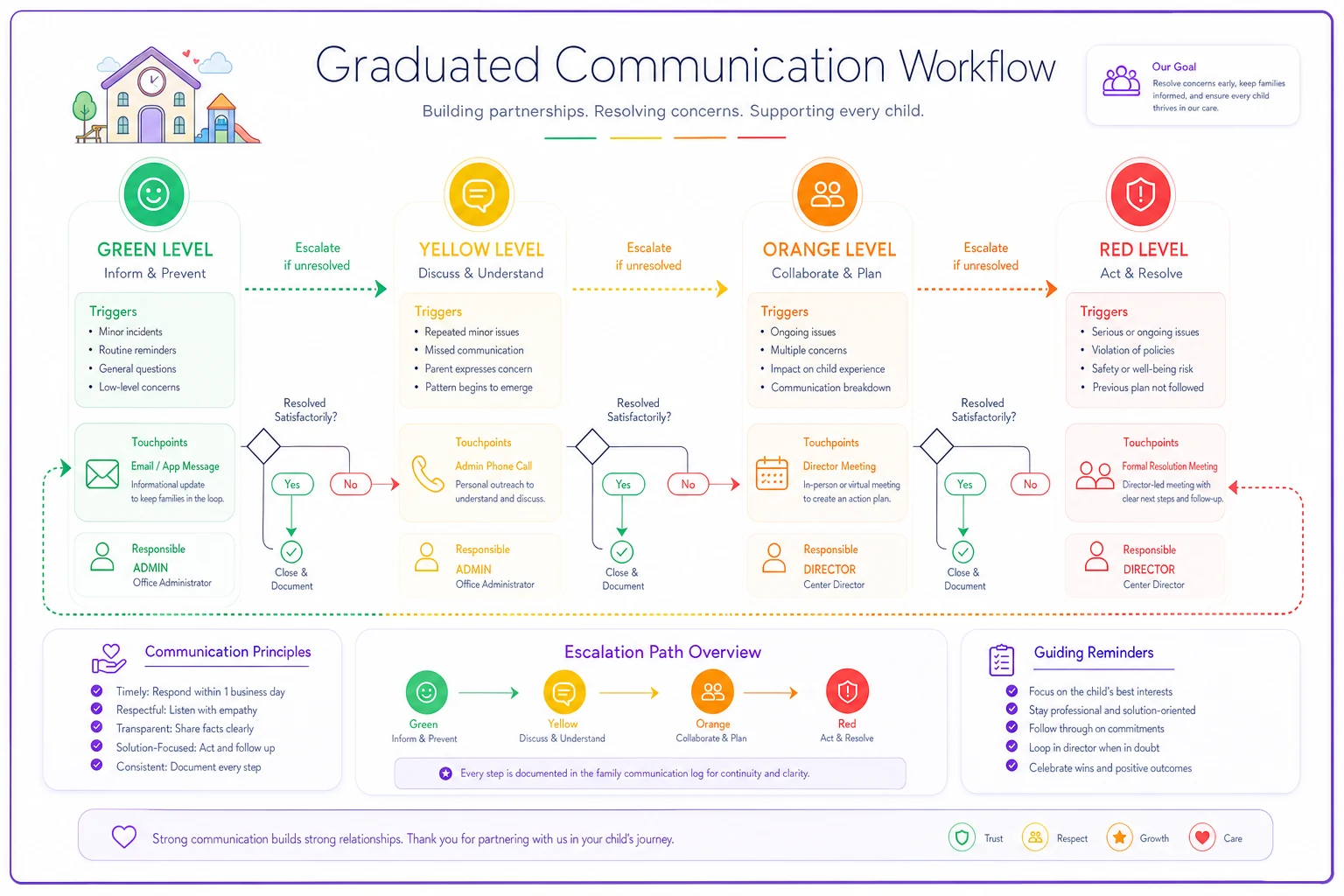
Each level has scripts, decision trees, and escalation criteria. Your admin team knows exactly when to loop in the director, when to offer payment plans, and when to suggest schedule modifications.
Centers using this kind of graduated approach see significantly fewer surprise withdrawals. Families feel supported rather than chased. And your staff stops treating every late payment like a five-alarm fire.
Cashflow forensics: what breaks first
The failure pattern is pretty predictable. Here's the typical sequence:
-
Delayed subsidy payments stretch from 30 to 45 days
-
Two or three private-pay families hit financial stress simultaneously
-
Working capital depletes covering payroll
-
Vendor payments get delayed
-
Vendors restrict terms or add surcharges
-
Admin team burns hours managing payment arrangements instead of enrollment
-
Quality drops, families notice, enrollment softens
-
The spiral accelerates
Understanding these pressure points is critical for cashflow management. Most centers focus on the big line items — payroll, rent, insurance. But the operational breakdown usually happens in the margins. The $400 monthly software subscription you can't cancel. The $1,200 in payment processing fees. The $800 in overtime because sub coverage fell through again. That's where the slow bleed happens, and most directors don't see it until they're already short on payroll.
Making the moves that matter
Higher rates aren't temporary. The Fed is being pretty clear about that. Centers that survive this aren't going to be the ones with the deepest pockets — they'll be the ones with the tightest operations.
Every move above can be implemented within 30 days. Not perfectly, but well enough to matter. Start with weekly payment monitoring and vendor renegotiation — those deliver the most immediate relief. Then work toward the structural changes: ratio flex staffing, enrollment banking, graduated communication.
The centers doing well right now aren't doing anything magical. They just started adapting before the crisis hit. They built operational flexibility while they still had breathing room. They created options for families before families needed them.
Your competition is hoping rates drop by spring. While they're waiting, you should be building operations that work regardless of what the Fed does next. When parents are choosing between centers, they won't pick the one with the best intentions. They'll pick the one that actually runs well.
The rate environment just made that difference a lot harder to hide.
Ready to elevate your childcare management?
Join hundreds of childcare providers using Totsyly to save time, improve communication, and grow their centers.