

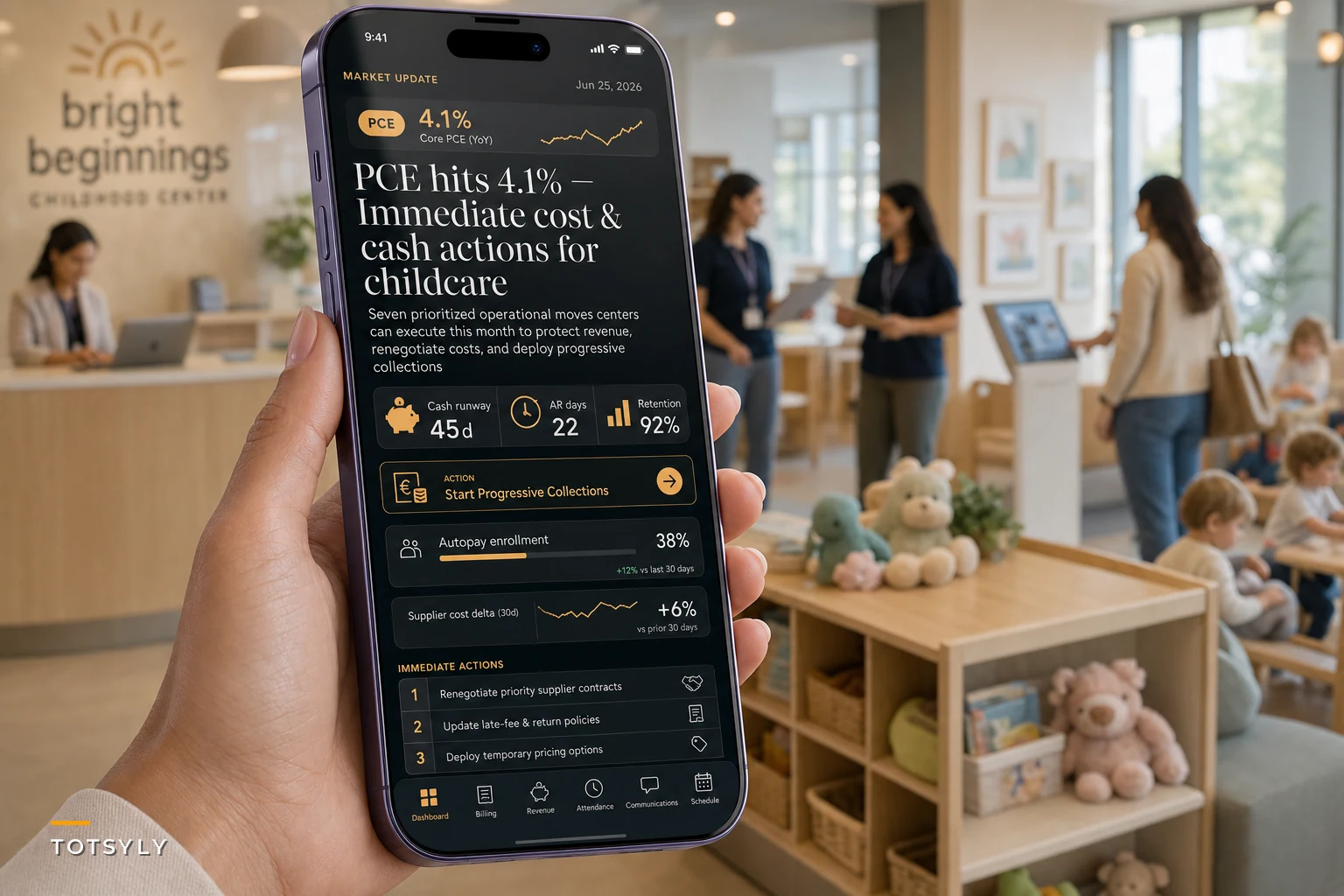

The BEA's June 25 release showing PCE inflation at 4.1% year-over-year landed like a gut punch for daycare administrators already stretching every dollar. Behind that headline number? Food costs up 14%, cleaning supplies up 18%, and utilities climbing month after month.
For childcare centers operating on 3-8% margins, this isn't just economic data—it's an operational emergency that demands immediate action on inflation childcare operations.
Most centers are responding wrong. They're either freezing up and hoping things improve, or panic-raising tuition without fixing the operational foundation first. Both approaches accelerate the same death spiral: enrollment drops, staff turnover, compliance failures. That's what kills centers during inflationary stretches.
The hidden operational cascade eating your margins
Every percentage point of inflation triggers multiple operational failures that compound fast. Your food vendor raises prices 8%, so you switch suppliers. The new vendor delivers inconsistently, meal planning turns into chaos, staff scramble to cover gaps, overtime spikes, morale drops. Meanwhile parents notice the food quality shift and start quietly questioning what else is slipping.
This cascade hits every cost center at once. The custodial service you've used for years wants 20% more. You bring cleaning in-house to save money, but now your assistant director is spending three hours weekly managing supplies and schedules instead of supporting classrooms. Teacher coverage gets thin. Incident reports tick up. Licensing catches small violations on their next visit.
What looks like inflation pressure is actually operational breakdown. Centers that survive this environment don't just adjust pricing—they rebuild how they operate, so the business can function efficiently at higher cost inputs without sacrificing quality or compliance.
Move 1: Implement sliding-scale variable pricing immediately
Fixed tuition rates during inflation guarantee failure. By the time you realize you need a 15% increase, families have already mentally locked in their childcare budget, and any major jump triggers immediate withdrawals.
Simplify your childcare center’s daily operations.
Totsyly helps you manage enrollments, staff, and communications efficiently so you can focus on care.
- Streamlined enrollment & waitlist management
- Automated billing & payment tracking
- Staff scheduling & attendance monitoring
No credit card required
Variable pricing lets you adjust incrementally based on actual cost changes while giving families predictability through advance notice. Here's the structure keeping centers stable right now:
| Component | Details |
|---|---|
| Base tuition: | Core rate covering fixed costs (rent, insurance, core staff) |
| Supply fee: | Monthly variable covering food, materials, cleaning (adjusts quarterly) |
| Utility surcharge: | Seasonal adjustment for heating/cooling |
| Staffing supplement: | Triggered when substitute costs exceed budget by 20% |
-
Base tuition
$1,100/month (locked for 6 months)
-
Supply fee
Currently $95/month (next review Sept 1)
-
Utility surcharge
$0 summer, $45 winter months
-
Staffing supplement
$0 currently (triggered if needed)
Parents understand component pricing far better than sudden jumps. When you show them food costs increased $31 per child monthly—with receipts—the supply fee adjustment feels fair, not arbitrary.
Move 2: Build your cash position through enrollment float management
Centers typically maintain 85-90% enrollment, leaving money on the table during inflationary periods when every dollar matters. The solution isn't cramming more kids into classrooms—it's strategic float management.
Create "bridge enrollment" spots that generate revenue without adding proportional costs:
Drop-in care slots: Reserve 2-3 spots per classroom for hourly care at premium rates ($15-20/hour versus the $6.25 equivalent for full-time). Parents needing occasional coverage pay happily, and you're generating $300-600 extra per room weekly without adding staff.
Extended day options: Offer 6:30am early drop-off and 6:30pm late pickup for $12/day each. Even 30% uptake adds roughly $2,400 monthly per classroom.
School break camps: Run camps during public school breaks for school-age siblings at $65/day. A one-week camp with 20 kids generates $6,500 using existing staff during normally slow periods.
These programs create financial buffer without the overhead and commitment of permanent enrollment increases.
Move 3: Restructure vendor contracts with inflation triggers
Negotiating flat rates during inflation is mostly pointless. Vendors will either build massive buffers into their pricing or request increases constantly. Instead, establish transparent adjustment mechanisms that protect both sides.
Approach your top five vendors—usually food, cleaning, curriculum, supplies, maintenance—with this framework:
"We want a three-year partnership with predictable adjustment mechanisms. Base pricing stays flat for six months, then adjusts quarterly based on the relevant CPI category (food away from home, cleaning supplies, etc.) with a 5% annual cap. In exchange, we'll guarantee minimum monthly orders and pay within 10 days."
Most vendors prefer this stability over constant renegotiating or losing customers to lowball competitors who can't sustain pricing anyway. You get predictability and avoid the vendor-hopping chaos that quietly destabilizes operations.
One center reported saving around 11% annually using this approach compared to reactive vendor switches, plus significantly less administrative time spent on price disputes.
Move 4: Deploy strategic staffing pools to control labor costs
Overtime and last-minute agency staffing can push labor costs up 35-40% during inflationary periods. The answer isn't skeleton crews—it's building a proper staffing pool before you need it.
Internal float pool: Hire 2-3 part-time floaters at 20 guaranteed hours per week. They cover breaks, sick days, and ratios during peak times. Cost is roughly $24,000 annually per floater. Savings typically exceed $35,000 in overtime and agency fees.
Parent volunteer bank: Create structured volunteer roles for parents who want tuition credits. Playground supervision, reading support, meal service—these reduce staff burden meaningfully. Offer $10/hour tuition credits versus $15-18 in staff costs. Most centers find 8-12 interested parents, providing 40-60 hours of support monthly.
High school partnership: Partner with local career-tech programs for afternoon assistants. Students get experience and school credit, you get reliable help at minimal cost. Requires more supervision but works well for peak periods.
Retired educator network: Former teachers often want limited, flexible hours. Build a roster of 4-5 substitutes available on 24-hour notice at competitive but not agency rates.
This layered approach reduces emergency staffing costs by roughly 60% while improving day-to-day consistency—which matters a lot when parents are already hypersensitive to quality changes.
Move 5: Accelerate cash flow through payment restructuring
Waiting 30-45 days for tuition payments while paying vendors net-15 creates serious cash crunches during inflation. Fixing the payment structure closes that gap fast.
What to change:
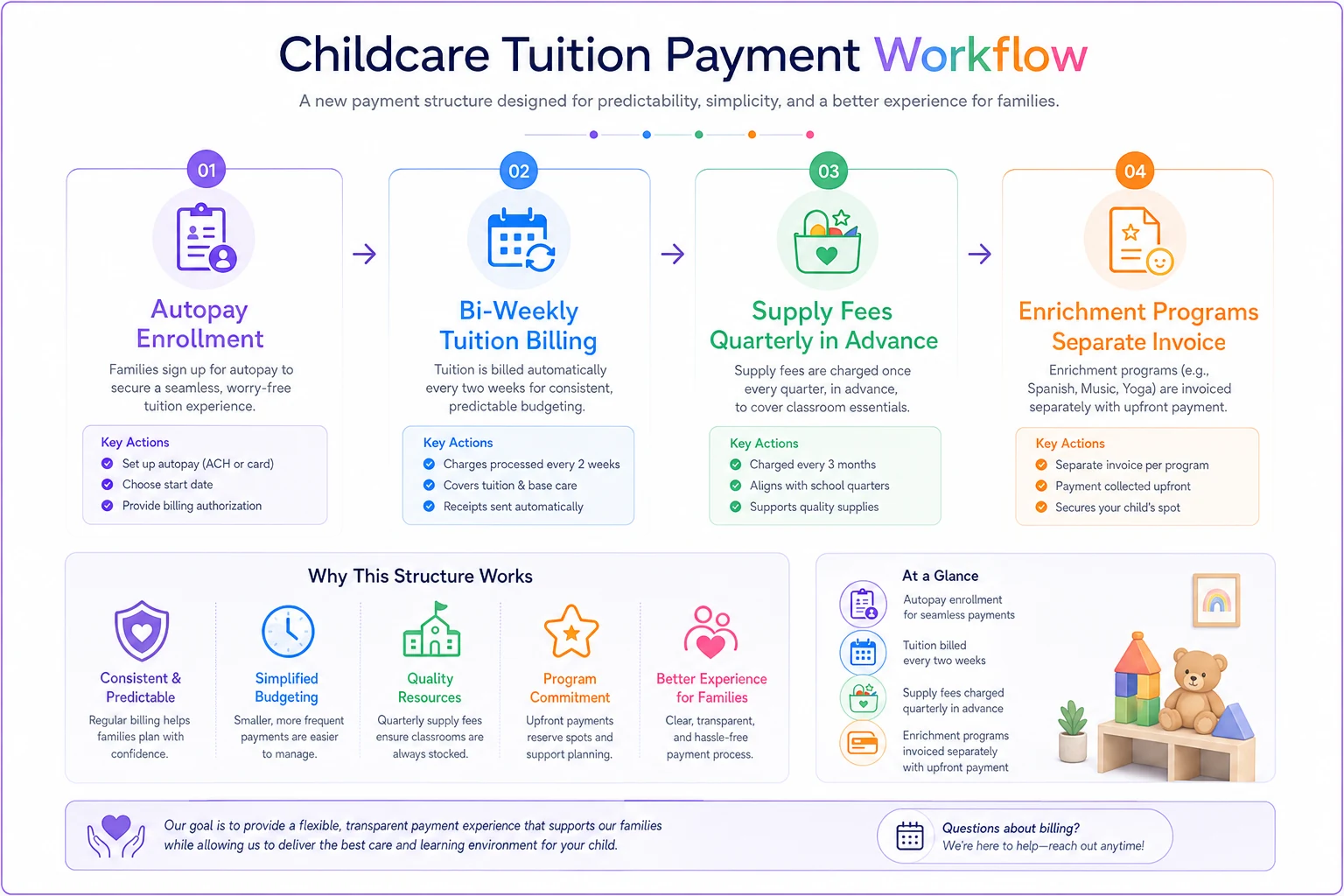
Here's a simple workflow to implement payment restructuring:
-
Require autopay enrollment for all families (offer 2% discount as incentive)
-
Shift billing from monthly to bi-weekly (improves cash flow by roughly 40%)
-
Charge supply fees quarterly in advance
-
Invoice enrichment programs separately with upfront payment
For families genuinely struggling, structured payment plans work better than late fees and collections. Offer automatic splits: 50% on the 1st, 50% on the 15th, with a $15 monthly administration fee. Your progressive collections workflow becomes preventive rather than reactive.
A center with 72 enrolled children shifted from monthly billing (averaging 18 days to payment) to bi-weekly autopay. The result was a $47,000 improvement in working capital—enough to eliminate their line of credit entirely.
Move 6: Minimize supply waste through consumption tracking
Centers waste somewhere between 20-30% of supplies through poor tracking and over-ordering. That's cash you can't afford to burn during inflation.
Track weekly consumption for:
-
Diapers and wipes by size
-
Food and snacks by classroom
-
Craft supplies by project
-
Cleaning supplies by area
Patterns emerge quickly. The infant room uses 180 size-3 diapers weekly, not the 240 you've been ordering. Preschool snacks average 14 pounds of goldfish monthly, not 20. Art supplies last 40% longer with project-based distribution versus open access.
One center found they were spending $1,900 monthly on supplies that either expired or went unused—close to $23,000 annually. A simple tracking sheet and adjusted ordering cut that waste by 70% without changing anything in the classroom.
Assign conservation monitors in each classroom and rotate monthly to sustain utility and supply reductions.
Don't overlook the invisible waste either. Running dishwashers half-full, lights on in empty rooms, cooling unoccupied spaces. Assign conservation monitors in each classroom—rotate monthly—with simple checklists. Most centers see 15-20% utility reductions through awareness alone.
Move 7: Create enrollment stability through family investment programs
Losing one family costs roughly $13,000 in annual revenue plus 40+ hours recruiting their replacement. During inflationary periods, retention is survival.
Build investment through participation, not just payment:
-
Family committees Involve parents in non-operational decisions—playground improvements, event planning, fundraising. Investment creates retention.
-
Skill sharing Parents contribute professional skills for tuition credits. The accountant parent reviews your books quarterly. The marketing parent manages social media. The nurse parent leads health workshops.
-
Referral incentives Offer $500 tuition credit for successful referrals, paid as $50 monthly credits. Cheaper than advertising and it builds community.
-
Graduated loyalty discounts 2% discount after year one, 3% after year two, capping at 5%. Longtime families become price-anchored and resist leaving even when cheaper options appear.
Centers using three or more of these strategies consistently report 90%+ annual retention versus the industry average around 75%. At average tuition of $1,100 monthly, keeping just five additional families means $66,000 in retained revenue.
The operational reality check
Inflation isn't a temporary disruption you can wait out. Centers still operating on pre-2023 assumptions are watching their margins compress every month while families and staff quietly drift away.
The moves here aren't theoretical. They're working right now at centers navigating 4%+ inflation while maintaining quality and compliance. They do require implementation now, because every month of delay means higher costs, fewer options, and more risk.
Start with Move 1 (variable pricing) and Move 5 (payment restructuring) this week—they generate immediate cash flow improvement while you work through the deeper operational changes. Document everything as you go. Your inflation response playbook becomes real institutional knowledge for your center.
The centers actually doing well through this inflationary period aren't the ones with the deepest pockets or highest tuition. They're the ones who treated inflation as an operational problem, not just a financial one, and rebuilt accordingly.
Ready to elevate your childcare management?
Join hundreds of childcare providers using Totsyly to save time, improve communication, and grow their centers.