

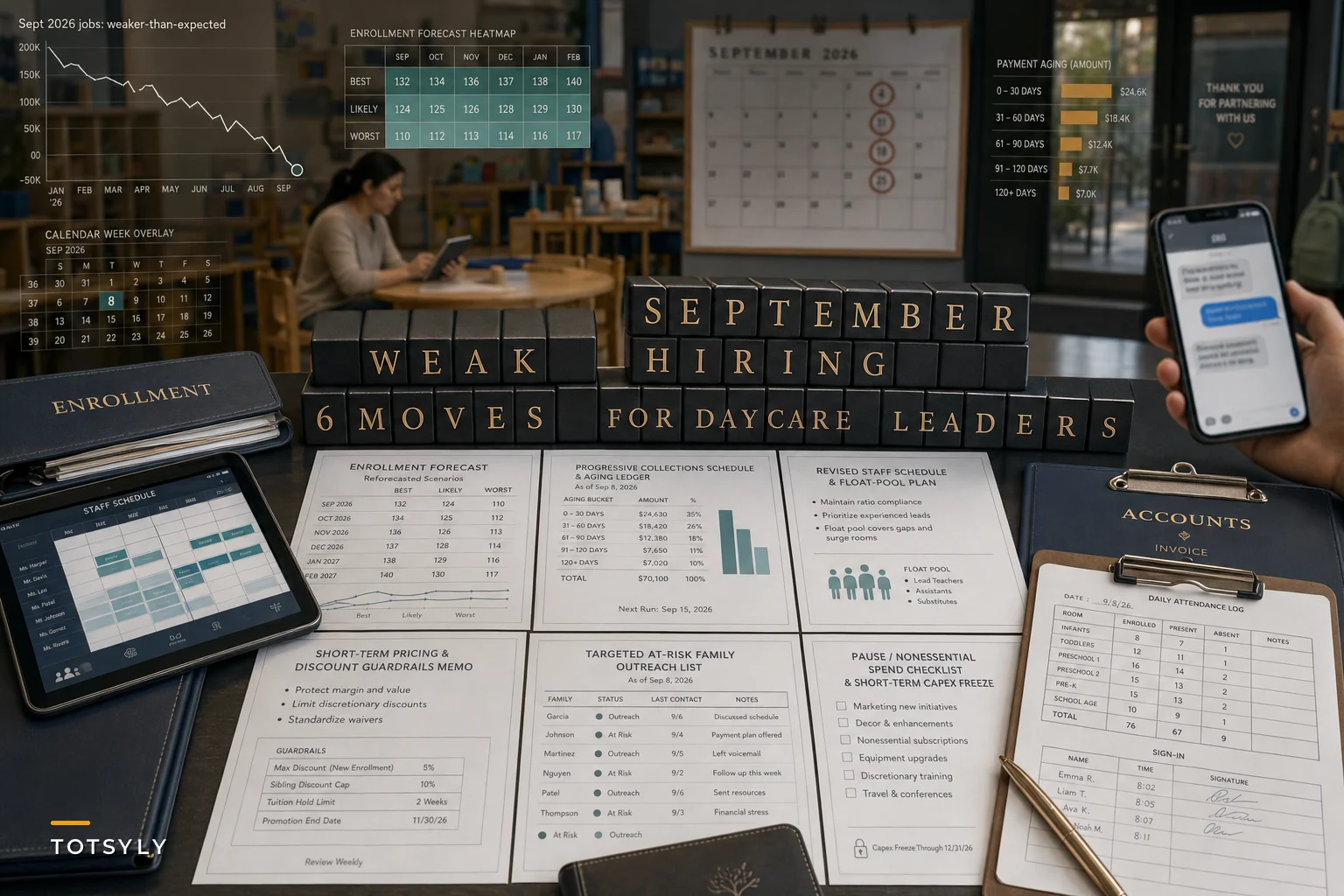

The September 2026 numbers came in weak. Nonfarm payrolls added just 29,000 jobs and unemployment nudged up to 4.2%, according to CNBC's reporting on the September jobs report. For most industries, that's a macro headline worth a quick scroll. For childcare operators, the timing is genuinely bad — this print landed right when families are locking in fall schedules and administrators are finalizing Q4 staffing and budgets.
Childcare demand is directly tied to parental employment. When hiring slows, two things tend to happen almost simultaneously: some parents start questioning whether they still need five full days of care, and others get quietly nervous about their own job security and start scrutinizing every recurring bill — including yours. Neither shows up in your enrollment numbers right away. Both show up about 30 to 60 days later, which is exactly when it's hardest to react.
This isn't an article about the economy. It's about what a soft hiring month exposes in how centers operate, and the specific moves that hold the line on enrollment, cashflow, and staffing before the lag catches up.
What a weak jobs month actually does to your center
The mistake most operators make is treating a soft labor report like a one-time event. It's not. It's the first domino in a chain that plays out across your P&L over the following quarter.
-
They drop from five days to three.
-
They stop paying for the extras — late pickup, enrichment add-ons, hot lunch.
-
They pay tuition a few days later each month, then a week later, then they're two cycles behind.
-
They start price-shopping competitors "just to see."
None of these are dramatic. That's exactly the problem. Each one is small enough to ignore in isolation, and collectively they erode your margin while headcount and fixed costs stay exactly where they were.
The deeper issue a slow month exposes is that most centers don't have an early-warning system. They find out demand is softening when the September tuition run comes back short — not when the behavior starts. By then you've already staffed the classrooms, committed to the lease, and set the schedule.
The pattern to watch: part-time demand creeping up
One of the clearest signals in a softening labor market is a quiet shift from full-time to part-time enrollment requests. In real operations this usually shows up first in your inquiry mix, not your billing. More families asking about three-day options. More "do you have a half-day program?" questions. More parents hesitating on the full-week commitment.
Simplify your childcare center’s daily operations.
Totsyly helps you manage enrollments, staff, and communications efficiently so you can focus on care.
- Streamlined enrollment & waitlist management
- Automated billing & payment tracking
- Staff scheduling & attendance monitoring
No credit card required
This matters because part-time enrollment is operationally expensive. A classroom with a mix of three-day and two-day kids still needs full-week staffing to maintain ratios. You're carrying the same labor cost against lower tuition per seat.
A typical example: a center with 60 full-time slots sees eight families downgrade to three-day schedules over a fall. On paper they "kept" those families. Revenue per classroom drops while staffing stays fixed, and suddenly a room that was running at a healthy margin is close to breakeven. The enrollment count looks fine. The cashflow doesn't.
Track your inquiry mix and schedule-change requests as a leading indicator, separate from confirmed enrollment. If part-time requests start climbing month over month, you're seeing the softening before it hits your bank account.
Six moves to make before the lag catches you
Below is the practical sequence. The order matters — start with visibility, then protect revenue, then adjust staffing last, because staffing decisions are the hardest to reverse.
The order below is practical: start with forecasting, tighten collections, lock enrollment, protect staff, build schedule flexibility, then smooth the seasonal cycle.
1. Re-forecast cashflow with a "soft" scenario, not just your base case
1. Re-forecast cashflow with a "soft" scenario, not just your base case
Most center budgets run one forecast: the optimistic one. In a softening market you need at least two more.
| Scenario | Assumption | Impact on monthly tuition |
|---|---|---|
| Base | Enrollment holds, on-time payments | Current run-rate |
| Soft | 5–8% of families downgrade days or delay payment | Roughly 6–10% lower collected tuition |
| Stress | Downgrades + 2–3 unexpected withdrawals | 12–15% below run-rate, plus a seat to backfill |
You don't need complicated modeling. You need to know — before it happens — what your bank balance looks like if January tuition comes in 10% light. That single number tells you how hard to push on the other five moves.
Running this kind of forecast manually every month is tedious, which is why a lot of centers skip it. AI-powered operational software can automate the scenario modeling and flag when your actual collections start drifting toward the soft case — giving you that early warning without the spreadsheet work.
2. Tighten the gap between a late payment and your response
2. Tighten the gap between a late payment and your response
In a slow economy, late payments stop being exceptions and start becoming a trend. The centers that get hurt are the ones who let the first few late accounts slide because "they've always paid before."
A late payment in a softening market is information, not just an inconvenience. It often signals a household under stress that may be weeks away from reducing days or leaving entirely. The faster you have a real conversation, the more options you both have.
Keep your collections approach firm but relationship-preserving — a friendly reminder on day one, a direct check-in by day five, and a conversation about payment plans before anything escalates. The goal isn't to be harsh. It's to catch the problem while it's still a cashflow timing issue and not a withdrawal.
3. Lock in your fall enrollment before families reconsider
3. Lock in your fall enrollment before families reconsider
Every family sitting on a verbal "yes" without a signed, deposited commitment is at risk when the economic mood shifts. A soft jobs report is exactly the kind of thing that turns a soft yes into "let's wait a few months."
-
Pull every inquiry and tour from the last 60 days that hasn't converted.
-
Identify anyone with a verbal commitment but no deposit.
-
Reach out personally — not a mass email, a direct, warm follow-up.
-
Offer a small, genuine incentive to confirm now (a locked rate, a waived registration fee) rather than later.
The faster you move families from "interested" to "deposited," the more insulated you are from the hesitation that follows a weak economic headline.
4. Protect your staff before you touch wages
4. Protect your staff before you touch wages
Softer job growth puts downward pressure on wages across the board, and it's tempting to read that as "I can slow down raises." In the short term, maybe. But childcare staffing isn't like other sectors — a departing lead teacher can trigger a ratio problem, a classroom disruption, and parent anxiety all at once.
Centers that freeze everything at the first sign of trouble tend to pay more later in turnover costs than they saved in deferred raises. Replacing a qualified teacher — recruiting, onboarding, the productivity dip while someone new gets up to speed — often runs several thousand dollars once you count everything.
-
Protect your highest-impact staff first (leads, anyone genuinely hard to replace).
-
Use non-wage retention levers — schedule stability, fewer split shifts, clearer advancement paths.
-
Delay net-new hiring you were doing "just to be safe," not hiring that keeps rooms legally staffed.
Instead of across-the-board cuts, get surgical:
5. Build schedule flexibility into your staffing plan
5. Build schedule flexibility into your staffing plan
If part-time demand is creeping up, your staffing model needs to flex with it. Rigid full-week schedules against a part-time-leaning enrollment mix is how centers end up overstaffed in some rooms and short in others on the same day.
The practical response: map your actual attendance patterns — not enrolled counts, real daily attendance — against your scheduled hours. In most centers there's a gap, and that gap gets expensive when every tuition dollar counts. Cross-train staff so you can shift coverage between rooms as attendance moves through the week, and build an on-call list before you actually need one.
[Map real daily attendance by room] ↓ [Compare against scheduled labor hours] ↓ [Identify coverage gaps and overlaps] ↓ [Cross-train staff to fill gaps] ↓ [Build on-call list for flexible coverage] ↓ [Review weekly as enrollment mix shifts]
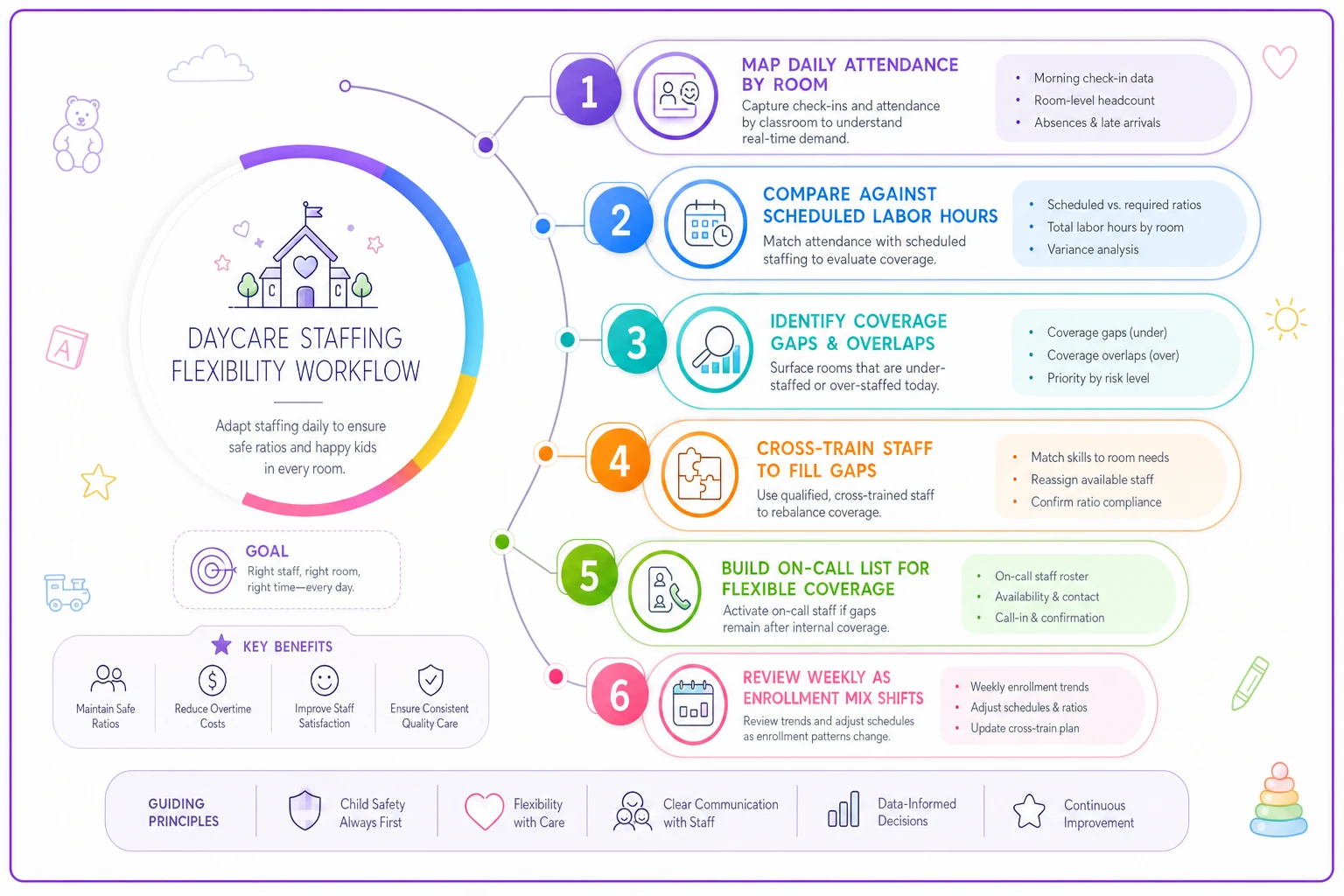
This visual shows the practical steps a center can run weekly to match staffing to real attendance rather than enrollment counts.
Keep a simple shared sheet with daily attendance vs. scheduled hours so cross-training shifts from theory to practice.
It's not complicated. The problem is that most centers don't do it consistently — they rely on gut feel and scramble when attendance shifts.
6. Smooth the seasonal cycle so one soft quarter doesn't compound
6. Smooth the seasonal cycle so one soft quarter doesn't compound
This is the longer-game move, and it's the one that separates centers that ride out a soft patch from ones that spiral. A single weak quarter is survivable. The damage happens when a soft fall feeds a thin winter feeds a panicked spring, and you never quite regain footing.
The fix is structural: stop treating enrollment as a once-a-year September event and run it as a continuous, 12-month pipeline. When your enrollment and staffing are mapped across the full year, a soft patch in one window gets absorbed instead of amplified. Our guide on how a 12-month enrollment calendar reduces seasonal dips and smooths staffing walks through the operational backbone that makes every other move on this list work better.
A real scenario: how a mid-size center absorbed a soft fall
Consider a two-room preschool with around 50 enrolled children and a monthly tuition run-rate in the low $60k range. Through late fall, the director noticed inquiry calls shifting — more three-day requests, fewer full-week commitments. Payments were coming in a little slower, nothing dramatic, maybe four or five accounts drifting from on-time to a week behind.
Instead of waiting for the January statement, she ran the soft scenario and saw that if the trend held, they'd be roughly $5k–$7k light per month by winter. That was enough to move.
Three things happened quickly: a personal follow-up sweep on every un-deposited verbal commitment converted about six of nine into signed enrollments. Late-paying families were moved into short payment plans before anyone fell two cycles behind. And a planned assistant hire was put on hold while existing staff were cross-trained to cover the part-time attendance gaps.
The result wasn't dramatic — that's the point. They came through winter close to their base-case cashflow instead of the soft scenario, kept every teacher, and didn't make a single panic decision in January. The soft fall still happened. It just didn't compound.
When to act aggressively — and when to hold steady
Not every center needs to pull all six levers. A quick read on where you sit:
Act aggressively if:
-
You're already seeing part-time requests climb or payments drifting late.
-
You have thin cash reserves (less than a month of operating expenses).
-
A meaningful share of your families work in sectors sensitive to hiring slowdowns.
Hold steady and monitor if:
-
Your waitlist is still healthy and inquiries are converting normally.
-
You have strong reserves and your enrollment skews toward dual-income, stable households.
-
You've already built schedule flexibility and a continuous enrollment pipeline.
Don't overcorrect if your fundamentals are solid. Slashing staff pay or cutting programs in response to a single soft month can do more damage to retention and reputation than the economic softness itself. The goal is preparedness, not panic.
Don't overcorrect if your fundamentals are solid. Slashing staff pay or cutting programs in response to a single soft month can do more damage to retention and reputation than the economic softness itself. The goal is preparedness, not panic.
The bottom line for operators
A weak hiring month doesn't sink a well-run center. What sinks centers is the lag — that 30-to-60-day gap between when demand starts softening and when it shows up in the bank account, with operators already making decisions based on stale information.
Everything above is about shortening that lag. Watch your inquiry mix and payment timing as early signals. Lock in commitments before hesitation sets in. Protect the staff you can't afford to lose. Build the kind of year-round enrollment and staffing rhythm that absorbs a soft quarter instead of letting it snowball. A disappointing jobs report should be a prompt to tighten operations — not a crisis you're scrambling to react to six weeks too late.
Everything above is about shortening that lag. Watch your inquiry mix and payment timing as early signals. Lock in commitments before hesitation sets in. Protect the staff you can't afford to lose. Build the kind of year-round enrollment and staffing rhythm that absorbs a soft quarter instead of letting it snowball. A disappointing jobs report should be a prompt to tighten operations — not a crisis you're scrambling to react to six weeks too late.
Ready to elevate your childcare management?
Join hundreds of childcare providers using Totsyly to save time, improve communication, and grow their centers.