
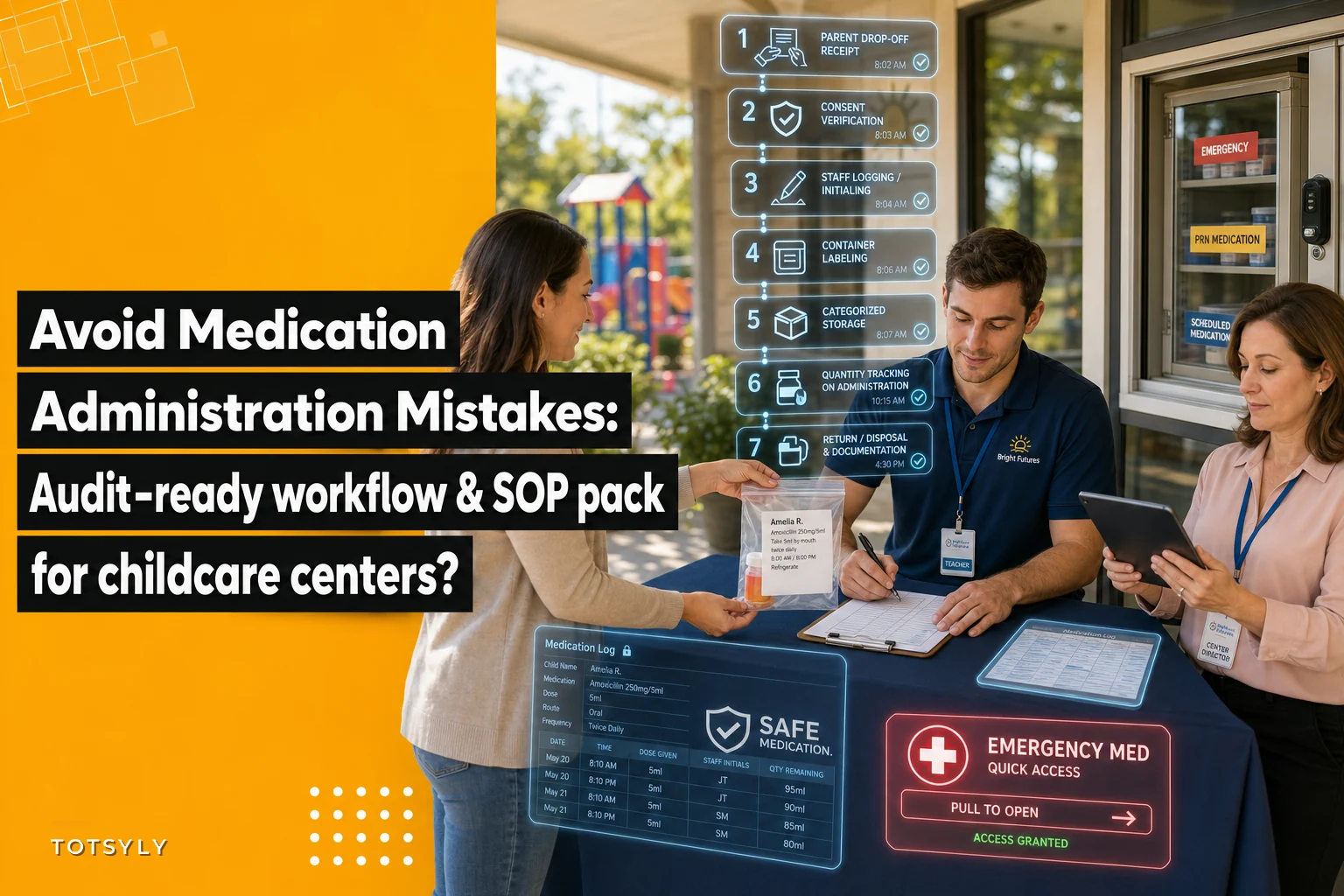

The scariest medication mistakes in childcare rarely come from a teacher being careless. They come from gaps in the handoff — the moment a parent hands over a baggie of pills at drop-off, the moment a float teacher covers a classroom she doesn't usually work in, the moment an EpiPen is "somewhere in the office." Those gaps are where the wrong child gets a dose, or the right child gets nothing when it matters most.
If you run a center, you already know the regulations exist. What you probably don't have is a clean, repeatable medication administration workflow for childcare that any staff member can follow under pressure — and that produces documentation an inspector can't poke holes in. That's what this toolkit is about. Not theory. The actual wording, custody steps, and log structures you can drop into your SOPs this week.
Where medication mistakes actually happen
Let's be specific, because "be careful with meds" helps no one.
-
The intake handoff. A parent mentions at pickup that "oh, she needs her allergy medicine tomorrow" and hands a bottle to whoever is at the door. No written order, no dosage confirmed, no consent signed. The bottle ends up in a drawer.
-
Ambiguous labeling. A half-used bottle of amoxicillin with the pharmacy label partially peeled off. Two siblings in the center, same last name, different doses. Nobody's sure which belongs to whom.
-
Storage without ownership. Meds that need refrigeration sitting next to staff lunches. Emergency meds locked in a cabinet that three people have the key to and two of them are off that day.
-
The coverage gap. The lead teacher who knows the medication routine calls out. The sub doesn't know a child is on a scheduled inhaler until the parent asks about it at pickup.
-
Logs filled in from memory. A teacher administers a dose at 11
40 but doesn't log it until naptime, estimates the time, and the entry contradicts another staff member's recollection.
What ties all of these together: the process depends on a specific person remembering a specific thing. The moment that person is replaced, distracted, or rushed, the system fails silently. You don't find out until an incident — or an audit.
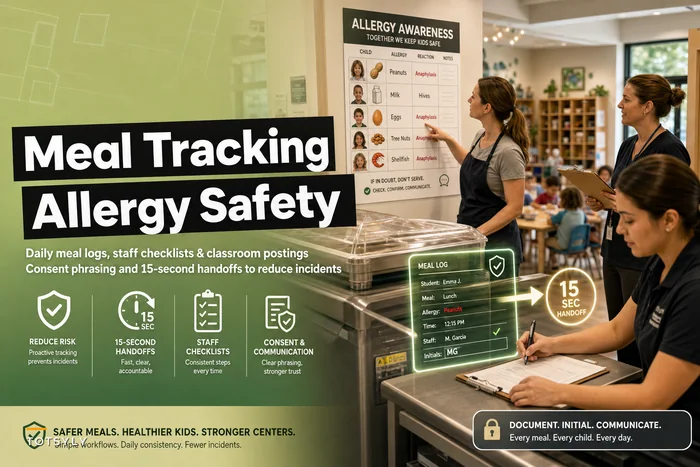
This same pattern shows up with food allergies, which is why the daily meal-tracking and consent workflow approach works so well there. Medication needs the same treatment: remove the dependency on memory.
Start with consent wording that actually protects you
Most consent forms are too vague to be useful and too generic to be safe. "I give permission to administer medication as needed" is not consent — it's a liability waiting to happen. You can't administer a prescription "as needed" without knowing what, how much, when, and under what conditions.
Simplify your childcare center’s daily operations.
Totsyly helps you manage enrollments, staff, and communications efficiently so you can focus on care.
- Streamlined enrollment & waitlist management
- Automated billing & payment tracking
- Staff scheduling & attendance monitoring
No credit card required
The structure your medication consent should force the parent to fill in completely is below. If any field is blank, the medication doesn't get administered. Full stop.
-
Child's full name and date of birth (two identifiers, always)
-
Medication name exactly as it appears on the pharmacy label
-
Reason for the medication
-
Exact dose (amount and units — "5 mL," not "a spoonful")
-
Route (oral, topical, inhaled, injected)
-
Scheduled times OR specific symptom triggers for PRN ("as needed") meds
-
Maximum doses in a 24-hour window
-
Start date and end date of authorization
-
What to do if a dose is missed or vomited back up
-
Parent signature, date, and a line stating authorization expires on the end date or after 10 school days, whichever comes first
That last line matters more than people realize. Open-ended consent is how a center ends up administering an antibiotic three weeks after the prescription should have ended. Tying consent to an expiration date forces a re-confirmation, which catches changed doses and discontinued meds.
For emergency medications — EpiPens, rescue inhalers, seizure rescue meds — the consent needs an extra layer: an individual action plan signed by the prescribing provider, not just the parent. The action plan spells out the exact symptoms that trigger administration and the steps that follow. This is the document that lets a teacher act in a crisis without second-guessing.
A custody and storage procedure anyone can follow
Custody is the part most centers get sloppy about because it feels like common sense. It isn't — it's where the chain of accountability either exists or doesn't.
Think of medication custody as having a documented owner at every single moment, from the parent's hand to the child's mouth and back to the parent (or the trash). No orphan periods.
-
Receipt. When a parent drops off any medication, a designated staff member checks it against the consent form in front of the parent. They confirm the name on the pharmacy label matches the child, the dose matches the consent, and the medication isn't expired.
-
Log the handoff. Both the staff member and the parent initial a receipt line
date, time, medication, quantity received. This is the single most skipped step and the one that ends disputes.
-
Label the container. Attach a center label with the child's name, classroom, and the location it's stored. The pharmacy label stays on; your label adds the operational detail.
-
Store by category. Scheduled meds, PRN meds, and emergency meds each go in a defined, separate location. Refrigerated meds go in a dedicated medication fridge or a labeled, sealed container — never loose next to food.
-
Track the quantity. Record the count on receipt. Every administration decrements the count. This turns up errors fast: if the log says six doses were given but eight are missing, you have a problem to investigate now, not at audit.
-
Return or dispose. When authorization ends, the medication is returned to the parent (with a signed return line) or disposed of per policy. Nothing lingers in the drawer.
Visualizing the custody chain as a workflow helps staff follow the steps under pressure.
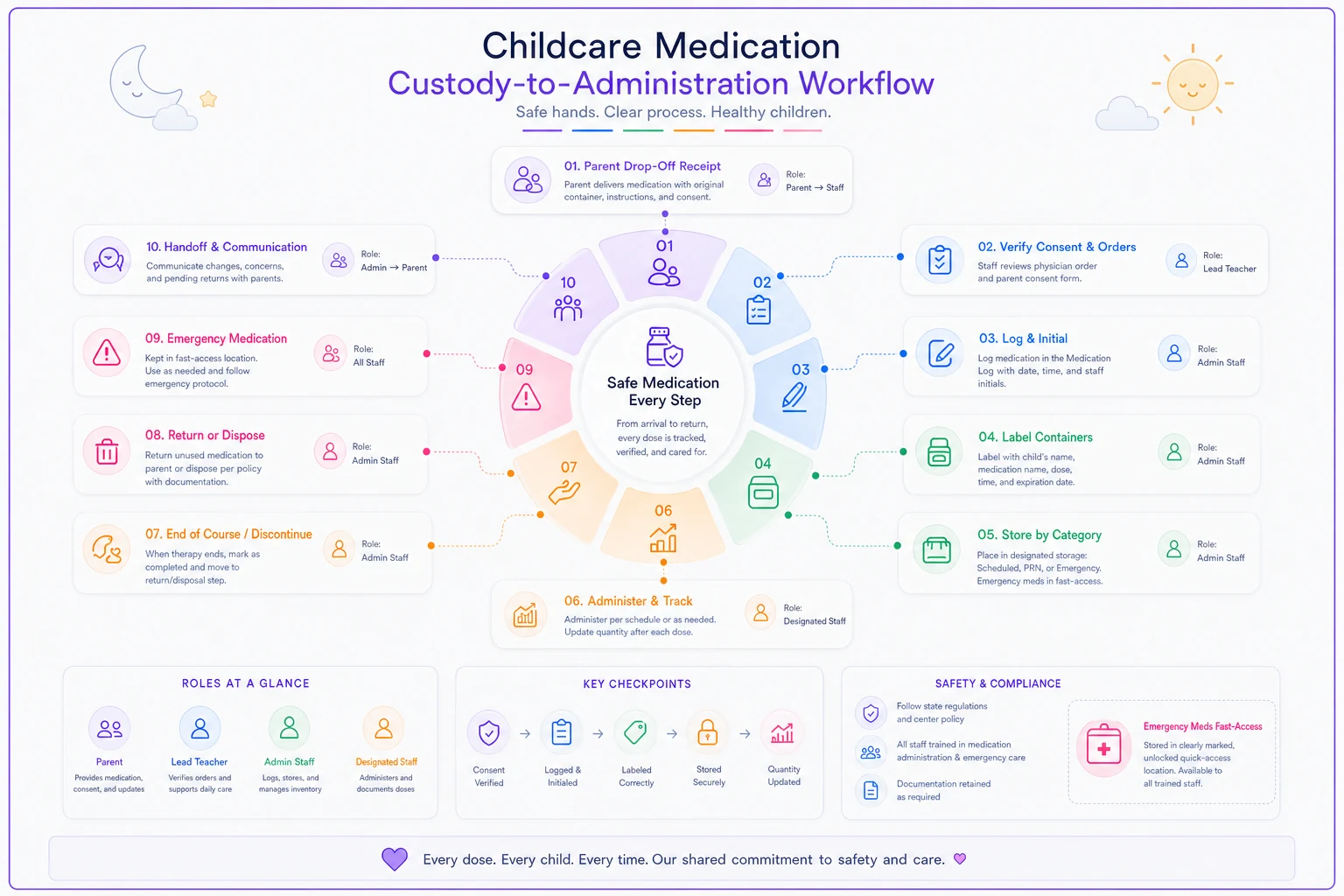
The key insight: emergency meds follow the opposite storage logic from everything else. Daily meds should be secured and out of reach. Emergency meds need to be reachable in seconds by any staff member on shift — locked against children, yes, but with the access method known to everyone, not just the office manager.
Quick-access protocols for emergency meds
Here's the tension every director feels: licensing wants medications locked and secured, but an anaphylactic reaction gives you minutes. If your EpiPen is in a locked cabinet and the one person with the key is at lunch off-site, "secured" just became "unavailable."
| Medication type | Storage | Access speed | Who can access |
|---|---|---|---|
| Scheduled daily meds | Locked cabinet/fridge, out of child reach | Minutes is fine | Trained med-authorized staff |
| PRN (symptom-based) meds | Locked, out of reach | Within a few minutes | Trained med-authorized staff |
| Emergency meds (EpiPen, inhaler, seizure rescue) | Locked against children but centrally posted, portable | Seconds | Every staff member on shift |
For emergency meds specifically:
-
Store them in a clearly marked, grab-and-go pouch per child when the child moves between rooms or goes outside. The medication travels with the child, not the classroom.
-
Post the location in every room where that child spends time. New subs should be able to find it without asking.
-
Include the child's action plan inside the pouch. In a crisis, no one should be hunting for the dosing instructions.
-
Run a 60-second drill with new staff on their first day
"Child X is having a reaction — show me where the meds are and what you'd do." If they hesitate, they're not ready to cover that room.
For emergencies, the goal isn't to restrict access — it's to make correct access faster than panic.
Emergency administration scripts
Under stress, people freeze or skip steps. A short, laminated script removes the thinking from a moment where thinking is the enemy. These should live inside the emergency med pouch.
Allergic reaction / anaphylaxis script:
-
Recognize — compare symptoms to the action plan triggers.
-
Call for a second staff member by name. One administers, one calls.
-
Administer the epinephrine per the action plan dose.
-
Call 911. State
child's age, what was administered, the time.
-
Note the exact time of administration on the pouch card.
-
Call the parent.
-
Stay with the child; be ready to administer a second dose if the plan allows and symptoms persist.
Seizure rescue script and rescue inhaler script follow the same shape: recognize, get a second person, administer, call 911, time-stamp, call parent. The structure is identical on purpose — staff learn one flow, not three.
Worth noting: time-stamping happens during the event, not after. When EMS arrives, "we gave it at 2:14" is critical information and also your cleanest documentation.
Audit-ready logs: the format inspectors want
A medication log fails an audit for boring reasons — missing initials, estimated times, no second verification, gaps in the quantity count. The fix is a log structure that makes the complete entry the only easy option.
-
Date and exact time administered
-
Child's full name
-
Medication and dose given
-
Route
-
Administering staff name and initials
-
A second staff initial for verification (strongly recommended for any scheduled or emergency med)
-
Running quantity remaining
-
Any notes (child refused, spit out, delayed)
And separately, a non-administration log — the one centers always forget. When a scheduled dose is not given (child absent, parent took the med home, dose held per parent instruction), that gets logged too. A blank where a dose should be is an audit flag. A documented reason is a clean record.
The folder and retention side of this matters as much as the daily log. Medication consents, action plans, and administration records all have retention requirements, and they're exactly the kind of files that go missing at the worst moment. If your filing is shaky, the childcare retention matrix and folder templates approach will save you during inspection — medication records should sit in that same disciplined structure.
A real scenario
A two-site preschool, around 110 kids total, had somewhere between 12 and 15 children on some form of medication at any given time — a mix of scheduled meds, a few inhalers, and three kids with EpiPens. Their process was a clipboard in each office and a lot of institutional memory.
The near-miss that forced a change: a float teacher covered a room and gave a scheduled afternoon dose that the parent had actually asked to hold that morning. The verbal message never made it to the clipboard. No harm done, but the parent was understandably rattled, and the director realized the whole system ran on one lead teacher's head.
They rebuilt around three things: consent forms with expiration dates, per-child emergency pouches that travel with the kids, and a dual-initial log with a running quantity count. The non-administration log caught the "hold this dose" situation the second time it came up — it was written down, visible, and the sub saw it before acting.
Six months later, their licensing visit flagged zero medication findings, which hadn't happened in the prior two inspections. More telling: the lead teacher took a week of vacation and the medication routine ran without a single parent call. That's the real test — the system worked when the person who used to be the system wasn't there.
Where software quietly removes the memory dependency
Everything above works on paper. The reason to move it into an operational platform is straightforward: paper can't remind you, flag an expired consent, or alert a sub that a child has a med routine before the day starts.
A workflow tool built around medication intake can enforce the complete-consent rule automatically — no administration gets scheduled until every required field is filled. It can flag a consent approaching its expiration date so you re-confirm before authorization lapses. It can surface a child's medication and emergency plan to whoever is assigned to that room that day, subs included, so coverage gaps stop being blind spots. The administration log becomes time-stamped automatically, with the quantity count maintained in the background — which removes the two most common audit failures without relying on anyone to remember.
The point isn't technology for its own sake. Medication safety fails in the handoffs, and handoffs are exactly what a well-built system catches that a human in a rushed moment won't.
When to tighten this now
You should prioritize rebuilding your medication workflow if any of these are true:
-
More than a handful of children are on scheduled or emergency meds
-
You rely on subs or floats who cover unfamiliar rooms
-
Your consents don't have expiration dates
-
You can't produce a quantity-reconciled log for any given medication on demand
-
Your emergency meds live in one locked spot that not everyone on shift can access
If your center has one teacher who "handles all that," you don't have a workflow — you have a single point of failure.
The goal is a process clear enough that the newest person on your worst-staffed day can follow it correctly.
Medication safety isn't about hiring more careful people. It's about building handoffs that don't depend on anyone being perfect.
Ready to elevate your childcare management?
Join hundreds of childcare providers using Totsyly to save time, improve communication, and grow their centers.