


The riskiest 90 minutes in a childcare calendar aren't inside your building. They happen the moment a group of 18 toddlers, 4 preschoolers who "just turned 5," and 3 staff members cross a parking lot toward a bus.
Field trips are where your normal ratios, your normal sightlines, and your normal communication channels all get thinner at exactly the same time. Everything that works inside four walls — sign-in binders, posted ratios, the fact that everyone knows where the bathrooms are — stops working the second you leave the property.
Most centers miss this part: field trip governance problems rarely show up as a dramatic disaster. They show up as small cracks. A missing permission slip that nobody noticed until the bus was loading. A child who was supposed to be in Group B riding in Group A's van. A parent who shows up at the destination to "help" and ends up carrying a kid you have no emergency contact form for. None of those are catastrophes on their own — but stack three of them on one trip and you've lost the thread entirely.
This post is narrow on purpose. It's not about whether field trips are worth it. It's about the operational scaffolding — the running order, the timed communications, the checklists, the reconciliation — that keeps a trip boring. Boring is the goal.
Where field trips actually break down
If you dissect a messy trip after the fact, the failures almost never happen at the destination. They happen at the transitions.
The predictable breakpoints:
-
Loading and unloading the vehicle. This is the single highest-risk moment and the one most centers treat casually. Kids move in a cluster, adults are distracted managing bags and straps, and head counts get done "in general."
-
The destination arrival. New environment, kids are excited, and the group spreads out before roles are assigned on the ground.
-
Transition points mid-trip. Moving from the exhibit to the lunch area. From the playground back to the bus. Any time the group reforms, somebody can get left behind at a drinking fountain.
-
The return and reunification. Kids get picked up at a park or a museum instead of the usual door, release procedures go out the window, and a child can be handed to someone who isn't on the authorized list.
What ties all of these together is that they're count problems and ownership problems. Nobody has a specific child assigned to them, so everybody assumes someone else is watching.
A pattern that comes up constantly: centers run solid building-level emergency procedures but have never translated them off-site. Your reunification plan with role assignments and staged parent messaging is built for your campus. On a field trip, that plan needs a travel version — different maps, different meet points, and a cleaner way to confirm every child is accounted for when you're standing in a parking lot you don't control.
The running order: a timed sequence, not a vibe
The fix for transition chaos is to stop treating the trip as one continuous event and start treating it as a sequence of timed checkpoints, each with a specific count and a specific person responsible for calling it. Here's a running order that works for a typical half-day trip. Adjust the clock to your schedule, but keep the structure of named checkpoints.
Simplify your childcare center’s daily operations.
Totsyly helps you manage enrollments, staff, and communications efficiently so you can focus on care.
- Streamlined enrollment & waitlist management
- Automated billing & payment tracking
- Staff scheduling & attendance monitoring
No credit card required
| Time | Checkpoint | Count required? | Who calls it |
|---|---|---|---|
| T‑60 min | Final permission + roster lock | Roster confirmed | Trip Lead |
| T‑30 min | Pre-trip vehicle + driver check | N/A | Driver + Trip Lead |
| T‑15 min | Group assignments read aloud, wristbands on | Full count #1 | Trip Lead |
| T‑0 (loading) | Board vehicle by group | Full count #2 + per-group count | Group Leaders |
| On arrival | Unload by group, regroup at meet point | Full count #3 | Group Leaders |
| Every 30 min on-site | Rolling count | Per-group count | Group Leaders |
| Each transition | Count before moving, count after arriving | Two counts | Group Leaders |
| Pre-departure | Board by group | Full count #4 | Group Leaders |
| On return | Unload, reconcile against roster | Full count #5 | Trip Lead |
| Post-trip | Reconciliation + sign-out | Final roster match | Trip Lead |
The important detail isn't the exact number of counts. It's that every count is paired with a named role and a specific trigger. "Count the kids" is a suggestion. "Group Leaders call their per-group count before the vehicle moves, out loud, to the Trip Lead" is a procedure.
Assign a single adult to audibly call each group count to the Trip Lead to avoid ambiguous confirmations.
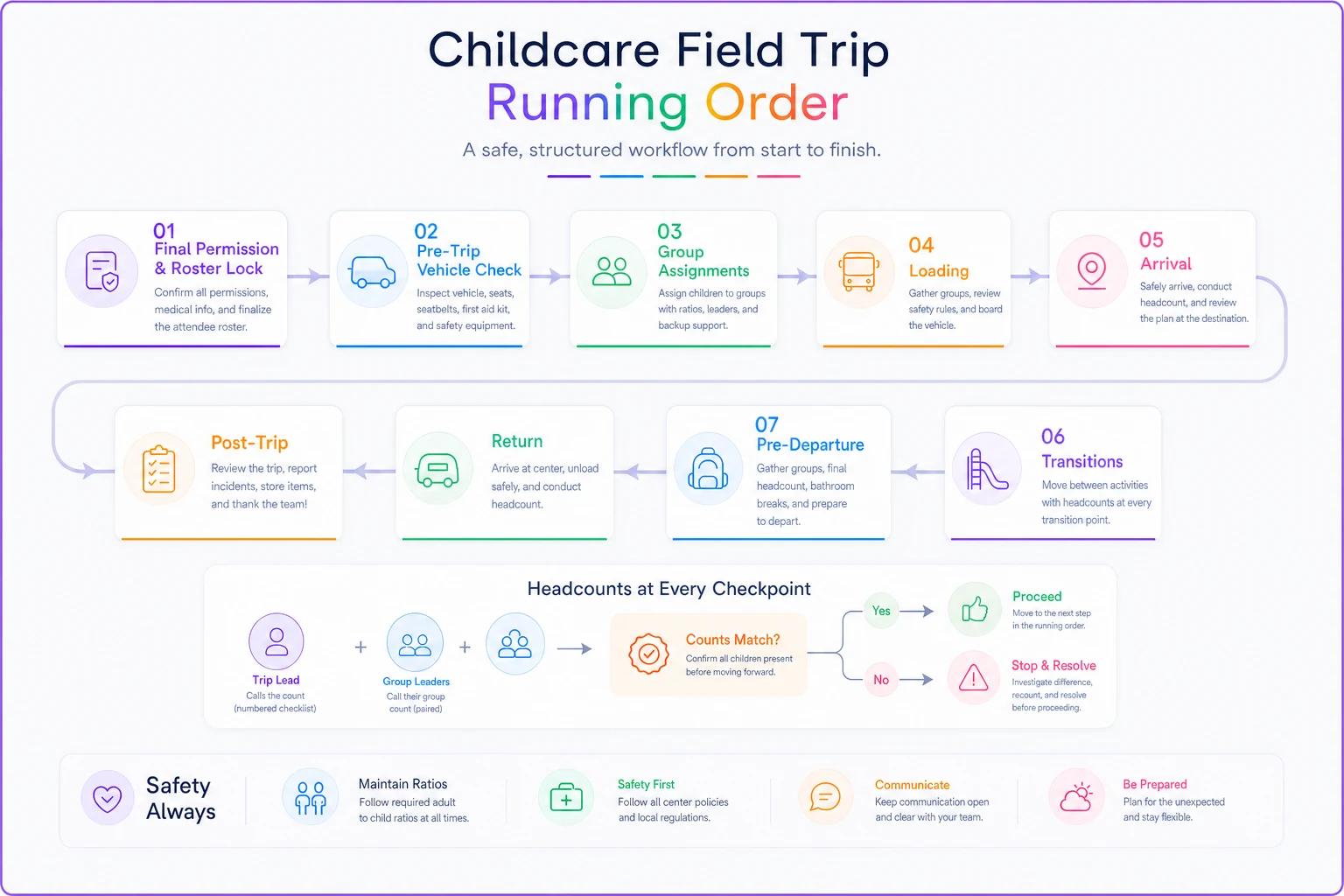
One operational rule that prevents most lost-child scares: counts happen before AND after every movement. You count your group of six before leaving the exhibit, and you count six again when you reach the lunch tables. If the numbers don't match, nobody moves until it's resolved. Most centers only do the "after" count, which means they don't notice a missing child until they're already somewhere new with no idea where the kid separated from the group.
Role assignments: three roles, zero overlap
Vague roles are why field trips feel chaotic. "Everybody watch the kids" produces diffused responsibility, and diffused responsibility is how a child ends up alone at a water fountain.
Assign three distinct roles before you leave. Write them on the trip sheet with names next to them.
-
Trip Lead. Owns the master roster and the overall timeline. Calls the full-group counts. Is the single point of contact for the center and for parents. The Trip Lead does not get assigned a group of children to directly supervise — their job is to float and track, not to be heads-down with a cluster of toddlers.
-
Group Leaders. Each owns a specific, named list of children. Not "the kids near me" — an actual list of 4–6 named children they are personally responsible for from loading to return. They call their per-group counts. If a Group Leader needs to step away (bathroom, incident), they hand their named list to another adult verbally and confirm the handoff.
-
Floater / Medical. Carries the medication, allergy information, and emergency kit. Handles the kid who needs a bathroom so the Group Leader never loses sight of their group. If something goes wrong, this person manages the affected child while Group Leaders keep their counts intact.
The mistake that comes up most often is the Trip Lead also being a Group Leader. The second there's an incident, that person has to choose between managing the problem and watching their assigned kids. Separating those roles means an incident never strips a group of its supervisor.
The single-page permission and pre-trip checklist
Multi-page permission forms are where compliance quietly fails. Parents skim them, staff don't verify them, and critical fields get left blank. The forms that actually get filled out correctly fit on one page and are built for fast verification, not legal exhaustiveness.
Parent permission block (top third):
-
Child's name + group assignment
-
Trip date, destination, departure and return times
-
Authorized pickup people for the return (names + IDs you'll check)
-
Emergency contact reachable during the trip window
-
Medical/allergy flags and consent to administer emergency medication
-
Parent signature + date
Driver and vehicle pre-trip check (middle third):
-
Driver name, license verified, insurance current
-
Vehicle inspected
tires, lights, brakes, seatbelts/restraints functional
-
Correct number of restraints for the age group riding
-
First aid kit present, fire extinguisher present
-
Fuel sufficient for round trip
-
Driver signature + date
Roster and count control (bottom third):
-
Printed list of every child on the trip, by group
-
Checkboxes for each full-group count (loading, arrival, departure, return)
-
Space to note any child added or removed day-of
The reason to force all three onto one page is that it becomes the single artifact the Trip Lead carries. One sheet to verify, one sheet to count from, one sheet to reconcile against at the end. When permission, vehicle safety, and the roster live on three separate documents, at least one of them gets left on the counter.
A note on volunteers: if you're bringing parent chaperones, they need the same quick vetting you'd apply to anyone supervising children. Don't let a well-meaning parent become an unvetted adult with direct access to kids who aren't theirs. The same fast vetting and booking flows you use for substitutes and volunteers apply here — just compressed to fit a trip timeline.
Reunification, the off-site version
Reunification at your own building is hard enough. On a field trip, you're reuniting children with parents at a location nobody is familiar with, often with parents who drove separately to "meet us there."
Three decisions you must make before the trip, not in the parking lot:
-
Where is the designated pickup point at the destination? Pick a specific, describable spot. "The main entrance by the ticket windows" — not "outside."
-
Who is authorized for day-of pickup, and how do you verify them? The same ID discipline you use at your front door applies here, except you're doing it in a crowd without your usual setup. The Trip Lead holds the authorized-pickup list and checks IDs against it. No name match, no release — full stop.
-
What's the extension plan if a parent is late? Decide in advance who stays with an unpicked child, where they wait, and when the center gets notified. A late pickup at your building is routine. A late pickup at a park when the bus is about to leave is a crisis if you haven't planned for it.
Build a short reunification extension onto your trip sheet: the destination pickup point, the authorized-pickup list, and the late-pickup protocol. Three lines of planning that prevent the worst-case scenario of a child released to the wrong adult in an unfamiliar place.
Post-trip reconciliation: close the loop every single time
The trip isn't over when the bus parks. It's over when every child is accounted for on paper and matched against who picked them up.
Post-trip reconciliation catches errors before they become phone calls to parents. It's a two-minute discipline that most centers skip because everyone's tired and the kids are "obviously all here."
-
[ ] Final return count matches the departure count
-
[ ] Every child on the roster is physically present or accounted for by a documented early pickup at the destination
-
[ ] All children signed back in to the correct classroom
-
[ ] Medication/first aid kit returned, any administration logged
-
[ ] Any incident during the trip documented before staff leave
-
[ ] Driver/vehicle sheet filed
-
[ ] Permission sheets filed with the trip date
-
[ ] Any anomaly (added child, early pickup, near-miss) noted for review
The high-value move here is the near-miss note. If a group was briefly one short at a transition, or a count had to be recalled, write it down even though it resolved fine. Those near-misses are your early warning system. A center that reviews three near-misses from the spring field trip season fixes its loading procedure before the fall trips, instead of learning the hard way.
A real scenario
A mid-sized preschool runs about eight off-site trips a year — somewhere around 20–24 children per trip. For years their process was a two-page permission packet, a general "everybody counts" expectation, and no formal running order.
On a spring trip to a nature center, a 4-year-old wandered toward a side trail during the transition from the pond to the picnic area. Nobody noticed for a few minutes because no single adult had that child on a named list. He was found quickly and was fine — but the incident rattled the director enough to overhaul the whole approach.
They switched to a single-page trip sheet, assigned the three-role structure, and built in paired counts before and after every movement. On the next six trips, the result wasn't dramatic — it was quiet. No scares, no "wait, where's—" moments. Loading went faster because each Group Leader knew exactly which five kids were theirs. Reconciliation caught one early-pickup that would've otherwise left a child marked absent in the classroom log.
The director's summary was blunt: the kids were never less safe before, they just felt safe without any system actually confirming it. The running order turned a gut feeling into a verified count.
When heavier governance makes sense — and when it's overkill
Not every outing needs the full apparatus. Match the structure to the risk.
Full running order + three roles + reconciliation makes sense when:
-
You're transporting children by vehicle
-
The group is larger than one classroom's normal ratio
-
The destination is crowded or has water, animals, or open exits
-
Parents are meeting you there for pickup
You can scale it down when:
-
It's a walking trip to a park two blocks away with the same staff and ratios you'd have in the building
-
The group is small and stays in one enclosed, controlled space
Who should NOT skip this: any center transporting children in vehicles, any center bringing parent volunteers, and any multi-site operation where trip quality varies by location. If one of your sites runs tight trips and another wings it, the governance gap is a liability waiting to surface.
Keeping the paperwork from becoming the new problem
The honest tension with all of this: more structure means more forms, and more forms mean more things to lose or forget. A clipboard full of paper permission slips is only as good as whoever remembered to grab the clipboard.
This is where centralizing trip records inside your management system earns its keep. When permission status, authorized-pickup lists, and allergy flags already live in the child's profile, generating the single-page trip sheet becomes a pull rather than a re-entry. Missing permissions flag themselves before the roster locks. Counts and sign-backs get logged against the actual roster instead of a photocopy. The point isn't to add software for its own sake — it's that the reconciliation step gets a lot easier when the roster you're checking against is the same live roster your classrooms already run on.
But the system is secondary. A center with a clipboard and a disciplined running order will run safer trips than a center with great software and no roles assigned. Get the sequence, the roles, and the paired counts right first. The tooling just makes the discipline easier to repeat across every trip and every site.
The takeaway
Field trips go wrong at the transitions, not the destinations — and they go wrong because responsibility gets diffuse the moment you leave the building. The fix isn't more rules. It's a timed running order with named counts, three clearly separated roles, a single-page document that combines permission, vehicle safety, and roster, and a two-minute reconciliation that closes the loop every time.
Build it once, run it the same way on every trip, and the hardest 90 minutes on your calendar become the most boring part of the week. That's exactly what you want.
Ready to elevate your childcare management?
Join hundreds of childcare providers using Totsyly to save time, improve communication, and grow their centers.