

Most childcare centers don't have a data problem. They have a trust problem with their data. The enrollment number on the director's dashboard says 94% capacity, but the billing system shows three families who withdrew last week still sitting in "active." The staffing report says you're in ratio, but two of those teachers are on the schedule for a room they haven't worked in a month. Everybody can see the dashboard. Nobody quite believes it.
That gap — between what the numbers say and what people trust — is where operations quietly falls apart. Administrators stop making decisions off the reports and start making phone calls instead. "Let me just check with Maria before I commit to that." Which means you've paid for reporting infrastructure and gone right back to running the center on tribal knowledge.
This is the part of childcare data quality governance almost nobody sets up on purpose: the rules that decide whether a number is good enough to act on, how you catch it when it drifts, and who gets pinged when it breaks. Not the schemas, not the retention policies — the ongoing verification layer that sits on top of everything else. The idea is borrowed from how software teams handle reliability: you set explicit quality targets, test against them constantly, and route failures to a human before they turn into a decision.
Here's how this actually works in practice, and where it tends to break.
Why "we have dashboards now" doesn't fix anything
This pattern repeats across centers that invest in reporting. They migrate systems, clean up their fields, build out reports, and everyone's happy for about six weeks. Then entropy sets in.
A front-desk hire starts entering start dates in MM/DD instead of DD/MM. A teacher marks attendance a day late because the tablet was dead. Someone processes a withdrawal in the CRM but forgets the billing side. None of these are disasters on their own. But dashboards don't know the difference between a real signal and a data-entry hiccup — they render both the same way, confidently, in a nice chart.
So the occupancy line dips 4% one Monday. Is that a real enrollment problem you need to act on, or did two families' records just not sync overnight? Without a governance layer telling you which one it is, you either overreact to noise or you learn to ignore the dashboard entirely. Most people pick "ignore." That's the quiet failure mode — the reports still exist, they're just decorative now.
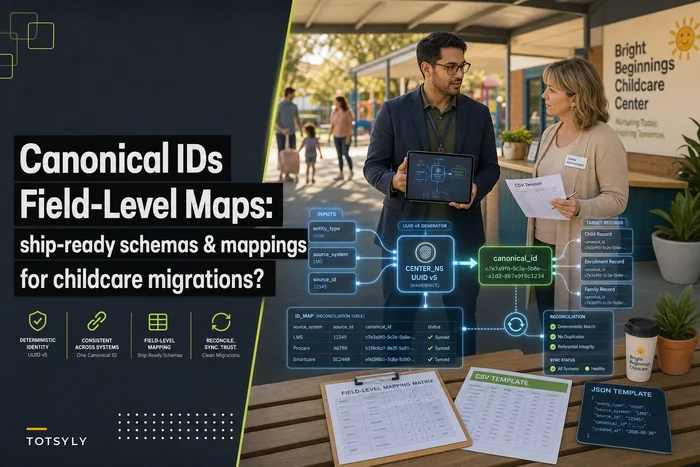
The deeper issue is that data quality isn't a one-time cleanup. It's a flow problem. Records are constantly being created, edited, and moved between systems, and every one of those transitions is a chance for something to go wrong. If you've done a system migration, you already know how fragile source-to-target mapping can be — the same discipline behind canonical field-level schemas and source-to-target mapping toolkits is exactly what erodes over time once real humans start typing into the boxes every day.
The core idea: treat data quality like a service you owe yourself
Software teams figured out years ago that "our system should be reliable" is useless as a goal because nobody can measure it. So they write it down as a specific promise — this service will be available 99.9% of the time, and here's what happens when it's not. That written promise is an SLA, and the specific measurable targets inside it are SLOs.
Simplify your childcare center’s daily operations.
Totsyly helps you manage enrollments, staff, and communications efficiently so you can focus on care.
- Streamlined enrollment & waitlist management
- Automated billing & payment tracking
- Staff scheduling & attendance monitoring
No credit card required
You can do the exact same thing for the data that runs your center. Instead of hoping your enrollment numbers are right, you declare what "right" means:
-
Attendance for every classroom must be entered by 10
00 AM, and the dashboard must reflect it by 10:15.
-
Every enrolled child in the CRM must have a matching billing record within 24 hours of enrollment.
-
Immunization and emergency-contact fields must be at least 98% complete across active families at all times.
-
Withdrawal in one system must reconcile to withdrawal in all others within one business day.
These are boring. They're supposed to be. Once you've written them down, "is the data good?" stops being a feeling and becomes a checkable fact. Either attendance was in by 10:00 or it wasn't. Either the billing record exists or it doesn't.
The mistake most centers make is skipping this step and jumping straight to building reports. You end up with beautiful dashboards sitting on top of data nobody agreed on the standards for. Define the promise first, then the report actually means something.
The three checks that catch problems before they hit your dashboard
There's a natural order to how you verify data, and each layer catches a different kind of failure. Skipping one leaves a blind spot.
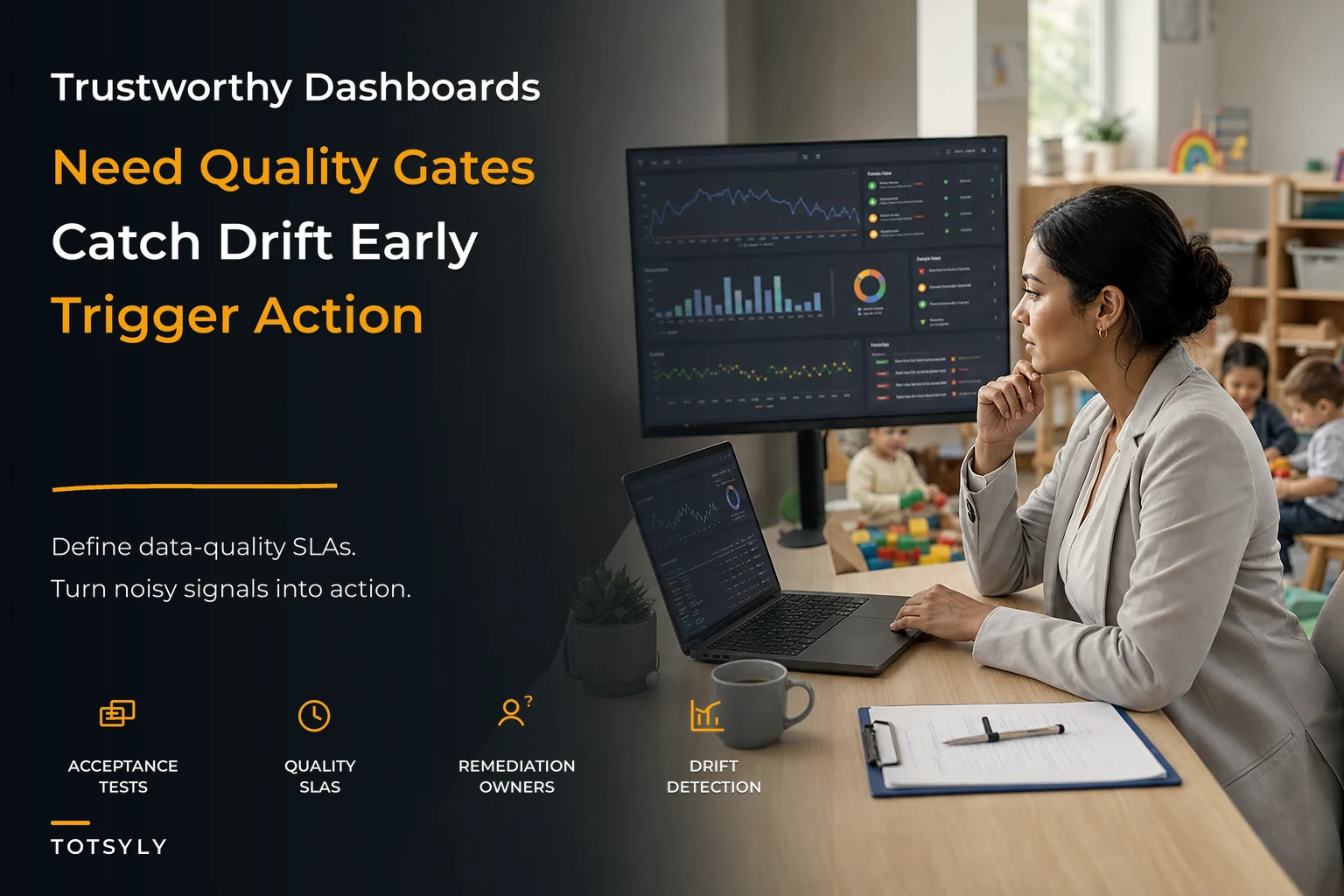
Acceptance tests run when data enters or moves. This is the gate. Before a record is considered valid, it has to pass basic rules: a child's date of birth can't be in the future, a start date can't be before the family's inquiry date, a room assignment has to point to a room that actually exists. In real operations, this is where most of your garbage gets stopped. If you don't gate on entry, you clean up forever on the back end.
Tolerance checks run continuously and ask "is this value within a believable range?" A classroom with a licensed capacity of 12 should never show 15 enrolled. Staff-to-child ratio should never read as one adult to twenty toddlers. Total revenue for a month shouldn't be triple last month's. These aren't about correctness exactly — they're about plausibility. When a number falls outside tolerance, something upstream broke, even if you don't yet know what.
Metric-drift detection is the subtle one, and the one almost nobody sets up. It watches for numbers that are technically valid but changing in a way that doesn't make sense. Attendance completeness slowly sliding from 99% to 91% over three weeks. Average days-to-enrollment creeping up. The percentage of records with missing emergency contacts ticking upward every Friday. No single day trips an alarm, but the trend is telling you a process is decaying — usually a person who stopped doing a step, or a form that quietly changed.
Here's how the three compare in practice:
| Check type | When it runs | What it catches | Typical example |
|---|---|---|---|
| Acceptance test | On data entry/import | Broken or impossible records | Start date before birth date; room that doesn't exist |
| Tolerance check | Continuously | Implausible values | Classroom over licensed capacity; revenue 3x normal |
| Drift detection | Over time (trend) | Slow process decay | Completeness sliding from 99% → 91% over weeks |
Centers that only run acceptance tests catch obvious junk but miss the slow rot. The ones that only watch tolerances catch big spikes but miss the quiet drift that does the real damage. You need all three, layered.
What breaks at scale
At one site, you can get away with a lot because the director is the governance layer. She knows the two families who withdrew, she remembers which teacher covered which room, she can eyeball a report and know instantly if it smells wrong. Her memory is patching every data gap in real time.
That doesn't survive growth. The moment you're running three, five, eight sites, no single person holds the ground truth anymore. Now the regional director is looking at a rolled-up dashboard, and every data error at every site flows upward into the number she's using to make budget and staffing calls. A site that's chronically late on attendance entry doesn't just have a local problem — it silently poisons the portfolio-wide occupancy number.
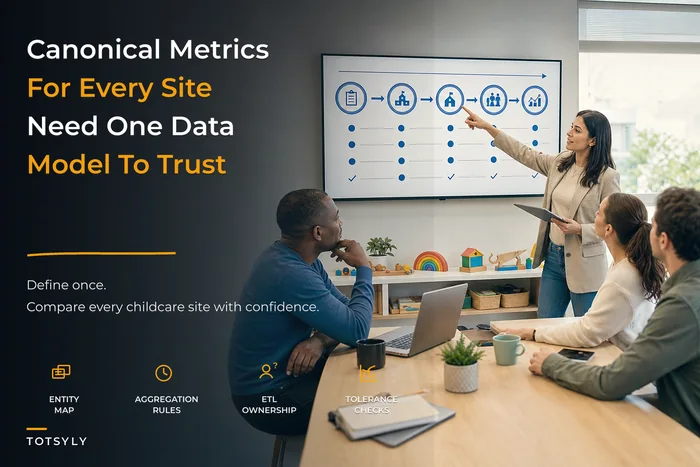
This is exactly why multi-site reporting needs standardized metric definitions before anything else. If "occupancy" is calculated three different ways at three sites, your rollup is meaningless no matter how clean each site's data is. Getting everyone onto a shared definition — the work behind a canonical data model for multi-site childcare reporting — is the foundation the whole governance layer stands on. Governance without shared definitions is just fast, confident nonsense.
The other thing that breaks at scale: manual verification becomes impossible. When one person could spot-check the numbers each morning, you didn't need automated checks. Across eight sites and thousands of records changing daily, nobody can eyeball anything. The checking has to run on its own, and it has to know who to tell when something fails.
The alerting playbook — the part everyone gets wrong
Detection is worthless without routing. Plenty of centers set up data checks, wire them to fire an email, and then everyone gets forty alert emails a week and stops reading any of them within a month. Now you have detection and a false sense of security, which is worse than nothing.
A real alerting playbook answers three questions for every check: who gets told, how fast, and what they do about it. Not every failure deserves the same response. A missing emergency contact needs to get fixed today. A revenue number that's suddenly triple normal needs someone looking at it within the hour, because it might mean a billing run doubled.
-
Critical — data that affects safety or compliance right now. Ratio breach showing on the dashboard, a licensed-capacity overage, missing immunization records for enrolled children. These page the site director immediately and don't stop until acknowledged.
-
High — data that affects money or decisions today. Enrollment/billing mismatch, revenue outside tolerance, attendance not entered by cutoff. Routed to the responsible person same-day with a clear fix.
-
Medium — drift and completeness issues. Slowly declining field completeness, rising days-to-enrollment. Batched into a weekly review, not a same-day fire drill.
-
Low — informational. Logged, trended, looked at monthly to spot patterns.
The insight most people miss: the response is the actual product, not the alert. An alert that says "attendance completeness dropped" is useless. An alert that says "attendance completeness at the Oak St site dropped to 89%, here are the four classrooms missing entries, notify Room 3 and Room 5 leads" is something a director can act on in ninety seconds. Write the playbook down to that level of specificity, or your alerts become background noise.
Here's a simple routing workflow visualization.
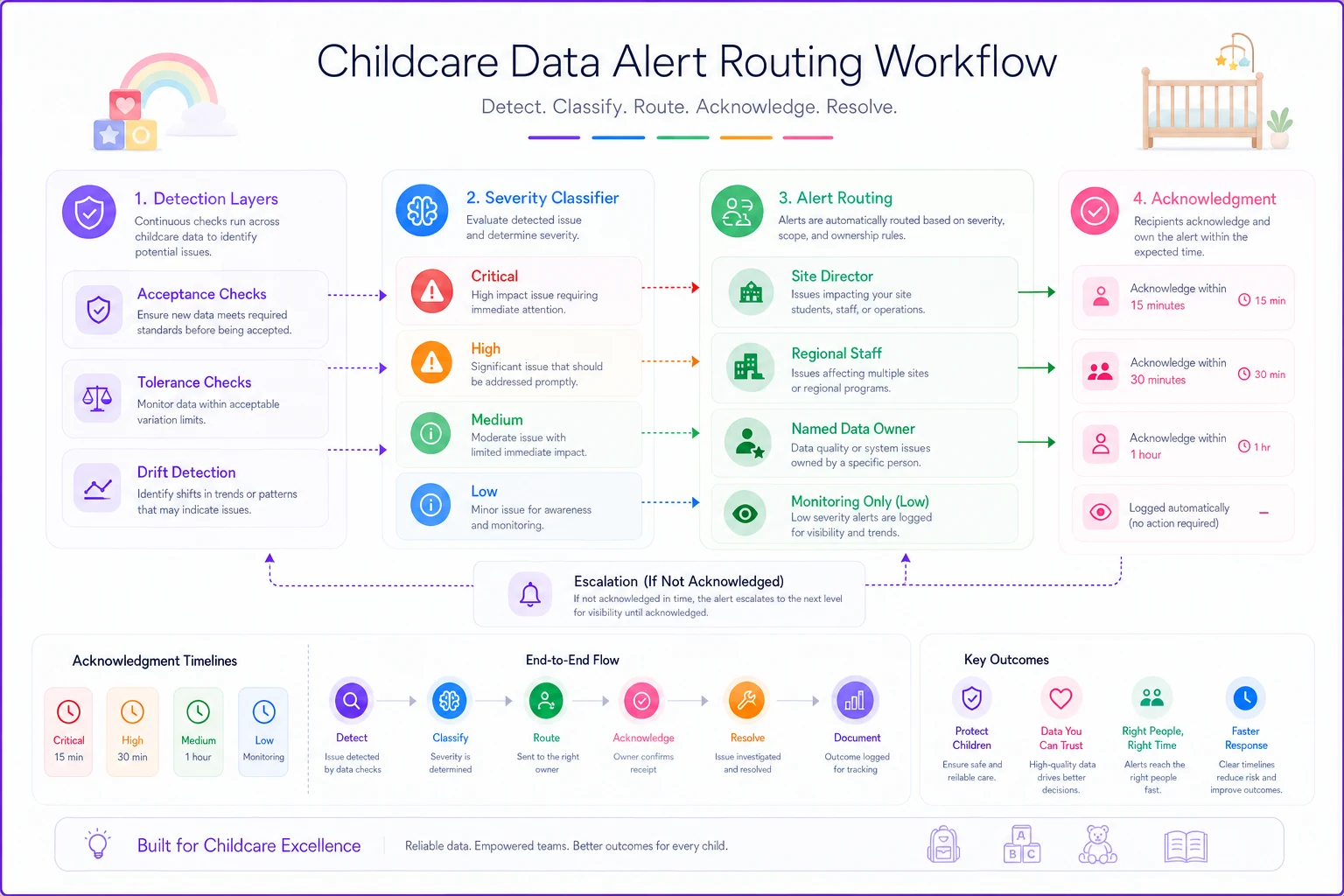
Build in acknowledgment too. Every critical and high alert should require someone to mark it handled. Without that, you don't know if the ratio breach got fixed or if the alert just scrolled off someone's screen during pickup rush.
A quick checklist to see where you stand
Run through this honestly. Most centers can't check more than two or three boxes at first, and that's the point — it shows you exactly where the gaps are.
-
[ ] We've written down specific, measurable targets for our most important data (attendance, enrollment, billing, compliance fields).
-
[ ] Bad records get stopped on entry, not cleaned up later.
-
[ ] We have plausibility limits so impossible numbers never reach a dashboard.
-
[ ] Something watches for slow drift in completeness and key metrics over weeks.
-
[ ] Every alert has a named owner and a specific action, not just "FYI."
-
[ ] Critical alerts require acknowledgment before they close.
-
[ ] Every site calculates core metrics the same way.
-
[ ] The director trusts the dashboard enough to make decisions without calling to double-check.
That last box is the real scorecard. Everything above it exists so you can honestly check it.
A real scenario
A four-site preschool group had rolled out a shared dashboard and, on paper, everything looked fine. In practice, the regional director had quietly stopped trusting the occupancy report. Two sites were reliable; two were consistently entering enrollment changes late and processing withdrawals in the CRM but not billing. The rollup occupancy number was running about 5–7 points too high most weeks, because withdrawn kids lingered as "active."
The visible cost was budgeting decisions made off inflated numbers — they'd greenlit a new hire at one site based on capacity that wasn't actually there. The hidden cost was slower: the director was spending close to an hour every Monday calling site leads to reconcile numbers by hand before any leadership meeting.
They didn't buy new software. They set three things up on top of what they already had. First, a tolerance check so enrollment could never exceed licensed capacity without flagging. Second, a daily reconciliation check comparing "active in CRM" against "active in billing" — any mismatch over 24 hours old fired a same-day alert to that site's admin. Third, a weekly drift report on attendance and field completeness per site.
Within about two months the rollup occupancy number matched reality within a point or so, the Monday reconciliation calls basically disappeared, and the director started making staffing calls straight off the dashboard. Nothing dramatic. Just the quiet, valuable thing where the numbers became trustworthy enough to act on.
When this is worth it — and when it isn't
If you're running a single site and the director already knows every family by name, a full governance layer is overkill. You are the governance layer, and you're probably pretty good at it. Set up basic acceptance tests so you're not typing garbage into the system, and leave it there. Building drift detection for one site with 60 kids is solving a problem you don't have yet.
Where this becomes genuinely necessary is the transition from "one person holds the truth" to "nobody can hold all of it." That usually hits somewhere around the second or third site, or when you cross the point where the director stops personally touching every record. That's when an unmanaged dashboard goes from helpful to actively misleading.
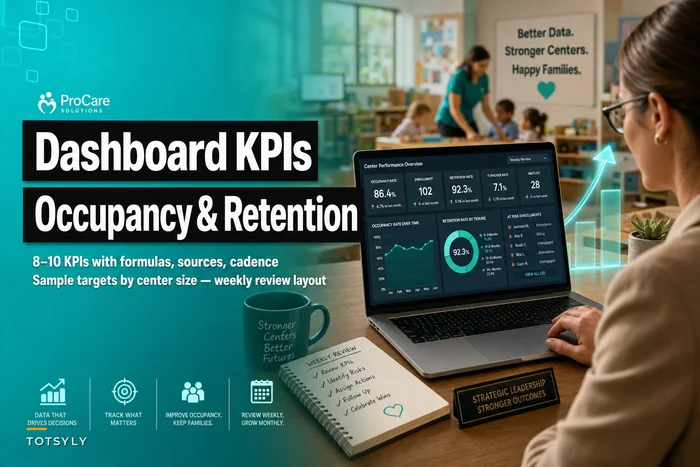
The bad-idea version: building an elaborate check-and-alert system while your underlying metric definitions are still inconsistent across sites. You'll be catching data-quality violations against standards you never agreed on, generating a flood of alerts that are half real and half definitional disagreement. Get the definitions and the shared model settled first — the kind of foundation covered in dashboard KPIs that actually move occupancy and retention — and only then wrap governance around it.
Where the software layer actually fits
None of this requires a big platform to start — a lot of the first checks can be simple reconciliation queries run on a schedule. But it doesn't scale by hand. Once you're running dozens of checks across multiple sites, with severity routing and acknowledgment tracking, that's real ongoing work, and it's the kind of thing worth letting AI-assisted operational software carry.
Start automating the tolerance and acceptance checks that produce narrow, actionable alerts first—those deliver trust fastest.
The useful role for automation here isn't flashy. It's the tireless part: continuously running tolerance and acceptance checks, watching trend lines for drift no human would notice week to week, and routing each failure to the right person with the right context attached. Automated checks don't get tired during pickup rush, don't forget to run on a busy Monday, and don't develop the human habit of ignoring the alert that fires too often. That consistency — a check that runs the same way every single day — is what turns a dashboard from decoration back into a decision tool.
The bottom line
Trustworthy dashboards aren't a reporting achievement. They're a governance one. The reports are the easy part — most systems can produce a chart. What makes people actually act on that chart is the invisible layer underneath it: the promises you've written down about what good data means, the checks that verify those promises constantly, the drift detection that catches slow decay, and the alerting that puts a real problem in front of a real person before it becomes a real decision.
Get that layer right and something quietly shifts in how the center runs. People stop double-checking the numbers by phone. Decisions get faster because the data earned trust. And the reporting you already paid for finally starts doing the job you bought it to do.
Get that layer right and something quietly shifts in how the center runs. People stop double-checking the numbers by phone. Decisions get faster because the data earned trust. And the reporting you already paid for finally starts doing the job you bought it to do.
Ready to elevate your childcare management?
Join hundreds of childcare providers using Totsyly to save time, improve communication, and grow their centers.