

Most multi-state childcare operators don't discover their data residency problem until a specific moment: a licensing specialist asks where the center's records are physically stored, a vendor gets acquired and quietly moves its hosting to a different region, or legal counsel during a financing round asks for a data map nobody has.
By then the problem isn't theoretical. You've got immunization records, custody documents, background check results, and billing data for families across five, eight, maybe twelve states — and no clear answer to a simple question: which state's rules govern each piece of that data, and where does it actually live?
This isn't a legal article. It's an operational one. The goal is to give you a way to think about childcare data residency compliance as a system you can build and run, not a legal memo you file and forget. Because the centers that get burned aren't the ones who read the statutes wrong — they're the ones who never mapped their data to begin with and had no controls connecting policy to practice.
Why residency gets messy the moment you cross a state line
A single-site center rarely thinks about data residency. Everything lives in one system, governed roughly by one state's framework, and the physical location of the server feels abstract. It works until it doesn't scale.
The trouble starts when you add sites in other states. Each state has its own expectations around record retention, who can access child and family information, how long you keep things after a child leaves, and increasingly, how personal data is handled under state privacy laws. Some states have explicit consumer privacy statutes that touch any personal data you hold. Others fold requirements into licensing regulations that never use the word "data" but absolutely govern it.
What shows up repeatedly across operators scaling past three or four states is that the real problem isn't any single rule — it's the collision of rules. A retention period that's fine in one state is too short in another. A vendor data flow that's acceptable in one jurisdiction creates exposure in a neighboring one. And nobody owns the reconciliation because the person managing enrollment isn't the person managing IT, who isn't the person managing compliance.
The data sits in the gaps between those roles. That's where residency problems breed.
Start with a jurisdiction map, not a policy document
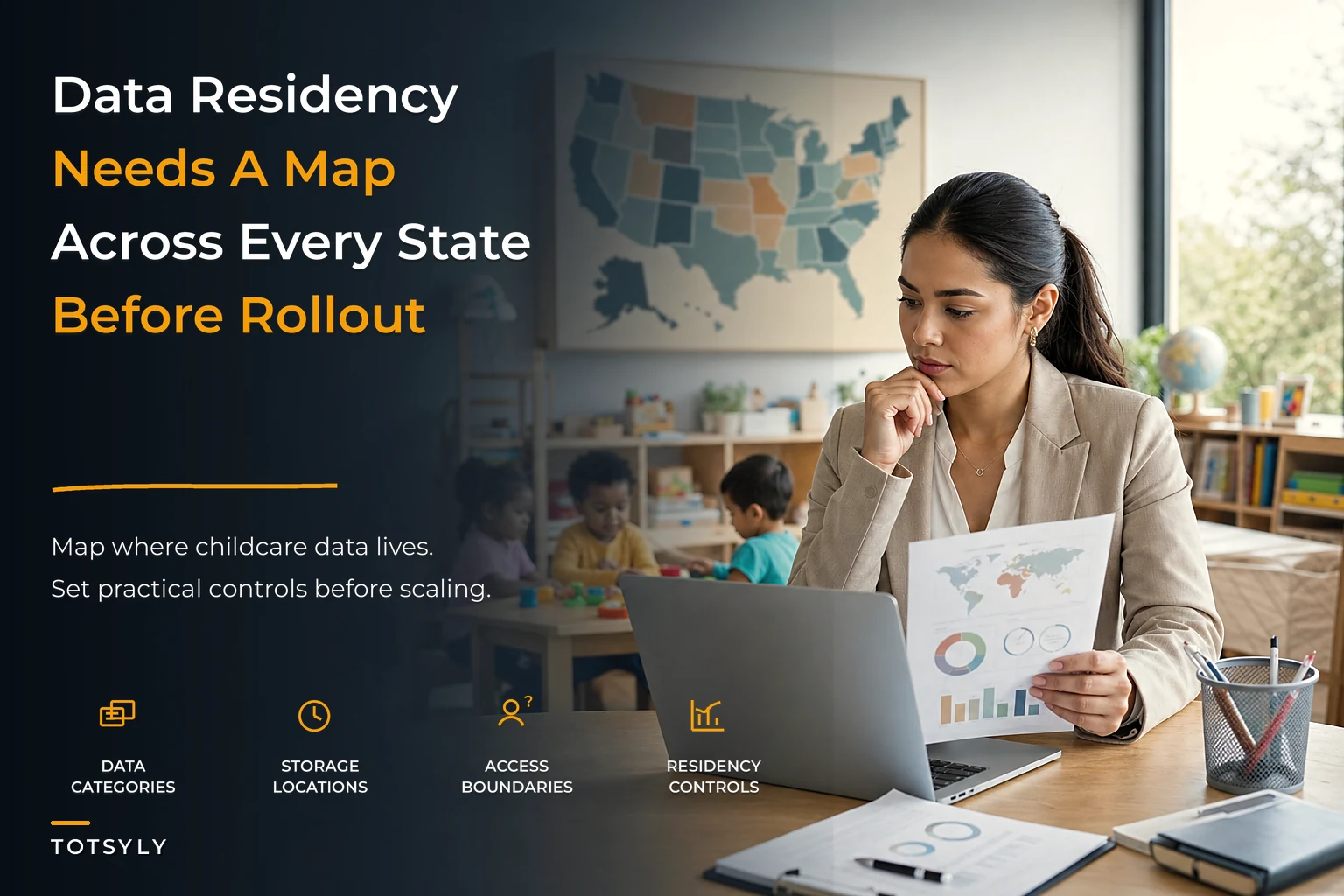
The single most useful artifact you can build is a jurisdiction map. Not a 40-page policy — a working table that tells you, for each type of data, which state's rules apply and where that data physically or logically resides.
Simplify your childcare center’s daily operations.
Totsyly helps you manage enrollments, staff, and communications efficiently so you can focus on care.
- Streamlined enrollment & waitlist management
- Automated billing & payment tracking
- Staff scheduling & attendance monitoring
No credit card required
Most operators skip straight to writing policies. That's backwards. A policy without a map is a guess. You can't write a meaningful retention rule if you don't know that State A requires seven years for incident records and State B requires three, and that both apply because you operate in both.
Here's a stripped-down version of what the map should capture:
| Data category | States that apply | Governing requirement type | Where it's stored | Retention driver | Access boundary |
|---|---|---|---|---|---|
| Immunization & health records | All operating states | Licensing + health | Primary SaaS (US-East) | Longest applicable state | Site + nurse roles only |
| Custody / legal documents | Per-child state | Licensing + family law | SaaS + secure docs | Longest applicable state | Director + legal |
| Background checks | Per-staff work state | State background check law | HR system | State-specific | HR + exec only |
| Billing & payment data | Family's state | Privacy + PCI | Payment processor | Financial retention | Finance roles |
| Attendance & ratios | Site state | Licensing | Primary SaaS | Licensing minimum | Site staff |
The columns matter more than the rows. "Where it's stored" forces you to actually confirm hosting location with your vendors — which is where the first unpleasant surprises usually show up. "Retention driver" forces the operational decision that quietly causes the most pain: when two states disagree on how long you keep something, you almost always default to the longest applicable period across your footprint, unless a specific state rule prohibits keeping it longer.
That last point trips people up. Longer is not automatically safer. A few states limit how long certain personal data can be retained. So the working rule is "longest applicable, unless prohibited," and your map needs a flag for those exceptions.
If you've already done serious work on what good childcare data governance looks like, the jurisdiction map is the layer that sits on top of it — governance tells you how you handle data, the map tells you which rules apply where.
Below is a simple visual of the jurisdiction-mapping workflow.
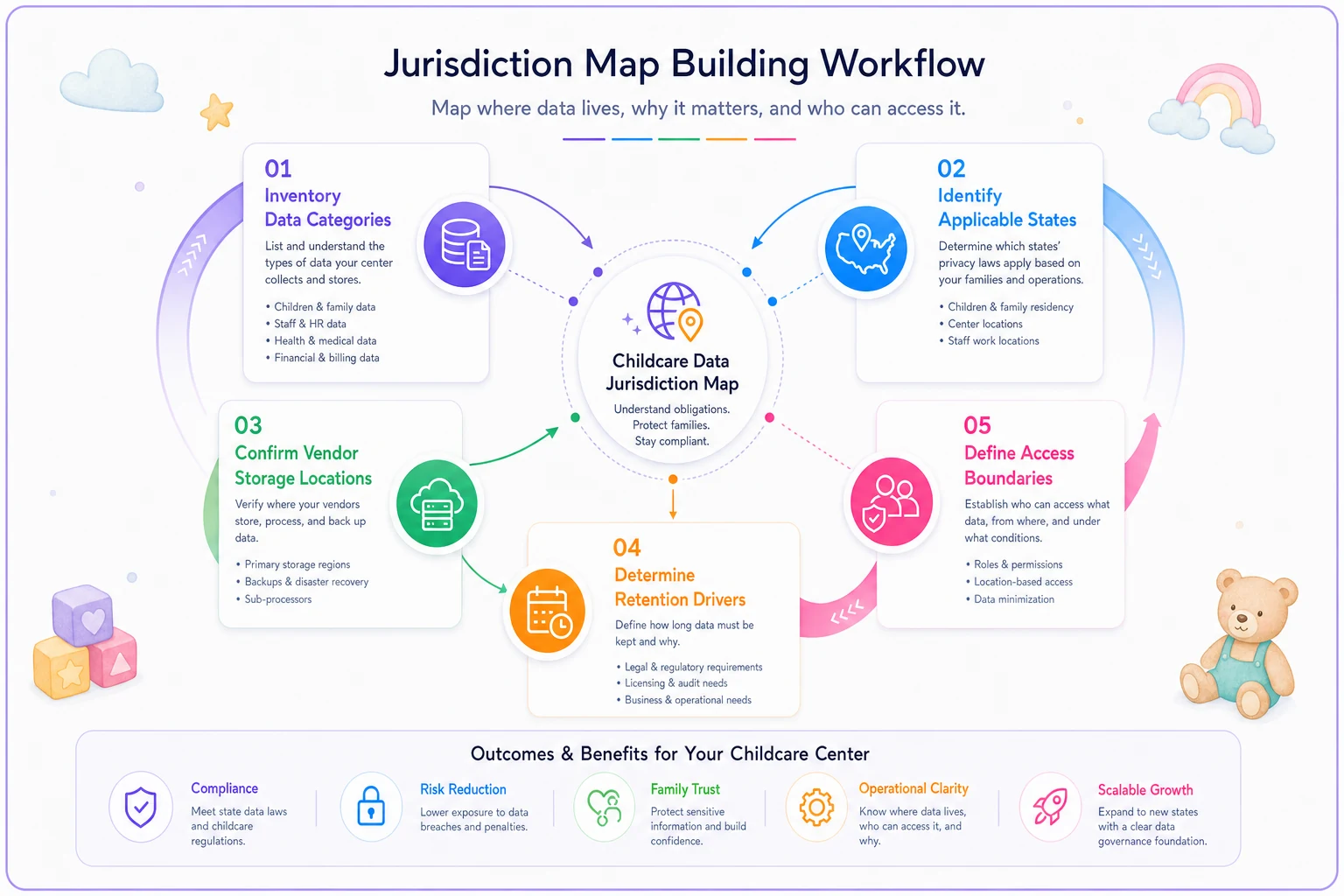
Use this to align teams on who does each step.
The minimal technical controls that actually matter
Residency gets over-engineered constantly. Operators hear "data localization" and picture spinning up separate servers per state. For childcare, you almost never need that. What you need is a small set of controls that let you prove where data lives, who can touch it, and that it moves the way your map says it should.
-
Hosting region confirmation. Get written confirmation from each vendor on the physical region where production data is stored and backed up. This is control zero. Everything else assumes you know this.
-
Role-based access scoped to geography. A site director in one state should not have default access to another state's family records. Most childcare platforms support role scoping; few operators actually configure it tightly across sites.
-
Retention automation per data category. Manual deletion never happens consistently. Your system should enforce retention windows tied to the longest applicable rule, with holds for active legal matters.
-
Audit logging on sensitive records. Who viewed custody documents, who exported a family's billing history, who changed a retention flag. If you can't answer those questions, you can't demonstrate control during an audit.
-
Export and transfer logging. Every time data leaves the primary system — a report, a vendor sync, a bulk export — it should be recorded. Uncontrolled exports are the single most common way residency boundaries get quietly broken.
Notice what's not on this list: encryption-at-rest isn't called out separately because any serious vendor already provides it, and country-level data isolation isn't here because for US-only childcare operations it's rarely the actual requirement. Don't build for European-style localization when your real exposure is a patchwork of US state rules.
Get written hosting-region confirmation before you finalize a vendor so you don't assume location later.
The pattern that keeps showing up: operators invest in heavy infrastructure controls and completely neglect access scoping and export logging — which are cheaper, and which are exactly what gets scrutinized when something goes wrong.
Vendor contracts: where residency actually lives or dies
Most of your family data physically lives on infrastructure you don't own. Your enrollment platform, payment processor, background check vendor, and document storage all hold pieces of it. Which means your residency posture is only as strong as your vendor contracts.
This connects directly to the broader discipline of vendor SLA and technology governance for childcare portfolios — residency clauses are a subset of that governance, but they're the subset people forget to write down.
Standard vendor agreements say nothing useful about residency. They tell you about uptime and liability caps. They rarely tell you where your data lives, whether the vendor can move it, who they share it with, or what happens to it when you leave.
Data location clause > "Vendor shall store and process all Customer Data within [specified region/country]. Vendor shall not relocate storage or processing of Customer Data to any other region without [30/60] days' prior written notice and Customer's written approval."
Subprocessor transparency clause > "Vendor shall maintain a current list of all subprocessors with access to Customer Data, including the geographic region of each. Vendor shall notify Customer of any new subprocessor at least [30] days before granting access and shall permit Customer to object."
Retention and deletion clause > "Vendor shall retain Customer Data only for the periods specified by Customer and shall securely delete Customer Data within [30] days of a documented deletion request, except where retention is required by law. Upon termination, Vendor shall return or delete all Customer Data within [60] days and certify completion."
Access and audit clause > "Vendor shall maintain access logs for all Customer Data containing personal information and shall provide such logs to Customer upon request. Vendor shall notify Customer within [24/48] hours of any unauthorized access."
Change-of-control clause > "In the event of a merger, acquisition, or change of control, Vendor shall notify Customer within [10] days and shall not transfer, relocate, or alter the handling of Customer Data as a result of such event without Customer's written consent."
That last one matters more than people expect. Vendor acquisitions are exactly when data quietly moves to new infrastructure in a new region, often without anyone at the childcare operator finding out until much later. A change-of-control clause is cheap insurance against your data map silently going stale.
Data localization pragmatics: what's real vs. what's theater
What's real: Knowing where your data physically resides, controlling who across your footprint can access it, honoring the strictest applicable retention and privacy rule, and being able to produce a map on demand. These are achievable with the controls above and don't require exotic infrastructure.
What's usually theater: Spinning up per-state database instances, insisting on in-state-only hosting for ordinary records, or treating every state as if it has European-grade localization requirements. For the vast majority of US childcare portfolios, this adds cost and operational fragility without reducing meaningful risk.
The pragmatic middle ground: one well-governed primary platform with confirmed hosting region, tight geographic access scoping, retention automation calibrated to your strictest applicable rules, and contracts that lock vendors to a known region. That setup satisfies the actual requirements for the overwhelming majority of multi-state operators.
Where you do tighten up: highly sensitive categories like custody documents and background checks. These deserve stricter access boundaries and sometimes separate storage — not because of localization law, but because the blast radius of a mistake is bigger.
When heavier localization actually makes sense
-
You operate in a state with an explicit, strict personal-data residency or processing requirement that your vendor can't otherwise meet.
-
You hold data for families connected to federal programs with their own data handling mandates.
-
You're large enough that a single breach would cross many states' notification laws simultaneously, and segmentation meaningfully limits exposure.
If none of those apply, resist the urge to over-build. Complexity is its own risk.
A real scenario: eight sites, four states, one surprise
Consider a mid-sized operator running eight centers across four states — roughly 600 enrolled families. They'd grown by acquisition, which meant they'd inherited three different enrollment systems and had been slowly consolidating onto one platform.
The residency problem surfaced during a refinancing. Lenders' counsel asked for a data map and a list of where family records were stored. Nobody had one. When the operations lead actually traced it, two things came up that stung.
First, the background check vendor for their newest two sites stored results on infrastructure in a different region than their main platform, and had added a subprocessor months earlier that nobody had been notified about — because the contract had no subprocessor clause.
Second, retention was running on whatever each inherited system's default was. One legacy system was auto-purging certain records after two years, which was under the retention floor for two of the four states. They'd been quietly out of compliance on retention for the better part of a year without a single alert firing.
The fix wasn't dramatic. It took somewhere around six to eight weeks: build the jurisdiction map, consolidate retention onto the primary platform with the longest-applicable rule, scope access by site and state, and renegotiate the two vendor contracts to add location and subprocessor clauses. The hard part wasn't technical — it was discovering how much they didn't know. After the cleanup, producing a current data map became a 20-minute export instead of a three-week scramble.
The lesson isn't "buy better software." It's that the absence of a map is the real failure point. Everything else is downstream of not knowing what you have and where it lives. This is the same blind spot that makes breach response so painful — which is exactly why an operations-first data-breach playbook and a residency map reinforce each other. You can't contain what you can't locate.
The ops-focused rollout checklist
If you're starting from nothing, here's the sequence that keeps this manageable instead of overwhelming. Work top to bottom — each step depends on the one before it.
Phase 1 — Discovery
-
[ ] List every system that holds child or family data (don't forget spreadsheets and shared drives)
-
[ ] Confirm hosting region for each vendor in writing
-
[ ] Identify every subprocessor touching your data
-
[ ] Document current retention behavior per system (actual, not intended)
Phase 2 — Mapping
-
[ ] Build the jurisdiction map
data category × applicable states × storage × retention driver
-
[ ] Flag any conflicts between states' retention or access rules
-
[ ] Mark exceptions where maximum retention is prohibited rather than required
-
[ ] Identify your "strictest applicable rule" per data category
Phase 3 — Controls
-
[ ] Scope role-based access by site and state
-
[ ] Automate retention to the strictest applicable rule, with legal holds
-
[ ] Turn on audit logging for sensitive record categories
-
[ ] Enable export/transfer logging
-
[ ] Confirm encryption at rest and in transit (should already exist)
Phase 4 — Contracts
-
[ ] Add data location clauses to all relevant vendor agreements
-
[ ] Add subprocessor transparency clauses
-
[ ] Add retention/deletion and return-on-termination clauses
-
[ ] Add change-of-control notification clauses
-
[ ] Set a renewal review so clauses get revisited, not forgotten
Phase 5 — Maintenance
-
[ ] Assign an owner for the jurisdiction map (one named person)
-
[ ] Review the map whenever you add a site, state, or vendor
-
[ ] Re-confirm hosting regions annually
-
[ ] Keep the map export-ready for audits and financing
The single most common failure in Phase 5: nobody owns the map, so it goes stale the moment the business changes. Assign an owner or skip the whole exercise, because an outdated map is arguably worse than none — it gives false confidence.
Who should not over-invest in this
Not every operator needs the full build. If you run a single site in one state with one well-governed platform, your residency obligations are real but simple — a one-page map and solid vendor contracts cover you. Building multi-jurisdiction controls at that scale is wasted effort.
This framework earns its keep the moment you cross a second state line, grow by acquisition, or take on institutional financing that triggers due diligence. Those are the triggers that turn residency from a background concern into something a lender, regulator, or acquirer will actively probe.
And if you're growing through acquisition specifically, do this before the next deal, not after. Every center you acquire brings its own inherited systems, retention defaults, and vendor contracts. Folding those into a map you already maintain is manageable. Discovering them all at once during due diligence is not.
Where operational tooling fits
A lot of this becomes dramatically easier when your core platform already enforces geographic access scoping, automates retention per rule, and logs access and exports without manual effort. AI-assisted operational platforms can help surface the gaps too — flagging when a record's retention doesn't match the applicable rule, or when an export crosses a boundary your map didn't anticipate. That kind of automation turns the jurisdiction map from a static document into something that stays accurate as the business moves.
But the tooling is the easy part. The discipline is building the map honestly and keeping it current. No platform compensates for not knowing what data you hold or where it lives. Get the map right first; let the software enforce it second.
Pulling it together
Data residency in a multi-state childcare operation isn't a legal puzzle you solve once. It's an operating rhythm: know what data you hold, know which states' rules apply to each piece, confirm where it physically lives, scope who can touch it, and lock your vendors to those boundaries in writing.
The operators who struggle aren't usually the ones with the most complex footprints — they're the ones who treated residency as a compliance checkbox instead of a connected system that touches enrollment, HR, finance, and IT at once. Build the map, wire in the minimal controls, fix the contracts, and assign an owner. Do that, and the question that used to trigger a three-week scramble becomes a routine export you can hand over without flinching.
Ready to elevate your childcare management?
Join hundreds of childcare providers using Totsyly to save time, improve communication, and grow their centers.