


Most childcare pricing conversations start and end with one question: "What are the centers down the street charging?" You match them, maybe undercut by $50, and move on. That's not a pricing strategy — that's a pricing accident that works until it doesn't.
The centers that keep rooms full and protect margins treat pricing like a system that reacts to occupancy, seasonality, and demand signals — not a number you set once a year and forget. Yield management — the discipline hotels and airlines have used for decades — maps almost perfectly onto how a daycare fills classrooms.
Most centers run pricing on gut feel, then panic-discount when a room dips below break-even. This post is about building the guardrails so you stop reacting emotionally and start reacting to data.
Why childcare pricing breaks in the first place
Childcare has a brutal cost structure that makes pricing mistakes expensive fast. Your ratios are fixed by law. A single empty infant seat doesn't just cost you that family's tuition — it means you're paying a teacher to supervise a room that isn't paying for itself. Occupancy and margin are tied together in a way most industries never have to deal with.
Here's what usually goes wrong:
-
Pricing is set for the whole center instead of by room, even though an infant room and a pre-K room have completely different demand curves and cost profiles.
-
Discounts get handed out reactively — a director sees three empty toddler spots in August and offers "50% off your first month" to anyone who tours, permanently anchoring those families to a lower expectation.
-
Nobody tracks why a room is empty. Is it seasonal? Is your price actually too high? Or did you just have a bad month of tours? Those three problems need three different responses, and most centers treat them all the same.
The damage compounds quickly. One panicked discount becomes the new baseline. Parents talk. Six months later, half your toddler room is paying a "temporary" rate that never went away, and your margin quietly erodes while your occupancy looks fine on the surface.
Elasticity bands: the foundation most centers skip
Before you touch a single price, you need to understand how sensitive each room actually is to price changes. This is elasticity, and it varies a lot across age groups.
Simplify your childcare center’s daily operations.
Totsyly helps you manage enrollments, staff, and communications efficiently so you can focus on care.
- Streamlined enrollment & waitlist management
- Automated billing & payment tracking
- Staff scheduling & attendance monitoring
No credit card required
Infant care is almost always inelastic. Parents desperate for infant spots will pay a premium and rarely leave over a $75 monthly increase — supply is scarce and switching is painful. Pre-K tends to be far more elastic. There are more options, more parents comparing prices, more families that'll walk over a modest hike.
What this means practically: you should never move all your prices by the same percentage. A flat 5% increase across the board overcharges your elastic rooms and undercharges your inelastic ones — you're leaving money on the table and chasing families away at the same time.
Instead, sort your rooms into elasticity bands:
| Room / Age Group | Typical Elasticity | Pricing Posture | Discount Tolerance |
|---|---|---|---|
| Infant | Low (inelastic) | Hold firm, raise confidently | Minimal — protect the rate |
| Toddler | Moderate | Adjust with occupancy | Situational incentives only |
| Preschool (3–4) | Moderate–High | Watch tour conversion closely | Tour incentives before price cuts |
| Pre-K / VPK | High (elastic) | Competitive, promo-sensitive | Enrollment timing incentives OK |
The band your room sits in decides how you respond when occupancy dips — not whether you respond. That's the whole game.
Occupancy-triggered guardrails
The biggest source of margin leakage is directors discounting based on how they feel about a room, not on where occupancy actually sits relative to break-even. Guardrails fix that by pre-deciding the response before emotion enters the picture.
The idea is simple: define occupancy thresholds for each room and attach a specific allowed action to each one. Below the line, certain moves are permitted. Above it, discounting is off the table regardless of how tempting it feels.
-
At or above 90% occupancy No discounts, period. If anything, this is where you consider a modest rate increase at the next enrollment cycle. A full room being sold at last year's promo rate is just lost margin sitting right in front of you.
-
80–89% occupancy Hold price. Focus on tour conversion and waitlist activation, not price adjustments. This band is healthy — don't panic.
-
70–79% occupancy Tour incentives allowed (waived registration, a free first week for a committed enrollment). Still no permanent rate cuts.
-
Below 70% occupancy Structured promotions permitted, but only time-boxed with a defined end date. Never open-ended.
The guardrail's real job is to stop the reflex discount. When your toddler room hits 78% in August, the rule says "tour incentive," not "slash the rate." That distinction alone protects thousands in annual margin. If you want to go deeper on how discounts silently erode profitability, the breakdown in common discounting mistakes that eat margin pairs directly with this.
Forecast-to-action: when to offer a tour incentive vs. hold price
Guardrails tell you what's allowed. Forecasting tells you what to actually do. The two work together.
The key insight most centers miss: a low occupancy number today isn't automatically a problem. What matters is the trajectory — where you're heading over the next 60–90 days based on your pipeline, your seasonal pattern, and your withdrawal notices.
-
Pull your projected occupancy 60 days out by room. Combine current enrollment, confirmed starts, and known withdrawals.
-
Compare projected occupancy to the guardrail bands. A room at 88% today but forecast to drop to 72% because of three summer graduations is a completely different situation than one stably sitting at 88%.
-
Check your tour pipeline. If a room is forecast low but you have solid tours scheduled, the problem is conversion — not price. Fix the tour experience before touching the rate.
-
If the pipeline is thin AND occupancy is forecast to drop below 75%, deploy a tour incentive to pull demand forward. Waived registration or a bonus enrollment perk moves fence-sitters without resetting your base rate.
-
Only if incentives fail to move the forecast after a defined window (4–6 weeks) do you consider a time-boxed promotional rate on that specific room.
Notice the ordering. Price cuts are the last lever, not the first. The failure mode in real operations is centers jumping straight to step 5 when they never tried steps 3 and 4. A weak tour pipeline masquerades as a pricing problem constantly.
Your pipeline health is doing most of the heavy lifting here, which is why the systems in turning your waitlist into steady enrollment matter so much for pricing — a strong pipeline means you rarely need to discount at all.
Below is a visual of the monthly forecast-to-action flow.
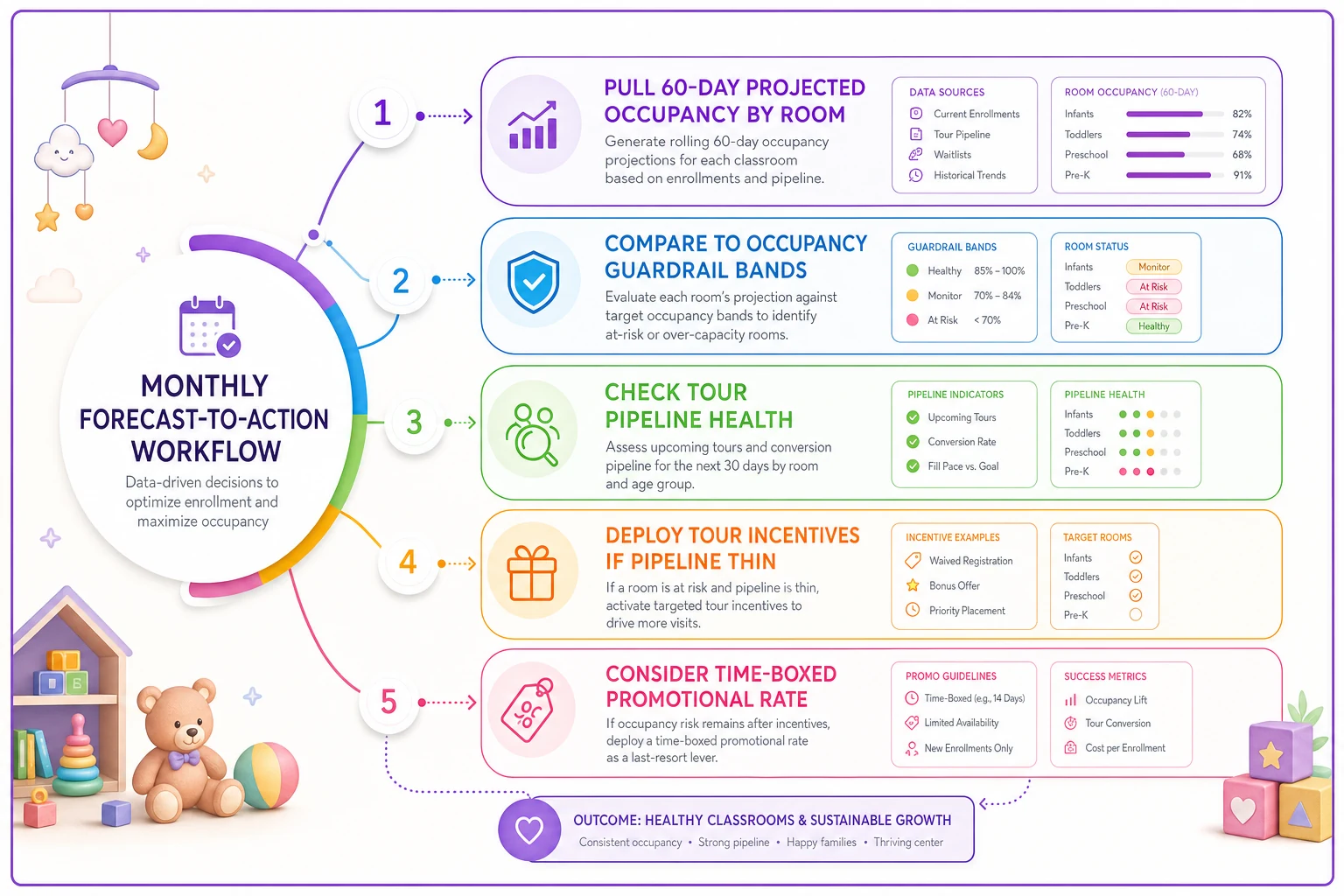
> Forecast-to-action decision flow (monthly)
>
> Pull 60-day projected occupancy by room → Compare to guardrail band → Check tour pipeline health → If pipeline thin + forecast <75%: deploy tour incentive → If incentives fail after 4–6 weeks: consider time-boxed promo rate
A price-band table you can actually build from
Elasticity bands and occupancy triggers come together in a price-band table. This is the artifact your front desk and enrollment staff actually work from, so nobody's improvising when a hesitant parent asks for a deal.
| Room | Base Rate (monthly) | Floor Rate (never below) | Incentive Allowed | Trigger to Deploy |
|---|---|---|---|---|
| Infant | $1,650 | $1,650 | None | N/A — hold always |
| Toddler | $1,380 | $1,310 | Waived reg ($150) | Forecast <75%, thin pipeline |
| Preschool | $1,180 | $1,090 | Free first week | Forecast <75% after tour push |
| Pre-K | $1,050 | $960 | Reg waiver + timing bonus | Forecast <72%, elastic room |
The floor rate matters as much as the base rate. It's the line staff cannot cross without director approval. Without a documented floor, every negotiation drifts downward and your "temporary" rates quietly become permanent. The table turns pricing from a judgment call into a controlled decision — which is the whole point.
The floor rates above are illustrative starting points. Your actual numbers will depend on your cost structure, local market, and what each room costs to staff.
A real scenario
A center running infant, toddler, and preschool rooms was sitting around 82% overall occupancy but bleeding margin. The toddler room kept dipping every late summer, and the director's habit was to offer a 30% first-three-months discount to fill it. It worked, sort of. The room filled, but a cluster of families got locked into rates that never reset, dragging that room's effective revenue down by roughly $2k–$3k a month once you added up all the discounted seats.
They rebuilt around bands and guardrails. Infant held firm — it was always full anyway. The toddler room got a floor rate and a forecast-to-action rule: when the summer dip showed up in the 60-day forecast, they deployed waived registration and a free first week for committed enrollments instead of the standing 30% cut. Tours picked up because "free first week" reads as generous without gutting the base rate.
Within two enrollment cycles, the toddler room stabilized in the low 80s and effective monthly revenue on that room recovered most of what the old discounts were quietly costing. Overall occupancy barely changed — it ticked up a few points — but margin improved noticeably because the fill wasn't coming from permanent rate erosion anymore.
When this makes sense — and when it doesn't
This makes sense when you have multiple rooms with genuinely different demand profiles, predictable seasonal swings, and enough enrollment volume that pricing decisions repeat often enough to systematize. If you're constantly reacting to summer dips or graduation gaps, banded pricing gives you a repeatable playbook instead of monthly panic.
This is a bad idea when you're a small single-room operation with a long waitlist. If you're turning families away, you don't need elasticity bands — you need to raise your base rate. Yield management is for centers where occupancy actually fluctuates.
Who should not do this: any center that hasn't first cleaned up its forecasting. If you can't project occupancy 60 days out with reasonable confidence, the forecast-to-action rules have nothing to run on. Get your enrollment and withdrawal tracking solid first. The forecasting foundation in avoiding cashflow surprises with tuition and forecasting is essentially the prerequisite for everything in this post.
Where the system tends to break
Even a well-designed price-band system fails at predictable points as a center grows:
-
Staff override drift. Front desk staff, wanting to close a nervous parent, quietly go below the floor "just this once." Without visibility into who discounted what, this compounds silently across dozens of enrollments.
-
Stale forecasts. The 60-day projection only works if withdrawal notices and confirmed starts are logged in near-real time. A forecast built on last month's data will point you at the wrong room.
-
Multi-site inconsistency. Once you have three or four locations, each director interprets the guardrails slightly differently, and your "standard" pricing quietly fragments across the portfolio.
This is where centralizing your data actually matters — not as a shiny software feature, but as the thing that keeps the guardrails honest. When occupancy, pipeline, and withdrawal data live in one operational system rather than scattered spreadsheets, the forecast-to-action rules run on current numbers instead of week-old guesses. Directors can also see when someone's drifting below the floor before it becomes a pattern. The point isn't the pricing table itself — you can build that in a spreadsheet. It's keeping the inputs accurate and visible so the whole system doesn't quietly rot from bad data.
Putting it together
A durable childcare pricing strategy isn't about finding the perfect number. It's about building a small set of rules that decide, in advance, how you respond when a room fills up or empties out — so nobody's improvising discounts under pressure.
Sort your rooms by elasticity. Set occupancy guardrails that pre-decide what's allowed. Let the 60-day forecast, not your anxiety, tell you when to act. And always reach for tour incentives before rate cuts, because a filled room at a preserved rate beats a filled room at an eroded one every single time.
The centers that get this right stop treating full rooms and healthy margins as competing goals. With the right bands and triggers in place, they're the same goal — reached through discipline instead of guesswork.
A durable childcare pricing strategy isn't about finding the perfect number. It's about building a small set of rules that decide, in advance, how you respond when a room fills up or empties out — so nobody's improvising discounts under pressure.
The centers that get this right stop treating full rooms and healthy margins as competing goals. With the right bands and triggers in place, they're the same goal — reached through discipline instead of guesswork.
Ready to elevate your childcare management?
Join hundreds of childcare providers using Totsyly to save time, improve communication, and grow their centers.