

Most childcare centers run their finances the way a household runs a checkbook. Money comes in from tuition, money goes out for payroll and rent, and as long as the account doesn't hit zero before the 15th, everyone breathes easy. That works right up until it doesn't — usually when a lease renewal, a subsidy delay, and a staffing crunch all land in the same quarter.
The gap between a center that survives a rough two years and one that quietly closes usually isn't quality of care. It's whether anyone modeled the downside before it arrived. A single-year budget tells you almost nothing about what happens if enrollment drops 12% and stays there. A multi-year model, built with actual decision rules attached, tells you exactly when you need to act and what you're going to do about it.
This is the difference between financial reporting and financial governance. For centers with a board, a governing council, or even a couple of silent partners, the second one is what keeps everyone rowing in the same direction when the numbers get ugly.
Why single-year budgets fail the moment things get hard
A one-year budget assumes the environment holds still. It rarely does in childcare. Subsidy reimbursement rates change with state legislative cycles. Wage floors move. A competitor opens six blocks away. A large employer closes and takes 20 families with it.
The core problem with annual budgeting is that it treats every future as the expected future. There's no room in it for "what if we're wrong." And in this industry, being wrong about enrollment by even a handful of children reshapes the entire P&L, because the cost structure is stubbornly fixed. You can't run a classroom at half ratio and half cost — the teacher gets paid whether there are eight kids or twelve.
What happens at a lot of centers is that owners feel the pressure building months before the budget reflects it. Enrollment inquiries slow down. A subsidy check comes two weeks late. But because the budget is a static document, none of that translates into a decision until cash actually runs short. By then, the options are all bad ones.
A multi-year model fixes this by forcing you to write down three futures instead of one and attaching pre-agreed actions to each. When you've already decided — in a calm month — what you'll do if occupancy falls below a certain line, you don't have to make that call in a panic.
The three-scenario spine: conservative, base, aggressive
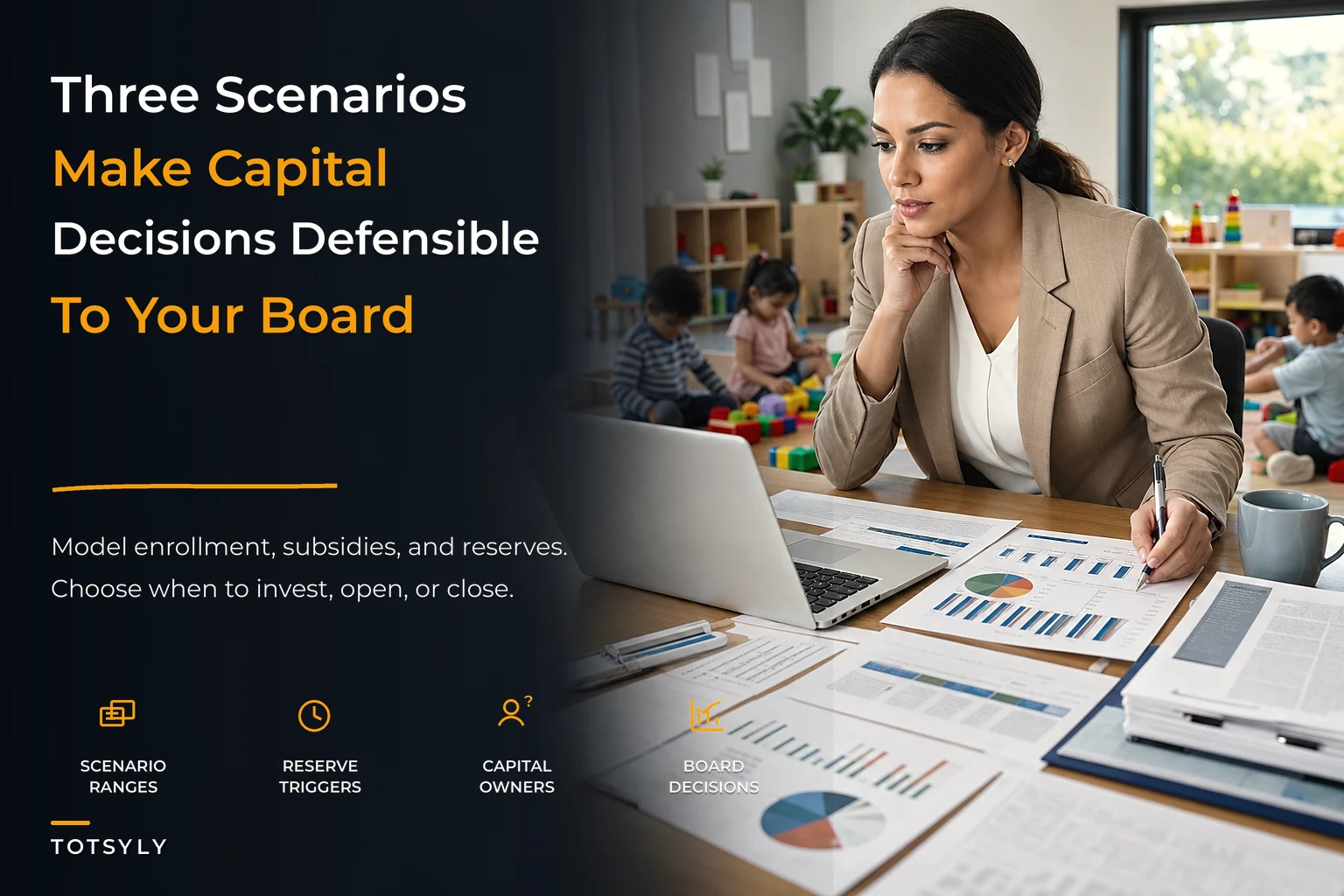
The backbone of serious multi-year financial planning for childcare is a three-scenario model running 3 to 5 years out. Not a single forecast with a fudge factor — three genuinely different stories about the future, each internally consistent.
Simplify your childcare center’s daily operations.
Totsyly helps you manage enrollments, staff, and communications efficiently so you can focus on care.
- Streamlined enrollment & waitlist management
- Automated billing & payment tracking
- Staff scheduling & attendance monitoring
No credit card required
The mistake most people make is only changing the revenue number across scenarios. In reality, when enrollment falls, bad-debt rates usually rise too, marketing spend goes up as you chase families, and staff turnover can climb because people sense instability. The scenarios need to move together.
| Driver | Conservative | Base | Aggressive |
|---|---|---|---|
| Average occupancy | 78–82% | 86–90% | 92–95% |
| Annual tuition increase | 2–3% | 4–5% | 5–7% |
| Subsidy reimbursement growth | Flat / slight cut | +2% | +4% |
| Staff wage growth | 5–6% (retention pressure) | 4% | 3% |
| Bad debt as % of billings | 3–4% | 1.5–2% | ~1% |
| Marketing as % of revenue | 4–5% | 2.5–3% | 2% |
Here's a simple workflow to build and use the three-scenario spine.
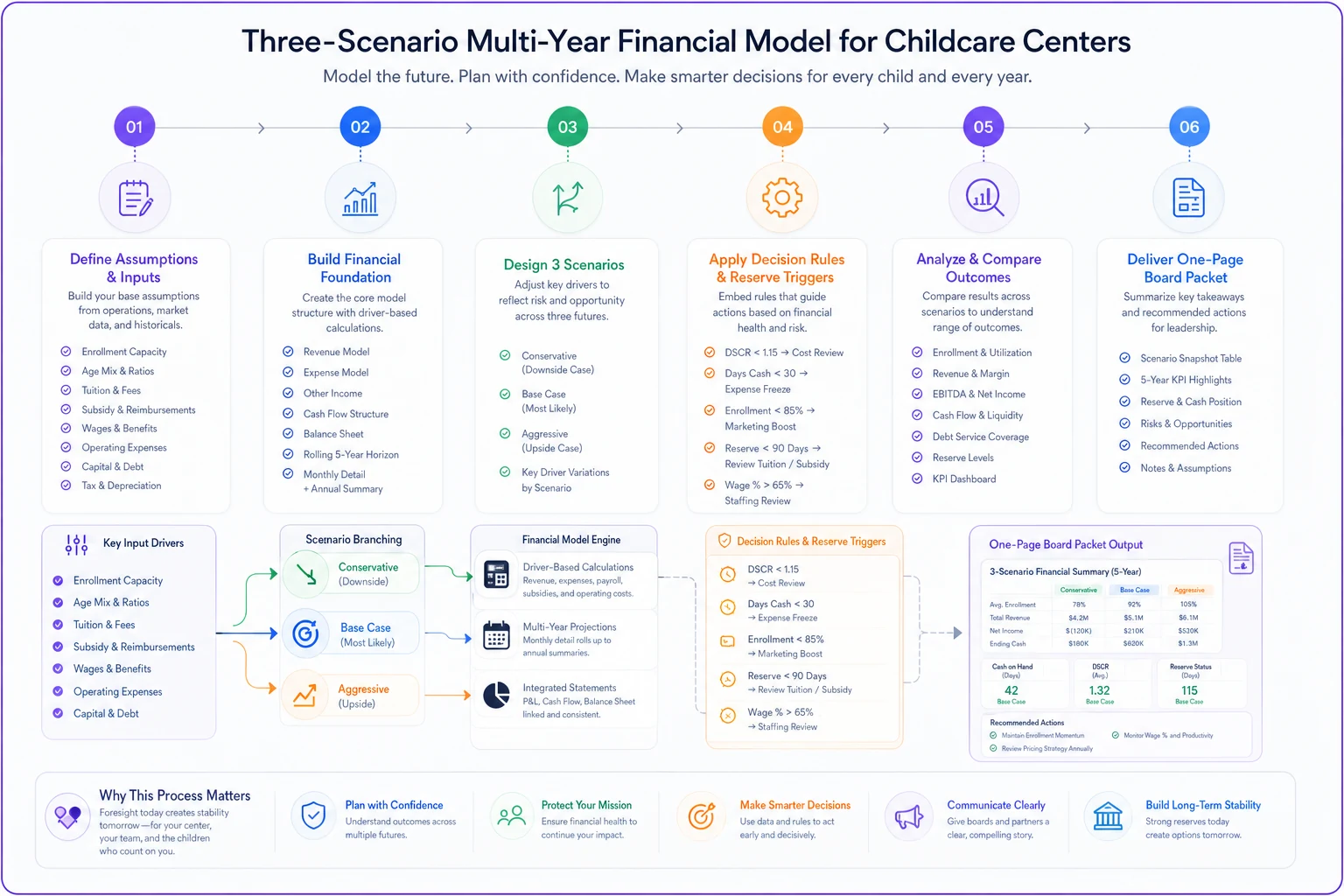
The numbers above are illustrative — your real ranges depend on your market, your subsidy mix, and your fixed-cost load. The point isn't the exact figures. It's that each column tells a coherent operational story. In the conservative case, you're paying more to keep staff and more to fill seats and collecting a smaller share of what you bill. Those pressures compound. A model that only knocks 10% off revenue and calls it "conservative" is lying to you.
One pattern worth flagging: centers almost always build a base case that's secretly the aggressive case. The base case should be genuinely boring — the future where nothing especially good happens. If your "base" assumes you'll finally fix collections and push through a 6% tuition increase without losing families, that's an aggressive scenario wearing a base-case costume.
Reserve and capital rules that mean something
A reserve policy that says "we aim to keep a healthy cash cushion" is not a policy. It's a wish. A real reserve rule states a number, ties it to a measurable trigger, and specifies who's allowed to spend it and under what conditions.
The most useful framing for childcare is months of operating expenses, not a dollar figure, because your expenses grow over time and a fixed dollar target silently erodes. A center running roughly $95k a month in expenses with a "3 months operating reserve" rule is holding close to $285k. That same center at $120k a month later needs $360k to maintain the same protection — and a lot of boards forget to re-index.
Re-index dollar reserve targets to months-of-expenses each budget cycle to keep protection consistent as costs change.
-
Operating reserve 3 months of total operating expenses, minimum. This is the floor you defend at almost any cost.
-
Restricted capital reserve funded separately for known big-ticket items — HVAC replacement, playground resurfacing, a roof. Roughly 1.5–2% of your facility's replacement value per year, set aside quarterly.
-
Opportunity reserve optional, and only after the first two are fully funded. This is what funds a second location or a strategic acquisition without touching operating cash.
The rule that matters most is the replenishment rule. Any reserve draw should trigger an automatic repayment schedule — for example, "reserves drawn below the 3-month floor must be restored within 18 months from operating surplus before any discretionary spending or distributions." Without that, reserves get raided in the bad year and never rebuilt, so the next bad year finds you defenseless.
Boards should also set a hard governance line: below a defined reserve level, certain decisions freeze automatically. No new hires above replacement, no capital projects, no owner distributions. Writing that down in advance removes the awkward politics of someone having to propose austerity in the moment.
Subsidy-mix sensitivity: the risk hiding in plain sight
For centers with meaningful public funding, subsidy mix is the single most underestimated risk in the model. A center that's 55% subsidy-funded has a completely different risk profile than one at 20%, and most owners never stress-test the difference.
The trouble with subsidy revenue is threefold: the rate can change with policy, the timing is often unreliable, and eligibility churn moves families in and out of funded status without you doing anything wrong. Any one of these can crack a model that looked fine on paper.
Sensitivity modeling here means asking pointed questions and putting real numbers behind them:
-
If subsidy reimbursement rates are frozen for two years while wages rise 4% annually, what happens to margin?
-
If payment timing slips from 30 days to 60 days, how much additional operating cash is needed to bridge payroll?
-
If 15% of subsidized families lose eligibility in a single year, can you backfill with private-pay, and at what price point?
Consider a center billing roughly $1.4M a year with about 50% subsidy revenue that modeled a 45-day payment delay. That single timing change — no rate cut, no lost families — required an extra ~$85k in working capital just to keep payroll clean. They'd never have caught that without running the scenario, and it directly changed their reserve target. This kind of interplay between funding sources and cash timing is exactly why financial controls for mixed-revenue centers can't be an afterthought — the mix itself is a risk factor that has to be modeled, not just managed.
The insight here: subsidy revenue should almost never be valued in your model at the same quality as private-pay revenue. Apply a discount for timing risk and eligibility churn. If the aggressive case leans heavily on growing subsidy enrollment, you're building fragility, not strength.
Explicit decision rules: invest, open, close
This is the part that separates a governance-grade model from a fancy spreadsheet. A forecast tells you what might happen. Decision rules tell you what you'll do — before emotion, sunk cost, and wishful thinking get involved.
The failure mode plays out the same way almost every time: a center loses money for a year, the owner is certain next year will turn around, so nothing changes. It doesn't turn around. Year two is worse. By year three the losses have eaten the reserves and the closure is forced and chaotic instead of managed. Pre-committed decision rules break that cycle.
Invest rules define when you put money into growth:
-
Trailing 12-month occupancy above 90% for two consecutive quarters
-
Operating reserve fully funded at target
-
A documented, funded plan to protect quality through expansion
Open rules (new classroom, new site) add hurdles:
-
Base-case model shows the new capacity breaks even within a defined window (say, 14–18 months)
-
Conservative-case model shows survival — losses don't breach reserve floors
-
Confirmed demand signals, not just intuition, backing the enrollment ramp. Turning inquiries into predictable fill is its own discipline, and your pricing and yield strategy should feed directly into the enrollment assumptions in the open-case model.
Close or contract rules are the hardest to write and the most important:
-
If a location runs below its contribution-margin floor for three consecutive quarters and the conservative case shows no path back above it within 12 months, the board initiates a wind-down review.
-
If a reserve draw would push operating reserves below one month of expenses, discretionary programs are cut first, automatically.
The value of writing "close" rules down while everyone's calm is hard to overstate. Nobody wants to be the person who suggests shutting a classroom. When the rule is already in the governance document, it's not a betrayal — it's just the policy the board adopted together.
When this level of rigor actually makes sense
Not every center needs a five-year, three-scenario model with formal reserve covenants. A single small center run by an owner-operator with tight cash instincts might do fine with a solid annual budget and a clear reserve target.
This governance layer earns its keep when:
-
You have a board, council, or outside investors who need a shared framework for hard decisions
-
You operate more than one site, where cross-subsidization can hide a failing location
-
A significant share of revenue comes from subsidy or grant funding with real timing and policy risk
-
You're contemplating expansion and need to understand the downside before committing capital
Who should probably not do this yet: a brand-new center still finding its enrollment baseline. You don't have enough real data to model three credible futures — you'd just be dressing up guesses in a governance costume. Get 12–18 months of clean actuals first. Solid enrollment-to-finance operating discipline comes before scenario modeling, because the model is only as good as the data feeding it.
A real scenario: catching the slide before it became a closure
A two-site preschool operation, combined revenue somewhere around $2.6M, had one strong location and one that "felt fine." The consolidated numbers looked healthy — the strong site was quietly covering the weak one.
When they finally built a proper multi-year model and broke out contribution margin by site, the weak location had been below its margin floor for four straight quarters. Under the base case it recovered "eventually." Under the conservative case — flat subsidy rates, 4% wage growth — it never did, and it would draw down the whole operation's reserves within about two years.
Because they'd adopted explicit rules, this wasn't a debate. The board triggered a contraction review, consolidated two under-enrolled classrooms, renegotiated the lease, and set a hard 12-month recovery deadline with quarterly checkpoints. The site returned to its margin floor in about nine months. Had they kept looking only at consolidated numbers, the cross-subsidy would have masked the problem until reserves were gone — and the outcome would have been a forced closure of both sites, not a managed fix of one.
The one-page board packet
Boards don't read 40-tab spreadsheets. They read one page and make decisions off it. If your model can't collapse into a single clear packet, it's not governance-ready.
A board-ready one-pager should fit these elements without crowding:
-
Scenario summary three columns (conservative / base / aggressive) showing revenue, operating margin, and ending cash for each of the next 3–5 years
-
Reserve status current reserve level, target, and months-of-expenses coverage — with a clear green/yellow/red flag
-
Decision-rule tripwires which rules are currently near a trigger, stated plainly ("Site B contribution margin: 2 quarters below floor — 1 more triggers review")
-
Key sensitivities the two or three assumptions the whole model hinges on, and what happens if each moves
-
Actions requested what, specifically, the board needs to decide this meeting
Everything else — the assumption logs, the detailed subsidy schedules, the site-by-site P&Ls — goes into appendices directors can open but rarely need to. Bury the decision in complexity and they'll either rubber-stamp it or freeze.
Suggested appendices directors can adopt
A defensible model keeps its supporting detail organized and consistent so any director — or an auditor, or a lender — can trace a number back to its source. Useful appendices include:
-
Assumption register every material assumption, its source, and who owns it. This is what stops "where did 88% occupancy come from?" from derailing a meeting.
-
Reserve policy statement the actual adopted policy, with floors, replenishment rules, and governance freezes written out.
-
Decision-rule schedule each invest/open/close rule with its exact trigger and required action.
-
Subsidy sensitivity worksheet the rate, timing, and eligibility scenarios with their cash impacts.
-
Site-level contribution margins for multi-site operations, so cross-subsidization can't hide a problem.
The discipline that keeps all of this credible year over year is consistency — same definitions, same structure, same update cadence every quarter. When the model gets rebuilt from scratch each cycle, or when three people are maintaining three different versions, the board loses trust in the numbers. And trust is the whole point.
This is where centralized operational data pays off quietly. When enrollment, billing, subsidy status, and payroll all live in connected systems rather than scattered spreadsheets, the model refreshes off real numbers instead of someone's month-end reconstruction. Operational platforms with built-in reporting and automation can pull actuals straight into your scenario framework, so the quarterly board packet is a five-minute export rather than a two-day fire drill — and the assumptions get pressure-tested against what actually happened, not what someone remembered.
Multi-year financial planning for childcare isn't about predicting the future accurately. Nobody can. It's about building a framework where being wrong doesn't wreck you — where you've already decided, in advance and together, what you'll do across a range of plausible futures.
The centers that weather rate cuts, subsidy delays, and enrollment swings aren't the ones with the rosiest forecasts. They're the ones with three honest scenarios, reserve rules with real teeth, and decision tripwires that fire before hope turns into denial. Write those down while things are calm. The version of you facing a hard quarter two years from now will be grateful you did.
Ready to elevate your childcare management?
Join hundreds of childcare providers using Totsyly to save time, improve communication, and grow their centers.