

Most center directors can walk into a classroom and know within about ninety seconds whether the teaching is working. The transitions are calm. Kids are engaged. The teacher is down at their level, not hovering by the wall. You feel it before you can even articulate it.
The problem is that instinct doesn't scale. Once you're running three, five, or eleven sites, that ninety-second read no longer covers your organization. You're relying on a patchwork of assistant directors, lead teachers, and occasional visits — each carrying a slightly different definition of "good teaching" in their head. That's where quality quietly drifts.
This is really the core challenge of teaching quality assurance in early childhood: not measuring one classroom, but making sure your definition of quality survives being copied across dozens of rooms run by people who never met each other. Below is how to build a QA system that holds up under that pressure — the observation rubrics, the coaching cadence, the fidelity tracking, and the evidence packs that make it real instead of aspirational.
Why quality drifts the moment you add a second site
At a single location, quality assurance is basically the director's presence. You're the standard. You correct things in the hallway. You model the tone. Nobody needs a rubric because you are the rubric.
Add a second site and something subtle breaks. The director at Site B has their own instincts, their own pet peeves, their own tolerance for a messy circle time. Neither of you is wrong, exactly — but you're now running two programs that look like one brand and feel like two different philosophies to families who compare notes.
Across multi-site programs, this drift almost never shows up in headline metrics first. Enrollment holds. Licensing passes. Parents seem fine. Then a year in, you notice one site has a wildly different re-enrollment rate, or a cluster of parent complaints about teachers seeming checked out, and you realize the two centers have been operating on different quality baselines the whole time. By then it's cultural, not just procedural, and culture is far harder to reset than a procedure.
The root cause is almost always the same: quality lived in people's heads instead of in a shared, observable system. When your best assistant director leaves, their standard walks out the door with them. That's what a QA pack is actually protecting against.
The observation rubric is the whole game — and most are too long to use
The uncomfortable truth about classroom observation tools: the more thorough they are, the less they get used. A 40-item rubric feels rigorous on paper. In practice, an assistant director juggling ratio coverage, a parent tour, and two callouts is not filling out 40 items with any honesty. They'll backfill it at 6 PM from memory, and now your "data" is fiction.
Simplify your childcare center’s daily operations.
Totsyly helps you manage enrollments, staff, and communications efficiently so you can focus on care.
- Streamlined enrollment & waitlist management
- Automated billing & payment tracking
- Staff scheduling & attendance monitoring
No credit card required
The rubrics that actually get used share three traits:
-
They're short. Somewhere between 8 and 12 observable items, not 40.
-
They're actionable. Every item describes something a teacher can change tomorrow, not an abstract quality like "fosters a love of learning."
-
They fit on one screen or one page. If the observer has to scroll or flip, adoption drops.
The distinction between vague and actionable matters more than people think. Compare these:
| Weak rubric item | Actionable rubric item |
|---|---|
| Teacher creates a positive classroom environment | Teacher greets each child by name within 5 minutes of arrival |
| Instruction is developmentally appropriate | Teacher offers at least 2 choices during a structured activity |
| Transitions are handled well | Transition to next activity takes under 3 minutes with a verbal or visual cue |
| Teacher builds strong relationships | Teacher gets down to child's eye level during at least one conflict |
The left column sounds professional. But two observers watching the same room will score it completely differently, which makes the data useless for comparison across sites. The right column is boring by comparison — and that's exactly why it works. Two different observers watching the same classroom will land within a point of each other. That inter-rater reliability is the entire point of a multi-site rubric.
Keep your core rubric to about 10 items with a small age-band supplement so observers actually use it.
A practical approach: build a core rubric of about 10 items that applies to every classroom regardless of age group, then add a small age-band supplement (infant, toddler, preschool) of 3–4 items each. The core is what you compare across sites. The supplement is what you coach on locally.
A coaching cadence that people can actually keep
Rubrics without coaching are just surveillance. You'll collect data and change nothing, and teachers will — correctly — resent the whole exercise as box-checking.
The mistake most organizations make is going too aggressive on frequency. Someone reads a study about frequent feedback and mandates weekly observations across every classroom. It survives about six weeks before assistant directors quietly stop doing them, because the math never worked. A site with eight classrooms and one instructional leader cannot run eight meaningful observation-and-coaching loops every week on top of everything else.
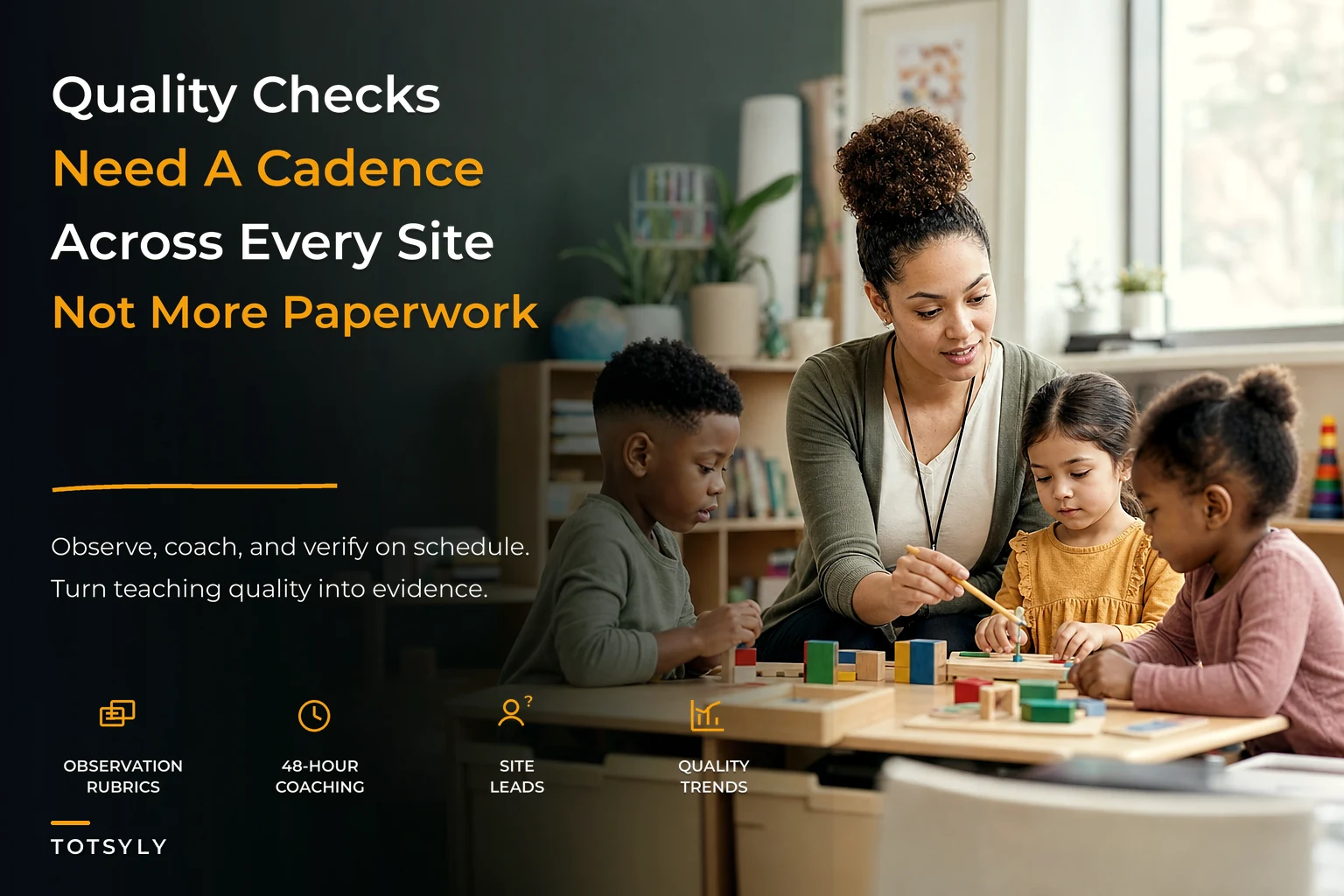
A quarterly cadence is the sustainable floor for formal QA, layered with lighter informal touches in between. A workable rhythm:
-
Week 1 of the quarter — announced observation. Full rubric, teacher knows it's coming. This isn't a gotcha; it's a baseline.
-
Within 48 hours — the coaching conversation. Short, structured, using a feedback template. Two strengths, one focus area, one concrete thing to try. Not seven action items.
-
Mid-quarter — a 10-minute walkthrough. Not scored. The instructional leader just checks whether the focus area is moving.
-
End of quarter — a brief follow-up observation on the focus area only, plus a note in the record about whether it improved.
The feedback template is what keeps this from turning into vague pep talks. A good one forces specificity:
-
What I saw (one observed behavior, tied to a rubric item)
-
Why it matters (connection to child outcome or safety)
-
What to try next (one specific, testable change)
-
How we'll know it worked (what the mid-quarter walkthrough will look for)
The 48-hour window matters more than the length of the conversation. Feedback delivered two weeks after an observation is basically worthless — the teacher barely remembers the moment you're referencing, and it lands as abstract criticism instead of useful, specific coaching.
This illustrates the coaching cadence workflow visually.
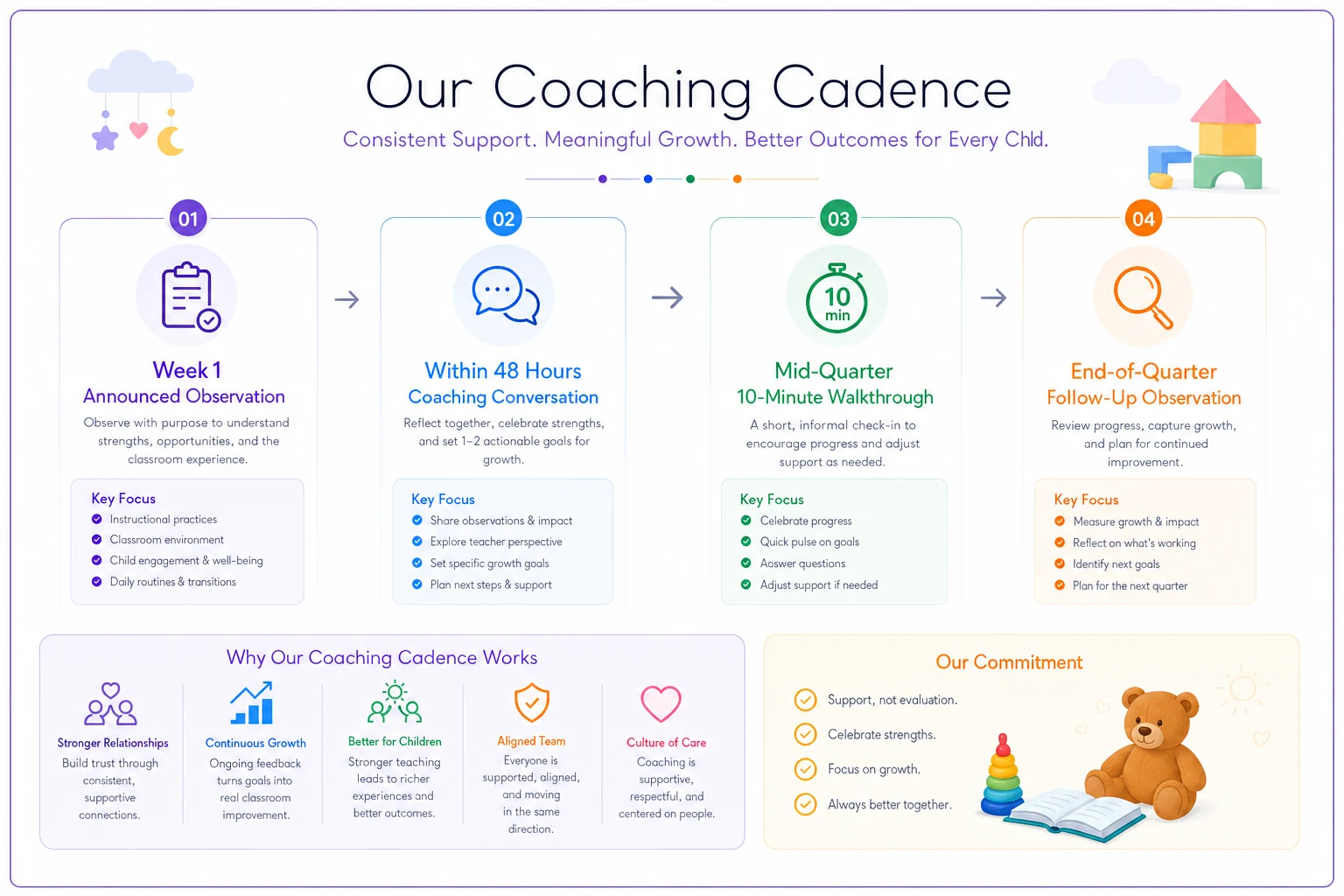
Keeping the cycle short and predictable is what makes coaching actionable instead of a paper exercise.
Fidelity metrics: are people actually running the system?
This is the layer most QA plans skip, and it's the one that separates a real system from a binder on a shelf.
Fidelity metrics don't measure teaching quality. They measure whether your QA process is actually happening. You can have the best rubric in the world, but if only three of your seven sites are completing observations, your quality data is quietly lying to you — the "good" sites might just be the ones not looking hard enough.
Track a small set of fidelity indicators at the org level:
-
Observation completion rate — percentage of scheduled observations actually done, per site, per quarter.
-
Feedback timeliness — percentage of coaching conversations that happened within the 48-hour window.
-
Coverage — every teacher observed at least once per quarter, not the same three star teachers over and over.
-
Rubric drift — are certain observers scoring systematically higher or lower than peers? A site whose average scores run a full point above everyone else's isn't necessarily better; it might just have a lenient observer.
That last one is subtle but important. When one site's scores run consistently high, the instinct is to celebrate. The more useful reaction is to ask whether that observer is calibrated to the same standard as everyone else. Building a shared reporting layer where these numbers live in one place — rather than scattered across each director's personal spreadsheet — is what makes cross-site comparison honest. If you're working through how to standardize those definitions, the work on a canonical data model for multi-site reporting covers how to keep metrics meaning the same thing everywhere.
The PD ROI model nobody builds (but should)
Professional development is usually the biggest quality lever a center has, and it's almost always spent on faith. Someone books a training day, everyone attends, boxes get checked for licensing, and nobody ever measures whether teaching actually changed.
A basic PD ROI model closes that loop. It doesn't need to be sophisticated — it needs to connect three things you're probably already tracking:
-
PD investment — cost of the training plus staff time. The staff time part is what people forget. A full training day across 30 staff is a real payroll number, not just the trainer's fee.
-
Fidelity of application — did the behavior actually show up in observations afterward? This is where your rubric earns its keep.
-
Downstream outcome — did the metric you cared about move? Fewer behavioral incidents, better transition times, improved parent feedback, teacher retention.
A rough example: say a program spends somewhere around $4k–$5k (trainer plus staff time) on a positive-guidance training across a site. In the next two quarters, the rubric item on "teacher gets to eye level during conflict" climbs from being met in roughly half of observations to nearly all of them, and behavioral incident reports in those rooms drop noticeably. That's a defensible ROI story — not because the numbers are precise, but because you can see the chain from spend to behavior to outcome. Most programs can't show that chain at all, which is exactly why PD budgets are the first thing cut when money gets tight.
The uncomfortable flip side: sometimes the model shows a training changed nothing. That's not a failure of the model — it's the model doing its job and saving you from repeating a useless PD day next year.
Improvement sprints instead of endless improvement plans
Traditional performance improvement plans tend to be slow, HR-flavored, and vaguely threatening. A better frame for quality work is a short improvement sprint: pick one thing, work it hard for a defined window, then check.
A sprint structure that works well at the classroom level:
-
Focus one rubric item that's underperforming (say, transition times running long).
-
Duration 4–6 weeks.
-
Support two short coaching touches during the window, plus a specific strategy to try — visual timers, a transition song, pre-staging materials.
-
Check one observation at the end, scored only on that item.
The power of the sprint is that it's small enough to actually complete and specific enough to actually measure. Teachers respond to it far better than open-ended improvement plans because there's a finish line and a clear definition of success. And because it's scoped to a single behavior, you're not overwhelming someone who's already stretched thin.
Sprints also aggregate nicely across sites. If four centers are all running transition-time sprints, you can share what's working between them — which is exactly the kind of cross-site learning that multi-site programs constantly claim to want and rarely actually operationalize.
Accreditation evidence packs: capture it once, use it everywhere
The documentation you generate for solid QA is almost identical to what accreditation and licensing bodies ask for. Programs that treat these as two separate efforts end up doing the work twice — once for their own quality process and again in a frantic scramble the month before an accreditation visit.
The smarter move is to design your QA outputs as reusable evidence from day one. An accreditation evidence pack, assembled continuously rather than in a panic, typically includes:
-
Completed observation records showing a pattern of ongoing assessment
-
Coaching notes and feedback templates demonstrating a continuous improvement process
-
PD records tied to observed changes in practice
-
Improvement sprint documentation showing you identify and act on quality gaps
-
Fidelity reports showing the system runs consistently across sites
Checklist — is your QA output accreditation-ready?
-
[ ] Every observation is timestamped and tied to a specific teacher and classroom
-
[ ] Coaching follow-ups are documented, not just verbal
-
[ ] PD is linked to a specific quality goal, not filed as a standalone attendance sheet
-
[ ] Improvement actions have a visible before/after
-
[ ] Records are stored centrally, not scattered across individual directors' laptops
-
[ ] You can pull a full quality history for any single classroom in a few minutes
That last item is the real test. If assembling one classroom's quality history means emailing three people and digging through a shared drive, you don't have a system — you have archaeology.
A real scenario
A four-site preschool group, roughly 260 kids total, had a recurring problem: parent satisfaction at two of the sites lagged the other two, and nobody could explain why. Licensing was clean everywhere. Staffing looked comparable.
When they introduced a short 10-item observation rubric and ran it consistently across all four sites for two quarters, the pattern surfaced fast. The two lagging sites scored fine on structure and safety but consistently low on relationship items — eye-level interaction, greeting children by name, offering choices. The teaching wasn't bad; it was transactional. That difference, invisible on every other report, was exactly what parents were picking up on.
They ran targeted sprints on those relationship items at the two sites, paired with a half-day of coaching. Over the following two quarters, the rubric scores on those items closed most of the gap with the stronger sites, and parent feedback at the lagging locations improved to roughly match the others. Nothing dramatic happened in a single week — it was a steady, visible climb because someone was finally measuring the right thing consistently everywhere.
The lesson wasn't that those teachers needed replacing. It's that the organization had no shared definition of quality specific enough to catch the gap until it built one.
When this level of QA makes sense — and when it doesn't
When it's worth building the full system:
-
You're running three or more sites, or clearly heading there
-
You've noticed quality varying between locations
-
You're pursuing or maintaining accreditation
-
You're growing fast enough that new leaders need a standard to inherit rather than invent
When it's overkill:
-
You're a single site where the director is in every classroom weekly. A lightweight version — a short rubric and quarterly conversations — is plenty. Building org-level fidelity dashboards for one location is effort you don't need yet.
Who should be careful: programs in the middle of major operational instability — high turnover, a licensing crisis, a system migration. Adding a formal QA layer on top of chaos usually just becomes one more thing that doesn't get done and breeds cynicism. Stabilize first. The work on a staffing blueprint to stop ratio breaches and cut burnout is often the more urgent prerequisite — you can't coach teaching quality in rooms that are chronically short-staffed and running on fumes.
Where the tooling quietly helps
None of this requires software to exist. Plenty of solid programs run it on paper and shared spreadsheets. But the friction shows up at scale. Once you're comparing observation data across sites, tracking feedback timeliness, and pulling classroom histories for accreditation, spreadsheets start to fight you. Scores live in different formats, definitions drift, and assembling an evidence pack becomes a weekend project.
This is where an operational platform earns its place — not by doing the coaching for you, but by making the system harder to abandon. When observations are logged on a phone in the classroom, feedback windows are tracked automatically, and fidelity metrics roll up across sites without anyone building a report by hand, the QA process stops depending on any one person's diligence. That durability is really the goal. The broader logic of holding standards steady while you grow is covered in this playbook for scaling multi-site operations without quality loss, and the connection between quality work and the numbers that actually move the business shows up in which dashboard KPIs move occupancy and retention.
Teaching quality in a multi-site program isn't fragile because your teachers aren't good. It's fragile because quality tends to live in individual heads, and heads leave, get busy, and disagree with each other. A QA pack — short observable rubrics, a coaching cadence people can actually keep, honest fidelity tracking, a PD model that closes the loop, and evidence that doubles as accreditation proof — is really just the work of moving your definition of good teaching out of people's heads and into a system everyone can see and repeat.
Start smaller than you think you should. A 10-item rubric run consistently across every site for two quarters will teach you more about your program than the most elaborate assessment tool used inconsistently. Consistency beats sophistication every single time in this work.
Ready to elevate your childcare management?
Join hundreds of childcare providers using Totsyly to save time, improve communication, and grow their centers.